What a are Twitter r bots, Twitter admits 8.5% of active and w - - PowerPoint PPT Presentation

what a are twitter r bots
SMART_READER_LITE
LIVE PREVIEW

What a are Twitter r bots, Twitter admits 8.5% of active and w - - PowerPoint PPT Presentation

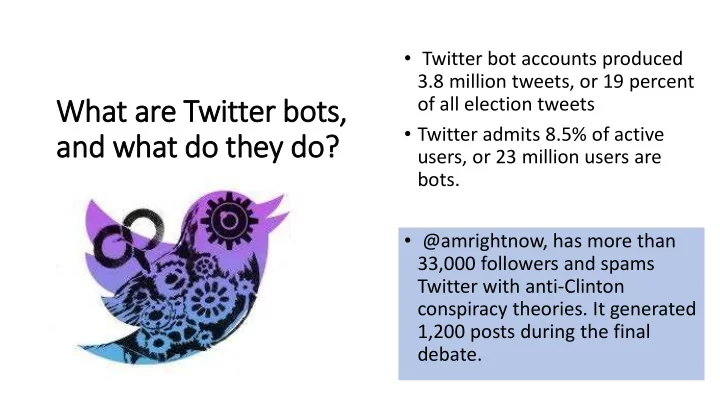
Twitter bot accounts produced 3.8 million tweets, or 19 percent of all election tweets What a are Twitter r bots, Twitter admits 8.5% of active and w what do they do? users, or 23 million users are bots. @amrightnow, has more


slide-1
SLIDE 1

What a are Twitter r bots, and w what do they do?

  • Twitter bot accounts produced

3.8 million tweets, or 19 percent

  • f all election tweets
  • Twitter admits 8.5% of active

users, or 23 million users are bots.

  • @amrightnow, has more than

33,000 followers and spams Twitter with anti-Clinton conspiracy theories. It generated 1,200 posts during the final debate.

slide-2
SLIDE 2

Social media have been extensively praised for increasing democratic discussion on social issues related to policy and politics. However, what happens when this powerful communication tools are exploited to manipulate online discussion, to change the public perception of political entities, or even to try affecting the outcome of political elections? In this study we investigated how the presence of social media bots, algorithmically driven entities that on the surface appear as legitimate users, affect political discussion around the 2016 U.S. Presidential election. By leveraging state-of- the-art social bot detection algorithms, we uncovered a large fraction of user population that may not be human, accounting for a significant portion of generated content (about one-fifth of the entire conversation). We inferred political partisanships from hashtag adoption, for both humans and bots, and studied spatio-temporal communication, political support dynamics, and influence mechanisms by discovering the level of network embeddedness of the bots. Our findings suggest that the presence of social media bots can indeed negatively affect democratic political discussion rather than improving it, which in turn can potentially alter public opinion and endanger the integrity of the Presidential election.

slide-3
SLIDE 3
slide-4
SLIDE 4
slide-5
SLIDE 5

Bot-or

  • r-Not
  • t Detection
  • n
slide-6
SLIDE 6

Qualities of a twitter bot

  • Customized profile
  • Absence of geographical

data

  • Frequency (excessive,

incessant)

  • Proportion of retweets
  • Followers vs. followees
  • Randomness of

username

slide-7
SLIDE 7

Handle and Score Bot or Not Notes ('@strng', 0.18)

  • riginal content, way more followers than

following ('@biloon', 0.25)

  • comedian. original jokes

('@katevnelson', 0.26)

  • riginal content, in conversations, not linking to

websites ('@MadonnaHaigh', 0.41) repetitive tweeting, but more like an unfamiliar

  • user. used infrequently. no links to sites.

('@Btysheen', 0.42) hard to guess, but each tweet is unique, but is following 3x more people than following this person. ('@kikionfleek', 0.49) Original tweets, has tumblr, similar followers/followees ('@TheRepostNews', 0.62) 1 “We spread news written by others”. Minimal followers, thousands of tweets

slide-8
SLIDE 8

15% of tweets come from bots 75% were pro trump

slide-9
SLIDE 9

Negative ve Impacts & & Concern rns

  • Bots are being very

effective at spreading information in the human population

  • Gaming of online polls
  • Shutting down human

users

  • Use AI to chat with

humans

  • Difficult for humans to

discern what is real vs bot

slide-10
SLIDE 10

Theoretical Implications

  • Public sphere and the

manufacture of public opinion

  • Invasion of public sphere for

profit motives

  • Homogenous news and news

production

  • Myth of public opinion is the
  • nly legitimate basis for

domination

  • Cultural hegemony vs. rule by

force

  • Ideology  “Common Sense”
slide-11
SLIDE 11
slide-12
SLIDE 12

Research Questions

  • What percentage of tweets

during political events (ie #womensmarch) are bots?

  • What are the most common

words used by bots during these events?

  • Politically, do these bots

seem to be promoting right

  • r left ideas?
  • Is there a threshold after

which bots enter a political discussion?

slide-13
SLIDE 13

Further questions

  • Was the public sphere a lie before

Twitter bots, anyway?

  • What is significantly different about

automated ideology as opposed to human produced ideology?

  • Should twitter be doing anything

about bots? What is the responsibility

  • f a corporation in its interaction in

the public sphere?