ROLES Governance Framework 5 years? Executive Committee Purpose, - - PowerPoint PPT Presentation

roles
SMART_READER_LITE
LIVE PREVIEW

ROLES Governance Framework 5 years? Executive Committee Purpose, - - PowerPoint PPT Presentation

BLC 2019 2019-11-02 INTRODUCTIONS WHO IS HERE? Raise your hand if you answer yes: Who is a board member? Staff members? Board chair or president? Vice Chair? Secretary? Treasurer? New Executive member? New to the board?


slide-1
SLIDE 1

BLC 2019 2019-11-02 1

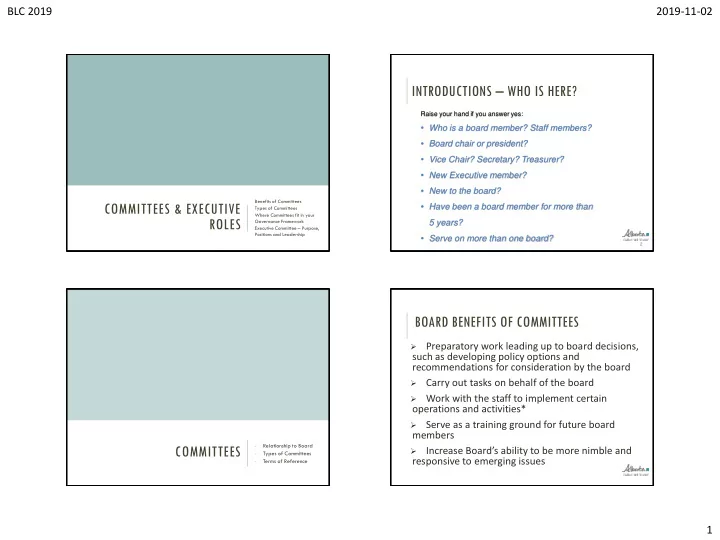
COMMITTEES & EXECUTIVE ROLES

Benefits of Committees Types of Committees Where Committees fit in your Governance Framework Executive Committee – Purpose, Positions and Leadership

INTRODUCTIONS – WHO IS HERE?

2

Raise your hand if you answer yes:

  • Who is a board member? Staff members?
  • Board chair or president?
  • Vice Chair? Secretary? Treasurer?
  • New Executive member?
  • New to the board?
  • Have been a board member for more than

5 years?

  • Serve on more than one board?

COMMITTEES

  • Relationship to Board
  • Types of Committees
  • Terms of Reference

BOARD BENEFITS OF COMMITTEES

  • Preparatory work leading up to board decisions,

such as developing policy options and recommendations for consideration by the board

  • Carry out tasks on behalf of the board
  • Work with the staff to implement certain
  • perations and activities*
  • Serve as a training ground for future board

members

  • Increase Board’s ability to be more nimble and

responsive to emerging issues

slide-2
SLIDE 2

BLC 2019 2019-11-02 2

TYPES OF COMMITTEES

Standing Committee Ad-hoc/Task Force Advisory Committee

Set up on a permanent basis and deal with matters that are consistently in play. Examples include:

  • Executive Committee
  • Finance Committee
  • Program Committee

Sub Committee Established by standing committees for specific focus within the standing committee’s purview. Established for specific, immediate or temporary

  • tasks. Upon completion
  • f the project or task, the

committee is dissolved. Examples include:

  • Building committee
  • Special event

committee Established to investigate, report, and make recommendations. Committee members usually provide a unique perspective that creates a broader picture and leads to more meaningful decisions. They provide a direct link to the community or membership. Examples include: seniors

  • r youth advisory

committees, regional focus groups.

COMMITTEE LEVELS OF AUTHORITY

Committees receive authority from the board:

 Limited Advisor: The committee investigates and reports;

the board makes decisions.

 Active Advisor: The committee investigates, reports, and

suggests action. The board will probably follow the committee suggestion.

 Limited Agent: The committee can take some action as

delegated by the board through the terms of reference. Still reports to board.

 Active Agent: The committee takes action. The board

can, if it wishes, ratify the action later. (Caution)

ACTIVITY – DELEGATING AUTHORITY

I will put up a brief description of a purpose, goal, and/or outcomes that a board wants to delegate to a committee to work on. In pairs discuss what type of committee you think it should be and what level of authority you think they should have. We will then discuss briefly as a large group.

ACTIVITY – DELEGATING AUTHORITY EX.1

Purpose of committee: Plan a large fundraising event for the organization. Should this be: 1) Standing Committee, Limited Agent 2) Ad Hoc Committee, Active Agent 3) Advisory Committee, Active Advisor

slide-3
SLIDE 3

BLC 2019 2019-11-02 3

ACTIVITY – DELEGATING AUTHORITY EX.2

Purpose of committee: Find out what others in a similar field or with a similar purpose do. Should this be: 1) Ad Hoc Committee, Active Advisor 2) Standing Committee, Limited Agent 3) Advisory Committee, Limited Advisor

ACTIVITY – DELEGATING AUTHORITY EX.3

Purpose of committee: Review bylaws and suggest updates and changes. Should this be: 1) Ad Hoc Committee, Active Advisor 2) Advisory Committee, Active Agent 3) Standing Committee, Limited Agent

TERMS OF APPOINTMENT

Recommended practice

  • Fixed terms of office (e.g. of 2-3 years)
  • Rules on the number of consecutive terms

a member can serve

Source: Seel, p. 95

ENSURING EFFECTIVE BOARD OVERSIGHT

“Committees and task forces only do work that legitimately is the responsibility or prerogative

  • f the board, and care must be taken to ensure

that these structures complement rather than interfere with the staff operations of the

  • rganization and the general oversight should be

provided by the full board.”

Source: Renz, p. 149

“Committees should each have terms of reference, even if it is functioning only in an advisory capacity.”

Source: Bourgeois, p. 164

slide-4
SLIDE 4

BLC 2019 2019-11-02 4

TERMS OF REFERENCE Terms of reference “outline the way in which a group of people agree to work together to accomplish common goals.”

Source: Adapted from Health Quality Ontario – Creating and sustaining patient and family advisory councils: Guides for common challenges, p. 7

EFFECTIVE TERMS OF REFERENCE

 Describe the purpose, structure and

  • perating rules

 Define the responsibilities and

accountabilities of the group

 Are easy to understand

Source: Adapted from Health Quality Ontario – Creating and sustaining patient and family advisory councils: Guides for common challenges, p. 7

EXECUTIVE COMMITTEE

  • Executive Positions
  • Executive Committee
  • Leadership

THINGS TO TALK ABOUT…

Individual Executive roles

 Meetings – time & agenda  People / group management and leadership  Leadership: Advocacy & planning

Roles of Executive Committee

 Leadership between meetings  Organizational structure and accountability

16

slide-5
SLIDE 5

BLC 2019 2019-11-02 5

BOARD LEADERSHIP CAPACITIES

17

  • Ability to share a compelling vision
  • Modeling and ensuring accountability
  • Commitment & knowledge of board

development and improvement

  • Support and participate in evaluating board,

self and any senior staff

  • Approve/ monitor budget & fiduciary duties
  • Develop & maintain positive relationships
  • Help facilitate effective meetings

INDIVIDUAL POSITIONS OF THE EXECUTIVE MEMBERS (OFFICERS)

Chair Vice Chair Secretary Treasurer

18

FOR THE BOARD CHAIR…

19

  • Help the Board make the wisest decisions possible
  • High standards of excellence and preparation
  • Positive, productive relationships with board

members, volunteers and staff

  • Clear level of decision making or delegation
  • Is the decision made by the board or by others?
  • Agenda and meeting facilitation / host
  • Done with support from others?
  • Consider policy revision and succession planning

CHAIR POSITION DESCRIPTION SAMPLE

Provides leadership to board & organization, Attends and leads all board & executive meetings Knowledge of the organization & commitment to

its mission, goals & objectives

Serves ex officio to committees Acts as one of the signing officers Evaluates board decision making & effectiveness Ensures mission focus and accountability

20

slide-6
SLIDE 6

BLC 2019 2019-11-02 6

CHAIR RESPONSIBILITIES – OUTSIDE MEETINGS

21

  • People - Leadership & Mentoring
  • Orient & build the team
  • Build relationships – committees & staff
  • Ensure accountability & performance

measures

  • Share your passion & knowledge - (and

know your group, foundations, bylaws, policies etc.)

  • Communication & Advocacy
  • Organization & Succession Planning

CHAIRING A MEETING

22

What are we going to resolve or accomplish at this meeting? (purpose & Purpose) Meeting management

  • Manage Time
  • Manage Agenda
  • Manage People

What are some ways to do these well?

ABOUT AGENDAS (THE WRITTEN KIND)

23

Ensure the following (work with others):

  • Send out agenda before the meeting so

members can be prepared

  • Clearly state group norms or ground rules
  • Put times on the agenda
  • Identify outcomes or what needs to be done for

each meeting / agenda

  • Link items to strategic plan and goals – include

mission and vision

  • Agenda should be decisions and discussion

focused (not passive listening)

PUPOSE

WHAT IS THE PURPOSE OF OUR MEETING?

What are we trying to achieve by having a meeting? What do we need to accomplish that requires us to come together? How will our meeting link to our

  • rganization’s

purpose or goals? Who needs to be in the room?

PURPOSE

Is this meeting essential?

24

slide-7
SLIDE 7

BLC 2019 2019-11-02 7

WHY HAVE AN AGENDA?

Acts as a meeting guide Important to democratic process Connects meeting to purpose/ outcomes Encourages focus Documents key group / team activities

AGENDA 25

SOME IDEAS…

  • Set reasonable timeframes and structure
  • Start and end on time
  • Discuss mission-driven questions
  • Facilitate meetings so each perspective is heard

respectfully and on topic

  • Build in generative governance conversations
  • Anticipate ‘difficult’ participants

26

Shifting perspective

environment enablers

Generative Governance as Leadership

WHAT IS THE FOCUS OF OUR AGENDA ITEMS?

14

AGENDA

Source: Adapted Governance as Leadership; Reframing the Work of Nonprofit Boards by Chait, Ryan and Taylor. 2005.

27

SUMMARY: GOVERNANCE AS LEADERSHIP

28

slide-8
SLIDE 8

BLC 2019 2019-11-02 8

ACTIVITY – TOOLS AND TECHNIQUES FOR THE CHAIR

  • We will go through a series of images
  • For each image you can either think to

yourself or talk to your neighbour for 30sec about how the board chair could use this item to make board meetings more successful.

  • After you’ve had some time to think I will

call out for some of your ideas.

slide-9
SLIDE 9

BLC 2019 2019-11-02 9

INFORMAL LEADERSHIP

All participants have a leadership role to play

 Use meetings to create broader leadership and

  • wnership within your team

 Share facilitation  Help keep the focus on purpose, topic, and timing  Rotate time-keeper, note-taker, vibe-watcher.  Ask questions, give feedback, admit mistakes  Other ideas?

STRUCTURE LEADERSHIP 36

slide-10
SLIDE 10

BLC 2019 2019-11-02 10

VICE CHAIR / PRESIDENT- ELECT

  • Attend all board meetings
  • Maintain knowledge of the organization and

personal commitment to its goals and objectives

  • Acts in absence of the Chair
  • Learns (shadows) duties of the Chair
  • Prepares to serve as Chair in future
  • May chair committee(s)
  • Acts as signing officer
  • May act as governance officer (e.g. bylaws)
  • Other duties?

37

SECRETARY’S RESPONSIBILITIES

WHAT:

  • Meeting Administration
  • Record Meeting Minutes - Decisions
  • Correspondence, Records & Documents Tracking

WHY:

  • Maintain organization’s history
  • Serve as contact person for organization's records &

documents

  • Help organizational effectiveness & efficiency
  • Reduce liability
  • Help represent the organization

WHAT

  • Notice of Meetings
  • Agenda - Prepare and distribute agenda
  • Include minutes, reports & correspondence
  • Ensure minutes are recorded accurately
  • Sign approved minutes & keep official record
  • Keep Track of Important Dates & Filings
  • Annual Return
  • Bylaw Amendments, Incorporating documents

SECRETARY’S RESPONSIBILITIES: ADMINISTRATION OF MEETINGS SECRETARY’S RESPONSIBILITIES: ADMINISTRATION OF MEETINGS CONTINUED

HOW

Consistent style, format (create a template) Cover the following (at minimum): Who was at the meeting, who wasn't Date, time (start and end), location Items discussed Reports presented Decisions made: record and provide descriptions of motions List of Action Item, completed by whom and by when Date, time and location of next meeting

slide-11
SLIDE 11

BLC 2019 2019-11-02 11

TIPS FOR MINUTES

  • Record decisions and actions but not the discussion (in

general)

  • Keep them brief but informative
  • Help the Chairperson ensure business and actions from

previous meetings are brought forward to future meetings

  • If possible, have the same person take minutes if you are

not able to attend a meeting

  • Write up & send minutes soon after meeting!
  • Have a safe place where the official minutes are stored

What other things have you found helpful?

SECRETARY’S RESPONSIBILITIES:

SECRETARY’S RESPONSIBILITIES:

CORRESPONDENCE

In a timely fashion:

  • Share correspondence received with board

members

  • Send out all organization correspondence
  • Ensure contact information for organizational

correspondence are up to date (email, telephone, mail, street addresses)

  • Ensure an up-to-date contact list of board,

members, funders and key contacts of the

  • rganization

SECRETARY’S RESPONSIBILITIES: CUSTODIAN OF RECORDS

Ensure that the records of the organization are maintained as required by law and made available when required by authorized persons and to reduce liability. TIP: Become familiar with legislation Societies Act Freedom of Information and Protection of Privacy Others?

SECRETARY’S RESPONSIBILITIES: RECORDS AND DOCUMENTATION

At meetings, it is helpful to have:

  • Agenda Package
  • Bylaws / Legislation
  • Policies
  • Quorum Guidelines
  • Meeting Minutes (from previous year)
  • Strategic Plan
slide-12
SLIDE 12

BLC 2019 2019-11-02 12

SECRETARY’S RESPONSIBILITIES: RECORDS AND DOCUMENTATION CONTINUED

List of key records and information commonly referenced &/or updated:

  • Bylaws, Societies Act Registration
  • Policies and Procedures
  • Minutes and Agendas
  • Financial Documents
  • Annual Returns
  • Organization/Member Contact List
  • Strategic Plan
  • Annual General Meeting

SECRETARY POSITION DESCRIPTION SAMPLE

SECRETARY

  • It shall be the duty of the secretary to attend all meetings of

the society and of the Board, and to keep accurate minutes

  • f the same.
  • He/she shall have charge of the Seal of the society which

whenever used shall be authenticated by the signature of the Secretary and the President, or, in the case of the death

  • r inability of either to act, by the Vice-President.
  • In case of the absence of the Secretary, his/her duties shall

be discharged by such officer as may be appointed by the Board.

From sample bylaws on Service Alberta – Corporate Registry website

SECRETARY POSITION DESCRIPTION CONTINUED

SECRETARY

The Secretary shall have charge of all the correspondence of the society and be under the direction of the President and the Board The Secretary shall also keep a record of all the members of the society and their addresses, send all notices of the various meetings as required, and Collect and receive the annual dues or assessments levied by the

  • society. Such monies shall be promptly turned over to the

Treasurer for deposit in a Bank, Trust Company, Credit Union or Treasury Branch as required. Where does your organization describe the role and responsibilities

  • f the secretary?

From sample bylaws on Service Alberta – Corporate Registry website

CHECK-IN

48

slide-13
SLIDE 13

BLC 2019 2019-11-02 13

RESPONSIBILITY OF THE BOARD

“…one of the fundamental roles of the board of directors is stewardship of the organization's

  • resources. This duty includes the responsibility to

protect the organization’s assets and to oversee its financial affairs.”

(Source: 20 Questions Directors Should Ask About Financial Responsibilities, p.1)

“Each member shares equally in the carrying out

  • f the mandate of the organization, as well as the

responsibility of prudent management of the

  • rganization’s finances.”

(“Financial responsibilities of Not-for-Profit Boards, Muttart p. 8.) Legal Obligations

49

RESPONSIBILITY OF THE BOARD

“Board members are responsible for the overall management of the

  • rganization’s resources – the

responsibility does not simply fall to the Treasurer of the organization.

Source: “A Guide to Financial Statements of Not-For-Profit Organizations” Chartered Professional Accountants (CPA) of Canada, p.8.

Fact Legal Obligations

50

WHAT IS A TREASURER?

One of the traditional Officer or Executive roles Nonprofit context: Oversee financial management and report to the board and members financial status of organization.

51

FINANCIAL RESPONSIBILITIES OF NP BOARDS

Who is Responsible?

The Board of Directors Individual – voting for financial policies and the budget Collectively – fiduciary responsibility The board may delegate authority for some financial management duties to senior staff, finance committee or a treasurer

What is Required?

Look to your incorporation legislation and other legislation. What is stated in your bylaws

Everything else is optional…

52

slide-14
SLIDE 14

BLC 2019 2019-11-02 14

FINANCIAL MANAGEMENT

Financial Management OR managing how:

1. Income is generated (contributions

  • r earnings)

2. Money is spent 3. Net assets are protected/ invested 4. Finances are presented and accounted for Activities Related to Financial Management: Budgeting Accounting and financial statements Reporting and analysis Developing and monitoring financial policy Managing cash flow Transactions and internal controls Managing grants and contracts Financial risk management Annual reporting & income tax filing

53

TREASURER POSITION DESCRIPTION SAMPLE

  • Attend all board meetings
  • Maintain organizational knowledge and personal commitment to

goals & objectives

  • Understand financial accounting
  • Serve as the chair of the finance committee
  • Manage, with the finance committee, the board's review of and

action related to the board's financial responsibilities

  • Ensure that appropriate & timely financial reports are available to

the board basis

  • Present the annual budget to the board for approval
  • Review the annual audit and answer board members' questions

Roles and Responsibilities (BoardSource 2008).

ROLES OF EXECUTIVE COMMITTEE

Decision Making - support the group to make the best decision possible Communication – internally & externally Advocacy – represent the organization Planning – strategic and succession planning People Management – leadership, group dynamics, accountability Evaluation – board, meetings, organization, staff etc.

55

DECISION MAKING -

56

  • No decision is necessary – someone else will make the

decision

  • Spontaneous decision – everyone goes along (trivial)
  • Simple majority – 50% +1
  • Clear Majority - When it is important that the majority of the

group support the decision & when a bylaw or other governance rule applies (66% or 75 % etc.)

  • Compromise - when a decision must be made and group

unity is secondary “the agree to disagree” syndrome

  • Consensus – when risk of a wrong decision is high, when

group decision is essential, when the group feels it is important to show commitment to the input, which is being given to an outside decision maker

Everyone must be willing to support the final decision

slide-15
SLIDE 15

BLC 2019 2019-11-02 15

COMMUNICATION & ADVOCACY

57

  • Create a healthy & respectful

environment

  • Be clear & manage your message
  • One board member but can represent

the board or organization externally

  • The board represents your

membership / community to the public & stakeholders

PLANNING

58

  • Set realistic goals – develop or review

strategic plan for organization

  • Identify quick wins & successes
  • Revue & approve timeline goals,

performance measures & meetings (budget cycle etc.)

  • Succession - what do you need to do to

ensure others can continue?

  • Can you mentor or support others to step in & learn?

MEETING MANAGEMENT

59

  • Ensure others are on task: minutes, reports etc.
  • Ensure rule of order are followed (bylaws etc.)
  • Set intention / expectations - “we are going to

spend 10 minutes on this and then move on” (and follow through)

  • May need different processes or tools to engage

people and come to good conclusions

  • Sticky notes, pairs or small group

conversations etc.

  • Evaluate meetings regularly – may be a short

debrief at each meeting or set it as an agenda item every few meetings

DON’T FORGET…

60

  • Establish accountability and action items

with timelines / due dates

  • Acknowledge and celebrate success
  • Say thank you & express gratitude often
  • Food / refreshments?
  • Have fun
slide-16
SLIDE 16

BLC 2019 2019-11-02 16

REFLECTION ON …

61

What is the legacy of your Executive? What do you want to do / get accomplished while you are on the board? What do you want to leave for those that follow you? What is one thing that you can take back to your board / group?

QUESTIONS AND COMMENTS ARE WELCOME

62

THANK YOU!

Joel Christianson, Coordinator – Board Development Program Joel.Christianson@gov.ab.ca Community Development website:

http://culture.alberta.ca/communitydevelopment/default.aspx

The Board Development Program http://culture.alberta.ca/bdp/default.aspx

63