Rock Island, Illinois Surveyed over 120 rental properties in the - - PDF document

rock island illinois
SMART_READER_LITE
LIVE PREVIEW

Rock Island, Illinois Surveyed over 120 rental properties in the - - PDF document

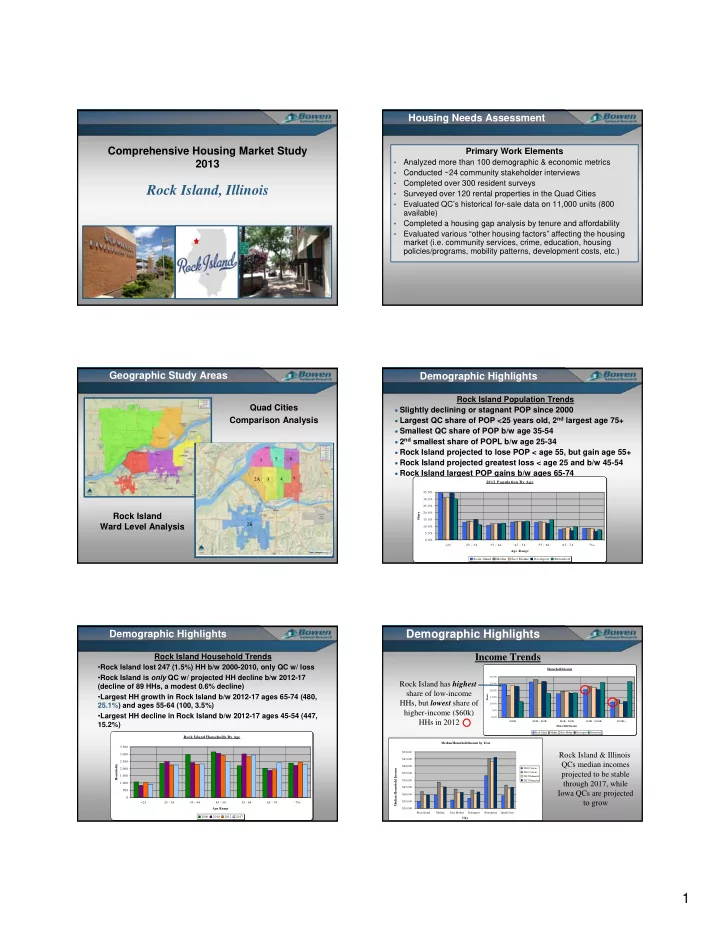
Housing Needs Assessment Comprehensive Housing Market Study Primary Work Elements Analyzed more than 100 demographic & economic metrics 2013 Conducted ~24 community stakeholder interviews Completed over 300 resident surveys


slide-1
SLIDE 1

1 Rock Island, Illinois

Comprehensive Housing Market Study 2013

Housing Needs Assessment

Primary Work Elements

  • Analyzed more than 100 demographic & economic metrics
  • Conducted ~24 community stakeholder interviews
  • Completed over 300 resident surveys
  • Surveyed over 120 rental properties in the Quad Cities
  • Evaluated QC’s historical for-sale data on 11,000 units (800

available)

  • Completed a housing gap analysis by tenure and affordability
  • Evaluated various “other housing factors” affecting the housing

market (i.e. community services, crime, education, housing policies/programs, mobility patterns, development costs, etc.)

Geographic Study Areas

Rock Island Ward Level Analysis Quad Cities Comparison Analysis

1 2A 5 6 3 4 7 2B

Rock Island Population Trends

 Slightly declining or stagnant POP since 2000  Largest QC share of POP <25 years old, 2nd largest age 75+  Smallest QC share of POP b/w age 35-54  2nd smallest share of POPL b/w age 25-34  Rock Island projected to lose POP < age 55, but gain age 55+  Rock Island projected greatest loss < age 25 and b/w 45-54  Rock Island largest POP gains b/w ages 65-74

Demographic Highlights

2012 Population B y Age

0.0% 5.0% 10.0% 15.0% 20.0% 25.0% 30.0% 35.0% <25 25 - 34 35 - 44 45 - 54 55 - 64 65 - 74 75+ Age R ange Share Rock Island M oline East M oline Davenport Bettendorf

Demographic Highlights

Rock Island Household Trends

  • Rock Island lost 247 (1.5%) HH b/w 2000-2010, only QC w/ loss
  • Rock Island is only QC w/ projected HH decline b/w 2012-17

(decline of 89 HHs, a modest 0.6% decline)

  • Largest HH growth in Rock Island b/w 2012-17 ages 65-74 (480,

25.1%) and ages 55-64 (100, 3.5%)

  • Largest HH decline in Rock Island b/w 2012-17 ages 45-54 (447,

15.2%)

Rock Island Households By Age

500 1,000 1,500 2,000 2,500 3,000 3,500 <25 25 - 34 35 - 44 45 - 54 55 - 64 65 - 74 75+ Age Range Households 2000 2010 2012 2017 Household Income

0.0% 5.0% 10.0% 15.0% 20.0% 25.0% 30.0% <$20K $20K - $40K $40K - $60K $60K - $100K $100K+ Household Income Share Rock Island Moline East Moline Davenport Bettendorf

Demographic Highlights

Income Trends

Rock Island has highest share of low-income HHs, but lowest share of higher-income ($60k) HHs in 2012

Median Household Income by Year $30,000 $35,000 $40,000 $45,000 $50,000 $55,000 $60,000 $65,000 $70,000 Rock Island Moline East Moline Davenport Bettendorf Quad Cities City Median Household Income

2000 Census 2010 Census 2012 Estimated 2017 Projected

Rock Island & Illinois QCs median incomes projected to be stable through 2017, while Iowa QCs are projected to grow

slide-2
SLIDE 2

2

Demographic Highlights

Rock Island Ward Level Household Trends

  • B/w 2012-17 overall HHs are projected to remain generally

stable

  • Highest resident turnover in Wards 1 & 5 (most renters)
  • Wards 1 & 6 experienced greatest declines in HHs 2000-10
  • Largest share of HHs <

age 25 are in/around downtown (Wards 1 & 6)

  • Largest share of seniors

in southeast part of city (Wards 4 & 7)

1 3 2A 4 2B 7 5 6

Demographic Highlights

Rock Island Ward Level Trends - Incomes

  • Highest median HH income in SE Rock Island, Wards 4 & 7
  • Lowest median HH income N/NW Rock Island, Wards 1 & 5
  • Poverty most prevalent in NW Rock Island (Ward 1: 1/3) & Ward

5: 1/4 )

1 5 2A 6 3 7 4 2B

Pov erty Pop ulation 1,889 418 324 481 271 1,476 688 285 5,947 1,000 2,000 3,000 4,000 5,000 6,000 7,000 Ward 1 Ward 2A Ward 2B Ward 3 Ward 4 Ward 5 Ward 6 Ward 7 Rock Island Location Population

Demographic Highlights

Rock Island Ward Level Trends – Age Cohorts Greatest senior household (HH) growth b/w ages 65-74 b/w 2012-17:

  • Ward 3 to add 137 HHs
  • Ward 5 to add 89 HHs
  • Ward 7 to add 72 HHs
  • Ward 4 to add 65 HHs

Other HH growth b/w 2012-17:

  • Ward 1 to add 34 HHs (age 25-34)
  • Ward 7 to add 23 HHs (age 25-34)
  • Ward 3 to add 41 HHs (age 35-44)

3 2A 4 5 2B 7 6 1

R

  • ck Islan

d H

  • u

seh

  • ld

s B y A ge

500 1,000 1,500 2,000 2,500 3,000 3,500 < 25 25 - 34 35 - 44 45 - 54 55 - 64 65 - 74 75+ A ge R an ge Households 2000 2010 2012 2017

Economic Highlights

  • QCs lost ~6,700 jobs b/w 2008-12, declining 6.1%
  • Rock Island lost 1,334 b/w 2008-2009
  • Rock Island began economic recovery quicker than QCs. 2.1%

job growth in 2010 2nd largest in decade

  • Rock Island unemployment rate declined past two years; 2012

rate of 8.5% (lower than state/nation)

0.0% 2.0% 4.0% 6.0% 8.0% 10.0% 12.0% 2002 2003 2004 2005 2006 2007 2008 2009 2010 2011 2012

Unemployment Rate Rock Island City State U.S. Rock Island City

16,500 17,000 17,500 18,000 18,500 19,000 19,500 2002 2003 2004 2005 2006 2007 2008 2009 2010 2011 2012

Unemployment Rates Total Employment

Satisfaction with Housing/Neighborhood

  • ~Three-fourths of Rock Island residents want to stay in RI
  • Nearly 85% were satisfied with current residence
  • Only 5% indicated they were not satisfied w/ current housing
  • Those somewhat or not satisfied cited the need for home

improvements (27.3%) as the primary housing issue

City Resident Surveys

  • More than 300 Rock Island residents

surveyed (January to March 2013)

  • Respondents representative of overall

Rock Island composition

  • Residents asked a series of 18 questions

Housing Issues/Challenges

  • 55% indicated the market had some housing issues
  • More than half indicated difficulty in finding suitable housing
  • Those stating it was difficult/somewhat difficult to find suitable

housing cited the following housing challenges: Not affordable (38.9%); Poor conditions (19.5%)

  • Other key issues affecting housing decisions

– High taxes (17.2%) – High housing costs (14.2%) – Poor housing quality/conditions (13.9%) – Crime/bad reputation (7.1%) – Poor public infrastructure (7.1%) – Weak economy/employment (6.7%)

Resident Surveys

slide-3
SLIDE 3

3

Resident Surveys Housing Needs/Priorities

Resident recommendations included addressing/improving the following:

  • Housing Conditions (21.3%)
  • Public Infrastructure/Services (20.0%)
  • Quality/Location of Housing (20.0%)

Resident opinions on housing types most needed:

  • Rental Housing (29.2%) vs. For-Sale Housing (23.7%)
  • Moderate priced housing (44.5%) vs. low-priced (24.3%)
  • Family housing (39.9%) vs. senior housing (15.6%)

Stakeholder Interviews Key/Common Interview Responses

  • Rock Island is generally well-served w/ community services, but

lacks sufficient commercial/retail space

  • Schools are good, but outsiders perceptions not positive
  • Good variety of housing, but old/low-quality, affects resident

retention and ability to attract new residents

  • Housing for young professionals & seniors needed
  • Special needs housing should be developed
  • Foreclosures and blight remain key housing issues
  • High taxes, lack of good paying jobs, & limited parking were

cited as other factors affecting the housing market

  • Factors limiting development included high development costs,

government “red tape”, and lack of available financing

Key/Common Interview Responses

  • Housing assistance needed to help people repair/maintain

homes (primarily seniors & disabled), stay in their homes longer

  • Improve education/outreach efforts regarding foreclosure

prevention, housing programs, housing alternatives, etc.

  • Work towards building synergy among various development

community segments

  • Improve efforts to solicit community input on housing needs
  • Any housing strategy should work in-step with economic

development efforts to maximize benefits of both

Stakeholder Interviews Housing Supply - Rental

  • Overall QC ‘s rental housing market is strong, 97.5% occ.
  • All rental segments (i.e. market-rate, Tax Credit, &

subsidized) performing well, 96.0%+

  • Rock Island highest QC rental occupancy at 98.8%

97.5% 97.5% 96.9% 97.3% 98.1% 98.8% Occupancy Rate 289 30 160 35 41 23 Vacant Units 11,610 1,213 5,117 1,283 2,109 1,888 Total Units 126 9 63 8 19 27 Projects Quad Cities Bettendorf Davenport

  • E. Moline

Moline Rock Island Overall Market Performance by Community

  • Rock Island: 27 projects w/ 1,888 units only 23 vacancies
  • All segments 95.6%+ occupancy, no apparent weaknesses
  • All market-rate units 96.4% occupied & Tax Credit 95.3% occupied
  • Subsidized housing market is very strong: 99.7% occupancy
  • 10 of 11 subsidized projects have wait lists, w/ 7 to 434 households
  • Housing Choice Voucher wait list: 188 households

Housing Supply - Rental

98.8% 23 1,888 27

Total

99.6% 5 1,282 10

Government-Subsidized

100.0% 162 1

Tax Credit/Government-Subsidized

100.0% 22 3

Tax Credit

95.6% 8 181 6

Market-rate/Tax Credit

95.9% 10 241 7

Market-rate Occupancy Rate Vacant Units Total Units Projects Surveyed Program Type Rock Island Multifamily Apartment Rentals Survey

Housing Supply – Rental (Apartments)

slide-4
SLIDE 4

4

$640

  • $640
  • Four-Bedroom/2.0

$785

  • $785

$680 $790 $400

Three-Bedroom/2.0

$540

  • $540
  • Three-Bedroom/1.5

$600

  • $600
  • $662

$535

Three-Bedroom/1.0

$614 $614 $685 $605 $675 $300

Two-Bedroom/2.0

$575 $585 $600

  • $555

$462

Two-Bedroom/1.0

$655

  • $655
  • One-Bedroom/2.0

$514 $470 $550 $525 $575 $400

One-Bedroom/1.0

$425

  • $375
  • $608

$291

Studio/1.0 Quad Cities Bettendorf Davenport

  • E. Molne

Moline Rock Island Bedroom / Baths Tax Credit, Non-Subsidized Median Collected Rents

$1,050 $1,585 $865

  • $1,200

$680

Three-Bedroom/2.0

$780

  • $780

$725 $827

  • Three-Bedroom/1.5

$812

  • $674
  • $812

$875

Three-Bedroom/1.0

$960 $925 $975 $711 $590 $600

Two-Bedroom/2.0

$730

  • $730
  • $860
  • Two-Bedroom/1.5

$645 $870 $650 $625 $725 $575

Two-Bedroom/1.0

$574 $720 $560 $495 $574 $450

One-Bedroom/1.0

$459 $787 $450 $430 $459 $350

Studio/1.0 Quad Cities Bettendorf Davenport

  • E. Moline

Moline Rock Island Bedroom / Baths Market-Rate Median Collected Rents

Housing Supply - Rental

Rental Housing by Quality Level

0% 10% 20% 30% 40% 50% 60% 70% 80% 90% 100% Rock Island Moline East Moline Davenport Bettendorf Quad Cities

City

Percent of Units

A B C

Rental Housing Quality

  • Rock Island has the 2nd smallest share of “A” quality

housing, smallest share of “B” quality housing and largest share of “C” quality housing

Housing Supply - Rental

Rental Housing by Year Built 0% 10% 20% 30% 40% 50% 60% 70% Rock Island Moline East Moline Davenport Bettendorf Quad Cities City

Percent of Units

Before 1970 1970 - 1979 1980 - 1989 1990 - 1999 2000 - 2013*

Rental Housing by Year Built

  • Nearly half of Rock Island’s rental stock was built pre-1970 (second

highest share of Quad Cities)

  • Less than 10% of Rock Island’s rental stock was built since 2000

(lowest share of Quad cities)

Housing Supply – For-sale

  • Rock Island median home sale prices range b/w $80k-$86k since 2009,

lowest of the QCs

  • Rock Island homes sales prices declined an average 2.2% since 2009

(second only to E. Moline); Iowa QCs increased

7.1% $194,693 0.1% $143,515

  • 2.8%

$87,313

  • 1.1%

$90,100

  • 2.2%

$84,725

Total

13.9% $226,000 6.3% $145,850

  • 2.7%

$82,500 0.7% $89,000

  • 5.8%

$80,000

2012

20.3% $198,475

  • 5.6%

$137,125

  • 7.9%

$84,750

  • 2.9%

$88,400 6.1% $84,900

2011

  • 12.9%

$164,950

  • 0.4%

$145,261 2.2% $92,000

  • 1.1%

$91,000

  • 7.0%

$80,000

2010

  • $189,350
  • $145,825
  • $90,000
  • $92,000
  • $86,000

2009 % Diff. Price % Diff. Price % Diff. Price % Diff. Price % Diff. Price Bettendorf Davenport East Moline Moline Rock Island Year Annual Median For-Sale Housing Price By Market

Housing Supply – For-sale

  • Historically, QC annual homes sales range b/w 2,197 & 2,527
  • Slight decline in QC home sales in 2010 & 2011, notable

(13.1%) increase in 2012

Annual Sales by Quad Cities Community

500 1,000 1,500 2,000 2,500 3,000 Rock Island Moline East Moline Davenport Bettendorf City Number of Annual Sales 2009 2010 2011 2012

Housing Supply – For-sale

87 $109,900 $172,733

$3,196,000

$7,900 823 Total Quad Cities 79 $327,400 $416,192

$3,196,000

$81,900 110 Bettendorf 80 $109,900 $146,580

$998,000

$18,500 355 Davenport 99 $96,700 $107,717

$398,000

$18,500 58 East Moline 87 $99,900 $135,775

$750,000

$7,900 156 Moline 104 $84,900 $117,458

$1,550,000

$9,900 144 Rock Island

  • Avg. Days

On Market Median Price Average Price High Price Low Price Total Units Available For-Sale Housing by Market

  • Rock Island has 144 available homes for-sale (3rd of 5 QCs)
  • Rock Island median homes sales (asking) price of $84,900; lowest of QCs.
  • Rock Island average days on market of 104, longest of QCs
slide-5
SLIDE 5

5

Housing Supply – For-sale

Nearly two-thirds of available for-sale housing in Rock Island priced below $100k, only 19 identified homes priced above $140k

$349,500 183 $164,900 88 $119,900 185 $73,500 367 Total Quad Cities $389,900 81 $149,900 8 $124,900 17 $91,950 4 Bettendorf $269,900 67 $168,950 48 $119,900 82 $73,900 158 Davenport $239,900 5 $163,700 6 $119,000 15 $64,000 32 East Moline $349,950 22 $164,500 15 $119,900 39 $74,900 80 Moline

$405,720 8 $159,900 11 $118,900 32 $69,900 93

Rock Island Median Price Units Median Price Units Median Price Units Median Price Units $200,000 & Higher $140,000-$199,999 $100,000-$139,999 Less Than $100k Available For-Sale Housing by Price Point

Housing Supply – For-sale (available) Housing Gap Estimates - Rental

  • Methodology considered household growth, units for balanced market,

substandard housing, demolitions, & turnover

  • Demand conducted by income level (0%-40%, 41%-60%, and 61%+

AMI) and age cohort (senior vs. family)

  • Overall rental housing demand for 48 to 384 new units by 2017
  • Note: Demand estimates represent potential units by 2017 (would

assume all product types, prices and locations developed) 48 306

Total Net Demand Moderate/High Income Housing (61%+ AMHI)

  • 22

124

Total Net Demand Low Income Housing (41%-60% AMHI)

114 384

Total Net Demand Very Low Income Housing (<40% AMHI) Family Senior Income Segment Rock Island Rental Housing Demand Estimates Summary - 2017

Housing Gap Estimates – For-sale

  • Methodology considered HH growth, units for balanced market,

substandard housing, and demolitions

  • Demand conducted by income level (<$30k, $30k-$60k, & $60k+)
  • Overall rental housing demand for 57 to 114 new units by 2017
  • Note: Demand estimates represent potential units by 2017 (would

assume all product types, prices and locations developed) 81 Total Net Demand For Moderate/High Income Households ($60,000 +) 57 Total Net Demand For Low Income Households ($30,000-$60,000) 114 Total Net Demand For Very Low Income Households (< $30,000)

Units Income Segment (Annual Income) Rock Island For-Sale Housing Demand Estimates Summary

Recommendations

Public Relations/Community Outreach

  • Conduct an annual Rock Island Housing Symposium
  • Conduct an annual Quad Cities Housing Symposium
  • Develop/Modify public perceptions of non-RI residents
  • Work with Realtors, HR Staff, and others to promote

attributes of Rock Island to prospective residents

  • Establish a central Internet presence for housing
  • Establish a local Housing Consortium & work towards a

collective housing plan

Recommendations

Governmental Assistance

  • Explore incentive program like Enterprise Zone, but citywide
  • LEED/Green certified projects should get additional benefits
  • Explore establishing potential “land bank” to assist in the

acquiring, improving and disposition of vacant/abandoned properties

  • Continue to support first-time homebuyer programs
  • Continue to actively support & publicize housing programs
  • Expand Healthy Homes program (cover asbestos, radon, and

mold mitigation)

  • Provide more assistance with site acquisition, land clearing, etc.
  • Continue to support incentives of in-fill and redevelopment
slide-6
SLIDE 6

6

Recommendations

Governmental Controls

  • Increase current maximum residential density of 21.8 units/acre

(2,000 sq.ft./unit)

  • Add/Modify permitted uses of multifamily zoning to improve clarity

& add more modern & diverse housing alternatives (Senior)

  • Consider reducing fees for plan review, building permits, and

utility connections to be more “new construction” friendly

  • Conduct workshop or create tasks force with housing

professionals to critique and recommend changes to city code Housing Costs

  • Create incentives and/or programs that reduce the costs gap

between new construction and existing housing

  • Consider reducing property taxes and/or costs of city-provided

utilities to increase competitiveness of Rock Island

Recommendations

Household Relocations

  • Retain graduating college students through jobs/housing
  • Retain young professionals through jobs/housing (downtown)
  • Support temporary/transitional housing for immigrants/refugees
  • Retain growing senior base w/ senior-oriented housing & services
  • Reduce evictions/foreclosures to stabilize neighborhoods

Private Lending

  • Assist mortgage applicants to secure financing
  • Encourage and assist minorities with mortgage applications

Recommendations

Housing product

  • Continue efforts to remove blight and repair/maintain existing

housing (emphasis on northwest Rock Island)

  • Support development of senior housing to meet projected

senior household growth; Variety of product will be needed

  • Support efforts to provide housing to those most economic

vulnerable (e.g. low-income, homeless, & disabled)

  • Support development of housing product that appeals to young

adults/professionals (downtown rental & for-sale housing)

  • Support construction of higher-end ($140k+) for-sale housing

Overall Housing Planning Strategies

  • Adopt a balanced housing development approach, stressing

diversity of housing development alternatives

  • Support, when possible, smaller projects to reach more areas of

Rock Island and spread out financing dollars

  • Support housing intended to retain and attract target markets such

as seniors, young professionals, families, corporate executives, etc.

  • Continue efforts to remove blight and maintain/modernize older

housing stock

  • Housing planning strategies should be coordinated with economic

development initiatives for mutual and maximized benefits

  • Improve perceptions, particularly among prospective residents
  • Educate and engage public on housing strategies
  • Build synergy among development community and work towards

common housing goals

Recommendations Contact Information Patrick M. Bowen Bowen National Research 155 E. Columbus St., Suite 220 Pickerington, Ohio 43147 Phone: 614-833-9300 E-Mail: patrickb@bowennational.com