Bearing Capacity of Rocks Intact Rock Mass Intact Rock Mass A rock - - PowerPoint PPT Presentation

bearing capacity of rocks
SMART_READER_LITE
LIVE PREVIEW

Bearing Capacity of Rocks Intact Rock Mass Intact Rock Mass A rock - - PowerPoint PPT Presentation

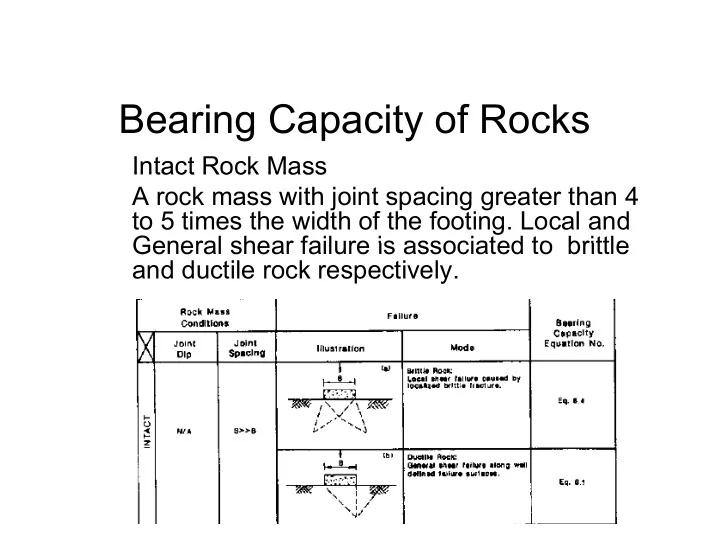
Bearing Capacity of Rocks Intact Rock Mass Intact Rock Mass A rock mass with joint spacing greater than 4 to 5 times the width of the footing. Local and General shear failure is associated to brittle General shear failure is associated to


slide-1
SLIDE 1

Bearing Capacity of Rocks

Intact Rock Mass Intact Rock Mass A rock mass with joint spacing greater than 4 to 5 times the width of the footing. Local and General shear failure is associated to brittle General shear failure is associated to brittle and ductile rock respectively.

slide-2
SLIDE 2
slide-3
SLIDE 3

Jointed Rock Mass Jointed Rock Mass

slide-4
SLIDE 4
slide-5
SLIDE 5
slide-6
SLIDE 6
slide-7
SLIDE 7

General Shear Failure Local Shear Failure Local Shear Failure

slide-8
SLIDE 8
  • Compressive Failure:

A h t i d b l t i d A case characterized by poorly constrained columns of poor rock. Splitting Failure For widely spaced and vertically oriented For widely spaced and vertically oriented discontinuities, failure generally initiates by splitting beneath the foundation.

slide-9
SLIDE 9
  • The ultimate bearing capacity is given by:
slide-10
SLIDE 10
slide-11
SLIDE 11

Guideline properties of Rock Mass Cl Classes

slide-12
SLIDE 12

Allowable Bearing Stresses on Rock Masses

Foundations on Fractured Rock Formation

30

MPa)

Note: Use maximum qa < q u where qu = compressive strength

20 25

ress qa (M

where qu compressive strength

  • f intact rock specimens

15

earing Str

) 130 / ( 1 ) 16 / ( 1 ) ( RQD RQD MPa q ALLOWABLE − + ≈

NOTE: 1 MPa = 10 tsf

5 10

  • wable Be

Peck, et al. (1974)

NOTE: 1 MPa = 10 tsf 10 20 30 40 50 60 70 80 90 100

Allo

( ) Approximation

Rock Quality Designation, RQD

slide-13
SLIDE 13

In case of rock mass with favorable discontinuities, the net allowable bearing pressure may be estimated from: qa = qc * Nj Where qc = average uniaxial compressive strength of rock cores Where qc average uniaxial compressive strength of rock cores Nj = empirical coefficient depending on the spacing of the discontinuities

/ 3 B S +

[ ]

) / ( 300 1 10 S δ + =

δ = thickness of discontinuity δ = thickness of discontinuity S = spacing of discontinuities B = width of footing The above relationship is valid for a rock mass with spacing of continuities > 0.3 m, δ < 10 mm (15 mm if filled with soil) and B >0 3 m B >0.3 m.

slide-14
SLIDE 14
slide-15
SLIDE 15

Pile Foundations:

The allowable bearing capacity of socketed piles is given by: qa = qc * Nj * Nd Where Where Nd = 0.8 + 0.2 h/d h = depth of socket in rock d = diameter of socket

Determination of Net Allowable Bearing Pressure from P t T t Pressuremeter Test:

[ ]

) ( 3 1

f l d f a

D P K D q γ γ − + =

Where qa = allowable bearing pressure in t/m2 Pl = limit pressure determined by the Pressuremeter in t/m2 γ Df = overburden pressure in t/m2

slide-16
SLIDE 16

Values of Kd Values of Kd

Depth of footing Kd Depth of footing Kd Load at rock surface 0.8 Load at radius/width of foundation 2.0 unit Load at 4 times radius/width of 3.6 foundation unit Load at 10 times radius/width of f d ti it 5.0 foundation unit

slide-17
SLIDE 17

Plate Load Test Plate Load Test

slide-18
SLIDE 18

Correction Factors : (Not required for RMR) Co ect o acto s ( ot equ ed o )

  • Ground Water Table:

(a) Rock with discontinuous joints with opening less (a) Rock with discontinuous joints with opening less than 1mm wide – 0.75 (b) Rock with continuous joints with opening 1 to 5 id fill d ith 0 7 t 0 5 mm wide filled with gouge – 0.7 to 0.5 (c) Limestone/ Dolomite deposit with major cavities filled with soil – 0.66 to 0.5.

  • Cavities: Major cavities inside limestone - 0.5
  • Slope and orientation of joints:

( ) F i i t ti f ti j i t i th l (a) Fair orientation of continuous joints in the slope – 1 to 0.5 (b) Unfavorable orientation of continuous joints in (b) Unfavorable orientation of continuous joints in slope – 0.5 to 0.33.

slide-19
SLIDE 19