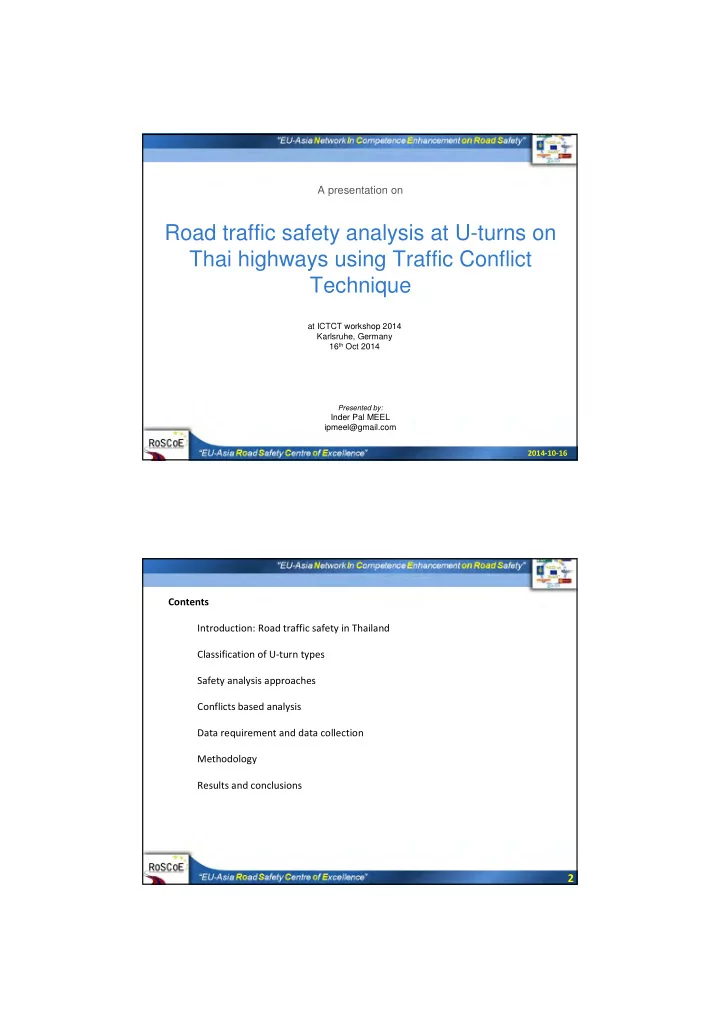
Road traffic safety analysis at U-turns on Thai highways using - - PDF document

road traffic safety analysis at u turns on thai highways
SMART_READER_LITE
LIVE PREVIEW

Road traffic safety analysis at U-turns on Thai highways using - - PDF document

A presentation on Road traffic safety analysis at U-turns on Thai highways using Traffic Conflict Technique at ICTCT workshop 2014 Karlsruhe, Germany 16 th Oct 2014 Presented by: Inder Pal MEEL ipmeel@gmail.com 2014-10-16 Contents


slide-1
SLIDE 1

2014-10-16

Road traffic safety analysis at U-turns on Thai highways using Traffic Conflict Technique

Presented by:

Inder Pal MEEL ipmeel@gmail.com

A presentation on

at ICTCT workshop 2014 Karlsruhe, Germany 16th Oct 2014

Contents Introduction: Road traffic safety in Thailand Classification of U-turn types Safety analysis approaches Conflicts based analysis Data requirement and data collection Methodology Results and conclusions

2

slide-2
SLIDE 2

Road traffic safety: socio-economics costs

  • approximately 1.24 million people were killed on the world's roads in 2010 and another 20

to 50 million sustain nonfatal injuries as a result of road traffic crashes (WHO 2013)

  • The negative consequences from road accidents are regarded as socio-economic costs.
  • Road Traffic accident socio-economic (losses) costing for Thailand
  • approx. 2.56 percent of the GDP in 2002 (Luathep and Yordphol 2005)
  • approx. 2.37 percent of the GDP in 2004 (Thongchim, et al. 2007)
  • approx. 3 percent of the GDP in 2010 (WHO 2013)
  • In 2010 the United Nations declared 2011–2020 as the Decade of Action for Road Safety.

Introduction Introduction

3

Need of study: Contributing Crash Factors

Introduction Introduction 57% 3% 26% 4% 6% Human Factors (93%) Road Environment Factors (34%) Vehicle Factors (13%)

Source: PIARC Road Safety Manual, 2003

1% 2%

4

slide-3
SLIDE 3

Objective of study

Road safety analysis of U-turns on Thai Highways with focus on their geometric design.

  • Layout Geometric of the U-turns…
  • Accident based safety analysis: accident cost rate…
  • Assessment of accident database…
  • Event/ conflict based safety analysis: TCT…
  • Assessment of ‘conflict index rate’…
  • Affect of variation of U-turn variables…
  • Most safest layout design…

Introduction Introduction

5

Need of study: Crashes at U-turns

6

(Source: Bureau of Highway Safety, Department of Highways, Thailand)

Reported road traffic fatalities (2010) 13766 and estimated GDP lost due to road traffic crashes about 3 percent (Source: WHO, Global status report on road safety 2013).

Introduction Introduction

Note: DoH reports accidents only with DoH property damage

slide-4
SLIDE 4

U-turn on Thai Highways

  • to facilitate road user to change to opposite traffic stream,
  • to avoid construction of T-junctions,
  • to reduce travel time for emergency services,
  • for efficient law enforcement, and
  • for highway maintenance purposes.

distance between two adjacent U-turns are varying form approx. 1.5 to 3 km, depends upon field geography.

Introduction Introduction

7

Combination of U-turn equivalent to 4-legged intersection

  • Nos. of conflict points
  • Conflict types
  • Speed
  • Access controls
  • Density (facility per km) on highways

32 Conflict points 12 Conflict points

8

Introduction Introduction

slide-5
SLIDE 5

Scope of study …focus on crash and conflict based investigation methods. …limited to U-turns on rural 4-lane divided highways (DoH).

Introduction Introduction

Limitations for selection of U-turns locations:

  • Outside of built-up area,
  • Highway having median width 0.5m to 15m,
  • Not to be located on horizontal curve,
  • Not to be located on crest,
  • Not to be part of T or X-junction,
  • Not to be grade separated design, and
  • No special design solution.

Accident data source:

  • Royal Thai Police
  • Department of Highway

9

Classification of U-turns

Introduction Introduction

Classification of U-turns type

Acceleration lane Deceleration lane

Road safety analysis at U-turns

Outer widening Directional Island

1

slide-6
SLIDE 6

U-turn on Thai Highways Introduction Introduction

1 1

Classification of U Classification of U-

  • turn types

turn types

UT-1 UT-2 UT-3 UT-4

Based on layout geometric design, 8 types of U-turn classified for study

1 2

slide-7
SLIDE 7

Classification of U Classification of U-

  • turn types

turn types

UT-5 UT-6 UT-7 UT-8

Based on layout geometric design, 8 types of U-turn classified for study

1 3

Safety analysis approaches

Safety analysis approaches Safety analysis approaches

Road safety analysis

Conflict based analysis Accident based analysis

Disadvantages Advantages Disadvantages Advantages

1 4

slide-8
SLIDE 8

Accident based analysis Disadvantages Advantages

  • Widely accepted
  • Highly reliable
  • Available and reliable accident data
  • Longer time period (1 – 3 year)

Advantage and disadvantages of accident based analysis Road safety analysis

Safety analysis approaches Safety analysis approaches

1 5

Road safety analysis

Conflict based analysis

Disadvantages Advantages

  • Accepted as surrogate approach
  • Shorter time duration
  • Depends upon subjective

(observer’s) decisions

Advantage and disadvantages of event based analysis

Safety analysis approaches Safety analysis approaches

1 6

slide-9
SLIDE 9

Road safety analysis

Conflict based analysis Accident based analysis

Data requirements Conflicting data

  • Conflict types
  • Conflict severity

Traffic data

  • Volume
  • Vehicle composition

Data requirements Accident data

  • Accident type
  • Accident category

Traffic data

  • Volume (AADT)

Data requirement

Safety analysis approaches Safety analysis approaches

1 7

Road safety analysis

Accident based analysis

Data requirements Accident data

  • Accident type
  • Accident category

Traffic data

  • Volume (AADT)

Data requirement

Data sources 1.Royal Thai Police 2.Department of Highways (DoH) Assessment of availability and reliability of accident data (Pilot Study)

Safety analysis approaches Safety analysis approaches

1 8

slide-10
SLIDE 10

Some facts about accident data in Thailand (Srirat 2008):

  • DOH has a trend of underreporting in the night time,
  • DOH has more underreporting trend during weekend than during weekdays,
  • The accident involving the crash between vehicle and object are always under-reported by police

but in other cases DOH has a trend of underreporting,

  • The small vehicles crashes have more tendencies to be under-reported by DOH than police, and
  • The hospital data collect the case of severity, disability and death, but not providing the property

damage.

Related literature Related literature Accident Analysis: Accident Data in Thailand

Source: Srirat 2008 Figure: Road traffic accident under-reporting between DoH and Royal Thai Police (Nakhon Ratchasima province)

1 9

Accident with fatalities Accident with serious injuries Accident with slight injuries Accident with property damage only Nearly accidents Heavy conflict Moderate conflict Light conflict Road Traffic events with respect to time duration Accident Based Investigation (data availability, data quality, long time duration)

Conclusion (Pilot Study)

  • Accident based investigation is not feasible
  • Police data not reliable
  • High under reporting in Department of Highways

Conflict Based Investigation Traffic Conflict Technique (TCT) Rare Events Frequent Events Events without conflict

Pilot Study Pilot Study

2

slide-11
SLIDE 11

The objective evidence of a traffic conflict by the definition is the evasive action which is indicated by a brake-light or a lane change affected by the offended driver.

NCHRP

Related literature Related literature Event Based Analysis: Traffic Conflict Techniques

Figure: The pyramid - the interaction between road users as a continuum of events (Hydén, 1987)

F I

2 1

Traffic Conflict Techniques: have been advocated as a proactive and supplementary approach to collision-based road safety analysis. Traffic conflict: an observable situation in which two or more road users approach each

  • ther in space and time to such an extent that there is a risk of collision if their movements

remain unchanged.

Amundsen and Hydén, 1977

The basic hypothesis is that there is a close relationship between conflicts and accidents.

(Svensson, A. 1998)

A major advantage of using traffic conflicts over traffic collisions in safety studies is the significant shorter observation period required; data can be collected over a matter of days

  • r weeks with conflicts as opposed to years using collision records.

(Autey, Jarvis 2010)

Related literature Related literature Event Based Analysis: Traffic Conflict Techniques

2 2

slide-12
SLIDE 12

Conflicts based analysis Conflicts based analysis

Road safety analysis

Conflict based analysis Objective

Data requirement

Subjective

2 3

Conflicts based analysis Conflicts based analysis Conflict based analysis Objective

Data requirement (Severity measurement)

Subjective Conflict measure

  • TA/Speed
  • TTC
  • PET

Conflict measure

  • Evasive action

Requirements

  • Require sophisticated positions of video

camera for recording

  • Image processing computer programs

Requirements

  • Require trained technical
  • bservers.

2 4

slide-13
SLIDE 13

Conflicts based analysis Conflicts based analysis

Road safety analysis

Conflict based analysis

Data requirements Conflicting data

  • Conflict types
  • Conflict Severity/ Intensity

Traffic data

  • Volume
  • Composition

Data requirement

Field Data collection

2 5

U-turn zones

Source: Own draft

Upstream Zones Turning Zone Downstream Zones Traffic Conflict Technique Traffic Conflict Technique

2 6

slide-14
SLIDE 14

UT-2 : A total 13 conflicts points

Conflicts points at U-turn

UT-1 : A total 13 conflicts points

Traffic Conflict Technique Traffic Conflict Technique

Diverging Merging Crossing Head-on

2 7

UT-4 : Total 12 conflicts points

Conflicts points at U-turn

UT-3 : Total 13 conflicts points

Traffic Conflict Technique Traffic Conflict Technique

Diverging Merging Crossing Head-on

2 8

slide-15
SLIDE 15

UT-6 : Total 17 conflicts points

Conflicts points at U-turn

UT-5 : Total 17 conflicts points

Traffic Conflict Technique Traffic Conflict Technique

Diverging Merging Crossing Head-on

2 9

UT-8 : Total 17 conflicts points

Conflicts points at U-turn

UT-7 : Total 17 conflicts points

Traffic Conflict Technique Traffic Conflict Technique

Diverging Merging Crossing Head-on

3

slide-16
SLIDE 16

Traffic Conflict Technique (Indicators) Traffic Conflict Technique (Indicators)

Conflict severity parameters (subjective approach)

1)Slight traffic conflict: Sudden lane change or mere braking 2)Moderate traffic conflict: Intense decelerate vehicle and almost stop 3)Severe traffic conflict: Hard braking or skid marks or braking sound

3 1

Conflict point grouping

Upstream Zone UD: Diverging UC: Crossing Turning Zone TH: Head-on Turning Zone DM: Merging DC: Crossing

  • Secondary

US1: Slight Conflict US2: Moderate Conflict US3: Sever Conflict

  • Diverging

UD1: Slight Conflict UD2: Moderate Conflict UD3: Sever Conflict Upstream Zone

  • Crossing

UC1: Slight Conflict UC2: Moderate Conflict UC3: Sever Conflict Traffic Conflict Technique Traffic Conflict Technique

3 2

slide-17
SLIDE 17

Conflict point grouping

Upstream Zone UD: Diverging UC: Crossing Turning Zone TH: Head-on Turning Zone DM: Merging DC: Crossing

  • Secondary

DS1: Slight Conflict DS2: Moderate Conflict DS3: Sever Conflict

  • Merging

DM1: Slight Conflict DM2: Moderate Conflict DM3: Sever Conflict Downstream Zone

  • Crossing

DC1: Slight Conflict DC2: Moderate Conflict DC3: Sever Conflict Traffic Conflict Technique Traffic Conflict Technique

3 3

Conflict point grouping

Upstream Zone UD: Diverging UC: Crossing Turning Zone TH: Head-on Turning Zone DM: Merging DC: Crossing

  • Head-on

TH1: Slight Conflict TH2: Moderate Conflict TH3: Sever Conflict Turning Zone

  • Secondary

TS1: Slight Conflict TS2: Moderate Conflict TS3: Sever Conflict Traffic Conflict Technique Traffic Conflict Technique

3 4

slide-18
SLIDE 18
  • S. No.

Type Province Distance from HDY Data collection status 1 UT-1 Sadao, Songkla 45Km 8 Hours 2 Ratchaburi 880Km 8 Hours 3 UT-2 Songkla 17Km 8 Hours 4 Songkla 20Km 8 Hours 5 UT-3 Chai Net 1122Km 8 Hours 6 Nakhon Si Ayutthaya 994Km 8 Hours 7 UT-4 Nakhon Si Thammarat 195Km 8 Hours 8 Nakhon Si Thammarat 193Km 8 Hours 9 UT-5 Phatthalung 117Km 8 Hours 10 Phatthalung 105Km 8 Hours 11 UT-6 Songkla 14Km 8 Hours 12 Songkla 13Km 8 Hours 13 UT-7 Phatthalung 96Km 8 Hours 14 Phatthalung 100Km 8 Hours 15 UT-8 Phetchabun 1254Km 8 Hours 16 Phetchabun 1212Km 8 Hours Total 128 Hours

Field data collection: Locations of identified U Field data collection: Locations of identified U-

  • turns

turns

3 5

Criteria for field data collection

Two of each type of U-turn were considered for data collection (total 16 U-turns) Total 8 hours of data collection planned for each location

  • 2 peak hours for each side (total 4 hours for each U-turn)
  • 2 off peak hours for each side (total 4 hours for each U-turn)
  • Only in day-light hours
  • No adverse weather condition (heavy rain, thunder shower etc)
  • No weekend or holidays

Data collection Data collection

3 6

slide-19
SLIDE 19

Field Data collection Field Data collection

Outcome of field study

1)Conflicts at Turning zone: Very rare. 2)Severe traffic conflict : Only one incidence was recorded.

3 7

Lmo Length of median opening Ldc Length of deceleration lane Ldt Taper section length of deceleration lane Lac Length of acceleration lane Lat Taper section length of acceleration lane Low Length of outer widening Lou Upstream taper section length of outer widening Lod Downstream taper section length of outer widening WM Median width Wm Median width along auxiliary lane WL Through lane width Wdc Width of deceleration lane Wac Width of acceleration lane Wow Width of outer widening Wos Width of outer shoulder Wis Width of inner shoulder

Geometric Data Geometric Data

3 8

slide-20
SLIDE 20

Functional length of Auxiliary lanes

U-turn type Ldc [m] Ldt [m] Ldf [m] Lac [m] Lat [m] Laf [m] UT-1 UT-2

32 46 56

UT-3

105 68 139 146 61 177

UT-4

99 52 124 99 50 124

UT-5

68 58 97

UT-6

62 88 106 62 92 108

UT-7

61 131 127

UT-8

100 59 129

Ldc – Length of the section of deceleration lane with full width, Ldt – Length of the tapper section of the deceleration, Ldf – Functional length of the deceleration lane = Ldc + Ldt/2 Lac – Length of the section of acceleration lane with full width, Lat – Length of the tapper section of the acceleration, Laf – Functional length of the acceleration lane = Lac + Lat /22

Variety! Consistency! Uniformity!

3 9

Geometric Data Geometric Data

4

Traffic volumes at U-turns Traffic Conflict Technique Traffic Conflict Technique HThV – Hourly through volume, HDiV – Hourly diverging volume, HMeV – Hourly merging volume,

slide-21
SLIDE 21

Through traffic Diverging Using deceleration lane Not-using deceleration lane Merging Using acceleration lane Not-using acceleration lane Motorbike Passenger Car Van Bus/ Truck Up to 10 wheels Tractor-Trailer > 10 wheels Others

Traffic streams and composition Traffic Data Traffic Data Traffic composition

4 1

Data collection Data collection

4 2

Observed traffic volumes at U-turns

slide-22
SLIDE 22

4 3

U-turn: Product of through and turning volumes (PTTVup, PTTVdn & PTTV) “the square root of the product of (average hourly) traffic volumes of the conflicting streams (through and turning)”.

Source: Yi and Thompson (2011)

Methodology Methodology

Exposure “the total number of traffic conflicts is proportional to the square root of the product of the conflicting volumes”

Methodology Methodology Hourly Traffic Conflict Number (HCN): defined as the number of observed conflicts at a zone divided by the number of observation hours for that zone. Average Hourly Traffic Conflict Number (AHN): defined as the summation of Hourly Traffic Conflict Numbers (HCN) at that particular zones divided by the number of that type of zones in particular group of U-turn type.

4 4

Conflict numbers:

slide-23
SLIDE 23

Methodology Methodology

Coefficient of Conflict Severity (CCS): (From a study of roundabouts…) Road segment Speed Round-about 40km/h (Design speed, rural area)1 U-turns 75 to 90 km/h (Average speed)2

Source: Krivda (2013)

Conflict seriousness Coefficient of Conflict Severity (Weighting factor) [-] Slight Conflict 1 Moderate Conflict 3 Serious Conflict 6

1 – Roundabouts: An Informational Guide (2000), FHA 2 – Observed average speed at U-turns for cars

4 5 4 6

Methodology Methodology

Weighted conflict rate: (From a study of roundabouts…)

Source: Krivda (2013)

slide-24
SLIDE 24

4 7

Methodology Methodology

Severity conflict index rate: …for Downstream zones

4 8

Methodology Methodology

Severity conflict index rate: …for Upstream zones

slide-25
SLIDE 25

4 9

Methodology Methodology

Severity conflict index rate: …for U-turns

Severity Conflict Indexes at Upstream Zones Results Results UT-1 UT-2 UT-3 UT-4 UT-5 UT-6 UT-7 UT-8

5

slide-26
SLIDE 26

Severity Conflict Indexes at Downstream zones Results Results UT-1 UT-2 UT-3 UT-4 UT-5 UT-6 UT-7 UT-8

!

5 1

Severity Conflict Indexes for U-turns Results Results UT-1 UT-2 UT-3 UT-4 UT-5 UT-6 UT-7 UT-8

!

5 2

slide-27
SLIDE 27

Effect of the directional island

Secondary results Secondary results

5 3

Inappropriate driving behaviors

Other findings Other findings

5 4

UT-3 UT-7

slide-28
SLIDE 28

Inappropriate driving behaviors

Other findings Other findings

5 5

Inappropriate driving behaviors

Other findings Other findings

5 6

slide-29
SLIDE 29

Illegal parking at U-turn

Other findings Other findings

5 7

Thank you

5 8 Inder Pal MEEL

Assistant Prof. ipmeel@gmail.com +91-9414254371 Sri Balaji College of Engineering and Technology, Jaipur, Rajasthan, India