SLIDE 1
RNA Secondary Structure
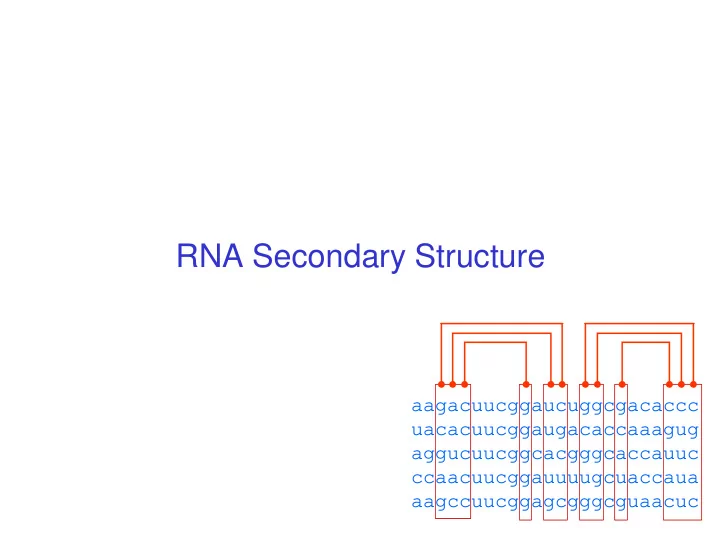
aagacuucggaucuggcgacaccc uacacuucggaugacaccaaagug aggucuucggcacgggcaccauuc ccaacuucggauuuugcuaccaua aagccuucggagcgggcguaacuc
SLIDE 2
Hairpin Loops Stems Bulge loop Interior loops Multi-branched loop
SLIDE 3
Context Free Grammars and RNAs
S → a W1 u W1 → c W2 g W2 → g W3 c W3 → g L c L → agucg What if the stem loop can have other letters in place of the ones shown?
ACGG UGCC AG U CG
SLIDE 4
The Nussinov Algorithm and CFGs
Define the following grammar, with scores: S → a S u : 3 | u S a : 3 g S c : 2 | c S g : 2 g S u : 1 | u S g : 1 S S : 0 | a S : 0 | c S : 0 | g S : 0 | u S : 0 | ε : 0
Note: ε is the “” string
Then, the Nussinov algorithm finds the optimal parse of a string with this grammar
SLIDE 5
The Nussinov Algorithm
Initialization:
F(i, i-1) = 0; for i = 2 to N F(i, i) = 0; for i = 1 to N S → a | c | g | u
Iteration:
For l = 2 to N: For i = 1 to N – l j = i + l – 1 F(i+1, j -1) + s(xi, xj) S → a S u | … F(i, j) = max max{ i ≤ k < j } F(i, k) + F(k+1, j) S → S S
Termination:
Best structure is given by F(1, N)
SLIDE 6
Stochastic Context Free Grammars
In an analogy to HMMs, we can assign probabilities to transitions: Given grammar X1 → s11 | … | sin … Xm → sm1 | … | smn Can assign probability to each rule, s.t. P(Xi → si1) + … + P(Xi → sin) = 1
SLIDE 7 Computational Problems
- Calculate an optimal alignment of a sequence and a SCFG
(DECODING)
- Calculate Prob[ sequence | grammar ]
(EVALUATION)
- Given a set of sequences, estimate parameters of a SCFG
(LEARNING)
SLIDE 8
Evaluation
Recall HMMs: Forward: fl(i) = P(x1…xi, πi = l) Backward: bk(i) = P(xi+1…xN | πi = k) Then, P(x) = Σk fk(N) ak0 = Σl a0l el(x1) bl(1) Analogue in SCFGs: Inside: a(i, j, V) = P(xi…xj is generated by nonterminal V) Outside: b(i, j, V) = P(x, excluding xi…xj is generated by S and the excluded part is rooted at V)
SLIDE 9 Normal Forms for CFGs
Chomsky Normal Form: X → YZ X → a All productions are either to 2 nonterminals, or to 1 terminal
Theorem (technical)
Every CFG has an equivalent one in Chomsky Normal Form
(That is, the grammar in normal form produces exactly the same set of strings)
SLIDE 10 Example of converting a CFG to C.N.F.
S → ABC A → Aa | a B → Bb | b C → CAc | c Converting: S → AS’ S’ → BC A → AA | a B → BB | b C → DC’ | c C’ → c D → CA
S A B C A
a a
B
b
B
b b
C A
c c a
S A S’ B C A A
a a
B B B B
b b b
D C’ C A
c c a
SLIDE 11
Another example
S → ABC A → C | aA B → bB | b C → cCd | c Converting: S → AS’ S’ → BC A → C’C’’ | c | A’A A’ → a B → B’B | b B’ → b C → C’C’’ | c C’ → c C’’ → CD D → d
SLIDE 12 The Inside Algorithm
To compute a(i, j, V) = P(xi…xj, produced by V) a(i, j, v) = ΣX ΣY Σk a(i, k, X) a(k+1, j, Y) P(V → XY)
k k+1 i j
V X Y
SLIDE 13
Algorithm: Inside
Initialization:
For i = 1 to N, V a nonterminal, a(i, i, V) = P(V → xi)
Iteration:
For i = 1 to N-1 For j = i+1 to N For V a nonterminal a(i, j, V) = ΣX ΣY Σk a(i, k, X) a(k+1, j, X) P(V → XY)
Termination:
P(x | θ) = a(1, N, S)
SLIDE 14 The Outside Algorithm
b(i, j, V) = Prob(x1…xi-1, xj+1…xN, where the “gap” is rooted at V) Given that V is the right-hand-side nonterminal of a production, b(i, j, V) = ΣX ΣY Σk<i a(k, i-1, X) b(k, j, Y) P(Y → XV)
i j
V
k
X Y
SLIDE 15
Algorithm: Outside
Initialization:
b(1, N, S) = 1 For any other V, b(1, N, V) = 0
Iteration:
For i = 1 to N-1 For j = N down to i For V a nonterminal b(i, j, V) = ΣX ΣY Σk<i a(k, i-1, X) b(k, j, Y) P(Y → XV) +
ΣX ΣY Σk<i a(j+1, k, X) b(i, k, Y) P(Y → VX)
Termination:
It is true for any i, that: P(x | θ) = ΣX b(i, i, X) P(X → xi)
SLIDE 16
Learning for SCFGs
We can now estimate c(V) = expected number of times V is used in the parse of x1….xN
1 c(V) = –––––––– Σ1≤i≤NΣi≤j≤N a(i, j, V) b(i, j, v) P(x | θ) 1 c(V→XY) = –––––––– Σ1≤i≤NΣi<j≤N Σi≤k<j b(i,j,V) a(i,k,X) a(k+1,j,Y) P(V→XY) P(x | θ)
SLIDE 17
Learning for SCFGs
Then, we can re-estimate the parameters with EM, by: c(V→XY) Pnew(V→XY) = ––––––––––––
c(V) c(V → a) Σi: xi = a b(i, i, V) P(V → a) Pnew(V → a) = –––––––––– = –––––––––––––––––––––––––––––––– c(V)
Σ1≤i≤NΣi<j≤N a(i, j, V) b(i, j, V)
SLIDE 18
Decoding: the CYK algorithm
Given x = x1....xN, and a SCFG G, Find the most likely parse of x (the most likely alignment of G to x) Dynamic programming variable: γ(i, j, V): likelihood of the most likely parse of xi…xj, rooted at nonterminal V Then, γ(1, N, S): likelihood of the most likely parse of x by the grammar
SLIDE 19
The CYK algorithm (Cocke-Younger-Kasami)
Initialization:
For i = 1 to N, any nonterminal V, γ(i, i, V) = log P(V → xi)
Iteration:
For i = 1 to N-1 For j = i+1 to N For any nonterminal V, γ(i, j, V) = maxXmaxYmaxi≤k<j γ(i,k,X) + γ(k+1,j,Y) + log P(V→XY)
Termination:
log P(x | θ, π*) = γ(1, N, S)
Where π* is the optimal parse tree (if traced back appropriately from above)
SLIDE 20
Summary: SCFG and HMM algorithms
GOAL HMM algorithm SCFG algorithm
Optimal parse Viterbi CYK Estimation Forward Inside Backward Outside Learning EM: Fw/Bck EM: Ins/Outs Memory Complexity O(N K) O(N2 K) Time Complexity O(N K2) O(N3 K3) Where K: # of states in the HMM # of nonterminals in the SCFG
SLIDE 21
A SCFG for predicting RNA structure
S → a S | c S | g S | u S | ε → S a | S c | S g | S u → a S u | c S g | g S u | u S g | g S c | u S a → SS Adjust the probability parameters to be the ones reflecting the relative strength/weakness of bonds, etc. Note: this algorithm does not model loop size!
SLIDE 22
CYK for RNA folding
Can do faster than O(N3 K3):
Initialization:
γ(i, i-1) = -Infinity γ(i, i) = log P( xiS )
Iteration:
For i = 1 to N-1 For j = i+1 to N γ(i+1, j-1) + log P(xiS xj) γ(i+1, j) + log P(S xi) γ(i, j) = max γ(i, j-1) + log P(xiS) maxi < k < j γ(i, k) + γ(k+1, j) + log P(S S)
SLIDE 23 The Zuker algorithm – main ideas
Models energy of an RNA fold
- 1. Instead of base pairs, pairs of base pairs (more accurate)
- 2. Separate score for bulges
- 3. Separate score for different-size & composition loops
- 4. Separate score for interactions between stem & beginning of loop
Can also do all that with a SCFG, and train it on real data
SLIDE 24 Methods for inferring RNA fold
– Crystallography – NMR
– Fold prediction (Nussinov, Zuker, SCFGs) – Multiple Alignment
SLIDE 25
Multiple alignment and RNA folding
Given K homologous aligned RNA sequences: Human aagacuucggaucuggcgacaccc Mouse uacacuucggaugacaccaaagug Worm aggucuucggcacgggcaccauuc Fly ccaacuucggauuuugcuaccaua Orc aagccuucggagcgggcguaacuc If ith and jth positions are always base paired and covary, then they are likely to be paired
SLIDE 26 Mutual information
fab(i,j) Mij = Σa,b∈{a,c,g,u}fab(i,j) log2–––––––––– fa(i) fb(j)
Where fab(i,j) is the # of times the pair a, b are in positions i, j Given a multiple alignment, can infer structure that maximizes the sum of mutual information, by DP
In practice:
1. Get multiple alignment 2. Find covarying bases – deduce structure 3. Improve multiple alignment (by hand) 4. Go to 2 A manual EM process!!
SLIDE 27 Current state, future work
- The Zuker folding algorithm can predict good folded structures
- To detect RNAs in a genome
– Can ask whether a given sequence folds well – not very reliable
- For tRNAs (small, typically ~60 nt; well-conserved structure)
Covariance Model of tRNA (like a SCFG) detects them well
- Difficult to make efficient probabilistic models of larger RNAs
- Not known how to efficiently do folding and multiple alignment
simultaneously