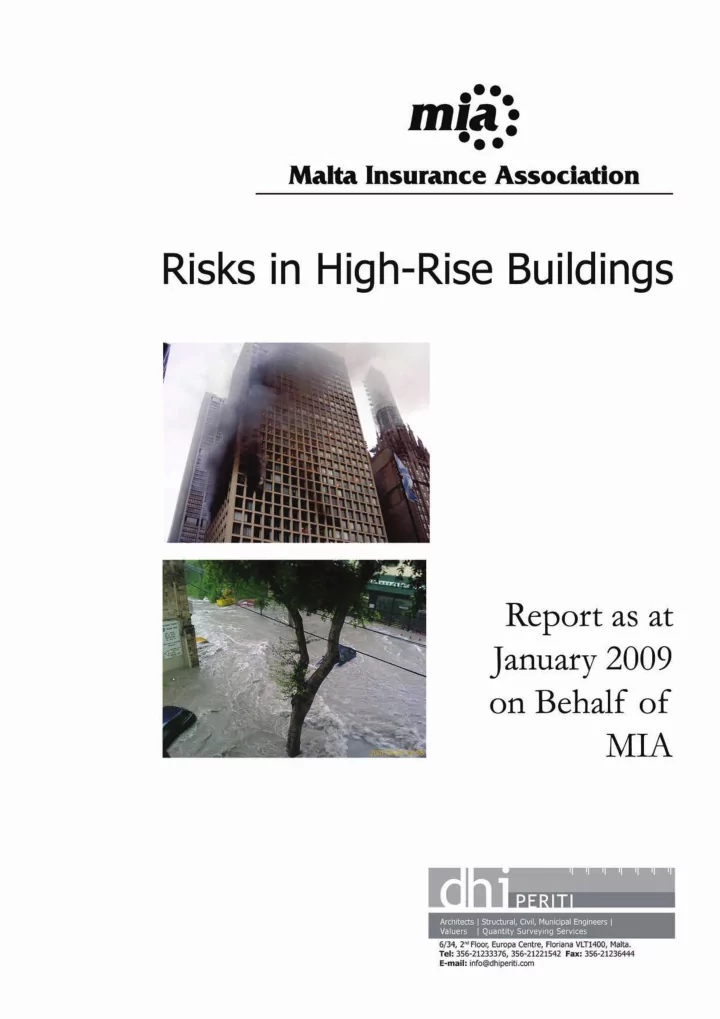
RISKS IN HIGH RISE BUILDINGS MALTA INSURANCE ASSOCIATION DHI PERITI - - PDF document
RISKS IN HIGH RISE BUILDINGS MALTA INSURANCE ASSOCIATION DHI PERITI - dhc@dhiperiti.com DENIS H CAMILLERI OCTOBER 2009 Risks to be Considered Maltas Building regulations The annual rental value of the property Windstorm Risk The
DENIS H CAMILLERI DHI PERITI - dhc@dhiperiti.com MALTA INSURANCE ASSOCIATION
OCTOBER 2009
RISKS IN HIGH RISE BUILDINGS
DENIS H CAMILLERI DHI PERITI - dhc@dhiperiti.com MALTA INSURANCE ASSOCIATION
OCTOBER 2009
Risks to be Considered
The annual rental value of the property The Capital Value of Land & Improvements The Unimproved site value of the land
- Malta’s Building regulations
- Windstorm Risk
Structural
- Earthquake Risks Eurocodes
- Ground conditions
- Flooding
- Tsunami
- Terrorism
- Probable Max Loss
- Fire
DENIS H CAMILLERI DHI PERITI - dhc@dhiperiti.com MALTA INSURANCE ASSOCIATION
OCTOBER 2009
Building Regulations to Date
- In Draft since 1995 -7 sections Parts A-G
- f which Part F issued
- “Fuel, Power & Conservation of Energy”
- Handbook on part C issued “Design
Guidelines on Fire Safety for Buildings in Malta”
- BICC had not published “Structural
Integrity” handbook referred to Part C, although various CPD courses undertaken
DENIS H CAMILLERI DHI PERITI - dhc@dhiperiti.com MALTA INSURANCE ASSOCIATION
OCTOBER 2009
Problems with Capital Value Transactions
Windstorm risks
- Malta’s climate is defined as well
behaved with hurricanes not the case for Malta.
- Malta’s Wind Rose Diagram should act
as a guide on positioning high rise.
- Strongest gale recorded 12/ 88 at
34m/ s (66 knots)
- Eurocode Provision (EN1991 - 1.4)
refers to a 10 min wind speed at 10m above open country which appears to approximate to 23m/ s.
DENIS H CAMILLERI DHI PERITI - dhc@dhiperiti.com MALTA INSURANCE ASSOCIATION
OCTOBER 2009
The Local Property Contracts Scenario (Table 1)
- Eurocode EN1998 - 1.1 requires the 175
year return period
- The 475 return period hovers around 0.06g
– 0.08g
- This classifies Malta as lying in a low
seismicity zone as falling within < 0.10g but > 0.04g
Earthquake Risk
Real Estate Damage & No of Casualties according to Earthquake Intensity
EARTHQUAKE INTENSITY RETURN PERIOD years REAL ESTATE Loss € NO OF FATAL CASUALTIES vi 125 (2-5)% g 165,000,000
- Vii
1,000 (5-10)% g 1,189,000,000 45 Viii 10,000 (10-20)% g 2,870,000,000 2,370
(Source: dhi periti)
DENIS H CAMILLERI DHI PERITI - dhc@dhiperiti.com MALTA INSURANCE ASSOCIATION
OCTOBER 2009
Ground Conditions
(damage to adjacent properties)
- Pembroke – strong lower coralline (tal-qawwi)
- Paceville
Gzira Luqa - stiff lower globigerina (tal-franka) Marsa
- Tigne – possibly shattered
- Qawra – soft middle globigerina
- Deep excavation in rock is to be monitored
via PPV method
DENIS H CAMILLERI DHI PERITI - dhc@dhiperiti.com MALTA INSURANCE ASSOCIATION
OCTOBER 2009
Flood Risks
- Malta’s average annual rainfall stands at
550mm (global average 1000mmm)
- For the max 24 hr precipitation Malta’s flash
floods are in the 100-200mm group (max global 500mm/ 24hr)
- Highest Maltese storms intensity 226mm Sept
2003, flow velocity 9km/ hr (5km/ hr person swept away).
- Flash floods average out at 2.5 years with an
average intensity of 144mm per 24 hr
- Flooding risks poised by the Marsa park, Gzira
and Paceville (lower end) sites.
DENIS H CAMILLERI DHI PERITI - dhc@dhiperiti.com MALTA INSURANCE ASSOCIATION
OCTOBER 2009
Flash flood at Valley Rd, Birkirkara 4thJune 2007 highest recorded for June at 57.6mm in 24 hrs.
DENIS H CAMILLERI DHI PERITI - dhc@dhiperiti.com MALTA INSURANCE ASSOCIATION
OCTOBER 2009
DENIS H CAMILLERI DHI PERITI - dhc@dhiperiti.com MALTA INSURANCE ASSOCIATION
OCTOBER 2009
Tsunami Risks
- The greatest tsunami damage with
7.00m ht run-off is expected from the Aegean Sea with 90min warning From Eastern Sicily only a 0.5m high run-off is expected with a 50min warning period.
- Greatest Tsunami damage is
expected in the Marsa Park & Gzira
- Qawra, Paceville & Tigne has a small
fraction exposed, with Luqa outside.
DENIS H CAMILLERI DHI PERITI - dhc@dhiperiti.com MALTA INSURANCE ASSOCIATION
OCTOBER 2009
Inundation of the Maltese Islands up to the 10m mark
Source: dhi periti
DENIS H CAMILLERI DHI PERITI - dhc@dhiperiti.com MALTA INSURANCE ASSOCIATION
OCTOBER 2009
DENIS H CAMILLERI DHI PERITI - dhc@dhiperiti.com MALTA INSURANCE ASSOCIATION
OCTOBER 2009
Terrorism Risks
- Have been increasing on a global scale since 1988
(Lockerbie) culminating in more than a total loss 11/ 09/ 2001 – Twin Towers.
- Appropriate prevention measures – to be included
in the design
- round columns
- anti-resistant glazing
- Design against disproportionate collapse (Roman
Point 1968) blast loading
- Islamic Banking (Smart City) growing American
presence in Malta
- Low level of National Security, scarcity of land to
provide for security buffer zones
DENIS H CAMILLERI DHI PERITI - dhc@dhiperiti.com MALTA INSURANCE ASSOCIATION
OCTOBER 2009
Probable Max Loss - PML
- The events of 9/ 11 have altered the PML
philosophy behind terrorism
- What had previously been considered
inconceivable has now occurred, a PML> 100%
- The fire PML is the most important element
- f a high rise
Art deco Verizon building still in place. (Source: Swiss Re)
DENIS H CAMILLERI DHI PERITI - dhc@dhiperiti.com MALTA INSURANCE ASSOCIATION
OCTOBER 2009
Fire Engineering Post 9/11
- Photo indicates
necessity of installing a fire- fighting lift
- Old Trafford
with a spectator capacity of 80,000 may be vacated in 8 minutes
Limitation of fire fighting hose reels noted in the Windsor Building Madrid (Source: Swiss Re)
DENIS H CAMILLERI DHI PERITI - dhc@dhiperiti.com MALTA INSURANCE ASSOCIATION
OCTOBER 2009
Present Day Fire Safety Legislation
- Fire engineering has moved away
from prescriptive measures (“do it like this approach”) toward engineered solutions (“achieve this”)
- Handbook on “Fire Safety in Malta” is
based on prescriptive measures and for buildings with a max height of 28m (under 10 storeys)
DENIS H CAMILLERI DHI PERITI - dhc@dhiperiti.com MALTA INSURANCE ASSOCIATION
OCTOBER 2009
Example 1
Changing Trends, Changing Risks & Fire Design
(Source: NCE)
Further placing sprinklers close to the façade may provide sufficient ‘wetting’ in the event of a fire, with this approach used instead of alternatively fire-rating a facade
With a simple, vertical façade the cooling as the hot gases leave the fire compartment is such that the potential for re- entrant fire spread is typically low. When the façade is inclined, the region of higher temperature is extended further up the façade and the potential for fire spread is much higher
DENIS H CAMILLERI DHI PERITI - dhc@dhiperiti.com MALTA INSURANCE ASSOCIATION
OCTOBER 2009
Structural Fire-Protection Measures
- These include for
fire-resistant constructions, fire- resistant sealants & fire compartments
- On the other hand,
fire detection systems fire- extinguishing equipment may be treated as suspect
Fire spread via floor to floor
(Source: NCE)
DENIS H CAMILLERI DHI PERITI - dhc@dhiperiti.com MALTA INSURANCE ASSOCIATION
OCTOBER 2009
Swiss Re’s Malta Report 2008
- Notes that structural fire protection is
generally rated as adequate, as benefitting from fire resistant concrete construction
- (Prof Ali for MEPA notes that Maltese appear
well equipped for concrete construction – steel construction could have unsorted problems)
- Fire and smoke detection above ground level
is rated as adequate
- Small access road widths in between blocks
hamper maneuverability for fire engines and ambulances
DENIS H CAMILLERI DHI PERITI - dhc@dhiperiti.com MALTA INSURANCE ASSOCIATION
OCTOBER 2009
Conclusions & Recommendations
- Being late in high rise construction signifies that
good practices of other countries should be adopted
- Risk-reduced advantages consist of adopting
concrete/ masonry construction with limited glazing
- High rise should be designed to achieve the
discussed structural parameters for blast, wind earthquake and progressive collapse, with National Annexes to the Eurocodes undertaken prior to March 2010.
- Although best practice regarding technical
protection is followed, regulatory control to ensure quality of construction is presently weak
- An overall Regulatory Body is necessary to
- versee that the above robustness measures are
in place