Right to live, right to die ? The medicalisation of the end of life - - PDF document

right to live right to die
SMART_READER_LITE
LIVE PREVIEW

Right to live, right to die ? The medicalisation of the end of life - - PDF document

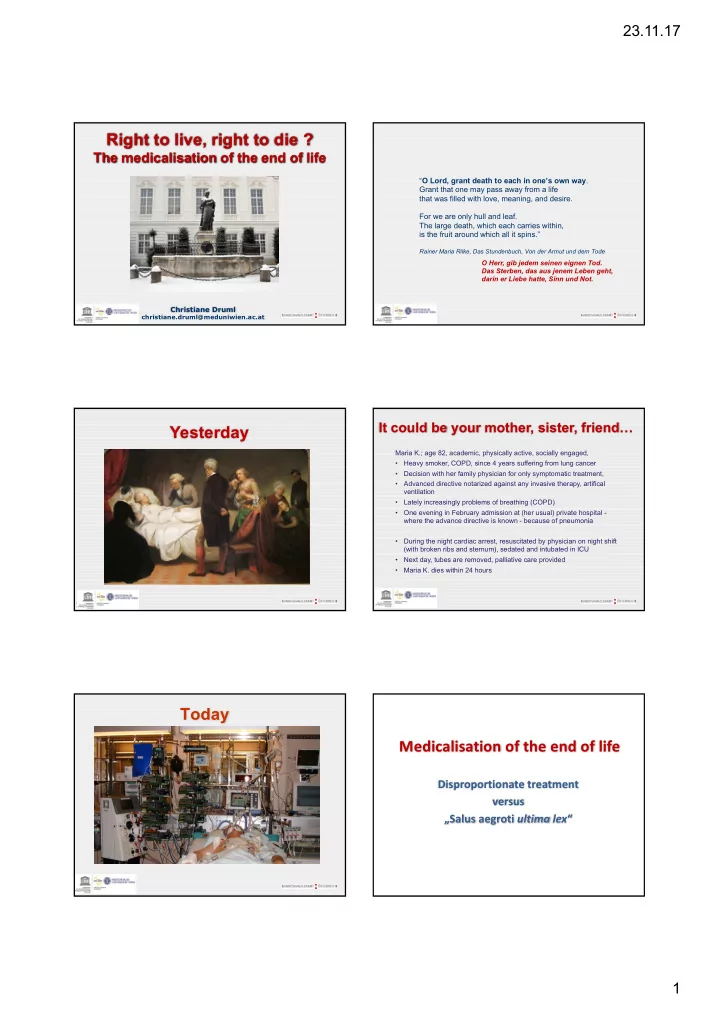
23.11.17 Right to live, right to die ? The medicalisation of the end of life O Lord, grant death to each in ones own way . Grant that one may pass away from a life that was filled with love, meaning, and desire. For we are only hull and


slide-1
SLIDE 1

23.11.17 1

CD 2017

Right to live, right to die ?

The medicalisation of the end of life

Christiane Druml

christiane.druml@meduniwien.ac.at

CD 2017

“O Lord, grant death to each in one’s own way. Grant that one may pass away from a life that was filled with love, meaning, and desire. For we are only hull and leaf. The large death, which each carries within, is the fruit around which all it spins.”

Rainer Maria Rilke, Das Stundenbuch, Von der Armut und dem Tode

O Herr, gib jedem seinen eignen Tod. Das Sterben, das aus jenem Leben geht, darin er Liebe hatte, Sinn und Not.

CD 2017

Yesterday

CD 2017

It could be your mother, sister, friend…

Maria K.; age 82, academic, physically active, socially engaged,

  • Heavy smoker, COPD, since 4 years suffering from lung cancer
  • Decision with her family physician for only symptomatic treatment,
  • Advanced directive notarized against any invasive therapy, artifical

ventilation

  • Lately increasingly problems of breathing (COPD)
  • One evening in February admission at (her usual) private hospital -

where the advance directive is known - because of pneumonia

  • During the night cardiac arrest, resuscitated by physician on night shift

(with broken ribs and sternum), sedated and intubated in ICU

  • Next day, tubes are removed, palliative care provided
  • Maria K. dies within 24 hours

CD 2017

Today Medicalisation of the end of life

Disproportionate treatment versus „Salus aegroti ultima lex“

slide-2
SLIDE 2

23.11.17 2

CD 2017

Place of death persons over 65 years

Where do people die? An international comparison of the percentage

  • f deaths occurring in hospital and residential aged care settings.

Broad JB et al; Int J Public health, 2013

CD 2017

Perceived p process i issues l leading t to i inappropriate l life- pr prolonging tr trea eatm tmen ent. t. Perceived r responsible p parties f for i inappropriate li life-pr prolonging tr trea eatm tmen ent. t.

A prospective determination of the incidence of perceived inappropriate care in critically ill patients

Singal RK. et al. Can Respir J 2014;21(3):165-170.

CD 2017

“It is a clear and undisputed principle that treatments which are

  • not (or no longer) indicated or
  • treatments which the patient refuses must not be

performed. There are still cases where disproportionate treatment is initiated. This results in diagnostic, therapeutic or care-related interventions whose benefit for the individual patient is highly questionable and which may expose the patient to a stressful situation that becomes problematic.”

Disproportionate treatment

CD 2017

  • Therapeutic ambition
  • Justified and unjustified fear of legal consequences
  • Service invoicing logistics at the hospital
  • Lack of communication within the healthcare team
  • Lack of communication between healthcare team and

patient

  • Relatives request therapy
  • Patient requests therapy

Causes for disproportionate treatment

Disproportionate treatment is incompatible with two ethical principles, the principle of non-maleficence and the principle of justice.

CD 2017

Austrian Bioethics Commission

www.bka.gv.at/bioethik 2011 2015

CD 2017

Prevention of disproportionate medical interventions

  • Medical interventions which provide no benefit for the

patient or which are more burdensome than potentially beneficial to the patient, and which may lead to a prolongation of the dying process in end-of-life situations, are ethically and medically unjustified because they come at a disproportionate burden.

  • The legal conditions for complex end-of-life

decisions should take due account of this fact to allow for carefully weighed decisions without fear of criminal prosecution.

Recommendations I

slide-3
SLIDE 3

23.11.17 3

CD 2017

The two following aspects are of crucial importance:

  • The outdated and imprecise terms “active and passive

euthanasia” need to be revised in accordance with the “Recommendations for the terminology of medical decisions in end-of-life situations” released by the Bioethics Commission.

  • This shall be taken into particular account in the education

and training programs for the legal and medical professions.

Recommendations II

The terminology

CD 2017

Trust and legal certainty in cases of limitation or discontinuation of medical measures which are no longer justified has to be established and to be exempted from legal punishment, when

  • The therapeutic decision is based on a comprehensible, substantiated

and to the individual situation corresponding decision-making process.

  • ethical standards and guidelines by professional associations; academic

ethical institutions or supranational institutions are followed.

  • Adherence to decision-making process is guaranteed.

Compliance with clear guidelines should lead to the presumption of trust and to legal certainty for the treating physician.

Recommendations III

CD 2017

Advance planning of medical end-of-life decisions shall be promoted through the following initiatives:

  • reducing the formal and financial hurdles to the

establishment of legally binding living wills and powers

  • f attorney
  • defining and checking quality standards and

qualifications to assure proper information of healthcare and legal professionals

  • raising public awareness through a national program

Planning for end-of-life care decisions (living will, power of attorney, guardianship, …)

CD 2017

Wallner J, Finding the right words for medical decisions at life's end Wien klin Wochenschr 2008

Confusion of terminology in German language

CD 2017

Terminology of end of life decisions

NAZI-EUTHANASIE = Murder

Do we need to change? Do we need a new culture for the end of life? For dying in „one‘s own way“?

slide-4
SLIDE 4

23.11.17 4

CD 2017

Respect of the patients‘ will Appropriate care for the patient

CD 2017

Doctors‘ Personal End-of-Life Preferences

CD 2017

Thank you for your attention!

www.josephinum.ac.at