Review Operating System Fundamentals CSCI 6730 / 4730 What is an - - PowerPoint PPT Presentation

review
SMART_READER_LITE
LIVE PREVIEW

Review Operating System Fundamentals CSCI 6730 / 4730 What is an - - PowerPoint PPT Presentation

Review Operating System Fundamentals CSCI 6730 / 4730 What is an OS? Operating Systems What does it do? How and when is it invoked? Structures Processes Monolithic Layered Microkernels Virtual Machines Modular 2


slide-1
SLIDE 1

Maria Hybinette, UGA

CSCI 6730 / 4730 Operating Systems

Processes

Maria Hybinette, UGA

2

Review

  • Operating System Fundamentals

» What is an OS? » What does it do? » How and when is it invoked?

  • Structures

» Monolithic » Layered » Microkernels » Virtual Machines » Modular

Maria Hybinette, UGA

3

Chapter 3: Processes: Outline

  • Process Concept: views of a process
  • Process Basics Scheduling Principles
  • Operations on Processes

» Life of a process: from birth to death …

  • Cooperating Processes (Thursday)

» Inter process Communication

– Mailboxes – Shared Memory – Sockets

Maria Hybinette, UGA

4

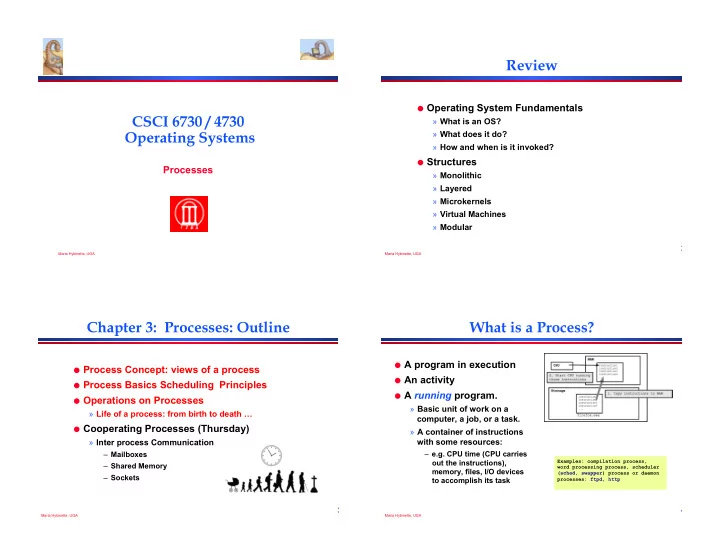
What is a Process?

  • A program in execution
  • An activity
  • A running program.

» Basic unit of work on a computer, a job, or a task. » A container of instructions with some resources:

– e.g. CPU time (CPU carries

  • ut the instructions),

memory, files, I/O devices to accomplish its task

Examples: compilation process, word processing process, scheduler (sched, swapper) process or daemon processes: ftpd, http

slide-2
SLIDE 2

Maria Hybinette, UGA

5

What are Processes?

System View:

  • Multiple processes:

» Several distinct processes can execute the SAME program

  • Time sharing systems run several processes by

multiplexing between them

  • ALL runnables including the OS are organized into a

number of sequential processes

Scheduler

n-1 Processes

Maria Hybinette, UGA

6

Process Definition

A process is a program in execution, a sequential execution characterized by trace. It has a context (the information or data) and this context is maintained as the process progresses through the system.

Maria Hybinette, UGA

7

Activity of a Process

Process A Process B Process C

A B C

Time Multiprogramming:

  • Solution: provide a programming counter.
  • One processor (CPU).

1 CPU

Maria Hybinette, UGA

8

Activity of a Process: Time Sharing

Process A Time Process B Process C

B A C

slide-3
SLIDE 3

Maria Hybinette, UGA

9

What Does the Process Do?

  • Created
  • Runs
  • Does not run (but ready to run)
  • Runs
  • Does not run (but ready to run)
  • ….
  • Terminates

Maria Hybinette, UGA

10

States of a Process

  • As a process executes, it changes state

» New: The process is being created. » Running: Instructions are being executed. » Ready: The process is waiting to be assigned to a processor (CPU). » Terminated: The process has finished execution. » Waiting: The process is waiting for some event to occur.

Ready New Running Waiting Terminated

Maria Hybinette, UGA

11

State Transitions

  • A process may change state as a result:

» Program action (system call) » OS action (scheduling decision) » External action (interrupts)

Ready New Running Waiting Terminated

Scheduler pick I/O or event wait exit Interrupt (time) and scheduler picks another process admitted I/O or event completion Maria Hybinette, UGA

12

OS Designers Questions?

  • How is process state represented?

» What information is needed to represent a process?

  • How are processes selected to transition

between states?

  • What mechanism is needed for a process to

run on the CPU?

slide-4
SLIDE 4

Maria Hybinette, UGA

13

What Makes up a Process?

User resources/OS Resources:

  • Program code (text)
  • Data

» global variables » heap (dynamically allocated memory)

  • Process stack

» function parameters » return addresses » local variables and functions

  • OS Resources, environment

» open files, sockets » Credential for security

  • Registers

» program counter, stack pointer

User Mode Address Space heap stack data routine1 var1 var2 main routine1 routine2 arrayA arrayB text address space are the shared resources

  • f a(ll) thread(s) in a program

Maria Hybinette, UGA

14

What is needed to keep track of a Process?

  • Memory information:

» Pointer to memory segments needed to run a process, i.e., pointers to the address space -- text, data, stack segments.

  • Process management information:

» Process state, ID » Content of registers:

– Program counter, stack pointer, process state, priority, process ID, CPU time used

  • File management & I/O information:

» Working directory, file descriptors

  • pen, I/O devices allocated
  • Accounting: amount of CPU used.

Process Number Program Counter Registers Process State Memory Limits Page tables List of opened files I/O Devices allocated Accounting

Process control Block (PCB)

Maria Hybinette, UGA

15

Process Representation

Initial P0 Process P1 Process P2 Process P3

Memory mappings Pending requests … Memory base Program counter …

Process P2 Information System Memory Kernel Process Table

P2 : HW state: resources P0 : HW state: resources P3 : HW state: resources P1 : HW state: resources

Maria Hybinette, UGA

16

OS View: Process Control Block (PCB)

  • How does an OS keep track of the state of a

process?

» Keep track of some information in a structure.

– Example: In Linux a process information is kept in a structure called struct task_struct declared in #include linux/sched.h – What is in the structure? – Where is it defined:

  • not in /usr/include/linux – only user level code
  • /usr/src/kernels/2.6.32-642.3.1.el6.x86_64/include/linux

» (on nike).

struct task_struct pid_t pid; /* process identifier */ long state; /* state for the process */ unsigned int time_slice /* scheduling information */ struct mm_struct *mm /* address space of this process */

slide-5
SLIDE 5

Maria Hybinette, UGA

17

State in Linux

volatile long state; /* -1 unrunnable, 0 runnable, >0 stopped */ #define TASK_RUNNING 0 #define TASK_INTERRUPTIBLE 1 #define TASK_UNINTERRUPTIBLE 2 #define TASK_ZOMBIE 4 #define TASK_STOPPED 8 #define TASK_EXCLUSIVE 32

  • traditionally zombies are child processes of parents that have not

processed a wait() instruction.

  • Note: processes that have been adopted by init are not zombies (these

are children of parents that terminates before the child). Init automatically calls wait() on these children when they terminate.

  • this is true in LINUX.
  • What to do: 1) Kill the parent 2) Fix the parent (make it issue a wait)

2) Dont care

Maria Hybinette, UGA

18

Process Table in Microkernel (e.g., MINIX)

  • Microkernel design - process table

functionality (monolithic) partitioned into four tables:

» Kernel management (kernel/proc.h) » Memory management (VM server vm/vmproc.h)

– Memory part of fork, exit etc calls – Used/unused part of memory

» File management (FS) (FS server fs/fproc.h » Process management (PM server pm/mproc.h)

Maria Hybinette, UGA

19

Running Processes

Running Ready Waiting

Process A Process B Process C Scheduler Time

1 CPU

Maria Hybinette, UGA

20

Why is Scheduling important?

  • Goals:

» Maximize the usage of the computer system » Maximize CPU usage (utilization) » Maximize I/O device usage » Meet as many task deadlines as possible (maximize throughput).

HERE

slide-6
SLIDE 6

Maria Hybinette, UGA

21

Scheduling

  • Approach: Divide up scheduling into task levels:

» Select process who gets the CPU (from main memory). » Admit processes into memory

– Sub problem: How?

  • Short-term scheduler (CPU scheduler):

» selects which process should be executed next and allocates CPU. » invoked frequently (ms) ⇒ (must be fast).

  • Long-term scheduler (look at first):

» selects which processes should be brought into the memory (and into the ready state) » invoked infrequently (seconds, minutes) » controls the degree of multiprogramming.

Maria Hybinette, UGA

22

Process Characteristics

  • Processes can be described as either:

» I/O-bound process – spends more time doing I/ O than computations, many short CPU bursts. » CPU-bound process – spends more time doing computations; few very long CPU bursts.

Maria Hybinette, UGA

23

Observations

  • If all processes are I/O bound, the ready

queue will almost always be empty (little scheduling)

  • If all processes are CPU bound the I/O

devices are underutilized

  • Approach (long term scheduler): Admit a

good mix of CPU bound and I/O bound processes.

Maria Hybinette, UGA

24

Big Picture (so far)

CPU Main Memory

Arriving Job Input Queue Long term scheduler Short term scheduler

slide-7
SLIDE 7

Maria Hybinette, UGA

25

Exhaust Memory?

  • Problem: What happens when the number of

processes is so large that there is not enough room for all of them in memory?

  • Solution: Medium-level scheduler:

» Introduce another level of scheduling that removes processes from memory; at some later time, the process can be reintroduced into memory and its execution can be continued where it left off » Also affect degree of multi-programming.

Maria Hybinette, UGA

26

Disk CPU Main Memory

Arriving Job Input Queue Long term scheduler Short term scheduler Medium term scheduler

Maria Hybinette, UGA

27

Which processes should be selected?

  • Processor (CPU) is faster than I/O so

all processes could be waiting for I/O

» Swap these processes to disk to free up more memory

  • Blocked state becomes suspend state

when swapped to disk

» Two new states

– waiting, suspend – Ready, suspend

Maria Hybinette, UGA

28

Suspending a Process

Ready New Running Waiting Terminated Waiting, Suspended Ready, Suspended

  • Which to suspend?
  • Others?

Suspended Processes (possibly on backing store) Main memory

slide-8
SLIDE 8

Maria Hybinette, UGA

29

Possible Scheduling Criteria

  • How long since process was swapped in our
  • ut?
  • How much CPU time has the process had

recently?

  • How big is the process (small ones do not get

in the way)?

  • How important is the process (high priority)?

Maria Hybinette, UGA

30

OS Implementation: Process Scheduling Queues

  • Job queue – set of all processes in the system.
  • Ready queue – set of all processes residing in

main memory, ready and waiting to execute on CPU

  • Device queues – set of processes waiting for an I/O

device.

  • Process migration between the various queues.

Maria Hybinette, UGA

31

Representation of Process Scheduling

Maria Hybinette, UGA

32

Ready Queue, I/O Device Queues

slide-9
SLIDE 9

Maria Hybinette, UGA

33

Context Switch

  • When CPU switches to another

process, the system must save the state of the old process and load the saved state for the new process.

  • Context-switch time is overhead; the

system does no useful work while switching.

  • Time dependent on hardware support.

Maria Hybinette, UGA

34

CPU Context Switches

Maria Hybinette, UGA

35

Process Creation

  • Process Cycle: Parents create children; results

in a (inverse) tree of processes.

» Forms an ancestral hierarchy

  • Address space models:

» Child duplicate of parent. » Child has a program loaded into it.

  • Execution models:

» Parent and children execute concurrently. » Parent waits until children terminate.

  • Examples

Maria Hybinette, UGA

36

Continuing the Boot Sequence…

  • After loading in the Kernel and it does a

number of system checks it creates a number

  • f dummy processes -- processes that

cannot be killed -- to handle system tasks.

  • A common approach (UNIX) is to create

processes in a tree process structure ….

slide-10
SLIDE 10

Maria Hybinette, UGA

37

Process Life Cycle: UNIX (cont)

  • PID 0 is usually the sched process (often called swapper –

which handles memory/page mapping of processes).

» is a system process -- **** it is part of the kernel ***** » the grandmother of all processes).

  • init - Mother of all user processes, init is started at boot

time (at end of the boot strap procedure) and is responsible for starting other processes

» It is a user process (not a system process that runs within the kernel like swapper) with PID 1 (but runs with root privileges) » init uses file inittab and directory /etc/rc?.d » brings the user to a certain specified state (e.g., multiuser mode)

» Daemons (background process):

– http://en.wikipedia.org/wiki/Daemon_(computing)

  • getty - login process that manages login sessions

Maria Hybinette, UGA

38

Processes Tree on a typical UNIX System

Process 1 (init) OS Kernel Process 0 (sched - ATT, swapper - BSD) Process 2 (BSD) pagedaemon deamon (e.g. httpd) getty login bash getty login ksh mother of all user processes

Maria Hybinette, UGA

39

Linux Specific Process Tree

init pid = 1 sshd pid = 3028 login pid = 8415 kthreadd pid = 2 sshd pid = 3610 pdflush pid = 200 khelper pid = 6 tcsch pid = 4005 emacs pid = 9204 bash pid = 8416 ps pid = 9298 Maria Hybinette, UGA

40

Other Systems

HP-UX 10.20 UID PID PPID C STIME TTY TIME COMMAND root 0 0 0 Apr 20 ? 0:17 swapper root 1 0 0 Apr 20 ? 0:00 init root 2 0 0 Apr 20 ? 1:02 vhand Solaris: UID PID PPID C STIME TTY TIME CMD root 0 0 0 Apr 19 ? 0:00 sched root 1 0 0 Apr 19 ? 0:22 /etc/init - root 2 0 0 Apr 19 ? 0:00 pageout * sched - dummy process which provides swapping services * pageout - dummy process which provides virtual memory (paging) services Linux RedHat 6.0: UID PID PPID C STIME TTY TIME CMD root 1 0 0 09:59 ? 00:00:07 init root 2 1 0 09:59 ? 00:00:00 [kflushd] root 3 1 0 09:59 ? 00:00:00 [kpiod] root 4 1 0 09:59 ? 00:00:00 [kswapd] root 5 1 0 10:00 ? 00:00:00 [mdrecoveryd] Page handler Process spawner Sched Buffering/Flushing I/O

slide-11
SLIDE 11

Maria Hybinette, UGA

41

Running Processes

{atlas:maria} ps -efjc | sort -k 2 -n | less {nike:maria} ps -ajx | sort -n -k 2 | less UID PID PPID PGID SID CLS PRI STIME TTY TIME CMD root 0 0 0 0 SYS 96 Mar 03 ? 0:01 sched root 1 0 0 0 TS 59 Mar 03 ? 1:13 /etc/init -r root 2 0 0 0 SYS 98 Mar 03 ? 0:00 pageout root 3 0 0 0 SYS 60 Mar 03 ? 4786:00 fsflush root 61 1 61 61 TS 59 Mar 03 ? 0:00 /usr/lib/sysevent/syseventd root 64 1 64 64 TS 59 Mar 03 ? 0:08 devfsadmd root 73 1 73 73 TS 59 Mar 03 ? 30:29 /usr/lib/picl/picld root 256 1 256 256 TS 59 Mar 03 ? 2:56 /usr/sbin/rpcbind root 259 1 259 259 TS 59 Mar 03 ? 2:05 /usr/sbin/keyserv root 284 1 284 284 TS 59 Mar 03 ? 0:38 /usr/sbin/inetd -s daemon 300 1 300 300 TS 59 Mar 03 ? 0:02 /usr/lib/nfs/statd root 302 1 302 302 TS 59 Mar 03 ? 0:05 /usr/lib/nfs/lockd root 308 1 308 308 TS 59 Mar 03 ? 377:42 /usr/lib/autofs/automountd root 319 1 319 319 TS 59 Mar 03 ? 6:33 /usr/sbin/syslogd

  • Print out status information of various processes in the system:

ps -axj (BSD) , ps -efjc (SVR4)

  • Daemons (background processes) with root privileges, no

controlling terminal, parent process is init

Maria Hybinette, UGA

42

Linux Processes/Daemons

  • Linux processes (ps –ef)

» pstree –a 1 (see the hierarchy of processes starting at pid 1). » lsof (list of open files) » htop, atop, top (process viewer, interactive version of ps)

  • Read:

» http://www.ibm.com/developerworks/library/l-linuxboot/index.html

  • Linux Daemons:

» watchdog

– Timer prevent system from hanging

» ksoftirqd

» http://www.sorgonet.com/linux/linuxdaemons/

Maria Hybinette, UGA

43

Process Creation: Execution & Address Space in UNIX

  • In UNIX process fork()-exec()

mechanisms handles process creation and its behavior:

» fork() creates an exact copy of itself (the parent) and the new process is called the child process » exec() system call places the image of a new program over the newly copied program of the parent

Maria Hybinette, UGA

44

fork() a child

Shared Program (read only) Copied Data, heap & stack Data, heap, & stack

Parent pid = fork() pid == 0 pid == 5 Child (can only have 1 parent) Parent

slide-12
SLIDE 12

Maria Hybinette, UGA

45

Example: parent-child.c

#include <stdio.h> #include <sys/types.h> #include <unistd.h> int main() { int i; pid_t pid; pid = fork(); if( pid > 0 ) { /* parent */ for( i = 0; i < 1000; i++ ) printf( \tPARENT %d\n, i ); } else { /* child */ for( i = 0; i < 1000; i++ ) printf( \t\tCHILD %d\n, i ); } }

{saffron} parent-child PARENT 0 PARENT 1 PARENT 2 CHILD 0 CHILD 1 PARENT 3 PARENT 4 CHILD 2 . .

Maria Hybinette, UGA

46

Things to Note

  • i is copied between parent and child
  • The switching between parent and child

depends on many factors:

» Machine load, system process scheduling, …

  • I/O buffering effects the output shown

» Output interleaving is non-deterministic

– Cannot determine output by looking at code

Maria Hybinette, UGA

47

Process Creation: Windows

  • Processes created via 10 params CreateProcess()
  • Child process requires loading a specific program into

the address space.

BOOL WINAPI CreateProcess( LPCTSTR lpApplicationName, LPTSTR lpCommandLine, LPSECURITY_ATTRIBUTES lpProcessAttributes, LPSECURITY_ATTRIBUTES lpThreadAttributes, BOOL bInheritHandles, DWORD dwCreationFlags, LPVOID lpEnvironment, LPCTSTR lpCurrentDirectory, LPSTARTUPINFO lpStartupInfo, LPPROCESS_INFORMATION lpProcessInformation );

Maria Hybinette, UGA

48

Process Termination

  • Process executes last statement and asks the operating

system to delete it by using the exit() system call.

» Output data from child to parent (via wait). » Process resources are deallocated by operating system.

  • Parent may terminate execution of children processes

(abort).

» Child has exceeded allocated resources. » Task assigned to child is no longer required. » Parent is exiting.

– Some Operating system does not allow child to continue if its parent terminates.

  • Cascading termination (initiated by system to kill of children of

parents that exited).

– If a parents terminates children are adopted by init() - so they still have a parent to collect their status and statistics

slide-13
SLIDE 13

Maria Hybinette, UGA

49

Cooperating Processes

  • Independent process cannot affect or be affected by

the execution of another process.

  • Cooperating process can affect or be affected by

the execution of another process

» Advantages of process cooperation

– Information sharing – Computation speed-up – Modularity – Convenience

» Requirement: Inter-process communication (IPC) mechanism.

Maria Hybinette, UGA

50

Two Communicating Processes

  • Concept that we want to implement

Process Chat Maria A Process Chat Gunnar B

Hello Gunnar! Hi Nice to Hear from you!

Maria Hybinette, UGA

51

On the path to communication…

  • Want: A communicating processes
  • Have so far: Forking – to create processes
  • Problem:

» After fork() is called we end up with two independent processes. » Separate Address Spaces

  • Solution? How do we communicate?

Maria Hybinette, UGA

52

How do we communicate?

Local Machines:

  • Files (done)
  • Pipes (done)
  • Signals (we talked about this)

Remote Machines: 2 Primary Paradigms:

  • Shared Memory
  • Messages (this paradigm also extends

to Remote Machines) [Same machine, Remote Machines, RPC].

slide-14
SLIDE 14

Maria Hybinette, UGA

53

Communication Models

  • Shared memory model

» Share memory region for communication » Read and write data to shared region » Typically Requires synchronization (e.g., locks) » Faster than message passing » Setup time

  • Message Passing model

» Communication via exchanging messages

Maria Hybinette, UGA

54

Communication Models

… Kernel Process A

M

Process B

M M 1 2

… Kernel Process A Process B

1 2

Shared memory

Message Passing Shared Memory

Maria Hybinette, UGA

55

Communication Implementations

  • Within a single computer

» Pipes (done)

– Unamed: only persist as long as process lives – Named Pipes (FIFO)- looks like a file (mkfifo filename, attach, open, close, read, write)

  • http://developers.sun.com/solaris/articles/named_pipes.html

» Message Passing (message Queues, next HW) » Shared Memory (next HW)

  • Distributed System (remote computers, connected via

cable, air e.g., WiFi) - Later

» TCP/IP sockets » Remote Procedure Calls (next, to next project) » Remote Method Invocations (RMI, maybe project) » Message passing libraries: MPI, PVM

Maria Hybinette, UGA

56

Message Passing Systems

  • NO shared state

» Communicate across address spaces and protection » Agreed protocol

  • Generic API

» send( dest, &msg ) » recv( src, &msg )

  • What is the dest and src?

» pid » File: e.g., pipe » Port, network address, queue » Unspecified source (any source, any message)

slide-15
SLIDE 15

Maria Hybinette, UGA

57

Direct Communication

  • Explicitly specify dest and src process by an

identifier

  • Multiple buffers:

» Receiver

– If it has multiple senders (then need to search through a buffer(s) to get a specific sender)

» Sender

  • What is the dest and src?

» pid » File: e.g., pipe » Port, network address, » Unspecified source (any source, any message)

To: Amy To: Homer

Maria Hybinette, UGA

58

Indirect Communication

  • dest and src are (unique) queues
  • Uses a unique shared queue, allows many to

many communication :

» messages sorted FIFO » messages are stored as a sequence of bytes » get a message queue identifier (can create queue)

int queue_id = msgget ( key, flags )

  • sending messages:

» msgsnd( queue_id, &buffer, size, flags )

  • receiving messages (type is priority):

» msgrcv( queue_id, &buffer, size, type, flags )

Maria Hybinette, UGA

59

Demo

  • kirk.c
  • spock.c
  • ipcs
  • ipcrm

Maria Hybinette, UGA

60

Mailboxes vs Pipes

  • Same machine: Are there any differences

between a mailbox and a pipe?

» Message types

– mailboxes may have messages of different types – pipes do not have different types

  • Buffer

» Pipes: Messages stored in contiguous bytes » Mailbox – linked list of messages of different types

  • Number of processes

» Typically 2 for pipes (one sender & one receiver) » Many processes typically use a mailbox (understood paradigm)

slide-16
SLIDE 16

Maria Hybinette, UGA

61

Shared Memory

  • Efficient and fast way for processes to communicate

» After setting up a shared memory segment

  • Process: Create, Attach, Populate, Detach

» create a shared memory segment

– shmid = shmget( key, size, flags )

» attach a sms to a data space:

– shmat( shmid, *shmaddr, flags )

» Populate or Read/Write (with regular instructions) » detach (close) a shared segment:

– shmdt( *shmaddr )- synchronized.

if more than one process can access segment, an outside protocol or mechanism (like semaphores) should enforce consistency and avoid collisions Simple Example: shm_server.c and shm_client.c

#include <sys/types.h> #include <sys/ipc.h> #include <sys/shm.h> #include <stdio.h> #define SHMSZ 27 main() { int shmid; key_t key; char *shm, *s; key = 5678; /* selected key by server */ /* Locate the segment. */ if ((shmid = shmget(key,SHMSZ,0666)) < 0) { perror("shmget"); exit(1); } /* Attach the segment to our data space. */ if ((shm = shmat(shmid, NULL, 0)) == (char *) -1) \ { perror("shmat"); exit(1); } /* Read what the server put in the memory. */ for (s = shm; *s != NULL; s++) putchar(*s); putchar('\n'); /* Write/Synchronize change the first character in segment to '*' */ *shm = '*'; exit(0); } #include <sys/types.h> #include <sys/ipc.h> #include <sys/shm.h> #include <stdio.h> #define SHMSZ 27 main() { int shmid; key_t key; char c, *shm, *s; key = 5678; /* selected key */ /* Create the segment.*/ if ((shmid = shmget(key,SHMSZ,IPC_CREAT | 0666)) < 0) { perror("shmget"); exit(1); } /* Attach the segment to our data space.*/ if ((shm = shmat(shmid, NULL, 0)) == (char *) -1) { perror("shmat"); exit(1); } /* Populate/Write: put some things into memory */ for (s = shm, c = 'a'; c <= 'z'; c++) *s++ = c; *s = NULL; /* Read: wait until first character changes to '*' */ while (*shm != '*') sleep(1); exit(0); }

shm_server.c shm_client

Maria Hybinette, UGA

63

Synchronous/Asynchronous Commands

  • Synchronous – e.g., blocking (wait until command

is complete, e.g., block read or receive).

» Synchronous Receive:

– receiver process waits until message is copied into user level buffer

  • Asynchronous – e.g., non-blocking (dont wait)

» Asynchronous Receive

– Receiver process issues a receive operation and then carries on with task

  • Polling – comes back to see if receive as completed
  • Interrupt – OS issues interrupt when receive has completed

Maria Hybinette, UGA

64

Synchronous: OS view vs Programming Languages

  • OS View:

» synchronous send sender blocks until message has been copied from application buffers to the kernel » Asynchronous send sender continues processing after notifying OS of the buffer in which the message is stored; have to be careful to not overwrite buffer until it is safe to do so

  • PL view:

» synchronous send sender blocks until message has been received by the receiver » asynchronous send sender carries on with other tasks after sending message

slide-17
SLIDE 17

Maria Hybinette, UGA

65

Buffering

  • Queue of messages attached to link:

» Zero capacity

– 0 message - link cannot have any messages waiting – Sender must wait for receiver (rendezvous)

» Bounded capacity

– n messages - finite capacity of n messages – Sender must wait if link is full

» Unbounded capacity

– infinite messages - – Sender never waits

Maria Hybinette, UGA

66

Remote Machine Communication

  • Socket communication (do on your own,

bonus available, with tutorial and code snippets): Interested?

  • Remote Procedure Calls RPC (right now)
  • Remote Method Invocation (next week)

HW 3 – later will be a one week HW RPC & RMI