Review Consider the following sequence of lock requests: l 1 (B); l - - PDF document

review
SMART_READER_LITE
LIVE PREVIEW

Review Consider the following sequence of lock requests: l 1 (B); l - - PDF document

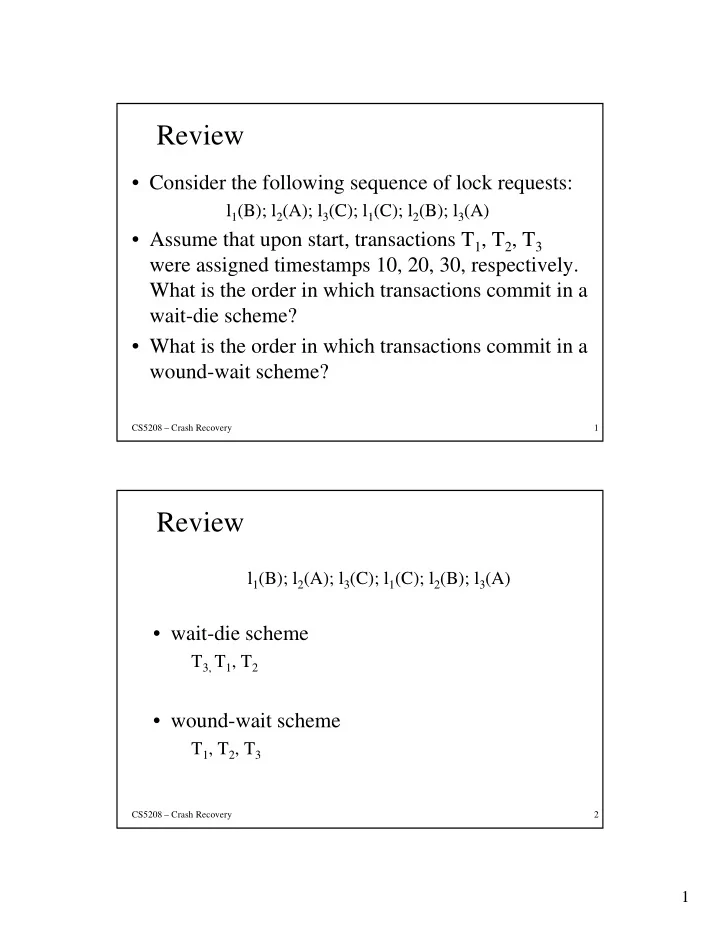
Review Consider the following sequence of lock requests: l 1 (B); l 2 (A); l 3 (C); l 1 (C); l 2 (B); l 3 (A) l 1 (B); l 2 (A); l 3 (C); l 1 (C); l 2 (B); l 3 (A) Assume that upon start, transactions T 1 , T 2 , T 3 were assigned


slide-1
SLIDE 1

1

Review

  • Consider the following sequence of lock requests:

l1(B); l2(A); l3(C); l1(C); l2(B); l3(A) l1(B); l2(A); l3(C); l1(C); l2(B); l3(A)

  • Assume that upon start, transactions T1, T2, T3

were assigned timestamps 10, 20, 30, respectively. What is the order in which transactions commit in a wait-die scheme?

  • What is the order in which transactions commit in a

wound-wait scheme?

CS5208 – Crash Recovery 1

Review

l1(B); l2(A); l3(C); l1(C); l2(B); l3(A)

  • wait-die scheme

T3, T1, T2

d it h

  • wound-wait scheme

T1, T2, T3

CS5208 – Crash Recovery 2

slide-2
SLIDE 2

2

Review

  • Four transactions T1, T2, T3, T4 used 2PL for concurrency control. Since

2PL ensures conflict-serializability, the schedule (say S) of actions of the four transactions has to be conflict equivalent to some serial schedule. We do not have access to the entire schedule S but only a part of it, which looks as follows: S = :::; u4(A); l1(B); :::; u1(B); l3(A); l2(B); :::; u3(A); l2(A); :::

  • Which of the following schedules are possible serial schedules that are

g p conflict-equivalent to S. (a) T1, T3, T2, T4 (b) T1, T4, T3, T2 (c) T4, T1, T3, T2

CS5208 – Crash Recovery 3

(Correct)

Log-Based Recovery Schemes

If you are going to be in the logging business, one of the things that you

CS5208 – Crash Recovery 4

, g y have to do is to learn about heavy equipment. Robert VanNatta, Logging History of Columbia County

slide-3
SLIDE 3

3

Integrity or consistency constraints

  • Predicates data must satisfy, e.g.
  • x is key of relation R
  • x is key of relation R
  • x  y holds in R
  • Domain(x) = {Red, Blue, Green}
  • no employee should make more than twice the average

salary

  • Definitions

CS5208 – Crash Recovery 5

  • Consistent state: satisfies all constraints
  • Consistent DB: DB in consistent state

DB cannot always be consistent!

Observation:

CS5208 – Crash Recovery 6

slide-4
SLIDE 4

4

DB cannot always be consistent!

Observation:

Example: Transfer 100 from a2 to a10 . . . . Example: Transfer 100 from a2 to a10 a2  a2 - 100 a10  a10 + 100

CS5208 – Crash Recovery 7

500 . . 1000 400 . . 1000

a2 a10

DB cannot always be consistent!

Observation:

Example: Transfer 100 from a2 to a10 . . . . . . Example: Transfer 100 from a2 to a10 a2  a2 - 100 a10  a10 + 100

CS5208 – Crash Recovery 8

500 . . 1000 400 . . 1000 400 . . 1100

a2 a10

slide-5
SLIDE 5

5

Transaction: collection of actions that preserve consistency preserve consistency

Consistent DB Consistent DB’ T

If T starts with consistent state + T executes in

CS5208 – Crash Recovery 9

If T starts with consistent state T executes in isolation (and absence of errors)  T leaves consistent state

Reasons for crashes

  • Transaction failures
  • Logical errors deadlocks

Logical errors, deadlocks

  • System crash
  • Power failures, operating system bugs etc
  • Disk failure
  • Head crashes

CS5208 – Crash Recovery 10

  • Head crashes
  • STABLE STORAGE: Data never lost. Can

approximate by using RAID and maintaining geographically distant copies of the data

slide-6
SLIDE 6

6

  • Atomicity – All actions in a transaction are carried out, or

none are, i.e., no incomplete transactions

  • Consistency – Each transaction preserves DB consistency

Review: The ACID properties

Consistency Each transaction preserves DB consistency

  • User’s responsibility, e.g., Funds transfer between bank accounts
  • Isolation – A transaction isolated or protected from the

effects of other transactions

  • Durability – When a transaction commits, its effects persist

CS5208 – Crash Recovery 11

  • Atomicity – All actions in a transaction are carried out, or

none are, i.e., no incomplete transactions

  • Consistency – Each transaction preserves DB consistency

Review: The ACID properties

Consistency Each transaction preserves DB consistency

  • User’s responsibility, e.g., Funds transfer between bank accounts
  • Isolation – A transaction isolated or protected from the

effects of other transactions

  • Durability – When a transaction commits, its effects persist

CS5208 – Crash Recovery 12

  • Question: which ones do the Recovery Manager

help with?

Atomicity & Durability

slide-7
SLIDE 7

7

Actions of Transaction:

  • Read
  • Read
  • Write
  • Commit
  • Abort

CS5208 – Crash Recovery 13

Key problem: Unfinished transaction

Example Transfer fund from A to B Example Transfer fund from A to B T1: A  A - 100 B  B + 100

CS5208 – Crash Recovery 14

slide-8
SLIDE 8

8

T1: Read (A); A  A-100 Write (A); R d (B) Read (B); B  B+100 Write (B);

A 800

CS5208 – Crash Recovery 15

A: 800 B: 800 A: 800 B: 800

memory disk

T1: Read (A); A  A-100 Write (A); R d (B) Read (B); B  B+100 Write (B);

A 800 700

CS5208 – Crash Recovery 16

A: 800 B: 800 A: 800 B: 800

memory disk

700

slide-9
SLIDE 9

9

T1: Read (A); A  A-100 Write (A); R d (B) Read (B); B  B+100 Write (B);

A 800 700

Updated A value is written to disk. This may be triggered “ANYTIME” by explicit command or DBMS or OS.

CS5208 – Crash Recovery 17

A: 800 B: 800 A: 800 B: 800

memory disk

700 700

T1: Read (A); A  A-100 Write (A); R d (B) Read (B); B  B+100 Write (B);

A 800 700

CS5208 – Crash Recovery 18

A: 800 B: 800 A: 800 B: 800

memory disk

700 900 700

slide-10
SLIDE 10

10

T1: Read (A); A  A-100 Write (A); R d (B) Read (B); B  B+100 Write (B);

A 800 700

failure!

CS5208 – Crash Recovery 19

A: 800 B: 800 A: 800 B: 800

memory disk

700 900 700

T1: Read (A); A  A-100 Write (A); R d (B)

Need atomicity: execute all actions of a transaction or none at all

Read (B); B  B+100 Write (B);

A 800 700

failure!

CS5208 – Crash Recovery 20

A: 800 B: 800 A: 800 B: 800

memory disk

700 900 700

slide-11
SLIDE 11

11 T1: Read (A); A  A-100 Write (A);

One Solution: Undo logging (Immediate modification)

Write (A); Read (B); B  B+100 Write (B);

A 800 A 800

CS5208 – Crash Recovery 21

A:800 B:800 A:800 B:800

memory disk Log (Stable)

T1: Read (A); A  A-100 Write (A);

One Solution: Undo logging (Immediate modification)

Write (A); Read (B); B  B+100 Write (B);

A 800 A 800

< T1, start>

CS5208 – Crash Recovery 22

A:800 B:800 A:800 B:800

memory disk log

slide-12
SLIDE 12

12 T1: Read (A); A  A-100 Write (A);

One Solution: Undo logging (Immediate modification)

Write (A); Read (B); B  B+100 Write (B);

A 800 A 800 700

< T1, start>

CS5208 – Crash Recovery 23

A:800 B:800 A:800 B:800

memory disk log

700 900

T1: Read (A); A  A-100 Write (A);

One Solution: Undo logging (Immediate modification)

Write (A); Read (B); B  B+100 Write (B);

A 800 A 800 700

< T1, start> < T1, A, 800>

CS5208 – Crash Recovery 24

A:800 B:800 A:800 B:800

memory disk log

700 900

slide-13
SLIDE 13

13 T1: Read (A); A  A-100 Write (A);

One Solution: Undo logging (Immediate modification)

Write (A); Read (B); B  B+100 Write (B);

A 800 A 800 700

< T1, start> < T1, A, 800>

700

CS5208 – Crash Recovery 25

A:800 B:800 A:800 B:800

memory disk log

700 900 700

T1: Read (A); A  A-100 Write (A);

One Solution: Undo logging (Immediate modification)

Write (A); Read (B); B  B+100 Write (B);

A 800 A 800 700

< T1, start> < T1, A, 800>

700

T1 B 800

CS5208 – Crash Recovery 26

A:800 B:800 A:800 B:800

memory disk log

700 900 700

< T1, B, 800>

slide-14
SLIDE 14

14 T1: Read (A); A  A-100 Write (A);

One Solution: Undo logging (Immediate modification)

Write (A); Read (B); B  B+100 Write (B);

A 800 A 800 700

< T1, start> < T1, A, 800>

700

T1 B 800

CS5208 – Crash Recovery 27

A:800 B:800 A:800 B:800

memory disk log

700 900 700

< T1, B, 800>

900

T1: Read (A); A  A-100 Write (A);

One Solution: Undo logging (Immediate modification)

Write (A); Read (B); B  B+100 Write (B);

A 800 A 800 700

< T1, start> < T1, A, 800>

00

T1 B 800

CS5208 – Crash Recovery 28

A:800 B:800 A:800 B:800

memory disk log

700 900

< T1, commit>

700

< T1, B, 800>

900

slide-15
SLIDE 15

15

Complication

  • Log is first written in memory

memory DB Log

A: 800 700 B: 800 900 Log: T t t A: 800 B: 800

CS5208 – Crash Recovery 29

< T1,start> < T1, A, 800> < T1, B, 800>

Complication

  • Log is first written in memory

memory DB Log

A: 800 700 B: 800 900 Log: T t t A: 800 B: 800 700

BAD STATE # 1

Failure occurs after

CS5208 – Crash Recovery 30

< T1,start> < T1, A, 800> < T1, B, 800>

partial updates on disk but before log is written to disk

slide-16
SLIDE 16

16

Complication

  • Log is first written in memory

memory DB Log

A: 800 700 B: 800 900 Log: T t t A: 800 B: 800 700

BAD STATE # 1

Failure occurs after

CS5208 – Crash Recovery 31

< T1,start> < T1, A, 800> < T1, B, 800>

partial updates on disk but before log is written to disk This means log record for A must be on log disk before A can be updated on data disk (DB)

Complication

  • Log is first written in memory
  • Updates are not written to disk on every action

Updates are not written to disk on every action

memory DB Log

A: 800 700 B: 800 900 Log: T t t A: 800 B: 800

CS5208 – Crash Recovery 32

< T1,start> < T1, A, 800> < T1, B, 800>

< T1, B, 800> < T1, commit>

slide-17
SLIDE 17

17

Complication

  • Log is first written in memory
  • Updates are not written to disk on every action

Updates are not written to disk on every action

memory DB Log

A: 800 700 B: 800 900 Log: T t t A: 800 B: 800 700

BAD STATE # 2

All logs are on disk (including

CS5208 – Crash Recovery 33

< T1,start> < T1, A, 800> < T1, B, 800> < T1,commit>

< T1, B, 800> < T1, commit>

disk (including commit log) but

  • nly partial updates
  • n disk.

Complication

  • Log is first written in memory
  • Updates are not written to disk on every action

Updates are not written to disk on every action

memory DB Log

A: 800 700 B: 800 900 Log: T t t A: 800 B: 800 700

BAD STATE # 2

All logs are on disk (including

CS5208 – Crash Recovery 34

< T1,start> < T1, A, 800> < T1, B, 800>

< T1, B, 800> < T1, commit>

disk (including commit log) but

  • nly partial updates
  • n disk.

Before commit log is written to Log, all updates must be on disk (DB)

slide-18
SLIDE 18

18

Undo logging rules

(1) For every action generate undo log record (containing old value) (2) Before x is modified on disk, log records pertaining to x must be on disk (write ahead logging: WAL)

CS5208 – Crash Recovery 35

(3) Before commit is flushed to log, all writes of transaction must be reflected on disk

Undo Logging

T1: Read (A); A  A-100 Write (A); Read (B); B  B+100 Write (B);

A: 800 700 B: 800 900 Log: A: 800

Write (B);

CS5208 – Crash Recovery 36

Log: < T1,start> < T1, A, 800> < T1, B, 800> B: 800 log

slide-19
SLIDE 19

19

Undo Logging

T1: Read (A); A  A-100 Write (A); Read (B); B  B+100 Write (B);

A: 800 700 B: 800 900 Log: A: 800

Write (B); <T1, Start> <T1, A, 800>

CS5208 – Crash Recovery 37

Log: < T1,start> < T1, A, 800> < T1, B, 800> B: 800 log

<T1, B, 800>

Undo Logging

T1: Read (A); A  A-100 Write (A); Read (B); B  B+100 Write (B);

A: 800 700 B: 800 900 Log: A: 800

Write (B);

700

<T1, Start> <T1, A, 800>

CS5208 – Crash Recovery 38

Log: < T1,start> < T1, A, 800> < T1, B, 800> B: 800 log

<T1, B, 800>

slide-20
SLIDE 20

20

Undo Logging

T1: Read (A); A  A-100 Write (A); Read (B); B  B+100 Write (B);

A: 800 700 B: 800 900 Log: A: 800

Write (B); <T1, Start> <T1, A, 800>

700

CS5208 – Crash Recovery 39

Log: < T1,start> < T1, A, 800> < T1, B, 800> B: 800 log

<T1, B, 800>

900

Undo Logging

T1: Read (A); A  A-100 Write (A); Read (B); B  B+100 Write (B);

A: 800 700 B: 800 900 Log: T t t A: 800

Write (B); <T1, Start> <T1, A, 800>

700

CS5208 – Crash Recovery 40

< T1,start> < T1, A, 800> < T1, B, 800> < T1, commit> B: 800 log

<T1, B, 800> <T1, Commit>

900

slide-21
SLIDE 21

21

Recovery rules: Undo logging

(1) Let S = set of transactions with <Ti, start> in log, b i i ( i b ) d i l but no <Ti, commit> (or <Ti, abort>) record in log (2) For each <Ti, X, v> in log, in reverse order (latest  earliest) do:

  • if Ti  S then - X  v

CS5208 – Crash Recovery 41

  • Update disk

(3) For each Ti  S do

  • write <Ti, abort> to log

What if failure during recovery? What if failure during recovery? No problem! Undo is idempotent

CS5208 – Crash Recovery 42

slide-22
SLIDE 22

22

Redo logging (deferred modification)

  • In UNDO logging, we remember the “old”

values values.

  • How about remembering the “new” (updated)

values instead?

  • What does this mean?

CS5208 – Crash Recovery 43

Redo logging (deferred modification)

  • In UNDO logging, we remember the “old”

value value.

  • How about remembering the “new” (updated)

values instead?

  • What does this mean?
  • NO updates must be written to disk until a

CS5208 – Crash Recovery 44

NO updates must be written to disk until a transaction commits! So?

slide-23
SLIDE 23

23

Redo logging (deferred modification)

  • In UNDO logging, we remember the “old”

value value.

  • How about remembering the “new” (updated)

values instead?

  • What does this mean?
  • NO updates must be written to disk until a

CS5208 – Crash Recovery 45

NO updates must be written to disk until a transaction commits!

  • All updates have to be buffered in memory!

Redo logging (deferred modification)

T1: Read(A); A  A-100; write (A); Read(B); B  B+100; write (B);

A: 800 B: 800 A: 800

CS5208 – Crash Recovery 46

B: 800 B: 800

memory DB LOG

slide-24
SLIDE 24

24

Redo logging (deferred modification)

T1: Read(A); A  A-100; write (A); Read(B); B  B+100; write (B);

A: 800 B: 800 A: 800 700 900

CS5208 – Crash Recovery 47

B: 800 B: 800

memory DB LOG

900

Redo logging (deferred modification)

T1: Read(A); A  A-100; write (A); Read(B); B  B+100; write (B);

A: 800 B: 800 A: 800 700 900

< T1, start> < T1, A, 700> < T1, B, 900>

CS5208 – Crash Recovery 48

B: 800 B: 800

memory DB LOG

900

< T1, commit>

slide-25
SLIDE 25

25

Redo logging (deferred modification)

T1: Read(A); A  A-100; write (A); Read(B); B  B+100; write (B);

A: 800 B: 800 A: 800 700 900

< T1, start> < T1, A, 700> < T1, B, 900>

  • utput

700

CS5208 – Crash Recovery 49

B: 800 B: 800

memory DB LOG

900

< T1, commit>

Redo logging rules

(1) For every action, generate redo log record ( ) y , g g (containing new value) (2) Before X is modified on disk (DB), all log records for transaction that modified X (including commit) must be on disk

CS5208 – Crash Recovery 50

slide-26
SLIDE 26

26

(1) Let S = set of transactions with <Ti it> i l

Recovery rules: Redo logging

<Ti, commit> in log (2) For each <Ti, X, v> in log, in forward

  • rder (earliest  latest) do:
  • if Ti  S then X  v

CS5208 – Crash Recovery 51

Update X on disk

Recovery is very, very SLOW !

Redo log:

First T1 wrote A,B Last Record Committed a year ago Record

... ... ... Crash

CS5208 – Crash Recovery 52

y g (1 year ago)

  • -> STILL, Need to redo after crash!!

Crash

What about UNDO scheme?

slide-27
SLIDE 27

27

Solution: Checkpoint (simple version)

Periodically: (1) D t t t ti (1) Do not accept new transactions (2) Wait until all transactions finish (3) Flush all log records to disk (log) (4) Flush all buffers to disk (DB) (5) W it “ h k i t” d di k (l )

CS5208 – Crash Recovery 53

(5) Write “checkpoint” record on disk (log) (6) Resume transaction processing

Example: what to do at recovery?

Redo log (disk):

< T1,A,16> < T1,commit> Checkpoint < T2,B,17> < T2,commit> < T3,C,21>

Crash ... ... ... ... ... ...

CS5208 – Crash Recovery 54

No need to examine log records before the most recent Checkpoint

slide-28
SLIDE 28

28

Key drawbacks:

  • Undo logging: increase the number of disk I/Os
  • Redo logging: need to keep all modified

blocks in memory until commit

CS5208 – Crash Recovery 55

Solution: undo/redo logging!

Update  <Ti, Xid, New X val, Old X val> page X page X Rules:

1) Page X can be flushed before or after Ti commit 2) Log record flushed before corresponding updated page (WAL) 3) Flush at commit (log only)

CS5208 – Crash Recovery 56

This is adopted in IBM DB2 – known as the Aries Recovery Manager

slide-29
SLIDE 29

29

Non-quiesce checkpoint (for Undo/Redo logging)

L

Start-ckpt

end

O G for undo dirty buffer

Start ckpt active TR: Ti,T2,...

end ckpt ... ... ... ...

CS5208 – Crash Recovery 57

pool pages flushed

Examples: what to do at recovery time?

no T1 commit

L O G

T1,- a ... Ckpt T1 ... Ckpt end ... T1- b ...

CS5208 – Crash Recovery 58

 Undo T1 (undo a,b)

slide-30
SLIDE 30

30

Example

L O G

... T1 a ... ... T1 b ... ... T1 c ... T1 cmt ... ckpt- end

ckpt-s

T1

 Redo T1: (redo b c)

CS5208 – Crash Recovery 59

 Redo T1: (redo b,c)

Recovery process:

  • Backwards pass (end of log  latest checkpoint start)
  • construct set S of committed transactions
  • undo actions of transactions not in S
  • Undo transactions that are in checkpoint active list
  • Forward pass (latest checkpoint start  end of log)
  • redo actions of S transactions

CS5208 – Crash Recovery 60

backward pass forward pass

start check- point

slide-31
SLIDE 31

31

Undo/Redo Log (Example)

<START S> <S, A, 60, 61> <COMMIT S> <START T> <START T> <T, A, 61, 62> <START U> <U, B, 20, 21> <T, C, 30, 31> <START V> <U, D, 40, 41> <V, F, 70, 71> <COMMIT U>

Suppose we begin a nonquiescent checkpoint immediately after <T, A, 61, 62>, where could the <END CKPT> record be potentially written in the log?

CS5208 – Crash Recovery 61

<COMMIT U> <T, E, 50, 51> <COMMIT T> <V, B, 21, 22> <COMMIT V>

Undo/Redo Log (Example)

<START S> <S, A, 60, 61> <COMMIT S> <START T> <START T> <T, A, 61, 62> <START U> <U, B, 20, 21> <T, C, 30, 31> <START V> <U, D, 40, 41> <V, F, 70, 71> <COMMIT U>

Suppose we begin a nonquiescent checkpoint immediately after <T, A, 61, 62>, where could the <END CKPT> record be potentially written in the log? ANYWHERE after <T, A, 61, 62> since the writing

  • f dirty blocks can be performed independent of

h t ti th t ti f i i

CS5208 – Crash Recovery 62

<COMMIT U> <T, E, 50, 51> <COMMIT T> <V, B, 21, 22> <COMMIT V>

whatever actions the transactions are performing in the interim

slide-32
SLIDE 32

32

Undo/Redo Log (Example)

<START S> <S, A, 60, 61> <COMMIT S> <START T>

Suppose we begin a nonquiescent checkpoint immediately after <T, A, 61, 62>. Suppose further th i h t ibl i t ft

<START T> <T, A, 61, 62> <START U> <U, B, 20, 21> <T, C, 30, 31> <START V> <U, D, 40, 41> <V, F, 70, 71> <COMMIT U>

there is a crash at any possible point after <T, A, 61, 62>, how far back in the log we must look to find all possible incomplete transactions if

  • <END CKPT> was written prior to the crash
  • <END CKPT> was not written

CS5208 – Crash Recovery 63

<COMMIT U> <T, E, 50, 51> <COMMIT T> <V, B, 21, 22> <COMMIT V>

Undo/Redo Log (Example)

<START S> <S, A, 60, 61> <COMMIT S> <START T>

The only active transaction when the checkpoint began was T.

<START T> <T, A, 61, 62> <START U> <U, B, 20, 21> <T, C, 30, 31> <START V> <U, D, 40, 41> <V, F, 70, 71> <COMMIT U>

was T.

  • <END CKPT> was written prior to the crash
  • We need only go back as far as the start of T.

Start CKPT End CKPT

CS5208 – Crash Recovery 64

<COMMIT U> <T, E, 50, 51> <COMMIT T> <V, B, 21, 22> <COMMIT V>

Crash

slide-33
SLIDE 33

33

Undo/Redo Log (Example)

<START S> <S, A, 60, 61> <COMMIT S> <START T>

The only active transaction when the checkpoint began was T.

<START T> <T, A, 61, 62> <START U> <U, B, 20, 21> <T, C, 30, 31> <START V> <U, D, 40, 41> <V, F, 70, 71> <COMMIT U>

was T.

  • <END CKPT> was written prior to the crash
  • We need only go back as far as the start of T.
  • <END CKPT> was not written
  • Any transaction that was active when the

previous checkpoint ended may have written some but not all of its data to disk. S t th i h k i t

CS5208 – Crash Recovery 65

<COMMIT U> <T, E, 50, 51> <COMMIT T> <V, B, 21, 22> <COMMIT V>

  • So, go to the previous checkpoint
  • In this case, the only other transaction that could

qualify is S, so we must look back to the beginning

  • f S, i.e., to the beginning of the log in this simple

example.

Summary

  • Consistency of data
  • One source of
  • One source of

problems: failures

  • Logging
  • Redundancy
  • Another source of

problems: data sharing

CS5208 – Crash Recovery 66

sharing

  • Concurrency Control