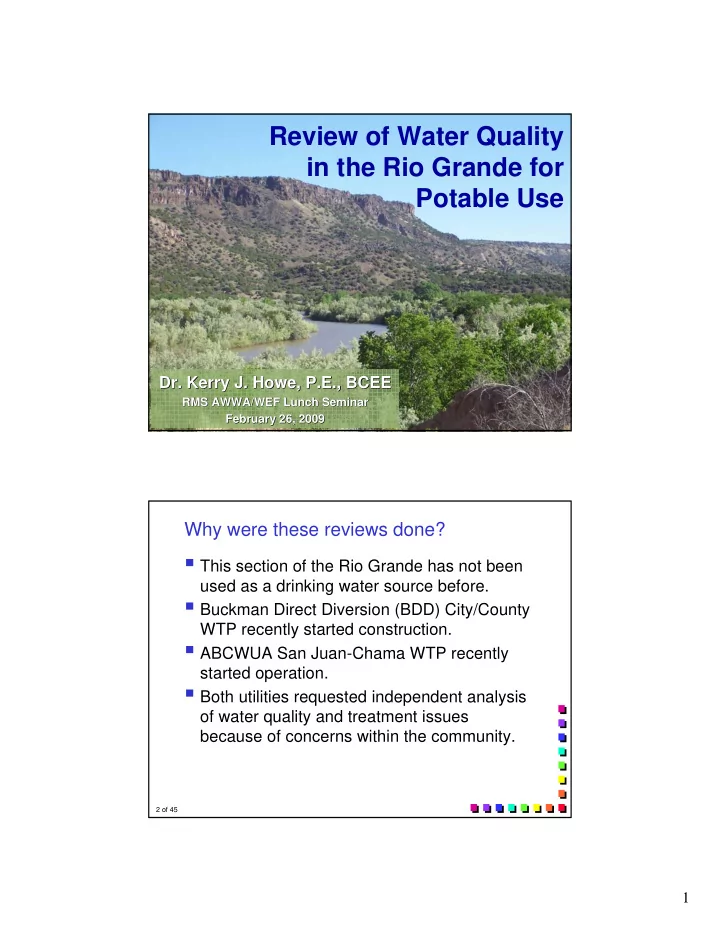
Review of Water Quality in the Rio Grande for Potable Use Dr. - - PDF document

review of water quality in the rio grande for potable use
SMART_READER_LITE
LIVE PREVIEW

Review of Water Quality in the Rio Grande for Potable Use Dr. - - PDF document

Review of Water Quality in the Rio Grande for Potable Use Dr. Kerry J. Howe, P.E., BCEE Dr. Kerry J. Howe, P.E., BCEE RMS AWWA/WEF Lunch Seminar RMS AWWA/WEF Lunch Seminar February 26, 2009 February 26, 2009 Why were these reviews done?


slide-1
SLIDE 1

1

Review of Water Quality in the Rio Grande for Potable Use

  • Dr. Kerry J. Howe, P.E., BCEE
  • Dr. Kerry J. Howe, P.E., BCEE

RMS AWWA/WEF Lunch Seminar RMS AWWA/WEF Lunch Seminar February 26, 2009 February 26, 2009

2 of 45

Why were these reviews done?

This section of the Rio Grande has not been

used as a drinking water source before.

Buckman Direct Diversion (BDD) City/County

WTP recently started construction.

ABCWUA San Juan-Chama WTP recently

started operation.

Both utilities requested independent analysis

  • f water quality and treatment issues

because of concerns within the community.

slide-2
SLIDE 2

2

3 of 45

Presentation outline

Watershed and impacts on water quality Treatment train (pilot and full-scale) Regulated contaminants

Microorganisms / IOCs / SOCs

Unregulated contaminants

Perchlorate Pharmaceuticals / personal care products (PPCPs)

Radionuclides Disinfection by-products Summary / More info

4 of 45

Rio Grande watershed

Factors affecting water quality:

Climate/terrain Upstream discharges:

Heavy industry Agriculture Population

Cochiti Lake Los Alamos N. L.

Cochiti Lake LANL

slide-3
SLIDE 3

3

5 of 45

Streamflow in the Rio Grande

Source: Langman and Anderholm, USGS, SIR 2004-5188

6 of 45

Impact of wastewater discharges

500 4.0 2.5 8.5 1.3 1.2 100 200 300 400 500 600 Rio Grande summer low flow Alamosa Española Rio Rancho WWTP #2 Rio Rancho WWTP #3 Town of Bernalillo WWTP Flow (cfs)

slide-4
SLIDE 4

4

7 of 45

Impact of Los Alamos canyon (water)

Ref: Graf (1994)

Annual water contribution of Los Alamos canyon to the Rio Grande: 0.008 %

8 of 45

Impact of Los Alamos canyon (sediment)

Ref: Graf (1994)

Annual sediment contribution of Los Alamos canyon to the Rio Grande: 0.1 %

slide-5
SLIDE 5

5

9 of 45

Finished water

Water treatment design process

Raw water quality

  • Historical data
  • Sampling

Finished water quality

  • Regulatory criteria
  • Unregulated parameters

Treatment Plant Rio Grande

Process selection and design

  • Design guides, textbooks
  • Engineering experience
  • Regulatory guidance
  • Treatment techniques
  • Best available technology
  • Recent research
  • Laboratory (bench) testing
  • Pilot testing

10 of 45

Data sources on river water quality

NMED USGS LANL BDD pilot plant ABCWUA pilot plant

slide-6
SLIDE 6

6

11 of 45

Pilot testing

BDD ABCWUA

12 of 45

Sediment in the river (BDD)

Turbidity Variations During Pilot Testing

500 1000 1500 2000

7/7/2005 7/1 7/2005 7/27/2005 8/6/2005 8/1 6/2005 8/26/2005

Date Turbidity, NTU

slide-7
SLIDE 7

7

13 of 45

BDD City/County WTP process train

Continued Below Rio Grande

14 of 45

San Juan Chama WTP process train

slide-8
SLIDE 8

8

15 of 45

Regulated: Microorganisms

3 4 — — 4 Cryptosporidium 3 5.7 2.5 0.7 2.5 Giardia 4 > 8 > 4 2.3 2 Viruses Removal required Total removal achieved Achieved with chlorine Achieved with

  • zone

Achieved with filters Organism

Both plants have multiple barriers: filtration,

  • zonation, chlorine

San Juan Chama WTP Log removal credit:

16 of 45

Regulated: Inorganics (ABCWUA pilot)

Yes Yes Yes Yes Yes Yes Yes OK? 10 0.11 0.064 2 NO3 0.1 0.02 0.01 3 Ni 4 0.47 0.4 32 F 0.1 0.015 0.004 29 Cr 0.004 0.001 0.001 1 Be 2 0.3 0.1 15 Ba 0.010 0.005 0.003 29 As MCL (mg/L) Max. (mg/L) Median (mg/L) Detects

29-32 samples, raw water (MCL is for treated water) Non-detectable: Sb, Cd, Cu, CN, Hg, NO2, Se, Tl

slide-9
SLIDE 9

9

17 of 45

Regulated: Organics (ABCWUA pilot)

Pretty much the same story. Sampling during ABCWUA pilot plant:

Raw and treated water ~ 100 organic contaminants ~ 30 sampling episodes

Thousands of samples; almost no detections

  • f anything.

18 of 45

Unregulated: Perchlorate

Why an issue?

Explosive manufacturing/detonation is one source

for perchlorate

Can interfere with thyroid function

Conclusions

Perchlorate not regulated, current health advisory

level = 15 µg/L

Measured values in river:

Mostly below detection limit Average measured conc. = 0.064 µg/L Maximum measured conc. = 0.071 µg/L

slide-10
SLIDE 10

10

19 of 45

Unregulated: Pharmaceuticals (PPCPs)

NMED (28 PPCPs, 23 surface water samples)

Only detect: 30 ng/L amitriptylene at Buckman

Crossing

USGS (Cochiti to Albuquerque)

Hundreds of samples (52 – 196 organics, 3

locations, multiple times)

Only detect: 0.2 ng/L tris(2-butoxyethyl)phosphate

Brown (39 PPCPs, 1 sample near intake)

No detects

Martinet (19 PPCPs)

7 detects in shallow groundwater adjacent to Rio

Grande (above SWRP but below intake)

20 of 45

Perspective on PPCPs

amitriptylene consumed at 30 ng/L in 2 L/day

for 70 years provides lifetime exposure of 1.5 mg.

amitriptylene taken for depression: typical

daily dose is 40 – 150 mg.

If no removal at treatment plants, lifetime exposure

would be 100 times less than single day’s dose when taken for medical purposes.

slide-11
SLIDE 11

11

21 of 45

Treatment for PPCPs

Ozone has been found to be one of the most

effective treatment processes for PPCPs.

Both plants use ozone.

Summary

Risk of PPCP presence in Rio Grande is

extremely low.

Plants have the best technology for removing

PPCPs.

22 of 45

Radionuclides – Why an issue?

Plant intakes are downstream of Los Alamos

National Lab

Canyons are contaminated

Radionuclides may have health impacts after

long-term exposure

slide-12
SLIDE 12

12

23 of 45

Radionuclide regulations

MCL Parameter 4 mrem/yr

Gross beta and photon emitters

Includes 126 different isotopes 15 pCi/L

Gross alpha activity

Excludes uranium and radon Includes plutonium, americium, others 5 pCi/L

Radium 226/228

30 µg/L

Uranium

24 of 45

Gross alpha, Rio Grande above Cochiti

20 40 60 80 1950 1960 1970 1980 1990 2000 2010 Date Gross alpha activity (pCi/L) LANL USGS MCL (15 pCi/L) (One sample off-scale at 235 pCi/L)

`

slide-13
SLIDE 13

13

25 of 45

Plutonium, Rio Grande above Cochiti

  • 5

5 10 15 20 1960 1970 1980 1990 2000 2010 Date Plutonium activity (pCi/L) SDWA Limit for Gross Alpha Activity

26 of 45

Americium, Rio Grande above Cochiti

  • 5

5 10 15 20 1970 1980 1990 2000 2010 Date Americium-241 activity (pCi/L) SDWA Limit for Gross Alpha Activity

slide-14
SLIDE 14

14

27 of 45

Cesium-137, Rio Grande above Cochiti

100 200 300 400 500 1970 1975 1980 1985 1990 1995 2000 2005 2010 Date Cs-137 activity (pCi/L) (Data from LANL) SDWA Screening Level

28 of 45

Strontium-90, Rio Grande above Cochiti

5 10 15 20 1970 1975 1980 1985 1990 1995 2000 2005 2010 Date Sr-90 activity (pCi/L)

SDWA Screening Level (8 pCi/L) Higher than gross beta activity in same sample Rain event

slide-15
SLIDE 15

15

29 of 45

Tritium, Rio Grande above Cochiti

2,000 4,000 6,000 8,000 1970 1975 1980 1985 1990 1995 2000 2005 2010 Date Tritium activity (pCi/L) SDWA Screening Level is 20,000 pCi/L

30 of 45

Radionuclides below Cochiti

USGS (Falk and Anderholm) did a summary

  • f all radionuclide activity between Cochiti

and Albuquerque for water years 1985-2005 from all agencies.

All raw water samples were below

corresponding treated water regulatory limits.

In general, radioactivity below Cochiti is less

than above Cochiti.

slide-16
SLIDE 16

16

31 of 45

Gross alpha activity removal in ABCWUA pilot

  • 5

5 10 15 20 25 30 35 1/1/07 3/2/07 5/1/07 6/30/07 8/29/07 10/28/07 12/27/07 2/25/08 Date Adjusted Gross Alpha Activity (pCi/L) Raw river water Finished water

MCL for adjusted gross alpha activity in finished water

32 of 45

Gross beta activity removal in ABCWUA pilot

10 20 30 40 50 60 1/1/07 3/2/07 5/1/07 6/30/07 8/29/07 10/28/07 12/27/07 2/25/08 Date Total Gross Beta Activity (pCi/L) Raw river water Finished water Screening level for vulnerable systems

slide-17
SLIDE 17

17

33 of 45

Radionuclide summary for ABCWUA

Historical data from USGS, NMED, and LANL:

Radioactivity in river water downstream of Cochiti

Lake always below regulated limits for treated drinking water

Intensive additional testing during pilot plant:

River water (before treatment) almost always below

regulated limits for treated drinking water

Pilot plant results:

Treatment process is very effective at removing

radionuclides

34 of 45

Radionuclide summary for BDD

Concentrations in the river are almost always

below regulated levels.

Exceptions can be traced to storm events with

high turbidity in the river.

Specific radionuclides like plutonium and

americium are very low compared to regulations.

Inflow to treatment facility can be stopped

during storm events.

Treatment process is capable of removing the

contaminants if they were in the water.

slide-18
SLIDE 18

18

35 of 45

Radiation exposure comparison

=

1 banana 400 8-oz glasses of treated Rio Grande water

(Gross beta activity comparison based on potassium-40 in bananas)

36 of 45

Radiation is everywhere

240 460 17 10 1000 4 3 0.5 200 400 600 800 1000 1200

Natural background radiation (world average annual dose) Typical annual radiation dose in Albuquerque, NM (not from LANL) Potassium-40 in body (annual dose) One X-ray One CT scan Beta emitters in drinking water (annual dose if continuously at MCL) One 4-hr airline flight Nuclear testing fallout (annual dose)

Equivalent dose (mrem)

slide-19
SLIDE 19

19

37 of 45

Disinfection by-products: Why an issue?

Reactions between disinfectants and

pathogens is key to delivering safe water

Reactions between disinfectants and natural

  • rganic matter (NOM) create contaminants

May have health impacts after long-term exposure

Rio Grande has higher NOM than groundwater

38 of 45

TOC in the Rio Grande (1975 – 2007)

2 4 6 8 10 12 1975 1985 1995 2005 2015 Date TOC Concentration (mg/L) Below Cochiti Dam San Felipe Alameda Bridge Albuquerque (4 samples were above 12 mg/L)

Source: USGS

slide-20
SLIDE 20

20

39 of 45

TOC in the Rio Grande (2007)

2 4 6 8 10 1/1/07 2/26/07 4/23/07 6/18/07 8/13/07 10/8/07 12/3/07 1/28/08 3/24/08 Date TOC Concentration (mg/L)

Source: ABCWUA pilot plant

40 of 45

THM Formation Potential (7-day)

395 109 78 20 50 100 150 200 250 300 350 400 450

Pre-Sed Effluent (3.4 mg/L) Clarifier Effluent (2.0 mg/L) Ozone Effluent (1.7 mg/L) Filter Effluent (0.43 mg/L)

Total THM Concentration (µg/L) TOC MCL (80 µg/L)

slide-21
SLIDE 21

21

41 of 45

Simulated Distribution System Tests

10 20 30 40 50 60 70 80 90 100 5 10 15 Reaction Time (days) Total THM Concentration (µg/L) Ozonated water (TOC = 1.7 mg/L) Filtered water (TOC = 0.43 mg/L) MCL (80 µg/L)

42 of 45

Disinfection by-products: Conclusions

Robust design:

Enhanced coagulation and ozone/biofiltration to

remove natural organic matter

Primary disinfectant: ozone

Pilot plant and additional testing results:

Plant effective at removing natural organic matter DBP formation meets regulations

Additional factors of safety:

Low DBP formation in the winter, compliance

based on annual averages

Blending with groundwater

slide-22
SLIDE 22

22

43 of 45

Production and capacity of San Juan Chama WTP

20 40 60 80 100 120 140 160 1/1/07 2/26/07 4/23/07 6/18/07 8/13/07 10/8/07 12/3/07 Date Water consumption (mgd) 92 mgd plant capacity Actual ABCWUA water consumption (2007)

44 of 45

Summary

Not much impact on Rio Grande from man-

made contaminants.

Treatment challenges are mostly related to

sediment removal.

Treatment trains are very robust for removing

a wide range of regulated and unregulated constituents.

slide-23
SLIDE 23

23

45 of 45

For more information:

http://www.abcwua.org/content/view/371/1/ http://www.bddproject.org/independent_review.htm