
SLIDE 1
Roger Miranda, Ph.D., P .G. Texas Commission on Environmental Quality RIO GRANDE REGIONAL WATER PLANNING GROUP (RGRWPG) (REGION M) July 1, 2020
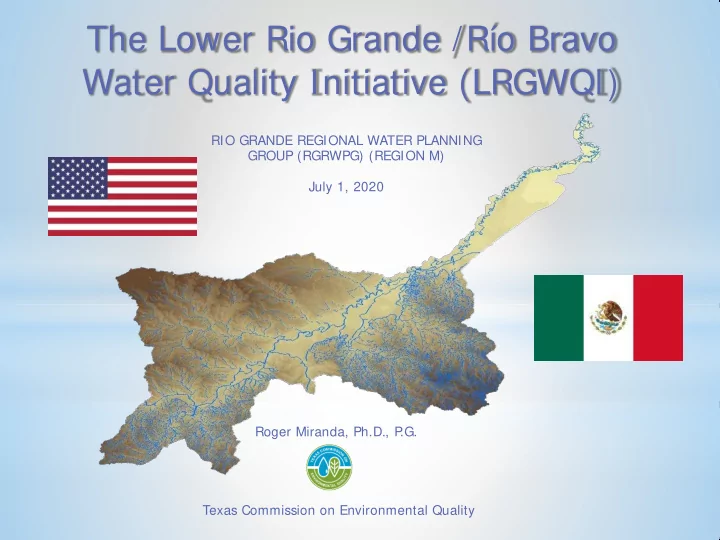
The Lower Rio Grande /Ro Bravo Water Quality Initiative (LRGWQI) - - PowerPoint PPT Presentation
The Lower Rio Grande /Ro Bravo Water Quality Initiative (LRGWQI) RIO GRANDE REGIONAL WATER PLANNING GROUP (RGRWPG) (REGION M) July 1, 2020 Roger Miranda, Ph.D., P .G. Texas Commission on Environmental Quality Water Quality Issues in the
Roger Miranda, Ph.D., P .G. Texas Commission on Environmental Quality RIO GRANDE REGIONAL WATER PLANNING GROUP (RGRWPG) (REGION M) July 1, 2020
Segment Number Segment Description I mpairment Year Listed Concerns*
2302 Rio Grande Below Falcon Reservoir Bacteria 1996 Ammonia Nutrients Dissolved Oxygen 2301 Rio Grande Tidal NA NA Dissolved Oxygen Bacteria Nutrients
Water Quality Issues in the Lower Rio Grande/Rio Bravo
Summary of Water Quality Assessment Results : Lower Rio Grande From TCEQ’s 2020 Integrated Report
*S alinity is also a big local concern
230 1 2301 2302
in t he Lower Rio Grande/ Río Bravo
Boundary and Wat er Commission (CILA/ IBWC)
ix agencies involved: US Mexico IBWC, US EP A, TCEQ CILA, CONAGUA, S EDUMA/ CEAT
* Exchange of Letters
S igned S eptember, 2013
* Developed Common
Terms of Reference (TOR) for the Proj ect
* The TOR established the
study area, goals and
proj ect and the structure of the binational working groups
* Established a Core
Group of agency representatives and a Binational Technical Work Group to advise the Core Group
LRGWQI Obj ectives
improve water quality under steady-state conditions, including salinity management
uggest implementation strategies
Goal = “ Binational Watershed Based Plan”
LRGWQI Obj ectives
improve water quality under steady-state conditions, including salinity management
uggest implementation strategies
Goal = “Binational Watershed Based Plan”
Technical Approach
Technical Approach
Work Completed S ince S eptember of 2013
ynoptic S urveys of Water Quality (2014-2016)
upport S
LRGWQI Decision S upport S ystem
interface
imulates the effects on water quality of various planning scenarios*
*Goal: suitable for planning needs - user needn’ t be a water quality modeler
Next S teps in the LRGWQI
Exchange
quality
Report, Exchange of Letters, or Treaty Minute)
takeholder Input, Binational financing and coordination
http://www.tceq.texas.gov/waterquality/tmdl
roger.miranda@tceq.texas.gov (512)239-6278