Review (1) We would like to sort the tuples of a relation R on a - - PDF document

review 1
SMART_READER_LITE
LIVE PREVIEW

Review (1) We would like to sort the tuples of a relation R on a - - PDF document

Review (1) We would like to sort the tuples of a relation R on a given key. The following is known about the relation: R contains 100,000 tuples. The size of a page on disk is 4000 bytes. The size of each R tuple is 400 b t bytes. R is


slide-1
SLIDE 1

1

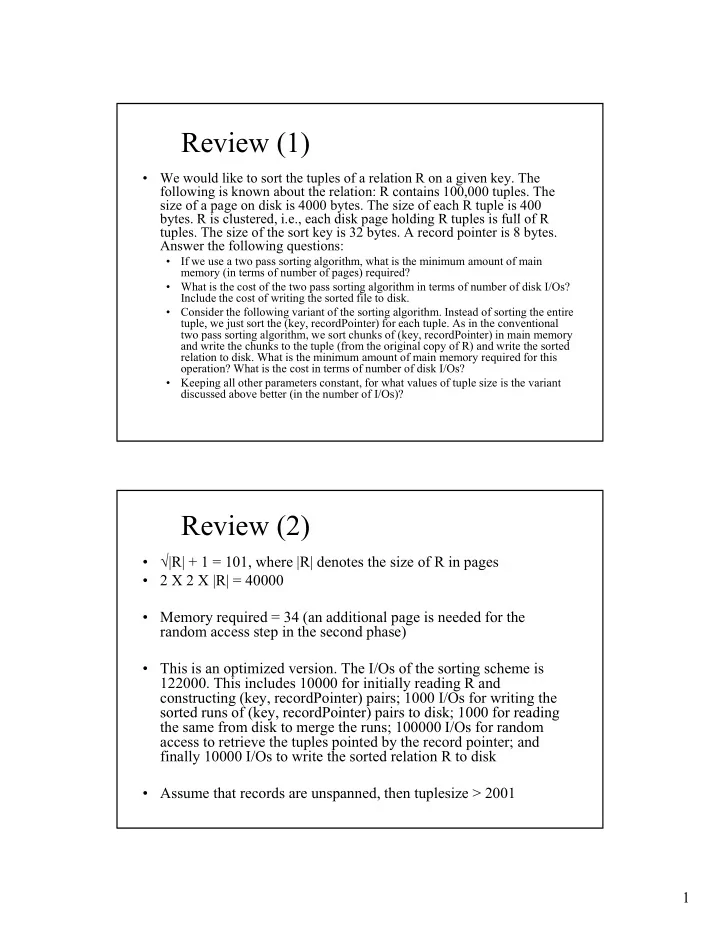
Review (1)

  • We would like to sort the tuples of a relation R on a given key. The

following is known about the relation: R contains 100,000 tuples. The size of a page on disk is 4000 bytes. The size of each R tuple is 400 b t R i l t d i h di k h ldi R t l i f ll f R

  • bytes. R is clustered, i.e., each disk page holding R tuples is full of R
  • tuples. The size of the sort key is 32 bytes. A record pointer is 8 bytes.

Answer the following questions:

  • If we use a two pass sorting algorithm, what is the minimum amount of main

memory (in terms of number of pages) required?

  • What is the cost of the two pass sorting algorithm in terms of number of disk I/Os?

Include the cost of writing the sorted file to disk.

  • Consider the following variant of the sorting algorithm. Instead of sorting the entire

tuple, we just sort the (key, recordPointer) for each tuple. As in the conventional p , j ( y, ) p two pass sorting algorithm, we sort chunks of (key, recordPointer) in main memory and write the chunks to the tuple (from the original copy of R) and write the sorted relation to disk. What is the minimum amount of main memory required for this

  • peration? What is the cost in terms of number of disk I/Os?
  • Keeping all other parameters constant, for what values of tuple size is the variant

discussed above better (in the number of I/Os)?

Review (2)

  • √|R| + 1 = 101, where |R| denotes the size of R in pages
  • 2 X 2 X |R| = 40000
  • Memory required = 34 (an additional page is needed for the

random access step in the second phase)

  • This is an optimized version. The I/Os of the sorting scheme is
  • 122000. This includes 10000 for initially reading R and

constructing (key, recordPointer) pairs; 1000 I/Os for writing the sorted runs of (key recordPointer) pairs to disk; 1000 for reading sorted runs of (key, recordPointer) pairs to disk; 1000 for reading the same from disk to merge the runs; 100000 I/Os for random access to retrieve the tuples pointed by the record pointer; and finally 10000 I/Os to write the sorted relation R to disk

  • Assume that records are unspanned, then tuplesize > 2001
slide-2
SLIDE 2

2

R l ti l O t Relational Operators

First comes thought; then

  • rganization of that thought, into

ideas and plans; then f i f h l i

CS5208 3

transformation of those plans into

  • reality. The beginning, as you will
  • bserve, is in your imagination.

Napolean Hill

Introduction

  • We’ve covered the basic underlying storage, buffering, and

i d i t h l indexing technology.

  • Now we can move on to query processing.
  • Some database operations are EXPENSIVE
  • Can greatly improve performance by being “smart”
  • e.g., can speed up 1,000,000x over naïve approach
  • Main weapons are:

CS5208 4

  • clever implementation techniques for operators
  • exploiting “equivalences” of relational operators
  • using statistics and cost models to choose among these.
slide-3
SLIDE 3

3

Steps of processing a high-level query

Parser Query Optimizer

Statistics Cost Model QEP Parsed Query

Database Query Evaluator

CS5208 5

High Level Query Query Result SELECT * FROM EMP WHERE SAL > 50k P1: Sequential Scan P2: Use SAL index

Relational Operations

  • We will consider how to implement:
  • Selection () Selects a subset of rows from relation.

( )

  • Projection (  ) Deletes unwanted columns from relation.
  • Join ( ) Allows us to combine two relations.
  • Set-difference ( - ) Tuples in reln. 1, but not in reln. 2.
  • Union ( U ) Tuples in reln. 1 and in reln. 2.
  • Aggregation (SUM MIN etc ) and GROUP BY

CS5208 6

  • Aggregation (SUM, MIN, etc.) and GROUP BY

Since each op returns a relation, ops can be composed! Queries that require multiple ops to be composed may be composed in different ways - thus optimization is necessary for good performance

slide-4
SLIDE 4

4

Example

SELECT S.sname FROM Reserves R, Sailors S WHERE R.sid=S.sid AND R.bid=100 AND S.rating>5

bid=100 rating > 5 sname sid=sid sname sid=sid sname rating > 5 CS5208

Sailors Reserves

sid=sid

Reserves Sailors

bid=100 rating > 5

Reserves

Sailors bid=100

Paradigm

  • Cross product
  • Index
  • Index
  • B+-tree, Hash
  • assume index entries to be (rid,pointer) pair
  • Clustered, Unclustered
  • Sort

CS5208 8

Sort

  • Hash
slide-5
SLIDE 5

5

Schema for Examples

Sailors (sid: integer, sname: string, rating: integer, age: real) R ( id i bid i d d i )

  • Reserves (R):
  • pR tuples per page, M pages. pR = 100. M = 1000.
  • Sailors (S):

p tuples per page N pages p = 80 N = 500 Reserves (sid: integer, bid: integer, day: dates, rname: string)

CS5208 9

  • pS tuples per page, N pages. pS = 80. N = 500.
  • Cost metric: # of I/Os (pages)
  • We will ignore output costs in the following discussion.

Equality Joins With One Join Column

SELECT *

sid=sid

  • In algebra: R S.
  • Most frequently used operation; very costly operation.

FROM

Reserves R, Sailors S

WHERE R.sid=S.sid

Sailors Reserves

CS5208 10

  • join_selectivity = join_size/(#R tuples x #S tuples)
slide-6
SLIDE 6

6

Equality Joins With One Join Column

SELECT sname

sname

  • In algebra: R S.
  • Most frequently used operation; very costly operation.

FROM

Reserves R, Sailors S

WHERE R.sid=S.sid

Sailors Reserves

sid=sid CS5208 11

  • join_selectivity = join_size/(#R tuples x #S tuples)

Join Example

sid sname rating age 22 d ti 7 45 0 sid bid day rname

Sailor Reserve

22 dustin 7 45.0 28 yuppy 9 35.0 31 lubber 8 55.5 44 guppy 5 35.0 58 rusty 10 35.0 31 101 10/11/96 lubber 58 103 11/12/96 dustin

CS5208 12

slide-7
SLIDE 7

7

Join Example

sid sname rating age 22 d ti 7 45 0 sid bid day rname

Sailor Reserve

22 dustin 7 45.0 28 yuppy 9 35.0 31 lubber 8 55.5 44 guppy 5 35.0 58 rusty 10 35.0 31 101 10/11/96 lubber 58 103 11/12/96 dustin

Query (join) output

CS5208 13

sid sname rating age bid day rname 31 lubber 8 55.5 101 10/11/96 lubber 58 rusty 10 35.0 103 11/12/96 dustin

Query (join) output

Simple Nested Loops Join

foreach tuple r in R do foreach tuple s in S do

  • For each tuple in the outer relation R, we scan the

entire inner relation S.

  • I/O Cost?

foreach tuple s in S do if r.sid == s.sid then add <r, s> to result

CS5208 14

I/O Cost?

  • Memory?
slide-8
SLIDE 8

8

Simple Nested Loops Join

foreach tuple r in R do foreach tuple s in S do

  • For each tuple in the outer relation R, we scan the

entire inner relation S.

  • Cost: M + pR * M * N = 1000 + 100*1000*500 I/Os

foreach tuple s in S do if r.sid == s.sid then add <r, s> to result

CS5208 15

Cost: M pR M N 1000 100 1000 500 I/Os.

Simple Nested Loops Join

foreach tuple r in R do foreach tuple s in S do

  • For each tuple in the outer relation R, we scan the

entire inner relation S.

  • Cost: M + pR * M * N = 1000 + 100*1000*500 I/Os

foreach tuple s in S do if r.sid == s.sid then add <r, s> to result

CS5208 16

Cost: M pR M N 1000 100 1000 500 I/Os.

  • Memory: 3 pages!
slide-9
SLIDE 9

9

Block Nested Loops Join

  • Use one page as an input buffer for scanning the inner S, one

page as the output buffer and use all remaining pages to hold page as the output buffer, and use all remaining pages to hold ``block’’ of outer R.

  • For each matching tuple r in R-block, s in S-page, add <r, s> to result.

Then read next R-block, scan S, etc.

R & S

Hash table for block of R (k < B-1 pages)

Join Result

CS5208 17

. . . . . .

( p g ) Input buffer for S Output buffer

. . .

Examples of Block Nested Loops

  • Cost: Scan of outer + #outer blocks * scan of inner
  • #outer blocks ?
  • #outer blocks ?

CS5208 18

slide-10
SLIDE 10

10

Examples of Block Nested Loops

  • Cost: Scan of outer + #outer blocks * scan of inner
  • #outer blocks = no of pages in outer relation / block size
  • #outer blocks = no. of pages in outer relation / block size

CS5208 19

Examples of Block Nested Loops

  • Cost: Scan of outer + #outer blocks * scan of inner
  • #outer blocks = no of pages in outer relation / block size
  • #outer blocks = no. of pages in outer relation / block size
  • With R as outer, block size of 100 pages:
  • Cost of scanning R is 1000 I/Os; a total of 10 blocks.
  • Per block of R, we scan S; 10*500 I/Os.
  • If block size for just 90 pages of R, scan S 12 times.

CS5208 20

slide-11
SLIDE 11

11

Examples of Block Nested Loops

  • Cost: Scan of outer + #outer blocks * scan of inner
  • #outer blocks = no of pages in outer relation / block size
  • #outer blocks = no. of pages in outer relation / block size
  • With R as outer, block size of 100 pages:
  • Cost of scanning R is 1000 I/Os; a total of 10 blocks.
  • Per block of R, we scan S; 10*500 I/Os.
  • If block size for just 90 pages of R, scan S 12 times.

With 100 page block of S as o ter?

CS5208 21

  • With 100-page block of S as outer?

Examples of Block Nested Loops

  • Cost: Scan of outer + #outer blocks * scan of inner
  • #outer blocks = no of pages in outer relation / block size
  • #outer blocks = no. of pages in outer relation / block size
  • With R as outer, block size of 100 pages:
  • Cost of scanning R is 1000 I/Os; a total of 10 blocks.
  • Per block of R, we scan S; 10*500 I/Os.
  • If block size for just 90 pages of R, scan S 12 times.

With 100 page block of S as o ter

CS5208 22

  • With 100-page block of S as outer:
  • Cost of scanning S is 500 I/Os; a total of 5 blocks.
  • Per block of S, we scan R; 5*1000 I/Os.
slide-12
SLIDE 12

12

Sort-Merge Join

  • Sort R and S on the join column, then scan them to do a ``merge’’ (on

join col.), and output result tuples.

Ad f R til t R t l t S t l th d

  • Advance scan of R until current R-tuple >= current S tuple, then advance scan
  • f S until current S-tuple >= current R tuple; do this until current R tuple =

current S tuple.

  • At this point, all R tuples with same value in Ri (current R group) and all S

tuples with same value in Sj (current S group) match; output <r, s> for all pairs

  • f such tuples.
  • Then resume scanning R and S

CS5208 23

  • Then resume scanning R and S.
  • R is scanned once; each S group is scanned once per matching R tuple.

(Multiple scans of an S group are likely to find needed pages in buffer.)

Example of Sort-Merge Join

sid sname rating age sid bid day rname 28 103 12/4/96 guppy 28 103 11/3/96 yuppy

  • Cost?

22 dustin 7 45.0 28 yuppy 9 35.0 31 lubber 8 55.5 44 guppy 5 35.0 58 rusty 10 35.0 28 103 11/3/96 yuppy 31 101 10/10/96 dustin 31 102 10/12/96 lubber 31 101 10/11/96 lubber 58 103 11/12/96 dustin

CS5208 24

  • Cost?
slide-13
SLIDE 13

13

Example of Sort-Merge Join

sid sname rating age sid bid day rname 28 103 12/4/96 guppy 28 103 11/3/96 yuppy

  • Cost: 2M*K + 2N*K + (M+N)

22 dustin 7 45.0 28 yuppy 9 35.0 31 lubber 8 55.5 44 guppy 5 35.0 58 rusty 10 35.0 28 103 11/3/96 yuppy 31 101 10/10/96 dustin 31 102 10/12/96 lubber 31 101 10/11/96 lubber 58 103 11/12/96 dustin

CS5208 25

  • Cost: 2M*K1+ 2N*K2+ (M+N)
  • K1 and K2 are the number of passes to sort R and S respectively
  • The cost of scanning, M+N, could be M*N (very unlikely!)

Example of Sort-Merge Join

sid sname rating age sid bid day rname 28 103 12/4/96 guppy 28 103 11/3/96 yuppy

  • Cost: 2M*K1+ 2N*K2+ (M+N)

22 dustin 7 45.0 28 yuppy 9 35.0 31 lubber 8 55.5 44 guppy 5 35.0 58 rusty 10 35.0 28 103 11/3/96 yuppy 31 101 10/10/96 dustin 31 102 10/12/96 lubber 31 101 10/11/96 lubber 58 103 11/12/96 dustin

CS5208 26

Cost: 2M K1+ 2N K2+ (M+N)

  • K1 and K2 are the number of passes to sort R and S respectively
  • The cost of scanning, M+N, could be M*N (very unlikely!)
  • With 35, 100 or 300 buffer pages, both R and S can be sorted in 2 passes;

total join cost: 7500.

(BNL cost: 2500 to 15000 I/Os)

slide-14
SLIDE 14

14

GRACE Hash-Join

X X X S 0 1 2 3 X X X X X X X X X X X X X X X X X X X X X R 1 2 bucketID = X mod 4

CS5208 27

X X X X X X X X X X X X X X X 2 3

GRACE Hash-Join

  • Operates in two phases:
  • Partition phase
  • Partition relation R using hash fn h.
  • Partition relation S using hash fn h.
  • R tuples in partition i will only match S tuples in partition i.
  • Join phase

R d i titi f R

CS5208 28

  • Read in a partition of R
  • Hash it using h2 (<> h!)
  • Scan matching partition of S, search for matches.
slide-15
SLIDE 15

15

Partitioning Phase

Original Relation

OUTPUT 2 INPUT 1 hash function

h

Partitions 1 2

. . .

CS5208 29

B main memory buffers Disk Disk

B-1

B-1

Joining Phase

Partitions

  • f R & S

Hash table for partition Ri (k < B-1 pages)

Join Result

hash fn

h2

h2

CS5208 30 Input buffer for Si

B main memory buffers Disk

Output buffer

Disk

slide-16
SLIDE 16

16

Cost of Hash-Join

  • In partitioning phase, read+write both relns

p g p ,

  • 2(M+N).
  • In matching phase, read both relns
  • M+N I/Os.

I i l thi i t t l f 4500 I/O

CS5208 31

  • In our running example, this is a total of 4500 I/Os.

Observations on Hash-Join

  • #partitions k  B-1 (why?), and B-2  size of largest partition to be

held in memory. Assuming uniformly sized partitions, and held in memory. Assuming uniformly sized partitions, and maximizing k, we get:

  • k= B-1, and M/(B-1)  B-2, i.e., B must be   M
  • If we build an in-memory hash table to speed up the matching of

tuples, a little more memory is needed.

  • If the hash function does not partition uniformly, one or more R

partitions may not fit in memory Can apply hash join technique

CS5208 32

partitions may not fit in memory. Can apply hash-join technique recursively to do the join of this R-partition with corresponding S- partition.

  • What if B <  M ?
slide-17
SLIDE 17

17

Index Nested Loops Join

foreach tuple r in R do search index of S on sid using S

h k

= r sid

  • If there is an index on the join column of one relation (say S), can make it the inner and

exploit the index.

  • Cost: M + ( (M*pR) * cost of finding matching S tuples)
  • For each R tuple cost of probing S index is about 1 2 for hash index 2 4 for B+ tree

search index of S on sid using Ssearch-key r.sid for each matching key retrieve s; add <r, s> to result

CS5208 33

  • For each R tuple, cost of probing S index is about 1.2 for hash index, 2-4 for B+ tree.

Cost of then finding S tuples (assuming leaf data entries are pointers) depends on clustering.

  • Clustered index: 1 I/O (typical), unclustered: upto 1 I/O per matching S tuple.

Schema for Examples

Sailors (sid: integer, sname: string, rating: integer, age: real) R ( id i bid i d d i )

  • Reserves (R):
  • pR tuples per page, M pages. pR = 100. M = 1000.
  • Sailors (S):

p tuples per page N pages p = 80 N = 500 Reserves (sid: integer, bid: integer, day: dates, rname: string)

CS5208 34

  • pS tuples per page, N pages. pS = 80. N = 500.
  • Cost metric: # of I/Os (pages)
  • We will ignore output costs in the following discussion.
slide-18
SLIDE 18

18

Examples of Index Nested Loops

  • Hash-index on sid of S (as inner):

S R 1000 I/O 100*1000 t l

  • Scan R: 1000 page I/Os, 100*1000 tuples.
  • For each R tuple: 1.2 I/Os to get data entry in index, plus 1 I/O to get

(the exactly one) matching S tuple. Total: 220,000 I/Os.

  • Hash-index on sid of R (as inner)?

CS5208 35

Examples of Index Nested Loops

  • Hash-index on sid of S (as inner):
  • Scan R: 1000 page I/Os, 100*1000 tuples.
  • For each R tuple: 1.2 I/Os to get data entry in index, plus 1 I/O to get

(the exactly one) matching S tuple. Total: 220,000 I/Os.

  • Hash-index on sid of R (as inner):
  • Scan S: 500 page I/Os, 80*500 tuples.
  • For each S tuple: 1.2 I/Os to find index page with data entries, plus cost
  • f retrieving matching R tuples

CS5208 36

  • f retrieving matching R tuples.
  • Assuming uniform distribution, 2.5 reservations per sailor (100,000 /

40,000). Cost of retrieving them is 1 or 2.5 I/Os depending on whether the index is clustered.

slide-19
SLIDE 19

19

General Join Conditions

  • Equalities over several attributes (e.g., R.sid=S.sid

Equalities over several attributes (e.g., R.sid S.sid

AND R.rname=S.sname):

  • Join on one predicate, and treat the rest as selections;
  • For Index NL, build index on <sid, sname> (if S is inner); use

existing indexes on sid or sname.

  • For Sort-Merge and Hash Join sort/partition on combination of the

CS5208 37

For Sort Merge and Hash Join, sort/partition on combination of the two join columns

  • Inequality join (R.sid < S.sid)?

Relational Operations

  • We will consider how to implement:
  • Selection () Selects a subset of rows from relation.

( )

  • Projection (  ) Deletes unwanted columns from relation.
  • Join ( ) Allows us to combine two relations.
  • Set-difference ( - ) Tuples in reln. 1, but not in reln. 2.
  • Union ( U ) Tuples in reln. 1 and in reln. 2.
  • Aggregation (SUM MIN etc ) and GROUP BY

CS5208 38

  • Aggregation (SUM, MIN, etc.) and GROUP BY

Since each op returns a relation, ops can be composed! Queries that require multiple ops to be composed may be composed in different ways - thus optimization is necessary for good performance

slide-20
SLIDE 20

20

Simple Selections

  • Of the form: R.attr op value (R)

SELECT * FROM

Reserves R

R.attr op value ( )

  • selectivity = Size of result / R
  • With no index, unsorted: Must essentially scan the whole

relation; cost is M (#pages in R).

  • Sorted?

FROM

Reserves R

WHERE R.rname < ‘C%’

CS5208 39

  • With an index on selection attribute: Use index to find qualifying

data entries, then retrieve corresponding data records. (Hash index useful only for equality selections.)

Using an Index for Selections

  • Cost depends on #qualifying tuples, and clustering.
  • Cost of finding qualifying data entries (typically small) plus

cost of retrieving records (could be large w/o clustering).

  • In example, assuming uniform distribution of names, about

10% of tuples qualify (100 pages, 10000 tuples).

  • Clustered index?

CS5208 40

  • Unclustered index?
slide-21
SLIDE 21

21

Using an Index for Selections

  • Cost depends on #qualifying tuples, and clustering.
  • Cost of finding qualifying data entries (typically small) plus

cost of retrieving records (could be large w/o clustering).

  • In example, assuming uniform distribution of names, about

10% of tuples qualify (100 pages, 10000 tuples).

  • Clustered index: ~ 100 I/Os

CS5208 41

  • Unclustered: upto 10000 I/Os!

Two Approaches to General Selections

  • First approach: Find the most selective access path, retrieve

tuples using it and apply any remaining terms that don’t tuples using it, and apply any remaining terms that don t match the index:

  • Most selective access path: An index or file scan that we estimate

will require the fewest page I/Os.

  • Terms that match this index reduce the number of tuples retrieved;
  • ther terms are used to discard some retrieved tuples, but do not

ff t b f t l / f t h d

CS5208 42

affect number of tuples/pages fetched.

  • Consider day<8/9/94 AND bid=5 AND sid=3. A B+ tree index on

day can be used; then, bid=5 and sid=3 must be checked for each retrieved tuple. Similarly, a hash index on <bid, sid> could be used; day<8/9/94 must then be checked.

slide-22
SLIDE 22

22

Intersection of Rids

  • Second approach (if we have 2 or more matching indexes

(assuming leaf data entries are pointers):

  • Get sets of rids of data records using each matching index.
  • Then intersect these sets of rids (we’ll discuss intersection soon!)
  • Retrieve the records and apply any remaining terms.
  • Consider day<8/9/94 AND bid=5 AND sid=3. If we have a B+ tree

CS5208 43

y index on day and an index on sid, we can retrieve rids of records satisfying day<8/9/94 using the first, rids of recs satisfying sid=3 using the second, intersect, retrieve records and check bid=5.

The Projection Operation (Duplicate Elimination)

  • An approach based on sorting:

SELECT DISTINCT

R.sid, R.bid

FROM

Reserves R

  • Modify Pass 0 of external sort to eliminate unwanted fields. Thus, runs are

produced, but tuples in runs are smaller than input tuples. (Size ratio depends on # and size of fields that are dropped.)

  • Modify merging passes to eliminate duplicates. Thus, number of result

tuples smaller than input. (Difference depends on # of duplicates.)

  • Cost: In Pass 0, read original relation (size M), write out same number of

smaller tuples In merging passes fewer tuples written out in each pass

CS5208 44

smaller tuples. In merging passes, fewer tuples written out in each pass.

  • Hash-based scheme?
slide-23
SLIDE 23

23

Set Operations

  • Intersection and cross-product special cases of join.
  • Union (Distinct) and Difference similar.
  • Sorting based approach to union:
  • Sort both relations (on combination of all attributes).
  • Scan sorted relations and merge them.

H h b d h t i ?

CS5208 45

  • Hash based approach to union?

Set Operations

  • Intersection and cross-product special cases of join.
  • Union (Distinct) and Difference similar.
  • Sorting based approach to union:
  • Sort both relations (on combination of all attributes).
  • Scan sorted relations and merge them.

H h b d h t i

CS5208 46

  • Hash based approach to union:
  • Partition R and S using hash function h.
  • For each S-partition, build in-memory hash table (using h2), scan
  • corr. R-partition and add tuples to table while discarding duplicates.
slide-24
SLIDE 24

24

Aggregate Operations (AVG, MIN, etc.)

  • Without grouping:
  • In general, requires scanning the relation.
  • Given index whose search key includes all attributes in the SELECT or WHERE

SELECT AVG(SALARY) FROM EMPLOYEE Given index whose search key includes all attributes in the SELECT or WHERE clauses, can do index-only scan.

  • With grouping:
  • Sort on group-by attributes, then scan relation and compute aggregate for each

SELECT DEPT, AVG(SALARY) FROM EMPLOYEE GROUP BY DEPT

CS5208 47

group.

  • Similar approach based on hashing on group-by attributes.
  • Given tree index whose search key includes all attributes in SELECT, WHERE and

GROUP BY clauses, can do index-only scan; if group-by attributes form prefix of search key, can retrieve data entries/tuples in group-by order.

Iterators for Implementation of Operators

  • Most operators can be implemented as an iterator

p p

  • An iterator allows a consumer of the result of the operator to get

the result one tuple at a time

  • Open – starts the process of getting tuples, but does not get a tuple. It

initializes any data structures needed.

  • GetNext – returns the next tuple in the result and adjusts the data

structures as necessary to allow subsequent tuples to be obtained It may

CS5208 48

structures as necessary to allow subsequent tuples to be obtained. It may calls GetNext one or more times on its arguments. It also signals whether a tuple was produced or there were no more tuples to be produced.

  • Close – ends the iteration after all tuples have been obtained.
slide-25
SLIDE 25

25

Iterators

Open(); Open(); While condition is true do { GetNext(); perform other operations }

CS5208 49

} Close();

More on Iterators

  • Why iterators?
  • Do not need to materialize (i.e., store on disk) intermediate results
  • Many operators are active at once, and tuples flow from one operator

to the next, thus reducing the need to store intermediate results

  • In some cases (e.g., sort), almost all the work would need to be

done by the Open function, which is tantamount to materialization

  • We shall regard Open, GetNext, Close as overloaded names of

h d

CS5208 50

methods.

  • Assume that for each physical operator, there is a class whose objects

are the relations that can be produced by this operator. If R is a member of such a class, then we use R.Open(), R.GetNext, and R.Close() to apply the functions of the iterator for R.

slide-26
SLIDE 26

26

An iterator for table-scan operator

Open(R) { b := first block of R; t := first tuple of block b; GetNext(R) { If (t is past the last tuple on b) b := next block t : first tuple of block b; Found := TRUE; } b := next block If (there is no next block) Found := FALSE; RETURN; Else t := first tuple in b;

CS5208 51

Close(R) { } t : first tuple in b;

  • ldt := t;

t := next tuple of b RETURN oldt; }

An iterator for tuple-based nested-loops join

  • perator (assumes R and S are non-empty)

Open(R,S) { R.Open();

GetNext(R,S) { REPEAT R G tN t()

p () S.Open(); s := S.GetNext(); } Close(R S) {

r := R.GetNext(); If (NOT Found) { R.Close(); s := S.GetNext(); IF (NOT Found) Return; R.Open();

CS5208 52

Close(R,S) { R.Close(); S.Close(); }

p (); r := R.GetNext(); } UNTIL (r and s join); Return the join of r and s; }

slide-27
SLIDE 27

27

Summary

  • A virtue of relational DBMSs: queries are composed of a few

basic operators; the implementation of these operators can be carefully tuned (and it is important to do this!) be carefully tuned (and it is important to do this!).

  • Many alternative implementation techniques for each
  • perator; no universally superior technique for most
  • perators.
  • Must consider available alternatives for each operation in a

CS5208 53

query and choose best one based on system statistics, etc. This is part of the broader task of optimizing a query composed of several ops.