
SLIDE 1
RESPONSIBLE CONDUCT OF SCIENCE
17 - 28 March 2014
Department of Plant Sciences, Quaid-i-Azam University Islamabad, Pakistan
Funded by US National Academy of Sciences
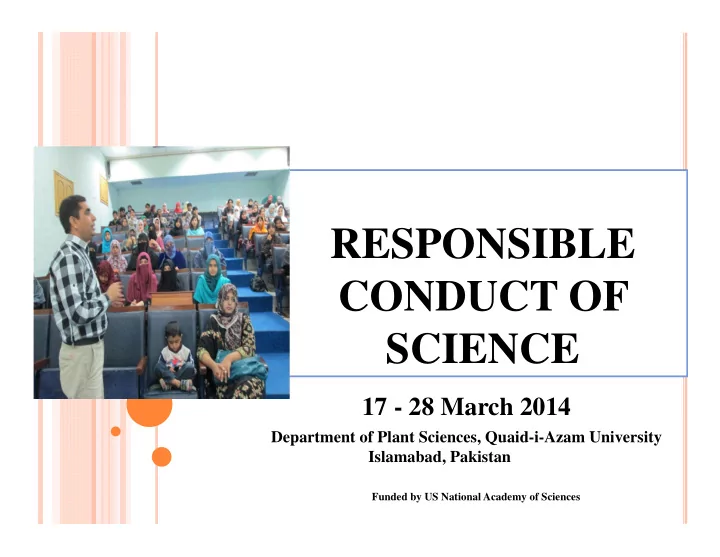
RESPONSIBLE CONDUCT OF SCIENCE 17 - 28 March 2014 Department of - - PowerPoint PPT Presentation
RESPONSIBLE CONDUCT OF SCIENCE 17 - 28 March 2014 Department of Plant Sciences, Quaid-i-Azam University Islamabad, Pakistan Funded by US National Academy of Sciences P RESENTED BY Dr. Mushtaq Ahmad Assistant Professor/Director Botanic
17 - 28 March 2014
Department of Plant Sciences, Quaid-i-Azam University Islamabad, Pakistan
Funded by US National Academy of Sciences
Dr. Muhammad Zafar, Quaid-i-Azam university Islamabad (Faculty member, belongs to a remote
area Mianwali)
Dr. Muhammad Arshad, PMAS, Arid University Rawalpindi (Representative from Urban
research Institute)
Dr. Shazia Sultana, ( 100 Publications, Post-Doc. Fellow) Tahira Bibi, Women University Quetta Baluchistan (Belongs to a remote area of Pakistan, where
female education ratio is the least)
Shehla Shinwari ( PhD Scholar , active member in bioethetics) Sara Asif, Lecturer (PMAS, Arid University Rawalpindi) Sadaf Kayani (Ph.D Scholar) Syed Ali Hassan, M.Phil scholar and School teacher at the Middle level Latif Ahmad, M.Phil Scholar Nida, M.Phil Scholar Maroof Ali Toori, M.Sc student from a remote area affected by the War on terror and terrorist
activities
Shazia Malik, M.Sc Student Ayaz Ali Mughal, M. Phil scholar at Sind University Jamshoroo Zulfiqar Ali Subero, Lecturer at Govt Boys Degree College Badin, Sind Faisal Javed, M.Phil Student Siraj, M.Sc Student
To engage participants in case-based discussions of ethical issues commonly encountered in, and raised by, current scientific research. To introduce participants to methods of analysis of ethical issues. To introduce participants to policies relevant to the conduct of research. To honour values in science. To address conflicts of interest in scientific research. Continued……………..
15 Trainees representing different segments of
educational and research institutes from all over Pakistan
Students of M. Phil/Ph.D Plant Systematics and
Biodiversity lab (40)
M. Phil and Ph.D students of Biodiversity course (55),
Plant sciences Department; Quaid-i-Azam University Islamabad
M. Sc 4th semester students of Economic Botany course
(35) Plant Sciences Department; Quaid-i-Azam University
M. Sc 3rd semester students of Plant Taxonomy course
(38), Plant Sciences Department; Quaid-i-Azam University
Lectures on different aspects of
Case studies Group/individual presentations Poster presentations Role plays/Skits Assignment/tasks
Ownership
Session by Session Detail 17–03–2014 (Monday)
Start Time Topic Instructor 9:30 – 9:40 am Recitation of Holy Quran Syeda Sana Hussain 9:40- 9:50 am Welcome
9:50 – 11:00 am Inauguration speech
11:00 – 11:30 am Refreshment N/A 11:30 – 1:30 pm Introduction to RCS
1:30 – 2:30 Lunch Break N/A 2:30 – 3:30 pm Case studies related to RCS objectives
3:30 – 5:00 pm Group discussions and presentations Different registered members 5:00 – 5:15 pm Tea break N/A 5:15 – 5:30 pm Feed back
18–03–2014 (Tuesday) Start Time Topic Instructor 9:30 am Sitting N/A 9:30 – 11:00 am Introduction to Research Ethics
11:00 – 11:30 am Refreshment N/A 11:30 – 1:30 pm Principles of Research ethics
1:30 – 2:30 pm Lunch Break N/A 2:30 – 3:30 pm Case studies of Research Ethics
3:30 – 5:00 pm Group discussions and presentations related to research Ethics All trainees 2:30 – 3:30 pm Case studies of Research Ethics
5:15 – 5: 30 pm Wrap up
19–03–2014 (Wednesday) Start Time Topic Instructor 9:30 am Sitting N/A 9:30 – 11:00 am Research Misconduct and its consequences
11:00 – 11:30 am Refreshment N/A 11:30 – 1:30 pm Research Misconduct and Policies for Handling It
1:30 – 2:30 pm Lunch Break N/A 2:30 – 3:30 pm Case studies of Research misconduct
3:30 – 5:00 pm Group discussions and presentations related to research misconduct All trainees 5:00 - 5:15 pm Tea break N/A 5:15– 5: 30 pm Wrap up
20–03–2014 (Thursday) Start Time Topic Instructor 9:30 am Sitting N/A 9:30 – 11:00 Introduction to Responsible Authorship
11:00 – 11:30 am Refreshment N/A 11:30 – 1:30 pm Principles of authorship and rules to resolving problems
1:30 – 2:30 pm Lunch Break N/A 2:30 – 3:30 pm Case studies of responsible authorship
3:30 – 5:00 pm Group discussions and presentations related to responsible authorship All trainees 5:00 – 5:15 pm Tea break N/A 5:15–5: 30 pm Wrap up
21–03–2014 (Friday) Start Time Topic Instructor 9:30 am Sitting N/A 9:30 – 11:00 Introduction to collaborative research
11:00 – 11:30 am Refreshment N/A 11:30 – 1:30 pm Principles of Collaborative research and its benefits
1:30 – 2:30 pm Lunch Break N/A 2:30 – 3:30 pm Case studies of Collaborative research
3:30 – 5:00 pm Group discussions and presentations related to Collaborative research All trainees 5:00 – 5:15 pm Tea break N/A 5:15 – 5: 30 pm Wrap up
24–03–2014 (Monday) Start Time Topic Instructor 9:30 am Sitting N/A 9:30 – 11:00 Data acquisition, management and
11:00 – 11:30 am Refreshment N/A 11:30 – 1:30 pm Rules of Data acquisition, management and ownership
1:30 – 2:30 pm Lunch Break N/A 2:30 – 3:30 pm Case studies of Rules of Data acquisition, management and ownership
3:30 – 5:00 pm Group discussions and presentations related to Rules of Data acquisition, management and ownership All trainees 5:00– 5:15 pm Tea break N/A 5:15– 5: 30 pm Wrap up
24–03–2014 (Monday) Start Time Topic Instructor 9:30 am Sitting N/A 9:30 – 11:00 Data acquisition, management and
11:00 – 11:30 am Refreshment N/A 11:30 – 1:30 pm Rules of Data acquisition, management and
1:30 – 2:30 pm Lunch Break N/A 2:30 – 3:30 pm Case studies of Rules of Data acquisition, management and ownership
3:30 – 5:00 pm Group discussions and presentations related to Rules of Data acquisition, management and ownership All trainees 5:00– 5:15 pm Tea break N/A 5:15– 5: 30 pm Wrap up
26–03–2014 (Wednesday) Start Time Topic Instructor 9:30 am Sitting N/A 9:30 – 11:00 am Conflict of interest, Values and Commitments
11:00 – 11:30 am Refreshment N/A 11:30 – 1:30 pm Causes of Conflict of interest, Values and Commitments and their consequences
1:30 – 2:30 pm Lunch Break N/A 2:30 – 3:30 pm Case studies of Conflict of interest, Values and Commitments
3:30 – 5:00 pm Group discussions and presentations related to Conflict of interest, Values and Commitments All trainees 5:00 – 5:15 pm Tea break N/A 5:15 – 5: 30 Wrap up
27–03–2014 (Thursday) Start Time Topic Instructor 9:30 am Sitting N/A 9:30 – 11:00 am Mentee-Mentor relationships
11:00 – 11:30 am Refreshment N/A 11:30 – 1:30 pm Major categories of Mentee-Mentor relationships
1:30 – 2:30 pm Lunch Break N/A 2:30 – 3:30 pm Case studies of Mentee-Mentor relationships
3:30 – 5:00 pm Group discussions and presentations related to Mentee-Mentor relationships All trainees 5:00 – 5:15 pm Tea break N/A 5:15 – 5: 30 pm Wrap up
28- 03 -2014 (Friday) Start Time Topic Instructor 9:30 am Sitting N/A 9:30 – 11:00 am Good laboratory practices ( GLPs)
11:00 – 11:30 am Refreshment N/A 11:30 – 1:30 pm Good conduct of laboratory practices and its benefits
1:30 – 2:30 pm Lunch Break N/A 2:30 – 3:30 pm Case studies of Good laboratory practices ( GLPs)
3:30 – 5:00 pm Group discussions and presentations related to Good laboratory practices ( GLPs) All trainees 5:00 – 5:15 pm Tea break N/A 5:30 – 6:00 pm Thanks
Plagiarism Plagiarism is cut-copy paste of data from internet, books and publications. Plagiarism is a crime so we should Avoid plagiarism Avoid false data Publish own research There should be a strong law to deal with. Instead of following plagiarism we should believe
Be honest because honesty is the best policy. Respect the work of other researchers and authors (cited)
Responsible Authorship Researcher should be given proper guidelines, good ideas and appreciation for his work. In team work the group leader should be followed by all the group members positively and there should be No diplomacy No fighting Coordination Friendly & Cooperative environment
Data Acquisition Data can be collected from different sites Science Direct Google Scholar Google Researchers Supervisors Topic of research should be Attractive Free of plagiarism Publishable
Mentor-Mentee Relationship Mentor-mentee relationship should be friendly and respectful Mentor should be active, cooperative, responsible and unbiased Mentee should be hardworking regular, honest and respectful and should avoid hesitation Four types of mentor-mentee relationship * Mentee is active and hard working but Mentor is irresponsible *Mentor is active and responsible but mentee is irregular and lazy
*Both mentor and mentee are confused and do not understand each other. *Both mentor and mentee are active, sensible and sincere If mentor is a good commentator, listener approachable and always available but mentee is irresponsible and show sluggish behavior them this is not a good relationship. If mentor is irresponsible and is always busy but mentee is hand working and intelligent then mentor behavior will affect research results. If both mentor and mentee do not understand and get each
If there is god communication understanding and good teaching learning behavior between mentor & mentee then this relationship will definitely work
Misinformation Due to misinformation of drugs and without consulting experts about them result into harmful effects eventually cause death etc. The researcher’s work is plagiarized lay the teacher that cause psychological problems and memory loss of student. Seniors discourage juniors, due to which juniors
affected.
Punctuality and regularity of the
All the assigned contents of the training
Review meetings were conducted
Next day planning was done regularly. Participants and visitors were satisfied
Prof Dr. Mir Ajab Khan, Ex. Dean Faculty
Islamabad
Prof Fiaz Ul Hassan Sai, PMAS Arid
Agriculture University Rawalpindi, Pakistan
Dr. Muhammad Khan Laghari, DG.
Pakistan Museum of Natural History
Prof. Dr. Muqarab Shah, Ex. Dean Hazara
University Mansehra
Except in specialized cases, this education should be
incorporated within broader course work and training rather than via stand-alone courses (MS/M.Phil, PhD levels)
To engage and conduct courses at school and college
teachers level using RCS based methods .
Insights from research on learning and effective teaching
should inform development of materials, and approaches to teaching students and preparing
Materials should be available in a range of languages Build networks of faculty and instructors through train-
the-trainer programs
Summative assessment based outcomes from trainees
and, where possible, impact (Qualitative and Quantitative) in re-union on dated 20th April-2014.