
SLIDE 1
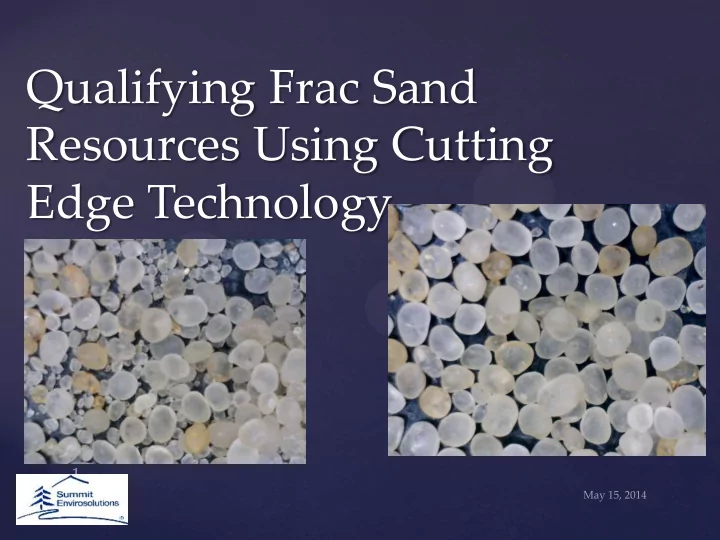
Resources Using Cutting Edge Technology Sample prep & handling - - PowerPoint PPT Presentation
Qualifying Frac Sand Resources Using Cutting Edge Technology Sample prep & handling Data correlation PSD as decision tool PSD for fingerprinting Conclusions Camsizer Quick Reliable 21 st Century
Conclusions
Camsizer
Quick Reliable 21st Century upgrade for PSD and more
Sample Handling Key to Reproducible Results Natural variability on material is different that
manufactured product
Use statistics & trend charts for big data sets vs.
time
*Gert Beckmann Retsch Technology
Methods Techniques Equipment
QA/QC
NEVER scoop always use sample splitter
No mechanical agitation like RoTap Clusters and “coating” source for
discrepancy
Smaller sample size – unforgiving!!
Sample prep
Air dry Split & weigh Wash, wet sieve – P200 Dry and calculate %loss Micro photograph Archive sample
representative
Split sample into 5 parts. 4 splits used for ro-tap. 1 split used exclusively for CAMSIZER Run 3 of 4 samples in the ro-tap individually - once (saved 2, 3 and 4 to run through the CAMSIZER) Run 4th sample three times through ro-tap Split the one sample used for the CAMSIZER into 4 smaller parts Run 3 of 4 samples through the CAMSIZER
Run the 4th sample through the CAMSIZER three times Run sample 2, 3, and 4 from the ro-tap through the CAMSIZER
Same split sample using sieves
All sets of Rotap data
Average of all Camsizer - Blue Rotap - Red
Site 1 Site 2 Site 3 Site 4 Sieve Size (US Standard) % Retained Roundness Sphericity % Retained Roundness Sphericity % Retained Roundness Sphericity % Retained Roundness Sphericity #16 0.1 0.92 0.96 0.4 0.91 0.87 0.3 0.91 0.87 0.6 0.67 0.86 #18 0.1 0.83 0.88 0.4 0.87 0.90 0.7 0.87 0.90 1.1 0.84 0.88 #20 0.8 0.75 0.85 1.1 0.83 0.87 1.5 0.83 0.87 1.7 0.85 0.85 #25 2.2 0.77 0.81 3.5 0.77 0.83 4.1 0.77 0.83 4.1 0.82 0.83 #30 6.6 0.78 0.83 5.2 0.82 0.83 7.2 0.82 0.83 6.3 0.80 0.78 #35 14.6 0.76 0.78 9.1 0.79 0.78 11.5 0.79 0.78 8.8 0.78 0.76 #40 17.6 0.73 0.77 10.2 0.79 0.77 12.7 0.79 0.77 9.7 0.76 0.76 #45 22.9 0.74 0.75 12.9 0.76 0.76 14.2 0.76 0.76 11.6 0.72 0.75 #50 20.0 0.70 0.72 10.2 0.72 0.73 11.4 0.72 0.73 10.2 0.68 0.73 #60 10.3 0.65 0.71 8.2 0.67 0.72 9.6 0.67 0.72 10.2 0.65 0.72 #70 2.2 0.61 0.70 5.3 0.63 0.70 5.7 0.63 0.70 7.2 0.62 0.71 #100 0.8 0.34 0.63 7.9 0.23 0.49 6.4 0.23 0.49 9.3 0.49 0.61 #200 0.4 0.19 0.54 16.5 0.22 0.43 8.1 0.22 0.43 11.3 0.24 0.38 PAN 1.5 9.2 6.6 8.0 20/40 41.0 0.7595 0.797 28.0 0.79275 0.79925 35.6 0.79275 0.79925 28.9 0.79175 0.784 30/50 75.1 0.7 0.8 42.4 0.8 0.8 49.8 0.8 0.8 40.3 0.7 0.8 40/70 55.3 0.7 0.7 36.6 0.7 0.7 40.9 0.7 0.7 39.2 0.7 0.7
ArcGIS – Raster block allows x,y,z arithmetic
Data used to build…..
quantity
collection