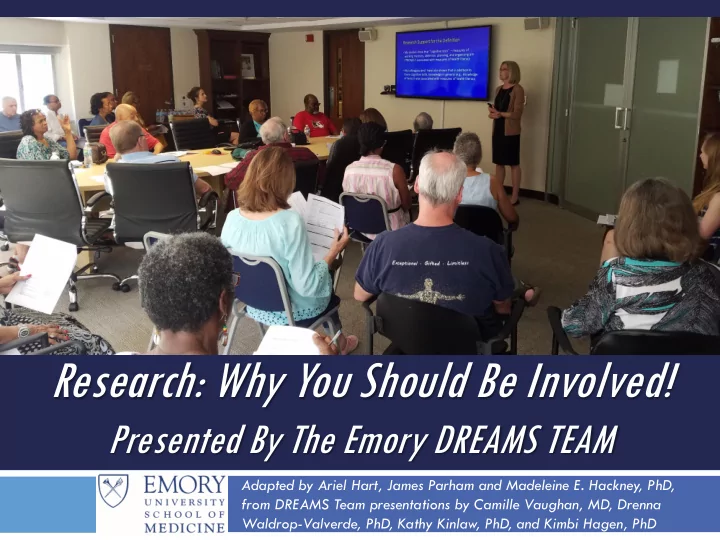
Research: Why You Should Be Involved! Presented By The Emory DREAMS - - PowerPoint PPT Presentation

research why you should be involved
SMART_READER_LITE
LIVE PREVIEW

Research: Why You Should Be Involved! Presented By The Emory DREAMS - - PowerPoint PPT Presentation

Research: Why You Should Be Involved! Presented By The Emory DREAMS TEAM Adapted by Ariel Hart, James Parham and Madeleine E. Hackney, PhD, from DREAMS Team presentations by Camille Vaughan, MD, Drenna Waldrop-Valverde, PhD, Kathy Kinlaw, PhD,


slide-1
SLIDE 1

Research: Why You Should Be Involved!

Presented By The Emory DREAMS TEAM

Adapted by Ariel Hart, James Parham and Madeleine E. Hackney, PhD, from DREAMS Team presentations by Camille Vaughan, MD, Drenna Waldrop-Valverde, PhD, Kathy Kinlaw, PhD, and Kimbi Hagen, PhD

slide-2
SLIDE 2

Our Talk Road Map

 The Clinical Research Process  Health Literacy & Participating in

Research

 Ethics in Research  Advocacy in Research: Why, Who &

What

slide-3
SLIDE 3

The Clinical Research Process

slide-4
SLIDE 4

A little quiz…. Match the Definition to the Correct Research Term

a.

The participant is not told which arm of the trial he is on

b.

One group of participants is given an experimental drug, while another group is given either a standard treatment for the disease

  • r an inactive treatment.

c.

Participants are assigned by chance to one of two or more treatment arms of a clinical trial

d.

An inactive pill, liquid, or powder that has no treatment value.

4

  • 1. Randomized trial
  • 2. Controlled trial
  • 3. Placebo
  • 4. Blind

Courtesy of the Parkinson’s Disease Foundation

slide-5
SLIDE 5

What is Clinical Research?

 Research performed to gain insight about

human behavior or body function

 It can involve

  • A particular person
  • Groups of people
  • Human behavior or tissues

NIH: https://www.nichd.nih.gov/health/clinicalresearch/Pages/index.aspx

slide-6
SLIDE 6

Why is Clinical Research Important?

 Provides scientific foundation (evidence)

for clinical practice

 Provides an ethical framework for

considering new treatment strategies

 Reduces bias in healthcare  Increases trust in medical science

slide-7
SLIDE 7

Clinical Trials

 Phase I: Safety or feasibility  Phase II: Check for efficacy  Phase III: Confirm efficacy  Phase IV: Post-market evaluation

slide-8
SLIDE 8

Clinical Trials

slide-9
SLIDE 9

Find out more and find studies:

 ClinicalTrials.gov  ResearchMatch.org  Fox Trial Finder  Find Clinical Studies at Emory:

ClinicalTrials.Emory.edu

slide-10
SLIDE 10

Patient-Centered Outcomes

 Subjective symptoms and objective measures don’t

always correlate – but which are most important?

 Maintain relevance for persons living with disease  Include patients in the process of research  Examples of patient-centered outcomes

  • Health-related quality of life
  • Symptom scales
  • Survival
  • Function
  • Factors informing health decisions

PCORI Methodology Report 2012

slide-11
SLIDE 11

Health Literacy & Participating In Research

slide-12
SLIDE 12

What is Health Literacy?

“The degree to which individuals can

  • btain, process, and understand the basic

health information and services they need to make appropriate health decisions”

(Selden, Zorn, Ratzan, & Parker, 2000)

slide-13
SLIDE 13

Health Literacy Challenges

 People need information they can understand

and use to make informed decisions to promote and protect their health

 The majority of adults have trouble using

everyday health information available in our health care facilities, retail outlets, media, and communities

slide-14
SLIDE 14
slide-15
SLIDE 15

Health Literacy and Research

 Health literacy challenges can negatively

affect research:

  • Can affect understanding of what is

required to participate in study

  • Often reduces research participation,

particularly by minorities

  • Reduces ability to trust findings and

assume that they apply to the general population

slide-16
SLIDE 16

Questions to Ask Before Joining a Study

 What is the main purpose of the study?  What will I be asked to do during the

study?

 How will I benefit from participating in this

study?

 What are the possible risks?  How will the results be shared?

http://buildingtrustumd.org/unit/informed-decision-making/knowledge-is-power

slide-17
SLIDE 17

Questions to Ask Before Joining a Study (continued)

 How will my personal information be kept

confidential?

 How long is the study going to last?  Are there reimbursements or incentives?  Who is funding the study?  What are the researcher and institutional

credentials?

slide-18
SLIDE 18

Ethics In Research

slide-19
SLIDE 19

What is ethics?

 Definitions:

Rules of conduct recognized with respect to a

class of human actions or a particular group, culture, etc. e.g., medical ethics

Philosophy dealing with values relating to human

conduct, with respect to the rightness and wrongness of certain actions and to the goodness and badness of the motives and ends of such actions

 How do you define ethics?  How can we make sure that research is ethical?

slide-20
SLIDE 20

Abuse of Research Ethics

Well known abuses in the 20th century:

  • Nazi experiments
  • Tuskegee Study of Untreated Syphilis

(1932-1972)

  • Stanford prison experiment (1971)

(http://www.prisonexp.org/rebellion)

Prompted development of required review procedures for human subject studies

slide-21
SLIDE 21

1974 – National Research Act

 Established federal regulations for research

with human subjects

 Required Institutional Review Boards (IRBs)  Created the National Commission for the

Protection of Human Subjects of Biomedical and Behavioral Research

 1979 Commission issues the Belmont Report:

Ethical Guidelines for the Protection of Human Subjects

slide-22
SLIDE 22

To conduct human research we must:

 Minimize harms and risks  Maximize benefits  Respect human dignity, privacy, autonomy  Take precautions with vulnerable

populations

 Strive to distribute benefits and burdens

  • f research fairly

Adapted from Shamoo A and Resnik D. 2015. Responsible Conduct of Research, 3rd ed. (New York: Oxford University Press).

slide-23
SLIDE 23

Recruitment Factors

 Potential for coercion

  • Financial incentives
  • Benefit of social contact
  • Participants’ trust of authority figures

 Participants must know they can withdraw

from study at any time because research participation is completely voluntary

slide-24
SLIDE 24

What is Informed Consent?

 Not just signing a form! Participant must

understand:

  • Nature of the study and procedures
  • Risks and benefits

Teach-back method should be used –

 “Let me tell you in my own words what I

understood”

 Continued invitation to ask questions

throughout the study

slide-25
SLIDE 25

Getting Others Involved: How To Advocate Effectively For Research Participation

slide-26
SLIDE 26

Why research advocacy matters

 Many believe that research answers: “Does this

treatment work?”

 Research actually asks: “Does this treatment work

  • n these particular study subjects?”

 Treatments don’t work identically on every

group… so every group needs to be included in clinical trials

slide-27
SLIDE 27

Who can be an advocate?

Anyone:

 Who cares about a cause or group  Who would be trusted by this group  Who wants to minimize suffering  Who is concerned about health equity  Who believes in scientific research

slide-28
SLIDE 28

What does an advocate do?

 Think about the

importance of including their group in research

 Ask the right

questions

 Recruit the right

participants

 Think about the

importance of participating in research

 Ask the right

questions

 Agree to participate

in the right studies

Helps researchers: Helps peers:

slide-29
SLIDE 29

What could an advocate do?

 Join associations and organizations for causes

that you care about

 Develop the study concept:

  • Discuss with researchers what is important to the

community

  • Assist in writing and reviewing grants

 Prepare the study protocol:

  • Provide input on study design, barriers to

recruitment

  • Help finalize eligibility criteria
  • Assist in creating the informed consent
slide-30
SLIDE 30

What could an advocate do?

 Implement study:

  • Assist with study recruitment
  • Serve as a peer advocate during informed

consent

 Monitor the study:

  • Join a Data Safety Monitoring Board
  • Sit on an IRB

 Analyze data and Interpret results:

  • Provide feedback on how the community will

view the study results

slide-31
SLIDE 31

What could an advocate do?

 Disseminate study information:

  • Write newsletter articles or blog about

results

  • Co-present results at a conference or support

group

  • Work with research team to ensure that

study participants get feedback from the study

slide-32
SLIDE 32

What could an advocate do?

 FDA review and approval:

  • Apply to be a consumer representative to an

FDA advisory committee

  • Attend FDA hearings and give comments

 Post-approval studies:

  • Advocate with physicians for continued

tracking of drugs, devices, therapies

slide-33
SLIDE 33

What interests you?

 What issues in research are important?  What healthcare areas need improvement?  What peer groups could I educate about

research?

 How can I get involved as an advocate and

educator?

 Tell us what YOU would like to do

slide-34
SLIDE 34

Thank you!

 Please contact any member of the DREAMS

Team on how you can get involved in research!

 Advocate for yourself and your peers;

recruit others into research!

Thank you to the Parkinson’ s Disease Foundation, National Parkinson Foundation and the Patient-Centered Outcomes Research Institute for generous support, which made the DREAMS Team possible.

slide-35
SLIDE 35

Resources

Check out the Patient-Centered

Outcomes Research Institute website:

  • PCORI.org – you can get involved by

suggesting a research question, becoming a reviewer, or joining an advisory panel

ClinicalTrials.gov ResearchMatch.org Fox Trial Finder

slide-36
SLIDE 36

WHAT IS PATIENT ENGAGEMENT IN RESEARCH?

Develop Concept and Secure Funding Prepare Protocol and Create Procedure Implement and Monitor Analyze Data and Interpret Results Share Results FDA Review and approval Post Approval Studies Before During… After

Join an Institutional Review Board (IRB) Develop concept and work as co- researcher Assist with grant writing Help finalize eligibility criteria Help recruit participants Apply to be a consumer

  • rep. to a US

Food and Drug Admin. (FDA) Advisory Committee Advocate continued tracking of drugs Work with researchers

  • n patient

centered

  • utcomes

*Adapted from Parkinson’s Disease Foundation materials for Emory’s DREAMS project Provide input on study design. What might prevent someone like me from participating? Help make informed consent form Serve as a peer advocate Provide feedback

  • n how
  • lder adult

community views the study Write newsletter articles or blog about results Present the findings to a group or at an event Discuss with researchers: What topics are important to my community? Review grants with the Patient Centered Outcome Research Institute (PCORI) Join a Data Safety Monitoring Board Help revise study as needed