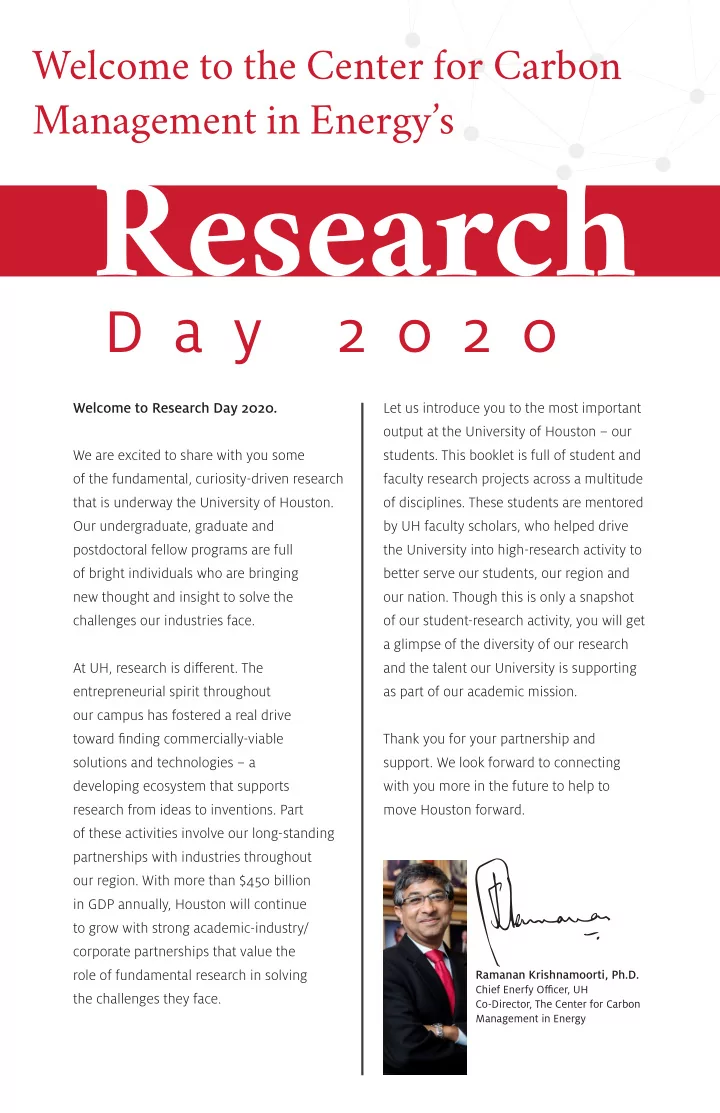
Research D a y 2 0 2 0 Welcome to Research Day 2020. Let us - - PDF document

research
SMART_READER_LITE
LIVE PREVIEW

Research D a y 2 0 2 0 Welcome to Research Day 2020. Let us - - PDF document

Welcome to the Center for Carbon Management in Energys Research D a y 2 0 2 0 Welcome to Research Day 2020. Let us introduce you to the most important output at the University of Houston our We are excited to share with you some


slide-1
SLIDE 1

Welcome to Research Day 2020. We are excited to share with you some

  • f the fundamental, curiosity-driven research

that is underway the University of Houston. Our undergraduate, graduate and postdoctoral fellow programs are full

  • f bright individuals who are bringing

new thought and insight to solve the challenges our industries face. At UH, research is difgerent. The entrepreneurial spirit throughout

  • ur campus has fostered a real drive

toward fjnding commercially-viable solutions and technologies – a developing ecosystem that supports research from ideas to inventions. Part

  • f these activities involve our long-standing

partnerships with industries throughout

  • ur region. With more than $450 billion

in GDP annually, Houston will continue to grow with strong academic-industry/ corporate partnerships that value the role of fundamental research in solving the challenges they face.

Ramanan Krishnamoorti, Ph.D. Chief Enerfy Offjcer, UH Co-Director, The Center for Carbon Management in Energy

Let us introduce you to the most important

  • utput at the University of Houston – our
  • students. This booklet is full of student and

faculty research projects across a multitude

  • f disciplines. These students are mentored

by UH faculty scholars, who helped drive the University into high-research activity to better serve our students, our region and

  • ur nation. Though this is only a snapshot
  • f our student-research activity, you will get

a glimpse of the diversity of our research and the talent our University is supporting as part of our academic mission. Thank you for your partnership and

  • support. We look forward to connecting

with you more in the future to help to move Houston forward.

Welcome to the Center for Carbon Management in Energy’s

D a y 2 0 2 0

Research

slide-2
SLIDE 2

CHEMICAL & BIOMOLECULAR ENGINEERING CHEMISTRY

Enhanced Catalytic Oxidation of Methane by Feed Modulation on Pt/Pd/Spinel Monoliths Elimination of Methane and Carbon Dioxide by Catalytic Tri-reforming COMSOL Modeling of Nonlinear Transport Properties Enhancing Methane Conversion over Platinum Group Metals with Tailored Oxygen Storage Materials Carbonate Assisted Electrochemical Methane Activation on Ni(111) and NiO(100) Screening Metal-Oxides for Effjcient Oxidative Coupling of Methane Global Commoditization of CO2 The Case for Dual-Use LNG-CO2 Shipping Afgordable Distributed Air Capture - Policy Pathways Integration with Renewable Wind Energy in W. Texas Techno-Economic Modeling of Dual-Use LNG-CO2 Shipping Techno-Economic Modeling of Coupled Direct Air Capture of CO2 and Renewable Wind Energy Enabling Rapid Temperature Swing CO2 Adsorption Through Materials Process & Design Autothermal Operation of Catalytic Oxidative Coupling of Methane in Packed-Bed Reactors Biological, Anaerobic Activation of Short-Chain Alkalines in E. coli Controlling Silicon and Aluminum Zoning in ZSM-5 for Improved Performance in the Methanol-to-Hydrocarbons Reaction

Index

6 8 9 11 12 13 14 15 16 17 19 20 21

slide-3
SLIDE 3

Index

Molten Salt Synthesis of MgO and NiO Materials Exposing Polar and High Index Facets Large Crystal Growth of Functional Inorganic Materials & Multifunctional Crystal Growth and Characterization

COMPUTER SCIENCE

High-dimensional Data-driven Energy Optimization for Multi-Mod- al Transit Agencies

MECHANICAL ENGINEERING INDUSTRIAL ENGINEERING

Full Spectrum Solar Thermal Energy Harvesting and Storage by a Molecular and Phase-Change Hybrid Material CFD Analysis of Windcatchers Permian Flaring of Natural Gas: Opportunities and Challenges

PETROLEUM ENGINEERING

Carbon Capture & Storage in Depleted Gas Fields Along the Texas Gulf Coast Development of First CCUS Project in Indian Oilfjeld CCUS in the Grayburg Formation, Permian Basin Experimental Study of Unconsolidated Sand Yielding Behavior for CO2 Injection-Storage Applications A Hierarchical Model for Predicting the Geo-Mechanical Properties

  • f Carbonate Formations

Candidate Selection for CO2 Storage Insights from Pore-Scale Modelling 22 23 24 25 27 28 29 30 31 32 33 35 36 38 39

slide-4
SLIDE 4

Index

PHYSICS PUBLIC POLICY

Carbon Dioxide Recycling and Carbon Free Fuel Production Using Sunlight Non-Precious Electrocatalysts for High-Performance Alkaline Seawater Electrolysis The Oil & Gas Workforce of the Future 40 41 42 43

slide-5
SLIDE 5

C H E M I C A L & B I O M O L E C U L A R E N G I N E E R I N G C H E M I S T R Y

slide-6
SLIDE 6

Page 6

With increasingly stringent tailpipe emissions regulations from vehicles powered by internal combustion engines, and growing concerns over the use of fossil fuel, Compressed Natural Gas (CNG) vehicles have gained interest [1]. Advan- tages of CNG vehicles include the use of inexpensive domestic fuel and less CO2 emissions than gasoline and diesel
  • vehicles. The challenge for emission control of CNG vehicles is to simultaneously convert hydrocarbons, CO, and NO
into water, CO2 and N2. However, conventional platinum group metal (PGM) based three-way catalysts are inefgec- tive in methane emission control [2]. Four way catalysts (FWC) that can also convert methane need to be developed. In this study, a novel dual layer (PGM+spinel) monolith FWC (30 PGM g/ft3 monolith, 19:1 ratio of Pt:Pd) developed by CDTi, Inc. is evaluated for methane and NOx conversions performance. Mn0.5Fe2.5O4 spinel was used as the oxygen storage material (OSM). Light-ofg curves show that the combination of lean/rich feed modulation and the addition of spinel enhances methane and NO conversions. Further experiments studied catalyst design and operating optimiza-
  • tion. Parametric studies explored the efgects of the oscillation amplitude, average lambda, and oscillation frequency
  • n catalyst performance. Experimenting with intermediate layers showed that the spinel’s afgects were unafgected by
distance to the PGM-layer. Finally, light-ofg curves with difgerent spinels as the OSM demonstrated that spinel compo- sition has a strong efgect on catalytic activity. References [1] M. Khan, T. Yasmeen, M. Khan, M. Farooq, M. Wakeel, Renewable and Sustainable Energy Reviews, 66 (2016) 702- 741 [2] S. Kang, S. Nam, B. Cho, I. Nam, C. Kim, S. Oh, Catalysis Today, 231 (2014) 3-14

CHBE

Abstract

Enhanced Catalytic Oxidation of Methane by Feed Modulation on Pt/Pd/Spinel Monoliths

Methane emissions are problematic in the production of in shale liquid and the use of natural gas as a transportation
  • fuel. In this project a new class of oxidation catalysts are in development to that have a lower Platinum Group Metal
(PGM) content.
slide-7
SLIDE 7

Page 7

Research Team

  • Kyle Karinshak, PhD, Chemical Engineering
  • Pak Wing Chen, PhD, Chemical Engineering
  • Dr. Lars Grabow

Dan Luss Associate Professor of Chemical and Biomolecular Engineering Associate Professor of Chemistry Email: grabow@uh.edu

Enhanced Catalytic Oxidation of Methane by Feed Modulation on Pt/Pd/Spinel Monoliths

CHBE

Related Publications

  • Joshi, S., Y. Ren, M.P. Harold, and V. Balakotaiah, “Determination of Kinetics and Controlling Regimes for Propylene
and Methane Oxidation on Pt/Al2O3 Monolithic Catalyst Using High Space Velocity Experiments,” Ind. Eng. Chem. Res., 51 (22), 7482–7492 (2012).
  • Bugosh, G., V. Easterling, and M.P. Harold, “Anomalous Steady-State and Spatio-Temporal Features of Methane Oxida-
tion on Pt/Pd/Al2O3 Monolith Spanning Lean and Rich Conditions,” Applied Catalysis B. Environmental, 165, 68-78 (2015).
  • Nguyen, H., M.P. Harold, and D. Luss, “Spatiotemporal Behavior of Pt/Rh/CeO2/BaO Catalyst During Lean-Rich Cy-
cling,” Chem. Eng. Journal, 262, 464-477 (2015).
  • Zhou, Z.., M.P. Harold and D. Luss, “Enhanced NO, CO and C3H6 Conversion on Pt/Pd Catalysts:
Impact of Oxygen Storage Material and Catalyst Architecture,” Catal. Today, in press (2020).
  • Kang, S.B., K.A. Karinshak, P.W. Chen, S. Golden, and M.P. Harold, “Coupled Methane and NOx Conversion on Pt+Pd/
Al2O3 Monolith: Conversion Enhancement Through Feed Modulation and Mn0.5Fe2.5O2 Spinel Addition,” Catal. Today, in press (2020).
  • Karinshak, K. A., P. Lott, O. Deutschmann, and M.P. Harold, “In Situ Activation of Bimetallic Pd-Pt Methane Oxidation
Catalysts,” Angewandte Chemie, in review (2020).
  • Dr. Michael Harold

Chair of Chemical and Biomolecular Engineering; ChBE Chair Professor of Chemical and Biomolecular Engineering Email: mharold@uh.edu

Lead PI’s

slide-8
SLIDE 8

Page 8

CHBE

Tri-Reforming of Methane is the synergistic combination of Steam and Dry Reforming with the Oxidation of Methane to produce Syngas. A careful balance between these reactions needs to be maintained in order to achieve a desirable yield without deactivating the catalyst. A mixture of reaction conditions and catalyst choices was considered in order to maximize the conversion of Carbon Dioxide and Methane.

Abstract

Elimination of Methane and Carbon Dioxide by Catalytic Tri-reforming

The emissions of greenhouse gases carbon dioxide (CO2) and methane (CH4) must be curtailed. In this project the concept of tri-reforming is under investigation as we move towards a carbon-constrained economy. In particular, we are examining the development of a catalytic process that involves the combined reforming of CH4 with CO2 and H2O in the presence of O2 to syngas (CO, H¬). The focus is on the development of a catalyst and reactor design that minimizes detrimental coke formation while addressing the energy balance and thermodynamic limitations.

Research Team

  • Jonathan Ratclifg, PhD, Chemical Engineering
  • Dr. Dan Luss

Cullen Professor of Engineering Email: dluss@uh.edu

  • Dr. Michael Harold

Chair of Chemical and Biomolecular Engineering; ChBE Chair Professor of Chemical and Biomolecular Engineering Email: mharold@uh.edu

Lead PI’s

slide-9
SLIDE 9

Page 9

Enhancing Methane Conversion over Platinum Group Metals with Tailored Oxygen Storage Materials

CHBE

In the current energy and environmental scenario, effjcient use of energy resources and reduction of greenhouse gases in the atmosphere have garnered a lot of attention. Consequently, researchers are spending substantial efgorts toward improved treatment of automotive exhaust, a major source of air pollution. Compressed Natural Gas (CNG) vehicles are becoming prominent as it can potentially lead to lower CO2 emissions due to the higher H:C ratio of methane compared to diesel and gasoline [1]. This technology, however, sufgers from unburnt methane emissions, another major potent climate change causal agent. The lack of viable processes converting methane from distributed sources to easily transportable liquids has also led to an increase in fmaring, i.e. the total combustion of methane, to lower the environmental impact of enhanced oil recovery. In both these applications effjcient methane oxidation/con- version catalysts can greatly incentivize technologies for natural gas/methane capture and use, a major step towards lowering net greenhouse gas emissions. This study is guided towards a fundamental understanding of methane oxidation process over precious metal (PGM)/ metal oxide catalysts. Spinels are a class of mixed metal oxides that can act as excellent oxygen storage materials (OSM). A dual layer (PGM+spinel) monolith (30 PGM g/ft3 monolith, 19:1 ratio of Pt:Pd) developed by CDTi, Inc. has demonstrated higher methane conversion at low temperatures of 300-400 °C than conventional Pd/ceria-zirconia
  • catalyst. A bench reactor system is used to conduct fmow experiment using both steady-state and modulated feeds
and the effmuent concentrations are measured by a Fourier transform infrared (FTIR) spectrometer. These experiments show that the combination of lean/rich feed modulation and the addition of spinel allow for reducing methane con- version temperatures. It has been hypothesized that methane activation follows two principal routes: direct activation
  • ver the surface sites of the PGM component, and an indirect route, where the oxide provides oxygen necessary to ef-
fjciently activate the C-H bond in methane. Direct methane activation over PGM sites and/or spinel surface metal sites demands high temperatures. The indirect route comprises of PGM sites being the only methane activation centers, with metal oxides simply acting as oxygen reservoir. This allows for easier low temperature methane activation on the PGM sites, located right on the spinel surface. Herein, we present the impact of two OSM materials, Mn0.5Fe2.5O4 spinel and Ce0.3Zr0.7O2 (CZO) on methane activation on PGM over OSM catalysts through pulse-injection method for the dynamic oxygen capacity (DOSC) measurement. Ab initio density functional theory calculations are performed to probe the oxygen vacancy formation and equilibrium oxygen evolution from the spinel oxides due to phase transition under varying oxygen partial pressure. Elucidating the DOSC of these materials can pave the way towards a funda- mental mechanistic understanding of methane activation and improved catalyst generation for future. References [1] S. P. A. Brown, Energy Policy 2017, 110, 210–221. [2] F. Huang, J. Chen, W. Hua, G. Li, Y. Wu, S. Yuan, L. Zhong, Y. Chen, Applied Catalysis B: Environmental, 219 (2017) 73-81

Abstract

slide-10
SLIDE 10

Page 10

CHBE

Enhancing Methane Conversion over Platinum Group Metals with Tailored Oxygen Storage Materials

Research Team

  • Debtanu Maiti, Post Doctoral Fellow, Chemical Engineering
  • Pak Wing Chen, PhD, Chemical Engineering
  • Dr. Lars Grabow

Dan Luss Associate Professor of Chemical and Biomolecular Engineering Associate Professor of Chemistry Email: grabow@uh.edu

  • Dr. Michael Harold

Chair of Chemical and Biomolecular Engineering; ChBE Chair Professor of Chemical and Biomolecular Engineering Email: mharold@uh.edu

Lead PI’s

slide-11
SLIDE 11

Page 11

  • Dr. Lars Grabow

Dan Luss Associate Professor of Chemical and Biomolecular Engineering Associate Professor of Chemistry Email: grabow@uh.edu

Carbonate Assisted Electrochemical Methane Activation on Ni(111) and NiO(100)

CHBE

Methane, an abundant resource in the U.S., has very strong C-H bonds, which makes its activation energy consuming. Current catalysts used to upgrade methane to higher value products are facing two major issues: (i) high tempera- tures (up to 900 K) are required, and (ii) the life time of the catalysts is limited due to sintering and coking. We aim to address these challenges and pursue a novel low temperature process, which leverages the use of an electrochemical cell to convert methane to methanol. This solution is particularly interesting for small-scale methane conversion and distributed manufacturing. The envisioned process uses carbonate anions (CO32-) that are produced from CO2 and O2 at the cathode and trans- ferred to the anode through an electrolyte. At the anode, carbonate ions serve as activator for methane and transfer a single oxygen atom to selectively oxidize methane to methanol. The fact that carbonate anion reduction leads again to CO2, which readily desorbs into the gas phase, is considered a key advantage of the proposed electrochemical
  • process. The rate of CO32- delivery can be controlled by adjusting the cell potential or current density. By simultane-
  • usly controlling the concentration of CH4 at the anode, we anticipate that the over-oxidation of methane can be
prevented, such that a high yield of methanol can be achieved. We have performed density functional theory (DFT) calculations on Ni(111) and NiO(100) and explicitly accounted for the efgects of applied electric fjelds. Our results indicate that the interaction between the externally applied electric fjeld and the dipole moment generated between the surface and adsorbates plays the dominant role in altering the binding behavior. Hence, the reaction enthalpy and activation energy of certain elementary steps exhibit a strong dependence on the applied electric fjeld. Although the applied electric fjeld does not lower the activation barrier signifjcantly, the results show the possibility to guide the reaction through a desired direction by altering the applied electric fjeld so that the selectivity of methanol can be increased. While the development of a viable process remains in its early stages, our results suggest that an electrochemical cell with a tunable electric fjeld ofgers unique advantages for selectively upgrading methane to value-added products.

Abstract Research Team

  • Qianyu Ning, Research Assistant, Chemical Engineering

Faculty Advisor

slide-12
SLIDE 12

Page 12

CHBE

Screening Metal-Oxides for Effjcient Oxidative Coupling of Methane

  • Dr. Lars Grabow

Dan Luss Associate Professor of Chemical and Biomolecular Engineering Associate Professor of Chemistry Email: grabow@uh.edu

Methane has become an abundant energy resource following the recent developments in the natural gas exploration and extraction technologies. Besides being an energy provider, methane can also serve as a commodity that can be converted to higher alkanes/alkenes. At many natural gas reserve sites, a particular volume of the natural gas may be fmared if it is considered uneconomical to obtain. A more lucrative alternative would be converting gaseous methane into liquid higher hydrocarbons as they are more valuable and their transport is more economical than the gaseous
  • methane. Oxidative coupling of methane (OCM) has traditionally been a focal point in methane conversion as it al-
lows for the direct conversion of methane into C2+ products. The biggest drawback of OCM is its limited C2+ yield as the formation of COx byproducts is thermodynamically strongly favored. While there have been several large-scale investigations on experimental OCM data aiming to reveal the most ideal catalyst compositions, the fjnal catalyst sug- gestions are mostly based on statistical analysis rather than intrinsic structural properties.1,2,3 In this study, we have computationally screened several metal-oxides, composed of alkali and/or alkaline earth met- als, to identify structural predictors for good OCM performance using DFT level of theory. We have constructed partial potential energy diagrams for crucial OCM reaction steps namely hydrogen abstraction and oxygen vacancy formation and correlated the corresponding energies with fundamental descriptors. Moreover, partial charges on participating
  • xygens are derived and their correlation with OCM energetics is investigated. Finally, the favorable structural proper-
ties that can lead to high OCM performance are suggested. With the right combination of operation conditions and catalyst choice, some of these suggested catalysts can enable an economically viable and single integrated process for the direct conversion of methane into ethylene, one of the most desired chemical building blocks. [1] U. Zavyalova, M. Holena, R. Schlögl and M. Baerns, ChemCatChem, 2011, 3, 1935–1947. [2] E. V Kondratenko, M. Schlüter, M. Baerns, D. Linke and M. Holena, Catal. Sci. Technol., 2015, 5, 1668–1677. [3] K. Takahashi, I. Miyazato, S. Nishimura and J. Ohyama, ChemCatChem, 2018, 10, 3223–3228.

Abstract Research Team

  • Hakan Demir, Post Doctoral Fellow, Chemical Engineering

Faculty Advisor

slide-13
SLIDE 13

Page 13

CHEM

  • Dr. Ramanan Krishnamoorti

Chief Energy Offjcer Co-Director, Center for Carbon Management in Energy Email: ramanan@uh.edu

Rising anthropogenic CO2 emissions and global temperatures are a technological, social, and political challenge. These necessitate deep decarbonization through carbon management strategies for sustained action. Cost-efgective transportation of CO2 from point sources to utilization and storage sites has become a signifjcant bottleneck for efgec- tive carbon management. We discuss a new mechanism to achieve international cooperation on carbon management through efgective CO2-source and CO2-use or sequestration matching is addressed. The mechanism is founded on utilizing the growth of global LNG trade to transport CO2 over long distances via dual-use vessels that carry CO2 on their return journey following the LNG delivery. A foundational carbon capture, utilization, and storage (CCUS)-based economic model for the utilization of CO2 originating in South Korea and Japan through enhanced oil recovery (EOR)- based sequestration in ofgshore U.S.is explored. The model sets forth the objectives, scale, costs, and implications for the international trade and commoditization of CO2, as against its current status of a waste product. Further, we will discuss policy considerations which can accelerate the deployment of this model, and the global commoditization of CO2 via dual-use shipping thereof.

Abstract Research Team Faculty Advisor

Global Commoditization of CO2 The Case for Dual-Use LNG-CO2 Shipping

  • Aparajita Datta, PhD Candidate, Hobby School of Public Afgairs & Department
  • f Political Science
  • Rafael De Leon, Research Assistant, Department of Chemical and Biomolecular

Engineering

Related Publications

  • Datta A and Krishnamoorti R (2019) Opportunities for a Low Carbon Transition-Deploying Carbon Capture, Utilization,
and Storage in Northeast India. Front. Energy Res. 7:12. doi: 10.3389/fenrg.2019.00012
  • Datta A, De Leon R and Krishnamoorti R, Advancing Carbon Management through the Global Commoditization of CO2
– The case for Dual-use LNG-CO2 Shipping, in review
slide-14
SLIDE 14

Page 14

CHBE

  • Dr. Ramanan Krishnamoorti

Chief Energy Offjcer Co-Director, Center for Carbon Management in Energy Email: ramanan@uh.edu

Direct Air Capture (DAC) is being mainstreamed as a solution for climate change mitigation, however, uncertainties remain around the long-term costs, energy consumption, and land requirement for at-scale capture. Meanwhile, Texas leads the nation in wind energy generation and has an independent electricity grid. During wind energy overgenera- tion at night, when supply is signifjcantly larger than demand, the excess electricity is sold at negative prices in the wholesale market. This provides an excellent opportunity to utilize this overgeneration to move high volumes of air through DAC units to enable low-cost DAC. This will alleviate the high cost and energy consumption challenges, allow for the rapid deployment of modular and process intensifjed DAC units co-located with wind farms to minimize trans- mission costs, and stabilize the grid. However, signifjcant economy-wide policy support would be required before at-scale deployment of DAC integrated with wind can be realized. We discuss some recent policy and regulatory shifts that are indicative of emerging opportunities of transforming DAC from a cost-center to a profjt-center, along with recommended policy pathways that could accelerate the pace of this transition.

Abstract Research Team Faculty Advisor Affordable Distributed Air Capture - Policy Pathways Integration with Renewable Wind Energy in W. Texas

  • Aparajita Datta, PhD Candidate, Hobby School of Public Afgairs & Department
  • f Political Science
slide-15
SLIDE 15

Page 15

CHBE

  • Dr. Ramanan Krishnamoorti

Chief Energy Offjcer Co-Director, Center for Carbon Management in Energy Email: ramanan@uh.edu

Source to sink matching is a critical determinant for the feasibility of Carbon Capture, Utilization, and Sequestra- tion (CCUS) projects as transportation costs scale up with distance. Typically, sources of CO2 like chemical and power plants are not in close proximity to potential use and storage (sinks), thereby rendering CCUS projects infeasible. The use of pipelines to transport CO2 has added excessive capital costs and the threat of sunk capital costs to existing
  • projects. Utilizing the explosive growth of the LNG/LPG shipping industry can substantially lower the costs and de-
risk transportation of CO2 for CCUS. In this scheme, importers of natural gas capture CO2 and transport it via specially designed dual-purpose vessels to exporters that have aging fjelds ofgshore or near to shore for utilization through enhance oil recovery. In this work, we analyze the techno-economic feasibility of this proposition to present the incentives that dual-purpose ship transport can provide- transportation over long distances at a fraction of prevalent costs, elimination of operating costs for an empty vessel on its return journey, the fmexibility to route CO2 where it’s needed, and the economic benefjt of sequestration.

Abstract Research Team Faculty Advisor

Techno-Economic Modeling of Dual-Use LNG-CO2 Shipping

  • Aparajita Datta, PhD Candidate, Hobby School of Public Afgairs & Department
  • f Political Science
  • Rafael De Leon, Research Assistant, Department of Chemical and Biomolecular

Engineering

slide-16
SLIDE 16

Page 16

Research Team

  • Aparajita Datta, PhD Candidate, Hobby School of Public Afgairs & Department
  • f Political Science
  • Rafael De Leon, Research Assistant, Department of Chemical and Biomolecular

Engineering

CHBE

  • Dr. Ramanan Krishnamoorti

Chief Energy Offjcer Co-Director, Center for Carbon Management in Energy Email: ramanan@uh.edu

Carbon capture technologies that capture CO2 from point sources such as power plants, refjneries, and chemical plants or distributed and typically low concentration sources like the atmosphere are being advanced as part of a comprehensive carbon management system. Fundamentally, there are three pathways to capture point source generated CO2. They depend on when and how the CO2 is captured in the combustion process: pre-combustion, post- combustion, and oxy-fuel combustion carbon capture. These processes have been scaled up to minimize the energy required for releasing the CO2 and for operations including pipeline compression of CO2. Such point source capture technologies have demonstrated improvements in energy effjciency through the integration of processes and more recently by application of intensifjcation methods. On the other hand, direct air capture (DAC) methods involve low concentration streams, are intrinsically smaller scale, and are distributed. DAC proves economical when adopting passive technologies to capture CO2. We provide a techno-economic analysis of existing DAC technologies and life cycle analysis to understand the effjcacy of these methods to reduce the global carbon footprint. We will also discuss the technical opportunities to modularize and intensify such distributed capture technologies to address energy con- sumption, high capex costs, and integration of renewable energy sources to provide an alternate pathway for rapid penetration of carbon capture technologies.

Abstract Faculty Advisor Techno-Economic Modeling of Coupled Direct Air Capture of CO2 and Renewable Wind Energy

slide-17
SLIDE 17

Page 17

CHBE

  • Dr. Praveen Bollini

Assistant Professor of Chemical and Biomolecular Engineering Email: ppbollini@uh.edu

Coal-fjred power plants are major point sources of CO2, the addressing of which will require the development of sepa- rations options that are a step change from traditional thermally driven technologies. Adsorption-based processes have been proposed as low-cost alternatives to absorption-based ones traditionally used for CO2 capture from power plant fmue gas. The achievement of high CO2 purities and recoveries, however, is predicated on rapidly cycling between adsorption and desorption cycles- the execution of which requires adsorbent materials that are endowed with im- proved adsorption kinetics. This work describes the design of high working capacity supported amine adsorbents, and its integration into a hollow fjber-based process that may create the opportunity for large-scale deployment of Rapid Temperature Swing Adsorption (RTSA) technology for CO2 capture from coal fjred power plants.

Abstract

Enabling Rapid Temperature Swing CO2 Adsorption Through Materials Process & Design

Related Publications

  • Afrin, S., Bollini, P.*, Cerium oxide catalyzes the selective vapor phase hydrodeoxygenation of anisole to benzene at
ambient pressures of hydrogen, Ind. Eng. Chem. Res. 58 (2019) 14603-14607.
  • Hall, J.N., Bollini, P.*, Structure, characterization, and catalytic properties of open-metal sites in metal organic frame-
works, React. Chem. Eng. 4 (2019) 207-222.
  • Bollini, P., Chen, T. T., Neurock, M., Bhan, A. Mechanistic Role of Water in HSSZ-13 Catalyzed Methanol-to-Olefjns
Conversion, Catal. Sci. Technol. 9 (2019) 4374-4383.
  • Bollini, P., Bhan, A., Improving HSAPO-34 Methanol-to-Olefjn Turnover Capacity by Seeding the Hydrocarbon Pool,
ChemPhysChem 19 (2018) 479-483.
  • Bollini, P., Bhan, A., Deactivation Mechanisms in methanol-to-hydrocarbons chemistry, Catalysis 30 (2018) 146-156.
  • Alkhabbaz, M. A., Bollini, P., Jones, C. W. Important roles of enthalpic and entropic contributions to CO2 capture from
fmue gas and ambient air using mesoporous silica grafted amines, J. Am. Chem. Soc. 136 (2014) 13170-13173.
  • Bollini, P., Brunelli, N., Didas, S., Jones, C. W., Dynamics of CO2 adsorption onto Amine Adsorbents. 1. Impact of Heat
Efgects, Ind. Eng. Chem. Res. 51 (2012) 15145-15152.
  • Bollini, P., Brunelli, N., Didas, S., Jones, C. W., Dynamics of CO2 Adsorption onto Amine Adsorbents. 2. Insights into
Adsorbent Design, Ind. Eng. Chem. Res. 51 (2012) 15153-15162.
  • Kuwahara, Y., Kang, D., Copeland, J., Bollini, P., Sievers, C., Kamegawa, T., Yamashita, H., Jones, C. W., Enhanced CO2
Adsorption over Polymeric Amines Supported on Heteroatom-incorporated SBA-15 Silica: Impact of Heteroatom Type and Loading, Chem. Eur. J. 18 (2012) 16649-16664.
  • Kuwahara, Y., Kang, D., Copeland, J., Brunelli, N., Didas, S., Bollini, P., Sievers, C., Kamegawa, T., Yamashita, H., Jones,
  • C. W., Dramatic Enhancement of CO2 Uptake by Poly(ethyleneimine) Using Zirconosilicate Supports, J. Am. Chem. Soc.
134 (2012) 10757-10760.
slide-18
SLIDE 18

Page 18

CHBE

  • Drese, J., Choi, S., Didas, S., Bollini, P., Gray, M. L., Jones, C. W., Efgect of Support Structure on CO2 Adsorption Proper-
ties of Pore-Expanded Hyperbranched Aminosilicas, Microporous Mesoporous Mater., 151 (2012) 231-240.
  • Bollini, P., Choi, S., Drese, J., Jones, C. W., Oxidative Degradation of Aminosilica Adsorbents Relevant to Post-combus-
tion CO2 Capture, Energy Fuels, 25 (2011) 2416-2425.
  • Bollini, P., Didas, S., Jones, C. W., Amine-oxide Hybrid Materials for Acid Gas Separations, J. Mater. Chem., 21
(2011)15100-15120.
  • Li, W., Bollini, P., Didas, S., Choi, S., Drese, J., Jones, C. W., Structural Changes of Silica Mesocellular Foam Supported
Amine-functionalized CO2 Adsorbents Upon Exposure to Steam, ACS Appl. Mater. Interfaces, 2 (2010) 3363-3372.

Enabling Rapid Temperature Swing CO2 Adsorption Through Materials Process & Design

slide-19
SLIDE 19

Page 19

CHBE

  • Dr. Vemuri Balakotaiah

Professor of Chemical and Biomolecular Engineering, Hugh Roy and Lillie Cranz Cullen Distinguished University Chair Email: bala@uh.edu

Oxidative coupling of methane (OCM) is an attractive route for the direct conversion of methane into value added
  • chemicals. The highly exothermic feature of OCM system leads to complex ignition-extinction behavior that depends
  • n both operating conditions and design parameters. Experimentally observed hysteresis behavior in lab-scale
reactors motivated the investigation of the feasibility of autothermal operation for OCM. In steady-state autother- mal operation, there is no heat addition to the reactor and there is no intentional heat removal by cooling through reactor walls. The existence of multiple steady-states, and in particular an ignited high temperature (conversion) state is essential for autothermal operation with low feed temperatures or space times. High temperature ignited steady-state can be attained either by reactor scale back-mixing of heat or by interphase gradients leading to particle level ignition. The present work examines the impact of operating variables (space time, methane to oxygen ratio and feed temperature), inter and intra-phase gradients and bed level heat and mass dispersion on the ignition-extinction behavior and C2 product selectivity in catalytic OCM reactors. The scale-up of the process for producing ethylene directly from methane at higher operating pressure is also analyzed.

Abstract Research Team Faculty Advisor

Autothermal Operation of Catalytic Oxidative Coupling of Methane in Packed-Bed Reactors

  • Zhe Sun, Post Doctoral Fellow, Hobby School of Public Afgairs & Department of

Political Science

Related Publications

  • Z. Sun, A. Kota, S. Sarsani, D. H. West, V. Balakotaiah, “Bifurcation analysis of methane oxidative coupling without
catalyst”, Chemical Engineering Journal, 343, pp. 770-788 (2018).
  • Z. Sun, D. H. West, V. Balakotaiah, “Bifurcation analysis of Catalytic Partial Oxidations in Laboratory-Scale Reactors
with Heat Exchange”, Chemical Engineering Journal, ISCRE-25 issue, 377, p. 119765 (2019).
  • V. Balakotaiah, Z. Sun and D. H. West “Autothermal Reactor Design for Catalytic Partial Oxidations”, Chemical Engi-
neering Journal, (2019), CHEMREACTOR-23 issue, 374, pp. 1403-1419 (2019).
  • Z. Sun, D. H. West, P. Gautam, V. Balakotaiah, “Scale-up Analysis of Autothermal Operation of Methane Oxidative
Coupling with La₂O₃/CaO Catalyst”, AIChE Journal (2020), In review.
slide-20
SLIDE 20

Page 20

CHBE

  • Dr. Patrick Cirino

Associate Professor of Chemical and Biomolecular Engineering; Associate Professor of Biology and Biochemistry Email: pccirino@uh.edu

We are harnessing components of a metabolic pathway found in Azoarcus sp. HxN1 and Desulfosarcina sp. Bus5 to anaerobically activate sub-terminal C-H bonds of short-chain alkanes via fumarate addition. The resulting alkylsuc- cinate products can be subsequently metabolized into biofuels or other, higher value chemicals. Using E. coli as a host microorganism that is readily genetically modifjed, we are optimizing conditions for the functional expression
  • f activating enzymes (AEs). These iron-sulfur cluster (ISC)-containing proteins are required to generate the catalytic
glycyl radical in partner alkylsuccinate synthases (AlkSyns). Several candidate genes have been cloned and expressed to produce AEs and AlkSyns, for various alkane substrates. Identifjcation of the anticipated alkylsuccinate products required organic synthesis of these compounds, for use as authentic standards in LC-MS analysis. Techniques devel-
  • ped, optimization of biological synthesis conditions, and progress toward improving production will be described.

Abstract Research Team Faculty Advisor Biological, Anaerobic Activation of Short-Chain Alkalines in E. coli

  • Yixi Wang, Research Assistant, Department of Chemical and Biomolecular

Engineering

  • Qinxuan Wang, Research Assistant, Department of Chemistry
  • Jeremy A. May, Associate Professor, Department of Chemistry
  • Qinxuan Wang, Research Assistant, Department of Chemistry
slide-21
SLIDE 21

Page 21

CHBE

  • Dr. Jeffery D. Rimer

Abraham E. Dukler Professor of Chemical and Biomolecular Engineering Email: jrimer@central.uh.edu

  • Ghosh, R., Le, T.T., Terlier, T., Rimer, J.D., Harold, M., Wang, D., Enhanced Selective Oxidation of Ammonia in a Pt/
Al2O3@Cu/ZSM-5 Core Shell Catalyst, ACS Catalysis, under review
  • Hwang, A.*, Le, T.T.*, Shi, Z., Dai, H., Rimer, J.D., Bhan, A., Efgect of difgusional constraints on lifetime and selectivity
in methanol-to-olefjns catalysis on HSAPO-34, J. Catal., 2019, 369, 122
  • Shen, Y., Le, T.T., Fu, D., Schmidt, J.E., Filez, M., Weckhuysen, B.M., Rimer, J.D., Deconvoluting the Competing Efgects
  • f Zeolite Framework Topology and Difgusion Path Length on Methanol-to-Hydrocarbon Reactions, ACS Catal., 2018,
8, 12
  • Rimer, J.D., Chawla, A.*, Le, T.T.*, Crystal Engineering for Catalysis, Annu. Rev. Chem. Biomol. Eng., 2018, 9, 283
  • Shen, Y., Le, T.T., Rimer, J.D., Optimized Synthesis of ZSM-11 Catalysts using 1,8-Diaminooctane as a Structure-Direct-
ing Agent, ChemPhysChem 2018, 19, 529

Publications Research Team Faculty Advisor Controlling Silicon and Aluminum Zoning in ZSM-5 for Improved Performance in the Methanol-to-Hydro- carbons Reaction

  • Thuy Le, PhD Candidate, Department of Chemical and Biomolecular

Engineering

slide-22
SLIDE 22

Page 22

CHBE

  • Dr. Jeffery D. Rimer

Abraham E. Dukler Professor of Chemical and Biomolecular Engineering Email: jrimer@central.uh.edu

  • M. D. Susman, S. Chinta, J. D. Rimer, In preparation, ‘Synthesis of mixed NiO-MgO oxides exposing high-index
facets via the molten salt route’.
  • M. D. Susman, H. N. Pham, X. Zhao, D. A. West, S. Chinta, P. Bollini, A. K. Datye, J. D. Rimer, In preparation, ‘Synthe-
sis of NiO Crystals Exposing Stable High-Index Facets’.
  • M. D. Susman, H. N. Pham, A. K. Datye, S. Chinta, J. D. Rimer, Chemistry of Materials 30 (2018), 2641–2650, ‘Fac-
tors governing MgO(111) faceting in the thermal decomposition of oxide precursors’.
  • M. D. Susman, Y. Feldman, T. Bendikov, H. Cohen, A. Vaskevich, I. Rubinstein. Nanoscale 9 (2017), 12573–12589,
‘Real-Time Plasmon Spectroscopy study of the solid-state oxidation and Kirkendall void formation in Cu nanoparticles’.
  • M. D. Susman, A. Vaskevich, I. Rubinstein. ACS Applied Materials & Interfaces 9 (2017), 8177–8186, ‘Refractive index
sensing with visible optical resonances of supported Cu2O particles’.
  • M. D. Susman, A. Vaskevich, I. Rubinstein, J. Phys. Chem. C 120 (2016), 16140–16152, ‘A general kinetic-optical model
for solid-state reactions involving the Nano Kirkendall efgect. The case of Cu nanoparticle oxidation’.
  • M. D. Susman, R. Popovitz-Biro, A. Vaskevich, I. Rubinstein, Small 11 (2015), 3942–3953, ‘pH dependent galvanic
replacement of supported and colloidal Cu2O nanocrystals with gold and palladium’.
  • M. D. Susman, Y. Feldman, A. Vaskevich, I. Rubinstein, ACS Nano 8 (2014), 162–174, ‘Chemical deposition of Cu2O
nanocrystals with precise morphology control’.
  • M. D. Susman, Y. Feldman, A. Vaskevich, I. Rubinstein, Chemistry of Materials 24 (2012), 2501–2508, ‘Chemical
deposition and stabilization of plasmonic copper nanoparticle fjlms on transparent substrates’.
  • R. F. Cossiello, M. D. Susman, P. F. Aramendía, T. D. Z. Atvars, Journal of Luminescence 130 (2010), 415–423, ‘Study of
solvent-conjugated polymer interactions by polarized spectroscopy: MEH–PPV and Poly(9,9-dioctylfmuorene-2,7-diyl)’.

Publications Research Team Faculty Advisor Molten Salt Synthesis of MgO and NiO Materials Exposing Polar and High Index Facets

  • Mariano D. Susman, Post Doctoral Fellow, Department of Chemical and

Biomolecular Engineering

slide-23
SLIDE 23

Page 23

CHEM

Large single crystals - centimeter size - of functional inorganic materials (optical, semiconductor, battery, energy, etc.) are crucial for advanced technologies, and to fully understand the underlying property. The Halasyamani laboratory has extensive crystal growth facilities - top-seeded solution growth, Bridgman, and fmoating zone - that enables the growth of a range of single crystals. In addition to the crystal growth, his group has the capability to cut, index, and polish the crystals. The crystal growth and characterization capabilities make the Halasyamani laboratory unique in the US.

Abstract Large Crystal Growth of Functional Inorganic Materials & Multifunctional Crystal Growth and Characterization Research Team

  • Dr. Weiguo Zhang

Research Associate

  • Dr. P. Shiv Halasyamani

Professor of Chemistru Email: psh@uh.edu

Related Publications

  • Yu, H., Young, J., Wu, H., Zhang, W., Rondinelli, J.M., and Halasyamani, P.S., The Next Generation of Nonlinear Optical
Material Rb3Ba3Li2Al4B6O20F - Synthesis, Characterization, and Crystal Growth, Adv. Opt. Mater., 1700840, 2017.
  • Tran, T.T., Koocher, N.Z., Rondinelli, J.M., and Halasyamani, P.S., Be-free B-Rb2Al2B2O7 (B-RABO) as a
Possible Deep-Ultraviolet Nonlinear Optical Material Replacement for KBe2BO3F2 (KBBF), Angew. Chemie, 56, 2969-2973, 2017.
  • Tran, T.T., Young, J., Rondinelli, J.M., and Halasyamani, P.S., Mixed-Metal Carbonate Fluorides as Deep-Ultraviolet Non-
linear Optical Materials, J. Am. Chem. Soc., 139, 1285-1295, 2017.
  • Tran, T.T., Yu, H., Rondinelli, J.R., Poeppelmeier, K.R., and Halasyamani, P.S., Deep Ultraviolet Nonlinear Optical Materi-
als, Chem. Mater., 28, 5238-5258, 2016.
  • Yu, H., Zhang, W., Young, J., Rondinelli, J.M., and Halasyamani, P.S., Design and Synthesis of the Beryllium-Free Deep-
Ultraviolet Nonlinear Optical Material Ba3(ZnB5O10)PO4, Adv. Mater., 27, 7380-7385, 2015.
slide-24
SLIDE 24

C O M P U T E R S C I E N C E

slide-25
SLIDE 25

Page 25

High-dimensional Data-driven Energy Optimization for Multi-Modal Transit Agencies

The goal of this project is to develop a high-resolution system-level data capture and analysis framework to revolu- tionize the operational planning of a regional transportation authority, specifjcally the Chattanooga Area Regional Transportation Authority (CARTA). There is existing research on improving energy effjciency in transportation net- works through analyzing energy consumption data per vehicle type and driving context. However, these studies are based on trip specifjc estimation and thus cannot be applied to a regional transportation network. Further, a number
  • f these studies are based on simplifjed model estimation that is used within a simulation framework for analysis and
are therefore diffjcult to validate during actual driving/road conditions that are not captured in the training dataset (which is typically limited in size and features). The availability of ubiquitous high-speed networking in Chattanooga provides us with a unique opportunity to change this status quo by providing mechanisms to signifjcantly improve the operational effjciency of fmeet operations. Specifjcally, we collect high-resolution datasets containing all information about engine status, vehicle location, fuel usage, etc. in real-time from CARTA’s fmeet of buses, car sharing, and e-bike sharing vehicles and send them to a central station for analysis. Additionally, we get state of charge data from the electric vehicles, which can then be used to estimate vehicle health using data-driven prognostic algorithms developed by the team. Combined with the traffjc congestion information obtained from external sources, such as HERE, this data can help create high-resolution energy consumption predictors, contextualized with features such as vehicle types and events in the city. These predictors can then be used by agencies like CARTA for operational optimization. Overall, this project will enable the development and evaluation of tools to promote energy effjciency within a mobility-as-a-service transportation model in a mid-sized city. In addition to energy effjciency within each specifjc mode of operation, such as electric bus and electric car, this project will identify network mobility and energy ef- fjciency associated with movement throughout the continuum of transportation choice present within Chattanooga. Further, the proposed project can complement the DoE national labs efgort on vehicle energy consumption model by exploiting new data to investigate impacts of road/driver factors on vehicle energy consumption. In addition, the project can supplement DoE national labs efgorts by providing more data on electric bus operations under various driving conditions for model validation.

Abstract Publications

http://aronlaszka.com/publications

CSCI

slide-26
SLIDE 26

Page 26

CSCI

  • Dr. Aron Laszka

Assistant Professor of Computer Science Email: alaszka@uh.edu

Research Team Faculty Advisor

  • Philip Pugliese
  • Afjya Ayman
  • Abhishek Dubey
  • Fred Eisele
  • Yuche Chen
  • Yunteng Zhang

High-dimensional Data-driven Energy Optimization for Multi-Modal Transit Agencies

slide-27
SLIDE 27

Page 27

M E C H A N I C A L E N G I N E E R I N G I N D U S T R I A L E N G I N E E R I N G

slide-28
SLIDE 28

Page 28

  • Varun Kashyap
  • Siwakorn Sakunkaewkasem
  • Parham Jafari
  • Masoumeh Nazari
  • Bahareh Eslami

Abstract Publications

Effjcient solar thermal energy harvesting and storage are critical steps toward utilizing the abundant solar irradiation that reaches the surface of the earth. Current solar-thermal approaches rely on costly high optical concentration sys- tems, leading to high heat losses by hot bulk materials and surfaces. At the same time, the energy stored in the form
  • f thermal energy has inherently large temporal losses. Herein, we combine the physics of molecular energy and latent
heat storage to introduce an integrated harvesting and storage hybrid paradigm for potential 24/7 energy delivery. The hybrid paradigm utilizes heat localization during the day to provide a harvesting effjciency of 73% at small-scale and ~90% at large-scale. Remarkably, at night, the stored energy by the hybrid system is recovered with an effjciency of 80% and higher temperature than that of the day, in contrast to all the state-of-the-art systems. The integrated hybrid concept and the system open a path for simultaneous harvesting and storage of solar-thermal energy for a wide range
  • f applications, including power-generation, desalination, and distillation.
  • Dr. Hadi Ghasemi

Bill D. Cook Associate Professor

  • f Mechanical Engineering

Email: hghasemi@uh.edu

Full Spectrum Solar Thermal Energy Harvesting and Storage by a Molecular and Phase-Change Hybrid Material

  • Full spectrum solar thermal energy harvesting and storage by a molecular and phase-change hybrid material, Joule, 3
(12), 3100-3111, 2019.

Research Team

  • Sina Nazifj
  • Peyman Irajizad
  • Maria D. Marquez
  • T. Randall Lee

Faculty Advisor

ME

slide-29
SLIDE 29

Page 29

  • Chaitanya Tolat

ME

Abstract

Windcatchers, or windtowers, are vernacular architectural elements employed in the Middle East, which ``catch’’ the
  • ncoming wind and redirect it inside a building for refrigeration and ventilation. Windcatchers are mostly passive and
in their operation provide a HVAC system that is extremely energy effjcient. But even if windcatchers exist for over three thousand years, there is abundant discrepancy about the key parameters in determining their effjciency. Namely, the design geometry varies across the regions of adoption, and the difgerent roles of humidity, natural convection and the oncoming wind in driving the fmow have not been untangled in the present literature. We simulate barebones models of windcatchers using computational fmuid dynamics simulations. We have assessed the efgects of tower shape and size on the generation of drafts. We also show how the presence of domes helps getting rid of hot, light air. These exploratory simulations have provided a fjrst set of barebones models to test in the wind-tunnel.
  • Dr. Rodolfo Ostilla Monico

Assistant Professor of Mechanical Engineering Email: rostilla@central.uh.edu

Research Team Faculty Advisor

CFD Analysis of Windcatchers

slide-30
SLIDE 30

Page 30

IE

Abstract

Most natural gas production in the Permian is associated gas – produced along with crude oil. There is not adequate capability to evacuate the gas and ship it to other locations for the use in traditional applications. As such the gas is either vented or fmared. The amount of vented or fmared gas from the Permian has been growing. This will only increase
  • ver time as Permian crude is forecast to increase in the near future.
The objective of the study is to understand the amount of gas produced, vented and fmared currently and in the near future, at a more granular level and to utilize the information to develop gathering systems to collect the gas in a central place(s). The study also plans to develop options (viability and economics) to properly utilize the gas – mainly focus on transport via pipelines, use for local power generation, convert the gas to chemicals. This study is ongoing and this report is a progress to date.

Permian Flaring of Natural Gas: Opportunities and Challenges

Research Team

  • Wenjun Chen, PhD Candidate, Industrial Engineering
  • Dr. S. Radhakrishnan

Instruction Assistant Professor, Bauer College of Business Email: sradhakrishnan3@uh.edu

  • Dr. Gino Lim

Professor and Chair, Hari and Anjali Agrawal Faculty Fellow, Industrial Engineering Email: ginolim@uh.edu

Faculty Advisors

slide-31
SLIDE 31

Page 31

P E T R O L E U M E N G I N E E R I N G

slide-32
SLIDE 32

Page 32

PE

Abstract Publications

Carbon Capture & Storage in Depleted Gas Fields Along the Texas Gulf Coast

Easily available information suggests that many depleted gas fjelds exist along the Texas Gulf Coast and many refjnery
  • perations in the area may include processes that could enable relatively cost efgective CO2 capture. This research ex-
plains advantages of storage in suffjciently large depleted gas fjelds related to existing well and pipeline infrastructure and the potential that pressure monitoring would be suffjcient to guard against leakage. Further, we describe conditions under which 45Q tax credits make such projects profjtable. We hope to publish several papers on or related topics to this research.

Undergraduate Researchers

  • Brian Flores, Nhung Nguyen, Miguel Mendoza
  • Dr. Dimitrios Hatzignatiou

Professor of Petroleum Engineering Email: dghatzignatiou@uh.edu

  • Dr. Christine Ehlig-Economides

Professor and Hugh Roy and Lillie Cranz Cullen Distinguished University Chair Email: ceconomides@uh.edu

Faculty

slide-33
SLIDE 33

Page 33

Development of First CCUS Project in Indian Oilfjeld

PE

Abstract Publications

This work summarizes the prospect of EOR and carbon sequestration, by injecting anthropogenic CO2 into an Indian mature oil fjeld in Assam. This work include laboratory study, reservoir static modeling, dynamic simulation, pilot design, and techno-economic sensitivity studies. It was confjrmed through PVT laboratory studies that CO2 injection can achieve the miscibility under reservoir conditions. Based on the results from CO2 EOR simulation study, we identifjed a pilot pattern area of ~ 60 acres with one injector and four producers. The CO2 was injected into reservoir at 150 metric ton per day for 5 years and cumulative injection volume is 15.4 BCF. Then the well is switched back to water injection
  • afterward. Around 1 million STB incremental oil recovery was obtained in about 10 years, which corresponds to 11% of
  • riginal oil in place in the fmooded area. The CO2 utilization ratio is approximately 6 MCF/BBL. It is expected that CO2
fmooding yields a pre-tax net cash fmow of US dollars of 9.4 MM. CO2-EOR and storage in this mature fjeld has a great techno-economic prospect. The investigation of CCUS opportunity and the substantial advancement in CO2 fmood pilot design project have created an excitement in Indian Oil& Gas industry since the CCUS can signifjcantly improve the domestic oil production from mature oilfjelds, and also reduce the carbon footprint in India. The volume of anthropogenic CO2 injection and storage in the reservoirs presents the great social and economic benefjts for CCUS in India.
  • P. Chen, G.C. Thakur, S. Balasubramanian, A. Selveindran, S. Bose, “CO2-EOR and Carbon Storage in Indian Oilfjelds:
From Laboratory Study to Pilot Design” SPE-195378-MS, the SPE Western Regional Meeting in San Jose, California, USA,
  • n April 23-26, 2019.
  • P. Chen, G.C. Thakur, S. Balasubramanian, A. Deka, Y. Zhu, S. Bose, “A Robust Reservoir Screening Approach to
Identify IOR/EOR Opportunities from Mature Oilfjelds”, SPE-195270-MS, the SPE Western Regional Meeting in San Jose, California, USA, on April 23-26, 2019.
  • P. Chen, S. Balasubramanian, S. Bose, A. Alzahabi and G.C. Thakur, “An Integrated Workfmow of IOR/EOR Assessment
in Oil Reservoirs”, OTC-28726-MS, paper presented at Ofgshore Technology Conference held in Houston, TX, April 30- May 3, 2018.
  • S. Balasubramanian, P. Chen, S. Bose, A. Alzahabi and G.C. Thakur, “Recent Advances in Enhanced Oil Recovery
Technologies for Unconventional Oil Reservoirs”, OTC-28973-MS, paper presented at Ofgshore Technology Conference held in Houston, TX, April 30-May 3, 2018.
  • A. Deka, P. Chen, and G.C. Thakur, “Diagnostic Analysis Approach to Evaluate Waterfmood Performance and IOR/
EOR Screening in Mature Reservoirs”, SPE Trinidad and Tobago Section Energy Resources Conference 2018, June 25-27. 18TTCE-P-395-SPE.
  • G. M. Thomas, A. Selveindran, A. Alzahabi, S. Bose, S. Balasubramanian, G. Thakur: “Improving the Recovery of a
Mature Permian Basin Oil Field: An Application of Integrated Petroleum Reservoir Management”, SPE-191234-MS, SPE Trinidad and Tobago Section Energy Resources Conference 2018, June 25-27.
  • Anand, P. Chen, S. Bose, S. Balasubramanian, G.C. Thakur: “Petrophysics-Driven CO2 EOR Scoping Study: A Field Case
Demonstration”, presentation and publication at the SPWLA 59th Annual Symposium in London, UK on June 2-6, 2018
  • G. C. Thakur, et al: “Assessment and Ranking of Oil Reservoirs for Improved Oil Recovery and
Enhanced Oil Recovery“, US Provisional Patent Application No. 62/637,265, March 1, 2018.
slide-34
SLIDE 34

Page 34

Development of First CCUS Project in Indian Oilfjeld

PE

Research Team

  • Dr. Peila Chen, Research Associate, Petroleum Engineering
  • Dr. Ganesh Thakur

Distinguished Professor of Petroleum Engineering and Director of UH Energy Industrial Partnerships Email: gcthakur@uh.edu

Faculty Advisor

  • G. C. Thakur et al: “Optimization Technique for CO2-EOR Miscibility Management in an Oil Reservoir“, US Provisional
Patent Application No. 62/740,379, October 2, 2018.
  • G. C. Thakur: “Advanced technique for screening EOR (Enhanced Oil Recovery) and IOR (Improved Oil Recovery)
methodologies for a given petroleum reservoir”. US Provisional Patent Application Serial No UHID: 2017-039, May 15, 2017.
  • G. C. Thakur: “Computer-Implemented Systems and Methods for Screening and Predicting the Performance of En-
hanced Oil Recovery and Improved Oil Recovery Methods“, US Patent 8,175,751 B2, Date of Patent – May 8, 2012.
  • G. C. Thakur: “The New Conventional”, The Way Ahead Magazine, SPE, 2012.
  • Permata, P. and Hatzignatiou, D.G.: “Revitalizing Small Ofgshore Oil Assets – Field Redevelopment Feasibility
Study,” J. of Pet. Sci. & Eng., 76, 3-4, 155–171 (March 2011); doi:10.1016/j.petrol.2011.01.007. https://doi.org/10.1016/j. petrol.2011.01.007.
  • G. C. Thakur: “The Role of Integrated Project Teams Applying Innovative Technologies to Improve Production and
Recovery”, pages 5-12, Investigations in Geophysics No. 15, Methods and applications in Reservoir Geophysics, 2010.
  • Hatzignatiou, D.G. and Lu, Y. “Feasibility Study of CO2 Immiscible Displacement Process In Heavy Oil Reservoirs”.
PETSOC-94-90 Petroleum Society of Canada, Annual Technical Meeting, Calgary, Alberta, 1994.
  • G. C. Thakur et al: “Design of a Major CO2 Flood, North Ward Estes Field, Ward County, Texas”, SPE Reservoir Engi-
neering Journal, Paper No. 19654, February 1991.
  • G. C. Thakur: Prepared 49 Technical Memoranda/Reports involving Partners for the SACROC CO2 EOR Project involv-
ing technical committee members from Chevron, Mobil, Texaco and Oryx/Sun, 1988-89.
  • Thakur, G. C. et al: “CO2 Mini-Test, Little Knife Field, N.D. – A Case History”, SPE Paper 12704 presented at the SPE/
DOE Fourth Symposium on Enhanced Oil Recovery (April 16–18, 1984).
  • G.C. Thakur, R.W. Rasor, et al., “Little Knife Field CO2 Minitest Water Injection Simulation Billings County, North Da-
kota”, Department of Energy (DOE) Report, Under Contract DE-AC21-79MC08383, July 1983.
  • G.C. Thakur, V. Cheung, et al., “Design of a CO2-Water Injection Program for the Little Knife CO2 Flood Minitest”,
Department of Energy (DOE) Report, Under Contract DE-AC21-79MC08383, July 1983.
  • C.J. Lin, Y.R. Patel, G.C. Thakur et al., “Little Knife Field CO2 Minitest Compositional Simulation”, Department of Energy
(DOE) Report, Under Contract DE-AC21-79MC08383, July 1983.
slide-35
SLIDE 35

Page 35

PE

CCUS in the Grayburg Formation, Permian Basin

Abstract

The purpose of this study is to optimize the fjeld development plan (FDP) and CO2 injection in the Grayburg formation in the South Cowden fjeld, integrating production history, geoscience, reservoir engineering and completions data with economic analysis. The South Cowden fjeld is a mature producing onshore oilfjeld located in the Permian Basin, West
  • Texas. The area under study is a sector of a larger fjeld, and is limited to the Grayburg formation, a tight carbonate zone.
The fjeld commenced production in the 1940s and was heavily waterfmooded since the 1960s. This work is built on petrophysical studies, waterfmooding analysis and simulation modelling. The key challenges in developing this fjeld are the low productivity of the rock, the high water-cuts in existing wells, and the likely high residual oil saturation remaining. Taking into account these various factors, several economic options were developed to optimize recoveries from the sector studied. One option is the recompletion, reperforation and re-fracking of existing strings, which could add 0.05 MBO incremental reserves. Second, the drilling of infjll wells and conversion of existing producers into injectors to optimize water fmood yielded an additional 0.5 MBO incremental reserves. CO2 fmooding was also investigated and simulation work showed that the use of a CO2 – WAG scheme yielded up to 0.62 MBO additional
  • reserves. The capability of storing CO2 in the Grayburg formation in the South Cowden fjeld was also estimated in this
study.

Research Team

  • Anand Selveindran, PhD Candidate, Petroleum Engineering
  • Dr. Ganesh Thakur

Distinguished Professor of Petroleum Engineering and Director of UH Energy Industrial Partnerships Email: gcthakur@uh.edu

Faculty Advisor

slide-36
SLIDE 36

Page 36

PE

Abstract

During CO2 injection and storage operations, reservoir rock goes through decreasing (unloading) and increasing (loading) efgective stress conditions. Ramifjcations of this stress hysteresis loop (loading and unloading cycle) on deformation and fmuid fmow for unconsolidated sand reservoir are not well understood. They afgect CO2 injectivity and containment risk; thereby, the injector design and performance. The simplest model assumes the mechanical behavior is the same for both loading and unloading conditions. In this study we tested this assumption experimentally using test samples made with unconsolidated sands (no cementation) and under difgerent stress unloading (magnitude and path) conditions. We mapped the loading yield surface with a multi-stage triaxial test with yield criterion of point of positive dilatancy. We then studied the yield behavior under two unloading stress paths of Constant Axial stress test (CAT) (reducing mean stress and increasing shear stress) and Constant Shear stress Test (CST) (reducing mean stress and keeping shear stress constant). Results showed the unloading-based yield surface is also stress path and stress magnitude dependent. However, the unloading and loading based yield surfaces are not the same. For the CAT stress path, the unloading yield criterion is the same as the loading yield criterion. While for the CST, the yield criterion is difgerent than the loading yield criteria and this stress path is being investigated further. Our tests results showed the loading and unloading-based yield surfaces are not the same. This highlights the needs to determine constitutive model of reservoir rock for representative unloading stress paths. They provide essential results for injector design, prediction of injection performance, and development of safe injection operation envelop for applications of CO2 injection-storage projects. We are planning additional tests to study the combined efgects of stress magnitude and unloading stress path on the yield surface of unconsolidated sand and its efgect on permeability of the unconsolidated sands. The results of this research are intended to update the simulation software and account for stress path and stress magnitude efgects while performing simulation for injectors.

Publications

  • Wong, G.K. (2017), “Geomechanics Challenges of Waterfmood in Deepwater and their Relevance to Subsurface Storage
  • f Carbon Dioxide,” Hydraulic Fracture Journal, 4 (1), pp. 86-92
  • Wong, G.K., Dudley, J.W., Golovin, E., Zhang, H., and Chudnovsky, A. (2017), “Injector Completion Performance under
Hydraulic Fracturing and Matrix Flooding Conditions into a Sand Pack,” ARMA 17-0705 presented at the 51st US Rock Mechanics/Geomechanics Symposium held in San Francisco, California, USA, 25-28 June, 2017
  • Tallin, A.G., Wong, G.K., and Han, Y., (2016), “Analysis of Sand Screen Integrity in Depleting Sandstone Reservoir,”
SPE 179018-MS presented at the SPE International Conference and Exhibition on Formation Damage Control, held in Lafayette, Louisiana, 24-26 February, 2016.
  • Mao, D., Karanikas, J., Fair, P.S., Prodan, I.D., and Wong, G.K., (2016), “A Difgerent Perspective on the Forchheimer and
Ergun Equations,” 180920-PA, SPE Journal Paper, 21 (5) – October 2016

Experimental Study of Unconsolidated Sand Yielding Behavior for CO2 Injection-Storage Applications

slide-37
SLIDE 37

Page 37

PE

Experimental Study of Unconsolidated Sand Yielding Behavior for CO2 Injection-Storage Applications

Publications - Continued

  • Zhang, H., Chudnovsky, A., Wong, G.K., and Dudley, J.W., (2013), “Statistical Aspects of Microheterogeneous Rock
Fracture: Observations and Modeling,” Rock Mechanics and Rock Engineering, Vol. 46 (3) - May 1, 2013.
  • Jasarevic, H., Chudnovsky, A., Dudley, J.W., and Wong, G.K., (2009), “Observation and Modeling of Brittle Fracture
Initiation in a Microheterogeneous Material,” International Journal of Fracture (2009), 158 (1): 73-80. (Download 131)

Research Team

  • Sabyasachi Prakash, Research Assistant, Petroleum Engineering
  • Dr. George K. Wong

Associate Professor Email: gwong3@uh.edu

Faculty Advisor

slide-38
SLIDE 38

Page 38

PE

A Hierarchical Model for Predicting the Geo- Mechanical Properties of Carbonate Formations

Abstract

The geomechanical characterization of a carbonate reservoir is required for formation stimulation and hydrocarbon
  • recovery. The pertinent core- or block-scale (large-scale) characterizations are time consuming and expensive, and
more importantly, cannot be used for drill cuttings. The present study proposes a two-scale model based on microscale (small-scale) measurements to predict the geomechanical properties of a carbonate formation at the core scale. At the small scale, we develop a physically representative element by accounting for the efgective stifgness of a constitutive mineral and of voids. At the large scale, we account for the volume fraction of each mineral, the porosity, and the pore structure of the void space. The elastic deformation of a large-scale model is simulated using a fjnite element method (FEM), whose results are tested against independent lab measurements. The proposed two-scale model has applications for geomechanical characterization of a formation at the core scale from drill cuttings. Sponsored by: Qatar Foundation

Research Team

  • Erica Esatyana, PhD Candidate, Petroleum Engineering
  • Wenfeng Li, Research Assistant, Petroleum Engineering
  • Prof. Fadhil Sadooni
  • Prof. Hamad A. Al-Kuwari
  • Dr. Ahmad Sakhaee-Pour

Assistant Professor Email: asakhaee@central.uh.edu

Faculty Advisor Publications

  • Esatyana, Erica., Li, W., and Sakhaee-Pour A., A Hierarchical Model for Predicting the Anisotropic Elastic Moduli of
Shale Formations. (submitted).
  • Sakhaee-Pour, A., and Li, W. (2019). Two-scale geomechanics of shale. SPE Reservoir Evaluation & Engineering, 22(01),
161-172.
  • Li, W., and Sakhaee-Pour, A. (2018). Two-scale geomechanics of carbonates. Rock Mechanics and Rock Engineering,
51(12), 3667-3679.
slide-39
SLIDE 39

Page 39

PE

Candidate Selection for CO2 Storage Insights from Pore-Scale Modelling

Abstract

For decades, CO2 has been injected int subsurface formations for various purposes, mostly to enhance oil recovery from such formations. While the energy industry perfected CO2 enhanced oil recovery technology, the rise of global warming and carbon management necessitates a similar but technically unique scenario for Energy companies – reinject CO2 into formations, not for enhancing oil recovery, but for permanent storage. This study presents research fjndings on the pore scale behaviour of CO2 when injected into such formations. Preliminary analysis involves characterization studies for digital equivalents of case study Bentheimer sandstone sample using ImageJ. Using the D3Q15 Lattice Boltzmann algorithm, fmow is studied in this formation primarily to assess its capability for capillary trapping, a major mechanism
  • f CO2 retention. The sample is fmooded up to 1.5 pore volume. Saturation distribution at difgerent stages are presented.
It is shown that assessing a storage reservoir requires a tradeofg between the permeability needed for CO2 fmow, and suffjcient tightness for CO2 retention.

Research Team

  • Lotanna Ohazuruike, PhD Candidate, Petroleum Engineering
  • Dr. Kyung Jae Lee

Assistant Professor Email: kjlee6@central.uh.edu

Faculty Advisor

slide-40
SLIDE 40

Page 40

P H Y S I C S P U B L I C P O L I C Y

slide-41
SLIDE 41

Page 41

Abstract Publications

The new millennium has been witnessing a variety of historically unprecedented environmental problems including a dramatic increase in the atmospheric carbon dioxide level and average global temperature, a decrease in the arctic ice coverage and an increase in the sea level. Recent studies link these changes with the emissions due to human
  • activities. Carbon dioxide recycling by converting it back to fuels and production of carbon free fuels such as hydrogen
from water using renewable sources are potential strategies. Among the solar fuel generation technologies emerged in recent years, photocatalytic and photoelectrochemical routes are highly promising. The photocatalytic properties of semiconducting materials are utilized in these technologies for the conversion of energy in the ultraviolet to near infra- red region of the solar spectrum to chemical energy. While many photocatalysts used in these processes lack the ability to either absorb sunlight in a broad energy region or convert the absorbed energy effjciently to fuels, other materials sufger from stability problems. We recently demonstrated that these problems could be addressed by combining 0, 1 and 2 dimensional (0, 1, 2D) architectures of photocatalysts. A unique nano-heterostructure formed by joining titania nanotubes (1D) with a few new 2D and 0D materials exhibited broad spectrum light absorption and utilization for solar hydrogen generation. This presentation will give the details of our recent efgorts to develop such nano-heterostructures for effjcient solar fuel generation.

Carbon Dioxide Recycling and Carbon Free Fuel Production Using Sunlight

PHYS

  • Dr. Oomman K. Varghese

Associate Professor, Department of Physics Email: okvarghese@uh.edu

Research Team

  • Lotanna Ohazuruike, PhD Candidate, Petroleum Engineering

Faculty Advisor

  • S. Radhakrishnan et al. Fluorinated boron nitride quantum Dots: A new 0D material for energy conversion and
detection of cellular metabolism, Particle & Particle Systems Characterization, 36, 1800346 (2019).
  • A. P. Balan et al. Exfoliation of a non-van der Waals material from iron ore hematite, Nature Nanotechnology, 13, 602-
609 (2018).
  • A. P. Balan et al. A non-van der Waals 2D Material from natural titanium mineral ore Ilmenite, Chemistry of Materials,
30, 5923-5931(2018).
  • O. K. Varghese, Sunlight for fuel generation via carbon dioxide recycling, Nanomaterials and Energy, 4, 244-255
(2013).
  • O. K. Varghese et al. High-rate solar photocatalytic conversion of CO2 and water vapor to hydrocarbon fuels, Nano
Letters 9, 731-737 (2009).
slide-42
SLIDE 42

Page 42

Publications

  • Non-noble metal-nitride based electrocatalysts for high-performance alkaline seawater electrolysis

Non-Precious Electrocatalysts for

PHYS

High-Performance Alkaline Seawater Electrolysis

  • Dr. Zhifeng Ren

M.D. Anderson Chair Professor, Department of Physics Email: zren@uh.edu

Research Team

  • Dr. Luo Yu, Post Doctoral Fellow, Texas Center for Superconductivity

Faculty Advisor

slide-43
SLIDE 43

Page 43

Abstract

The Oil & Gas Workforce of the Future

PP

We conducted an online survey of UH students who are likely to consider a future career in the energy industry. The purpose of this survey is to understand how potential employees in the energy industry perceive corporate social responsibility (CSR) and how CSR infmuences their employment decisions. A total of 608 respondents completed the
  • survey. A majority of respondents say CSR and environmental stewardship plays an important role in their employment
decisions in the oil and gas industry. When evaluating hypothetical job ofgers, the importance of environmental stew- ardship remains and is very substantial, even after taking into consideration the type of industry and starting salary. Students in technical fjelds such as petroleum engineering, and students in social science, business and humanities, all view corporate social responsibility as important to their employment decisions.

Publications

  • Ryan Kennedy and Pablo Pinto. 2019. “Insights into the Oil and Gas Workforce of the Future.” UH Energy Whitepaper
Series: No. 03.2019.
  • Dr. Ryan Kennedy

Associate Professor of Political Science; Founding Director of the Center for International and Comparative Studies Email: rkennedy@uh.edu

  • Dr. Pablo Pinto

Associate Professor and Director of the Center for Public Policy Email: ppinto@central.uh.edu

Research Team

slide-44
SLIDE 44

Notes

slide-45
SLIDE 45

Notes