NICHD NICHD Research Mission & Research Mission & - - PDF document

nichd nichd
SMART_READER_LITE
LIVE PREVIEW

NICHD NICHD Research Mission & Research Mission & - - PDF document

Presented at Mailman School of Public Health, Columbia University December 9, 2010 NICHD NICHD Research Mission & Research Mission & Research Mission & Research Mission & Eugene G. Hayunga, Ph.D. Eugene G. Hayunga, Ph.D.


slide-1
SLIDE 1

1

NICHD NICHD

Research Mission & Research Mission & Research Mission & Research Mission & Funding Opportunities Funding Opportunities

[December 9, 2010] [December 9, 2010] Eugene G. Hayunga, Ph.D. Eugene G. Hayunga, Ph.D. Director, Office of Extramural Policy Director, Office of Extramural Policy Eunice Kennedy Shriver Eunice Kennedy Shriver National Institute of Child Health National Institute of Child Health and and Human Development (NICHD) Human Development (NICHD) National Institutes of Health National Institutes of Health

http://nih.gov/ http://nih.gov/ http://nichd.nih.gov/ http://nichd.nih.gov/

Agenda Agenda

Overview of NIH Overview of NIH NICHD Research Mission & Priorities NICHD Research Mission & Priorities Research Funding Opportunities Research Funding Opportunities Career Development & Loan Repayment Career Development & Loan Repayment Review Process Review Process Some Grant Writing Tips Some Grant Writing Tips Resources, Links & Contacts Resources, Links & Contacts Q&A and Discussion Q&A and Discussion

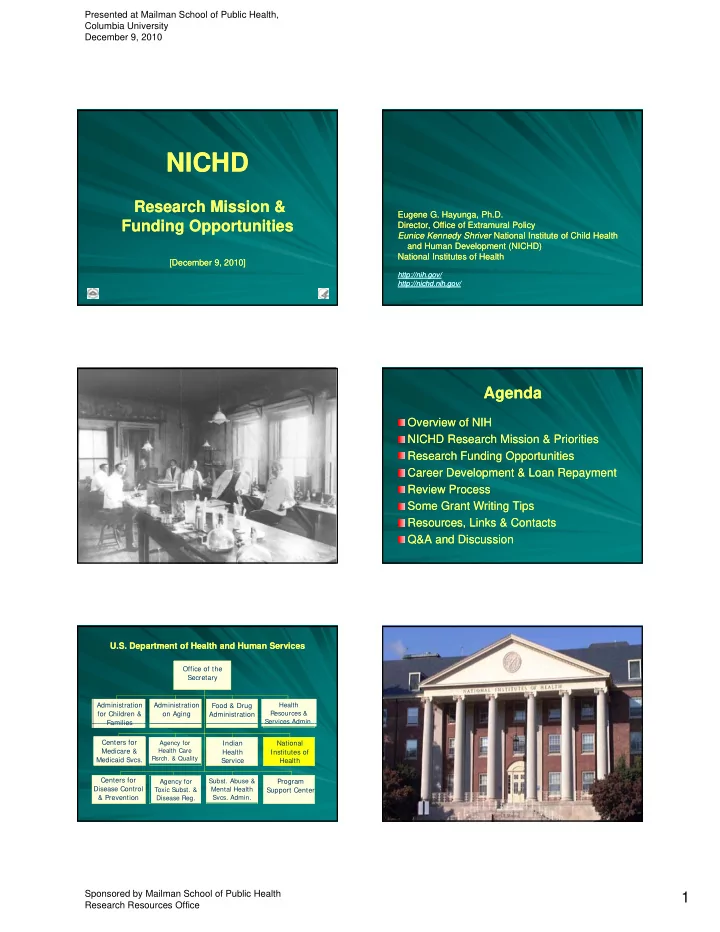
U.S. Department of Health and Human Services U.S. Department of Health and Human Services

Administration

  • n Aging

Food & Drug Administration Health Resources & Services Admin. Office of the Secretary Administration for Children & Families Se ces d Centers for Medicare & Medicaid Svcs.

Agency for Health Care

  • Rsrch. & Quality

Indian Health Service National Institutes of Health Centers for Disease Control & Prevention Agency for Toxic Subst. & Disease Reg.

  • Subst. Abuse &

Mental Health

  • Svcs. Admin.

Program Support Center Families

Presented at Mailman School of Public Health, Columbia University December 9, 2010 Sponsored by Mailman School of Public Health Research Resources Office
slide-2
SLIDE 2

2

NIH Mission NIH Mission

NIH is the steward of medical and behavioral research for the NIH is the steward of medical and behavioral research for the

  • Nation. Its mission is science in pursuit of fundamental
  • Nation. Its mission is science in pursuit of fundamental

knowledge about the nature and behavior of living systems knowledge about the nature and behavior of living systems and the application of that knowledge to extend healthy life and the application of that knowledge to extend healthy life and reduce the burdens of illness and disability. and reduce the burdens of illness and disability.

NIH Director’s Five Thematic NIH Director’s Five Thematic Areas Areas

Applying Genomics and Other High Throughput Applying Genomics and Other High Throughput Technologies Technologies Technologies Technologies Translating Basic Science Discoveries into New and Translating Basic Science Discoveries into New and Better Treatments Better Treatments Using Science to Enable Health Care Reform Using Science to Enable Health Care Reform Focusing on Global Health Focusing on Global Health Reinvigorating the Biomedical Research Community Reinvigorating the Biomedical Research Community

[RFA [RFA-

  • OD

OD-

  • 10

10-

  • 005]

005]

Research Support by NIH Research Support by NIH

NIH accounts for approximately 30% of the total NIH accounts for approximately 30% of the total national support for Health R&D. national support for Health R&D. NIH obligations account for approximately 79% NIH obligations account for approximately 79% f th F d l h f bli ti f H lth f th F d l h f bli ti f H lth

  • f the Federal share of obligations for Health
  • f the Federal share of obligations for Health

R&D. R&D. Approximately 80% of the NIH Budget is Approximately 80% of the NIH Budget is devoted to extramural awards. devoted to extramural awards. Over 90% of NIH’s extramural awards are Over 90% of NIH’s extramural awards are grants. grants.

Approximate Distribution of Approximate Distribution of NIH Expenditures NIH Expenditures Approximate Distribution of Approximate Distribution of NIH Expenditures NIH Expenditures

Other 7% Intramural Research 11% Extramural Expenditures 82%

Presented at Mailman School of Public Health, Columbia University December 9, 2010 Sponsored by Mailman School of Public Health Research Resources Office

slide-3
SLIDE 3

3

Annual Scope of Annual Scope of Activities Activities Annual Scope of Annual Scope of Activities Activities

NIH budget of approximately $30 billion NIH budget of approximately $30 billion Over 70,000 new or competing applications Over 70,000 new or competing applications NIH budget of approximately $30 billion NIH budget of approximately $30 billion Over 70,000 new or competing applications Over 70,000 new or competing applications Over 13,000 new or competing awards Over 13,000 new or competing awards Over 47,000 ongoing grant awards Over 47,000 ongoing grant awards Approximately 3,000 study section meetings Approximately 3,000 study section meetings Approximately 80 council meetings Approximately 80 council meetings Approximately 200 million pieces of paper Approximately 200 million pieces of paper

(prior to electronic submission) (prior to electronic submission)

Over 13,000 new or competing awards Over 13,000 new or competing awards Over 47,000 ongoing grant awards Over 47,000 ongoing grant awards Approximately 3,000 study section meetings Approximately 3,000 study section meetings Approximately 80 council meetings Approximately 80 council meetings Approximately 200 million pieces of paper Approximately 200 million pieces of paper

(prior to electronic submission) (prior to electronic submission)

NIH Budget

Allocation of NI H Appropriations

R&D Contracts All Other 8% RMS 4% I ntra- mural 10% Contracts 9% Research Grants 69%

NIH Organization NIH Organization

Office of the Director NI A NI AAA NI AI D NI AMS NCI NI CHD NI DCD NI DCR NI DDK NI DA NI EHS NEI NI GMS NHLBI NI MH NI NDS NI NR NHGRI NI BI B FI C NLM NCRR NI MHD NCCAM CSR CC CI T

The The Eunice Kennedy Shriver Eunice Kennedy Shriver National National Institute of Child Health and Human Institute of Child Health and Human Development (NICHD) Development (NICHD) Public Law 87 Public Law 87-

  • 838 (1962)

838 (1962) “…an institute for the conduct and support “…an institute for the conduct and support

  • f research and research training
  • f research and research training

related to maternal health, child health, related to maternal health, child health, and human development, and human development, including…the special health problems including…the special health problems

  • f mothers and children…”
  • f mothers and children…”

NICHD Mission NICHD Mission

The mission of the NICHD is to ensure that every The mission of the NICHD is to ensure that every person is born healthy and wanted, that women person is born healthy and wanted, that women suffer no harmful effects from reproductive suffer no harmful effects from reproductive processes, and that all children have the chance processes, and that all children have the chance to achieve their full potential for healthy and to achieve their full potential for healthy and productive lives, free from disease or disability, productive lives, free from disease or disability, and to ensure the health, productivity, and to ensure the health, productivity, independence, and well independence, and well-

  • being of all people

being of all people through optimal rehabilitation through optimal rehabilitation.

How do we get there from here? How do we get there from here?

Presented at Mailman School of Public Health, Columbia University December 9, 2010 Sponsored by Mailman School of Public Health Research Resources Office

slide-4
SLIDE 4

4

Contracts Contracts Grants Grants Grants Grants Cooperative Agreements Cooperative Agreements

Definitions Definitions

A contract is a legal instrument used to A contract is a legal instrument used to acquire services or goods for the direct acquire services or goods for the direct benefit or use of the Government. benefit or use of the Government. Grants and cooperative agreements are Grants and cooperative agreements are financial assistance mechanisms whereby financial assistance mechanisms whereby money and/or direct assistance is provided money and/or direct assistance is provided to carry out approved activities. to carry out approved activities.

Uses Uses

A contract is normally used when there is a need A contract is normally used when there is a need for substantial Government programmatic for substantial Government programmatic

  • versight during performance of the project.
  • versight during performance of the project.

A grant is used whenever the awarding office A grant is used whenever the awarding office anticipates no substantial programmatic anticipates no substantial programmatic anticipates no substantial programmatic anticipates no substantial programmatic involvement with the recipient during involvement with the recipient during performance of the financially assisted activities. performance of the financially assisted activities. A cooperative agreement is used when A cooperative agreement is used when substantial Federal programmatic involvement substantial Federal programmatic involvement with the recipient is anticipated during with the recipient is anticipated during performance. performance.

General Responsibilities General Responsibilities

With grants and cooperative agreements, With grants and cooperative agreements, the applicant investigators are responsible the applicant investigators are responsible for developing concepts, methods and for developing concepts, methods and h f th i h j t h f th i h j t approaches for their research projects. approaches for their research projects. With contracts, the awarding institute is With contracts, the awarding institute is responsible for establishing plans, responsible for establishing plans, protocols, and detailed requirements. protocols, and detailed requirements.

NIH Award NIH Award Mechanisms Mechanisms

R01? RFA? FOA? SRO? R01? RFA? FOA? SRO?

Don’t be afraid of the alphabet soup. Don’t be afraid of the alphabet soup. Find someone to help you navigate the Find someone to help you navigate the system. system.

Presented at Mailman School of Public Health, Columbia University December 9, 2010 Sponsored by Mailman School of Public Health Research Resources Office

slide-5
SLIDE 5

5

Who are we and how can Who are we and how can you find us? you find us?

NICHD Organization NICHD Organization

Office

  • f the

Director

Board of Scientific Counselors

National Advisory Board

  • n Medical Rehabilitation

Research National Advisory Child Health and Human Development Council Offi f Office of Science Policy, Analysis & Communication Office of Administrative Management

Center for Research for Mothers and Children National Center for Medical Rehabilitation Research Center for Developmental Biology and Perinatal Medicine Division of Epidemiology, Statistics, and Prevention Research Center for Population Research

Division of Intramural Research Division of Scientific Review

The NIH Extramural Team The NIH Extramural Team The NIH Extramural Team The NIH Extramural Team

Scientific Scientific Review Review Scientific Scientific Review Review Scientific Scientific Programs Programs Scientific Scientific Programs Programs Grants Grants Management Management Grants Grants Management Management Contracts Contracts Management Management Contracts Contracts Management Management

Manage Manage SRG SRG meetings meetings Select Select ad hoc ad hoc Nominate Nominate SRG SRG members members Assign review Assign review responsibilities responsibilities Communicate to Communicate to

Scientific Review Officer (SRO) Scientific Review Officer (SRO) Scientific Review Officer (SRO) Scientific Review Officer (SRO)

Scientific Review Officer Scientific Review Officer

ad hoc ad hoc reviewers reviewers and site and site visitors visitors Prepare Prepare summary summary statements statements Communicate Communicate with program with program staff on review staff on review matters matters Provide Provide

  • rientation
  • rientation

for SRG for SRG members members Advisory Councils Advisory Councils regarding SRG regarding SRG recommendations recommendations Think Think about about science science Browse Browse Science Science

IC Program Official IC Program Official IC Program Official IC Program Official

Program Program Program Program

Work with Work with grantees/ grantees/ applicants applicants Assess Assess portfolio portfolio balance balance Identify gaps Identify gaps in scientific in scientific programs programs Develop Develop new new initiatives initiatives Work with Grants Work with Grants Management Management

Program Program Official Official Program Program Official Official

Think Think about about science science Coordinate Coordinate with other with other ICs/Divisions ICs/Divisions Browse Browse Science Science Produce Produce reports reports Monitor Monitor progress of progress of projects projects Communicate Communicate with review with review staff on staff on program program matters matters

Grants Management Specialist Grants Management Specialist Grants Management Specialist Grants Management Specialist

G t G t G t G t

Provide Provide business business guidance to guidance to applicants applicants and and reviewers reviewers Assist in Assist in developing developing program program policy policy Interpret and Interpret and apply grant apply grant policy policy Maintain Maintain

  • fficial
  • fficial

grant grant files files Provide fiscal Provide fiscal

Grants Grants Management Management Specialist Specialist Grants Grants Management Management Specialist Specialist

Coordinate Coordinate with other with other ICs/Division ICs/Division s/Groups s/Groups Produce Produce Reports Reports Attend SRG Attend SRG meetings meetings as resource as resource Manage Manage Overall Overall budget budget Provide fiscal Provide fiscal management management

  • f grants
  • f grants

Participate with Participate with program staff in program staff in budget budget negotiations prior negotiations prior to and following to and following award award Award Award Grants Grants

Presented at Mailman School of Public Health, Columbia University December 9, 2010 Sponsored by Mailman School of Public Health Research Resources Office

slide-6
SLIDE 6

6

www.nih.gov www.nih.gov

What are our research What are our research priorities? priorities?

Center for Developmental Biology & Center for Developmental Biology & Perinatal Perinatal Medicine (CDBPM) Medicine (CDBPM)

The CDBPM supports scientists who are advancing fundamental The CDBPM supports scientists who are advancing fundamental and clinical knowledge about maternal health and problems of and clinical knowledge about maternal health and problems of child development, including preterm labor and birth, intellectual child development, including preterm labor and birth, intellectual and developmental disabilities, congenital and genetic disorders, and developmental disabilities, congenital and genetic disorders, fetal growth restriction, and other conditions. The Center and its fetal growth restriction, and other conditions. The Center and its programs aim to maximize human development, prevent programs aim to maximize human development, prevent diseases and disorders, and improve diagnoses, therapy, and diseases and disorders, and improve diagnoses, therapy, and clinical care. clinical care. Developmental Biology, Genetics & Teratology (DBGT) Branch Developmental Biology, Genetics & Teratology (DBGT) Branch Intellectual and Developmental Disabilities (IDD) Branch Intellectual and Developmental Disabilities (IDD) Branch Pregnancy and Pregnancy and Perinatology Perinatology (PP) Branch (PP) Branch

Developmental Biology, Genetics & Developmental Biology, Genetics & Teratology (DBGT) Branch Teratology (DBGT) Branch

The DBGT Branch supports basic and clinical research on normal The DBGT Branch supports basic and clinical research on normal and abnormal development that relates to the causes and and abnormal development that relates to the causes and prevention of congenital and genetic defects, as well as research prevention of congenital and genetic defects, as well as research training in relevant academic and medical areas. Among the training in relevant academic and medical areas. Among the Branch’s high Branch’s high-

  • priority research areas is basic research on

priority research areas is basic research on elucidating the biochemical, molecular biologic, genetic, and cellular elucidating the biochemical, molecular biologic, genetic, and cellular elucidating the biochemical, molecular biologic, genetic, and cellular elucidating the biochemical, molecular biologic, genetic, and cellular mechanisms of early development. mechanisms of early development. Developmental Immunology Developmental Immunology Developmental Neurobiology Developmental Neurobiology Developmental and Clinical Genetics and Genomics Developmental and Clinical Genetics and Genomics Developmental and Reproductive Immunology Developmental and Reproductive Immunology Early Embryonic Development Early Embryonic Development Organogenesis, Limb Development and Related Processes Organogenesis, Limb Development and Related Processes

Intellectual and Developmental Intellectual and Developmental Disabilities (IDD) Branch Disabilities (IDD) Branch

The The IDD Branch sponsors research and research training aimed IDD Branch sponsors research and research training aimed at preventing and ameliorating at preventing and ameliorating intellectual and related intellectual and related developmental disabilities. The program supports biomedical, developmental disabilities. The program supports biomedical, biobehavioral biobehavioral, behavioral, and translational research in etiology, , behavioral, and translational research in etiology, pathoph siolog pathoph siolog screening pre ention treatment and screening pre ention treatment and pathophysiology pathophysiology, screening, prevention, treatment, and , screening, prevention, treatment, and epidemiology. epidemiology. Behavioral, Behavioral, biobehavioral biobehavioral and social science research and social science research Biochemical and metabolic research Biochemical and metabolic research Biomedical and genetic/genomic research Biomedical and genetic/genomic research Prenatal diagnosis, newborn screening and population screening Prenatal diagnosis, newborn screening and population screening and diagnosis and diagnosis

Presented at Mailman School of Public Health, Columbia University December 9, 2010 Sponsored by Mailman School of Public Health Research Resources Office

slide-7
SLIDE 7

7

Pregnancy & Pregnancy & Perinatology Perinatology (PP) (PP) Branch Branch

The PP Branch seeks to improve the health of mothers and children with a The PP Branch seeks to improve the health of mothers and children with a focus on maternal health, pregnancy, fetal well being, labor and delivery, focus on maternal health, pregnancy, fetal well being, labor and delivery, and the developing child. The Branch supports research to: Determine basic and the developing child. The Branch supports research to: Determine basic mechanisms of normal and disease processes; identify new treatments, mechanisms of normal and disease processes; identify new treatments, methodologies, and preventative strategies; assess dissemination and methodologies, and preventative strategies; assess dissemination and impact of therapeutic and preventative interventions; and increase scientific impact of therapeutic and preventative interventions; and increase scientific resources through recruitment and training of investigators. resources through recruitment and training of investigators. Disorders of the Newborn Disorders of the Newborn Fetal Fetal Pathophysiology Pathophysiology High High-

  • Risk Pregnancy

Risk Pregnancy NICHD Neonatal Research Network (NRN): Extremely Preterm Birth NICHD Neonatal Research Network (NRN): Extremely Preterm Birth Outcome Data Outcome Data Preterm Labor and Birth Preterm Labor and Birth Suddent Suddent Infant Death Syndrome (SIDS) Infant Death Syndrome (SIDS)

Center for Population Research Center for Population Research (CPR) (CPR)

The CPR supports a range of population studies that aim to: understand The CPR supports a range of population studies that aim to: understand reproductive health and biology of the male and female; establish new reproductive health and biology of the male and female; establish new diagnostic and treatment methods for infertility; develop contraceptive diagnostic and treatment methods for infertility; develop contraceptive methods that are safe, effective, inexpensive, preferably reversible, and methods that are safe, effective, inexpensive, preferably reversible, and acceptable and those that reduce the spread of sexually transmitted acceptable and those that reduce the spread of sexually transmitted diseases; evaluate contraceptive methods, drugs, devices, and surgical diseases; evaluate contraceptive methods, drugs, devices, and surgical procedures related to reproductive health; ascertain the determinants of procedures related to reproductive health; ascertain the determinants of fertility and mortality; understand the consequences of population size and fertility and mortality; understand the consequences of population size and distribution changes; define the antecedents and consequences of distribution changes; define the antecedents and consequences of conditions that precipitate migration and immigration; examine resources conditions that precipitate migration and immigration; examine resources and other contextual influences on family functioning and child well and other contextual influences on family functioning and child well-

  • being.

being. Contraception and Reproductive Health (CRH) Branch Contraception and Reproductive Health (CRH) Branch Demographic and Behavioral Sciences (DBS) Branch Demographic and Behavioral Sciences (DBS) Branch Reproductive Sciences (RS) Branch Reproductive Sciences (RS) Branch

Contraception & Reproductive Contraception & Reproductive Health (CRH) Branch Health (CRH) Branch

The CRH Branch develops and supports research and research training The CRH Branch develops and supports research and research training programs in reproductive health, epidemiology and contraceptive programs in reproductive health, epidemiology and contraceptive

  • technology. Major research areas include studies of: New contraceptive
  • technology. Major research areas include studies of: New contraceptive

methods; mechanisms of action and effects of contraceptive and methods; mechanisms of action and effects of contraceptive and reproductive hormones, drugs, devices, and procedures; optimal reproductive hormones, drugs, devices, and procedures; optimal form lations and dosages of contracepti e agents spermicidal form lations and dosages of contracepti e agents spermicidal formulations and dosages of contraceptive agents, spermicidal formulations and dosages of contraceptive agents, spermicidal microbicides microbicides, and hormone replacement therapies (in animals and humans); , and hormone replacement therapies (in animals and humans); post post-

  • marketing surveillance of reproductive products, devices, and

marketing surveillance of reproductive products, devices, and procedures; and health and fertility effects of reproductive drugs, devices, procedures; and health and fertility effects of reproductive drugs, devices, and procedures. and procedures. Contraception Research and Development Contraception Research and Development Contraceptive and Reproductive Evaluation Contraceptive and Reproductive Evaluation Prevention of HIV/AIDS and other Sexually Transmitted Infections (STIs) Prevention of HIV/AIDS and other Sexually Transmitted Infections (STIs) Reproductive and Gynecological Health Issues Reproductive and Gynecological Health Issues

Demographic & Behavioral Sciences Demographic & Behavioral Sciences (DBS) Branch (DBS) Branch

The DBS Branch supports demographic, behavioral, and social sciences The DBS Branch supports demographic, behavioral, and social sciences research on fertility, families, population movement, morbidity and mortality, research on fertility, families, population movement, morbidity and mortality, HIV/AIDS, and population composition, research on population diversity and HIV/AIDS, and population composition, research on population diversity and change, studies of the consequences of population diversity and change for change, studies of the consequences of population diversity and change for health and well health and well-

  • being, and research on the interrelationships among

being, and research on the interrelationships among individual, family, group, community, and population processes are all individual, family, group, community, and population processes are all y g p y p p p y g p y p p p central to this mission. central to this mission. Family, Children and Intergenerational Research Family, Children and Intergenerational Research Fertility, Infertility and Reproductive Health Fertility, Infertility and Reproductive Health HIV/AIDS and Sexually Transmitted Infections (STIs) HIV/AIDS and Sexually Transmitted Infections (STIs) Health, Health Disparities and Mortality Health, Health Disparities and Mortality Immigrants, Migration and Population Distribution Immigrants, Migration and Population Distribution Population Research Infrastructure Program (PRIP) Population Research Infrastructure Program (PRIP) Race, Ethnicity, Population Composition and Change Race, Ethnicity, Population Composition and Change Research Methodologies Research Methodologies

Reproductive Sciences (RS) Branch Reproductive Sciences (RS) Branch

The RS Branch supports research aimed at alleviating human infertility, The RS Branch supports research aimed at alleviating human infertility, uncovering new contraceptive leads and expanding fundamental knowledge uncovering new contraceptive leads and expanding fundamental knowledge

  • f processes that underlie human reproduction, to include basic, clinical and
  • f processes that underlie human reproduction, to include basic, clinical and

translational studies that will enhance our understanding of normal translational studies that will enhance our understanding of normal reproduction and reproductive reproduction and reproductive pathophysiology pathophysiology, as well as enable the , as well as enable the development of more effective strategies for the diagnosis, management development of more effective strategies for the diagnosis, management and prevention of conditions that compromise reproductive health and prevention of conditions that compromise reproductive health and prevention of conditions that compromise reproductive health. and prevention of conditions that compromise reproductive health. Fertility Preservation Fertility Preservation Male Reproductive Health Male Reproductive Health Ovarian Biology Ovarian Biology Pre Pre-

  • implantation Genetics and Development

implantation Genetics and Development Reproductive Endocrinology and Immunology Reproductive Endocrinology and Immunology Reproductive Genetics and Reproductive Genetics and Epigenetics Epigenetics Reproductive Medicine :Infertility and Gynecology Reproductive Medicine :Infertility and Gynecology Reproductive Reproductive Neuroendocrinology Neuroendocrinology

Center for Research for Mothers & Center for Research for Mothers & Children (CRMC) Children (CRMC)

The CRMC supports research and research training in maternal and The CRMC supports research and research training in maternal and child health, to include gestational diabetes, antecedents of adult child health, to include gestational diabetes, antecedents of adult diseases, obesity and overweight, specific learning disabilities, diseases, obesity and overweight, specific learning disabilities, mechanisms of cognition and learning, growth retardation, mechanisms of cognition and learning, growth retardation, HIV/AIDS d th it l i f ti d di d HIV/AIDS d th it l i f ti d di d HIV/AIDS, and other congenital infections and diseases, and HIV/AIDS, and other congenital infections and diseases, and promotes research to understand the effects and effectiveness of promotes research to understand the effects and effectiveness of pharmaceuticals on maternal and child health. pharmaceuticals on maternal and child health. Child Development and Behavior (CDB) Branch Child Development and Behavior (CDB) Branch Endocrinology, Nutrition and Growth (ENG) Branch Endocrinology, Nutrition and Growth (ENG) Branch Obstetric and Pediatric Pharmacology (OPP) Branch Obstetric and Pediatric Pharmacology (OPP) Branch Pediatric, Adolescent and Maternal AIDS (PAMA) Branch Pediatric, Adolescent and Maternal AIDS (PAMA) Branch

Presented at Mailman School of Public Health, Columbia University December 9, 2010 Sponsored by Mailman School of Public Health Research Resources Office

slide-8
SLIDE 8

8

Child Development & Behavior Child Development & Behavior (CDB) Branch (CDB) Branch

The CDB Branch develops scientific initiatives and supports research and research The CDB Branch develops scientific initiatives and supports research and research training relevant to the psychological, psychobiological, language, behavioral, and training relevant to the psychological, psychobiological, language, behavioral, and educational development of children. The following theme characterizes all Branch educational development of children. The following theme characterizes all Branch programs: Development is best described and studied as a variable process in which programs: Development is best described and studied as a variable process in which individual differences in cognitive, social, affective, language, neurobiological individual differences in cognitive, social, affective, language, neurobiological maturation, environment and life experiences, and genetics interact in complex ways. maturation, environment and life experiences, and genetics interact in complex ways. Developmental Cognitive Psychology, Behavioral Neuroscience and Psychobiology Developmental Cognitive Psychology, Behavioral Neuroscience and Psychobiology Program Program Early Learning and School Readiness Program Early Learning and School Readiness Program Human Human-

  • Animal Interaction (HAI) Research Program

Animal Interaction (HAI) Research Program Language, Bilingualism and Language, Bilingualism and Biliteracy Biliteracy (LBB) Program (LBB) Program Mathematics and Science Cognition and Learning: Developmental and Disorders Mathematics and Science Cognition and Learning: Developmental and Disorders Program Program NICHD Summer Research Institute in Applied Child and Adolescent Development NICHD Summer Research Institute in Applied Child and Adolescent Development Pediatric Behavior and Health Promotion Research Program Pediatric Behavior and Health Promotion Research Program Reading, Writing and Related Learning Disabilities Program Reading, Writing and Related Learning Disabilities Program Social and Affective Development/Child Maltreatment and Violence Program Social and Affective Development/Child Maltreatment and Violence Program

Endocrinology, Nutrition & Endocrinology, Nutrition & Growth (ENG) Branch Growth (ENG) Branch

The ENG Branch provides the NICHD with a focus for The ENG Branch provides the NICHD with a focus for research and research training in nutritional science, research and research training in nutritional science, childhood antecedents of adult disease, developmental childhood antecedents of adult disease, developmental endocrinology, developmental endocrinology, developmental neuroendocrinology neuroendocrinology, and , and physical growth and body composition, including bone health physical growth and body composition, including bone health and obesity. Research supported in these areas is directed and obesity. Research supported in these areas is directed toward laying the groundwork for future health. toward laying the groundwork for future health. Endocrinology Endocrinology Growth and Development Growth and Development Nutrition Nutrition Prevention of Chronic Disease Prevention of Chronic Disease

Obstetric & Pediatric Pharmacology Obstetric & Pediatric Pharmacology (OPP) Branch (OPP) Branch

The OPP Branch promotes research to improve the safety and The OPP Branch promotes research to improve the safety and efficacy of pharmaceuticals and to ensure centralization and efficacy of pharmaceuticals and to ensure centralization and coordination of research, clinical trials, and drug development coordination of research, clinical trials, and drug development activities for obstetric and pediatric populations. The Best activities for obstetric and pediatric populations. The Best Pharmaceuticals for Children Act (BPCA) activities at the NICHD is Pharmaceuticals for Children Act (BPCA) activities at the NICHD is a major activity for the Branch, which is responsible for developing a major activity for the Branch, which is responsible for developing j y , p p g j y , p p g and supporting a comprehensive national effort to increase the and supporting a comprehensive national effort to increase the knowledge base for understanding how to appropriately treat knowledge base for understanding how to appropriately treat disease during pregnancy, infancy, and childhood using disease during pregnancy, infancy, and childhood using pharmaceuticals that are appropriately tested within their target pharmaceuticals that are appropriately tested within their target populations. populations. Best Pharmaceuticals for Children Act (BPCA) Best Pharmaceuticals for Children Act (BPCA) Obstetric Obstetric-

  • Fetal Pharmacology Research Unit (OPRU) Network

Fetal Pharmacology Research Unit (OPRU) Network Pediatric Pharmacology Research Unit (PPRU) Network Pediatric Pharmacology Research Unit (PPRU) Network

Pediatric, Adolescent & Maternal Pediatric, Adolescent & Maternal AIDS (PAMA) Branch AIDS (PAMA) Branch

The PAMA Branch supports and conducts both domestic and international The PAMA Branch supports and conducts both domestic and international research into the epidemiology, natural history, pathogenesis, transmission, research into the epidemiology, natural history, pathogenesis, transmission, treatment, and prevention of HIV infection and its complications in infants, treatment, and prevention of HIV infection and its complications in infants, children, adolescents, pregnant women, mothers, women of childbearing children, adolescents, pregnant women, mothers, women of childbearing age, and the family unit as a whole. The Branch seeks to maximize age, and the family unit as a whole. The Branch seeks to maximize cooperation with other NICHD components, other federal components and cooperation with other NICHD components, other federal components and agencies and interested private organizations that share a focus on agencies and interested private organizations that share a focus on agencies, and interested private organizations that share a focus on agencies, and interested private organizations that share a focus on maternal, adolescent, and pediatric HIV infection and disease, while maternal, adolescent, and pediatric HIV infection and disease, while avoiding overlap with other efforts. avoiding overlap with other efforts. Adolescent HIV Infection and Disease Adolescent HIV Infection and Disease Epidemiology, Natural History and Therapeutic Research of HIV Epidemiology, Natural History and Therapeutic Research of HIV Infection in Pregnant and Non Infection in Pregnant and Non-

  • Pregnant Women, Infants, Children and

Pregnant Women, Infants, Children and Adolescents Adolescents Pediatric and Maternal Biomedical HIV Pediatric and Maternal Biomedical HIV-

  • Related Research Issues

Related Research Issues Global Network Global Network

National Center for Medical National Center for Medical Rehabilitation Research (NCMRR) Rehabilitation Research (NCMRR)

The NCMRR aims to foster development of scientific knowledge The NCMRR aims to foster development of scientific knowledge needed to enhance the health, productivity, independence, and quality needed to enhance the health, productivity, independence, and quality-

  • f
  • f-
  • life of people with disabilities. A primary goal of Center

life of people with disabilities. A primary goal of Center-

  • supported

supported research is to bring the health related problems of people with research is to bring the health related problems of people with disabilities to the attention of the best scientists in order to capitalize disabilities to the attention of the best scientists in order to capitalize upon the myriad advances occurring in the biological, behavioral, and upon the myriad advances occurring in the biological, behavioral, and engineering sciences. engineering sciences. Behavioral Sciences and Rehabilitation Technologies (BSRT) Program Behavioral Sciences and Rehabilitation Technologies (BSRT) Program Biological Science and Career Development (BSCD) Program Biological Science and Career Development (BSCD) Program Pediatric Critical Care and Rehabilitation (PCCR) Program Pediatric Critical Care and Rehabilitation (PCCR) Program Spinal Cord and Musculoskeletal Disorders and Assistive Devices Spinal Cord and Musculoskeletal Disorders and Assistive Devices (SMAD) Program (SMAD) Program Traumatic Brain Injury (TBI) Program Traumatic Brain Injury (TBI) Program Stroke Rehabilitation (TSR) Program Stroke Rehabilitation (TSR) Program

Division of Special Populations (DSP) Division of Special Populations (DSP)

The DSP supports programs to ensure the health and well The DSP supports programs to ensure the health and well-

  • being of

being of children, adults, families, and communities by addressing and children, adults, families, and communities by addressing and eliminating health disparities through the participation of diverse eliminating health disparities through the participation of diverse populations in biomedical and behavioral research within the United populations in biomedical and behavioral research within the United States and abroad. The DSP informs the public about issues related States and abroad. The DSP informs the public about issues related to health disparities; develops initiatives that encourage, facilitate, to health disparities; develops initiatives that encourage, facilitate, p ; p g , , p ; p g , , and increase participation of diverse populations and developing and increase participation of diverse populations and developing nations in biomedical and behavioral research; and develops nations in biomedical and behavioral research; and develops research and scientific leadership in colleges and universities research and scientific leadership in colleges and universities worldwide. worldwide. Extramural Associates (EA) Program Extramural Associates (EA) Program Research Supplements to Promote Diversity in Health Research Supplements to Promote Diversity in Health-

  • Related

Related Research Program Research Program Academic/Community Partnership Conference Series. Academic/Community Partnership Conference Series.

Presented at Mailman School of Public Health, Columbia University December 9, 2010 Sponsored by Mailman School of Public Health Research Resources Office

slide-9
SLIDE 9

9

Division of Epidemiology, Statistics Division of Epidemiology, Statistics & Prevention Research (DESPR & Prevention Research (DESPR)

DESPR conducts research and supports research training in DESPR conducts research and supports research training in the fields of reproduction, child health, and maternal health as the fields of reproduction, child health, and maternal health as part of the NICHD’s intramural research portfolio. The part of the NICHD’s intramural research portfolio. The pa

  • e

C s a u a esea c po

  • o

e pa

  • e

C s a u a esea c po

  • o

e Division’s research portfolio includes studies on: infant Division’s research portfolio includes studies on: infant mortality; biostatistics, mathematics, and statistical mortality; biostatistics, mathematics, and statistical methodology and consultation; epidemiology; human methodology and consultation; epidemiology; human fecundity and fertility; pregnancy complications and adverse fecundity and fertility; pregnancy complications and adverse pregnancy outcomes; childhood injuries; teen driving; pregnancy outcomes; childhood injuries; teen driving; pediatric infectious diseases; birth defects; and behavioral pediatric infectious diseases; birth defects; and behavioral research in health promotion and disease prevention. research in health promotion and disease prevention.

How to Find Funded Projects How to Find Funded Projects d P t ti l C ll b t d P t ti l C ll b t and Potential Collaborators and Potential Collaborators

http://projectreporter.nih.gov/reporter.cfm http://projectreporter.nih.gov/reporter.cfm

Looking Towards the Future Looking Towards the Future Looking Towards the Future Looking Towards the Future

NICHD's Scientific Vision: NICHD's Scientific Vision: The Next Decade The Next Decade

Throughout the coming year, the NICHD will collaborate Throughout the coming year, the NICHD will collaborate with its many stakeholders to identify the most promising with its many stakeholders to identify the most promising scientific opportunities of the next decade across the scientific opportunities of the next decade across the breadth of the Institute’s mission breadth of the Institute’s mission breadth of the Institute s mission. breadth of the Institute s mission. The aim of this process is to develop a scientific Vision The aim of this process is to develop a scientific Vision that sets an ambitious agenda and inspires the NICHD, that sets an ambitious agenda and inspires the NICHD, its many partners, and the research community to its many partners, and the research community to achieve critical scientific goals and meet pressing public achieve critical scientific goals and meet pressing public health needs. health needs.

http://www.nichd.nih.gov/vision/index.cfm http://www.nichd.nih.gov/vision/index.cfm

Presented at Mailman School of Public Health, Columbia University December 9, 2010 Sponsored by Mailman School of Public Health Research Resources Office

slide-10
SLIDE 10

10

Visioning Process and Timeline Visioning Process and Timeline

May 2010 May 2010: The NICHD convenes a group of extramural and : The NICHD convenes a group of extramural and intramural staff members to identify broad intramural staff members to identify broad scientific themes scientific themes that encompass the NICHD’s multifaceted research portfolio. that encompass the NICHD’s multifaceted research portfolio. June 2010 June 2010: Then Acting Director Dr. Alan : Then Acting Director Dr. Alan Guttmacher Guttmacher, M.D., , M.D., presents the proposed Vision process to the National presents the proposed Vision process to the National p p p p p p p p Advisory Child Health and Human Development (NACHHD) Advisory Child Health and Human Development (NACHHD) Council, the Institute’s federal advisory committee, to seek Council, the Institute’s federal advisory committee, to seek input and approval of the Vision themes. input and approval of the Vision themes. January January— —March 2011 March 2011: The NICHD sponsors a series of : The NICHD sponsors a series of workshops workshops to facilitate focused discussions on the scientific to facilitate focused discussions on the scientific

  • pportunities and needs related to each Vision theme. White
  • pportunities and needs related to each Vision theme. White

papers produced at the conclusion of the workshops form the papers produced at the conclusion of the workshops form the foundation for the draft scientific Vision statement. foundation for the draft scientific Vision statement.

Visioning Process and Timeline Visioning Process and Timeline (cont’d) (cont’d)

June 2011 June 2011: The NICHD holds a large multidisciplinary : The NICHD holds a large multidisciplinary conference at which participants provide feedback to the draft conference at which participants provide feedback to the draft scientific Vision statement. scientific Vision statement. September 2011 September 2011: NICHD leadership presents the draft vision : NICHD leadership presents the draft vision p p p p p statement to the NACHHD Council for additional input. statement to the NACHHD Council for additional input. By December 2011 By December 2011: The NICHD completes the final version : The NICHD completes the final version

  • f the scientific Vision statement and prepares it for
  • f the scientific Vision statement and prepares it for

publication to inform the Institute's partners and stakeholders publication to inform the Institute's partners and stakeholders and to help stimulate future research activities. and to help stimulate future research activities. The NICHD welcomes public feedback throughout the Vision The NICHD welcomes public feedback throughout the Vision

  • process. Please send all questions and comments to:
  • process. Please send all questions and comments to:

NICHDvision@mail.nih.gov NICHDvision@mail.nih.gov. .

Overarching Questions Overarching Questions

In the scientific theme area, consider questions vital to the NICHD In the scientific theme area, consider questions vital to the NICHD mission over the next ten years mission over the next ten years: What are compelling scientific research opportunities within the What are compelling scientific research opportunities within the workshop thematic area that lie within the NICHD mission? workshop thematic area that lie within the NICHD mission? T l it th t iti T l it th t iti To exploit these opportunities: To exploit these opportunities:

– What basic, clinical, and translational research questions must be What basic, clinical, and translational research questions must be answered? answered? – How would answering the questions affect public & global health? How would answering the questions affect public & global health? – What research tools, methods, or approaches should be developed What research tools, methods, or approaches should be developed to realize these scientific and public health opportunities? to realize these scientific and public health opportunities?

What innovative training and other workforce development What innovative training and other workforce development activities should be pursued? activities should be pursued?

NICHD Visioning Theme Workshops NICHD Visioning Theme Workshops

Plasticity Plasticity– – January 13 January 13-

  • 14

14 Reproduction Reproduction– – January 25 January 25-

  • 26

26 Development Development– – February 9 February 9-

  • 10

10 Developmental Origins Developmental Origins– – February 14 February 14-

  • 15

15 Developmental Origins Developmental Origins February 14 February 14 15 15 Behavior Behavior– – February 17 February 17-

  • 18

18 Pregnancy and Pregnancy Outcomes Pregnancy and Pregnancy Outcomes– – February 22 February 22-

  • 23

23 Diagnostics and Therapeutics Diagnostics and Therapeutics – – March 1 March 1-

  • 2

2 Environment Environment– – March 10 March 10-

  • 11

11 Cognition Cognition– – March 14 March 14-

  • 15

15

Vision Themes: Cross Vision Themes: Cross-

  • cutting Issues

cutting Issues

(topics important to all scientific Vision theme areas) (topics important to all scientific Vision theme areas)

Analytical and measurement Analytical and measurement tools & methods tools & methods Animal & computational models Animal & computational models Bioethics Bioethics Epigenetics Epigenetics/meta /meta-

  • genomics

genomics Functional status Functional status Global health Global health Implementation science Implementation science Bioethics Bioethics Bioinformatics Bioinformatics Biotechnologies/bioengineering, Biotechnologies/bioengineering, including high throughput, including high throughput, assistive, and other related assistive, and other related technologies technologies Developmental Trajectory Developmental Trajectory Differences/disparities across Differences/disparities across populations populations Implementation science, Implementation science, including health economics including health economics Nutrition Nutrition Prevention/personalized Prevention/personalized medicing medicing Stem cells Stem cells Systems biology Systems biology Training and mentoring Training and mentoring

Funding Opportunity Funding Opportunity Announcements Announcements

Presented at Mailman School of Public Health, Columbia University December 9, 2010 Sponsored by Mailman School of Public Health Research Resources Office

slide-11
SLIDE 11

11

Current NICHD RFAs Current NICHD RFAs

RFA RFA-

  • HD

HD-

  • 12

12-

  • 105: The Role of Human

105: The Role of Human-

  • Animal interactions

Animal interactions in Child Health and Development (R03) in Child Health and Development (R03) – – receipt date: receipt date: 12/21/2010 12/21/2010 RFA RFA-

  • HD

HD-

  • 10

10-

  • 017: Identifying and Understanding Effective

017: Identifying and Understanding Effective Interventions for Orphans and Vulnerable Children Interventions for Orphans and Vulnerable Children Interventions for Orphans and Vulnerable Children Interventions for Orphans and Vulnerable Children Affected by HIV/AIDS (R01) Affected by HIV/AIDS (R01) – – receipt date: 12/30/2010 receipt date: 12/30/2010 RFA RFA-

  • HD

HD-

  • 10

10-

  • 001: Systems Oriented Pediatric Obesity

001: Systems Oriented Pediatric Obesity Research and Training (SPORT) Center of Excellence Research and Training (SPORT) Center of Excellence (U54) (U54) – – receipt date: 12/30/2010 receipt date: 12/30/2010 RFA RFA-

  • HD

HD-

  • 12

12-

  • 169: Specialized Cooperative Centers

169: Specialized Cooperative Centers Program in Reproduction and Fertility Research (U54) Program in Reproduction and Fertility Research (U54) – – receipt date: 5/26/2011 receipt date: 5/26/2011

Some Recent NICHD PAs Some Recent NICHD PAs

PAR PAR-

  • 11

11-

  • 039/040/041: Understanding and Treating Co

039/040/041: Understanding and Treating Co-

  • Morbid

Morbid Conditions in Adolescents with Intellectual and Developmental Conditions in Adolescents with Intellectual and Developmental Disabilities (R01/R03/R21) Disabilities (R01/R03/R21) PAR PAR-

  • 10

10-

  • 276: Dual Purpose with Dual Benefit: Research in

276: Dual Purpose with Dual Benefit: Research in Biomedicine and Agriculture Using Agriculturally Important Domestic Biomedicine and Agriculture Using Agriculturally Important Domestic Species (R01) Species (R01) Species (R01) Species (R01) PAR PAR-

  • 10

10-

  • 230/231/232: Innovative Therapies and Tools for

230/231/232: Innovative Therapies and Tools for Screenable Screenable Disorders in Newborns (R01/R03/R21) Disorders in Newborns (R01/R03/R21) PAR PAR-

  • 10

10-

  • 221/222: Biophysical and Biomechanical Aspects of

221/222: Biophysical and Biomechanical Aspects of Embryonic Development (R01/R21) Embryonic Development (R01/R21) PAR PAR-

  • 10

10-

  • 190/191/192:

190/191/192: Vulvodynia Vulvodynia – – Systematic, Epidemiologic, Systematic, Epidemiologic, Etiologic or Therapeutic Studies (R01/R03/R21) Etiologic or Therapeutic Studies (R01/R03/R21) PAR PAR-

  • 10

10-

  • 154: Innovative Neuroscience K

154: Innovative Neuroscience K-

  • 12 Education (SBIR:

12 Education (SBIR: R43/R44) R43/R44)

Keep the Pipeline Flowing Keep the Pipeline Flowing

Career Path for an MD

T35- Short-term Training Grant for Health Professional Students F33- Sr. Postdoctoral Fellowship (NRSA) K08- Mentored Clinical Scientist Development Award K23- Mentored Patient-Oriented Research Career Development Award K24- Mid-Career Investigator in Patient-Oriented Research K07, K12- IC specific Plus all mechanisms from Ph.D. track

Medical Student Independent PI M.D. Faculty Position

T35 T32

  • r

F32 R01 R37 K08

  • r

K23 K22

Clinical Training

K02 K24 F33 R21 K99/ R00

Career Path for a Ph.D.

T32- Institutional training grant (NRSA)-has pre-& postdoc slots F30 and F31- Individual predoc fellowship (NRSA) (some ICs only support Diversity F30/31s) F32- Individual postdoc fellowship (NRSA) F33- Sr. postdoc fellowship (NRSA) R03- Small Grant R21- Exploratory/Developmental Research Grant R01- Research grant K02- Independent Scientist Award K22- Research Scholar Development Award K99/R00- Pathway to Independence Award R37- Merit award P01- Program Project Grant U01- Cooperative Agreement

Graduate student Independent PI Ph.D. Faculty Position

T32 F31 F32

  • r

T32 K22 R01 R37 K02 F33 R21 R03

Diversity Supplements

K99/ R00 Ps Us

Training Grants (Ts) Training Grants (Ts)

NRSA NRSA-

  • National Research Service Award

National Research Service Award Legislated, program began in 1974 (P.L. 93 Legislated, program began in 1974 (P.L. 93-

  • 348)

348) Multi Multi-

  • slot awards

slot awards Domestic institutions only Domestic institutions only Fund training programs for pre Fund training programs for pre-

  • and

and postdocs postdocs in any in any Fund training programs for pre Fund training programs for pre-

  • and

and postdocs postdocs in any in any scientific area within our scientific mission scientific area within our scientific mission Can be basic or clinical Can be basic or clinical Trainees work in a mentor’s lab Trainees work in a mentor’s lab MDs, PhDs, DVMs MDs, PhDs, DVMs Awards go the best training programs in the Nation Awards go the best training programs in the Nation

Presented at Mailman School of Public Health, Columbia University December 9, 2010 Sponsored by Mailman School of Public Health Research Resources Office

slide-12
SLIDE 12

12

Fellowships (Fs) Fellowships (Fs)

NRSA NRSA-

  • National Research Service Award

National Research Service Award Legislated, program began in 1974 (P.L. 93 Legislated, program began in 1974 (P.L. 93-

  • 348)

348) Individual Individual awards under a mentor awards under a mentor Training can be at domestic or foreign institutions Training can be at domestic or foreign institutions F d F d d td td t i i i tifi ithi t i i i tifi ithi Fund pre Fund pre-

  • and

and postdoc postdoc trainees in any scientific area within trainees in any scientific area within

  • ur scientific mission
  • ur scientific mission

Can be basic or clinical Can be basic or clinical -

  • most are basic

most are basic Most awardees are for Ph.D.s Most awardees are for Ph.D.s F Kiosk: F Kiosk: http://grants.nih.gov/training/F_files_nrsa.htm http://grants.nih.gov/training/F_files_nrsa.htm

Career Development Awards (Ks) Career Development Awards (Ks)

Individual awards Individual awards Mechanisms for basic and clinical Investigators Mechanisms for basic and clinical Investigators Some mentored others not Some mentored others not Some designed as awards for faculty investigators Some designed as awards for faculty investigators Newer programs (K22 and K99/R00) are transition awards Newer programs (K22 and K99/R00) are transition awards-

  • these are for MDs and PhDs

these are for MDs and PhDs K Kiosk: K Kiosk: http://grants.nih.gov/training/careerdevelopmentawards.htm http://grants.nih.gov/training/careerdevelopmentawards.htm

Training Grants Training Grants

Some all Some all predoc predoc/some all /some all postdoc postdoc Most are a mixture of slots Most are a mixture of slots Funds are mostly for tuition and trainees Funds are mostly for tuition and trainees Training Related Expenses may be used to defray costs such as Training Related Expenses may be used to defray costs such as staff salaries, equipment, research supplies, and other expenses staff salaries, equipment, research supplies, and other expenses directly related to the training program directly related to the training program y g p g y g p g Costs: Costs: – Tuition Tuition-

  • 60% of requested tuition, capped at $16,000 ($21K for

60% of requested tuition, capped at $16,000 ($21K for MD MD-

  • PhD programs)

PhD programs) – Stipends Stipends-

  • $20,772 pre/

$20,772 pre/ postdoc postdoc $36,996 (level 0) $36,996 (level 0)-

  • $51,036 (level

$51,036 (level 7) 7) – Training Related Expenses Training Related Expenses-

  • $4,200 pre/$7,850 (post); both

$4,200 pre/$7,850 (post); both include health insurance include health insurance – Travel Travel-

  • $400

$400-

  • $1000

$1000 – F&As F&As-

  • 8%

8%

F30s and F31s F30s and F31s Predoc Predoc Fellowships Fellowships

Individual awards Individual awards Cannot change the scope, move fellowship, or change Cannot change the scope, move fellowship, or change mentor without prior NIH approval! (They do anyway) mentor without prior NIH approval! (They do anyway) Predoctoral Predoctoral NRSA awards limited to 5 years total NRSA awards limited to 5 years total Tuition Tuition- 60% of requested tuition, capped at $16,000 60% of requested tuition, capped at $16,000 Tuition Tuition 60% of requested tuition, capped at $16,000 60% of requested tuition, capped at $16,000 ($21K for MD ($21K for MD-

  • PhD programs)

PhD programs) Stipends Stipends-

  • $20,772 pre

$20,772 pre Training Related Expenses Training Related Expenses-

  • $4,200 includes health

$4,200 includes health insurance insurance Travel Travel-

  • $400

$400-

  • $1000

$1000

F32s F32s Postdoc Postdoc NRSA Fellowships NRSA Fellowships

Postdoc Postdoc only

  • nly

Individual award Individual award Cannot change the scope, move fellowship, or change Cannot change the scope, move fellowship, or change mentor without prior NIH approval! (They do anyway) mentor without prior NIH approval! (They do anyway) NRSA support for up to 3 years total NRSA support for up to 3 years total Stipends Stipends-

  • $36,996 (level 0)

$36,996 (level 0)-

  • $51,036 (level 7)

$51,036 (level 7) – Training Related Expenses Training Related Expenses-

  • $7,850; includes health

$7,850; includes health insurance insurance – Travel Travel-

  • $400

$400-

  • $1000

$1000

F33 Senior F33 Senior Postdoc Postdoc Fellowships Fellowships

Not for Not for postdocs postdocs who have been who have been postdocs postdocs a long time a long time Used for associate or full professors who want support Used for associate or full professors who want support for a sabbatical for a sabbatical For MDs or PhDs For MDs or PhDs Few applicants Few applicants - too little money too little money Few applicants Few applicants too little money too little money Stipend = $51,036 Stipend = $51,036 Training Related Expenses Training Related Expenses -

  • $7,850; includes health

$7,850; includes health insurance insurance Travel Travel-

  • $400

$400-

  • $1,000

$1,000

Presented at Mailman School of Public Health, Columbia University December 9, 2010 Sponsored by Mailman School of Public Health Research Resources Office

slide-13
SLIDE 13

13

Fellowship Review Criteria Fellowship Review Criteria

In addition to an Overall Impact score there are In addition to an Overall Impact score there are five Core Review Criteria for Fellowships: five Core Review Criteria for Fellowships:

– Fellowship Applicant Fellowship Applicant – Sponsors, Collaborators, and Consultants Sponsors, Collaborators, and Consultants – Research Training Plan Research Training Plan – Training Potential Training Potential – Institutional Environment & Commitment to Training Institutional Environment & Commitment to Training

K01 K01-

  • Mentored Research Scientist

Mentored Research Scientist Development Award Development Award

Support development experiences leading to research

Support development experiences leading to research independence, training in new field or following hiatus in independence, training in new field or following hiatus in a research career (varies by IC) a research career (varies by IC)

MDs or PhDs

MDs or PhDs

3 5 years

5 years

3-5 years

5 years

Salary Cap varies by IC + FBs

Salary Cap varies by IC + FBs

Research Support: up to $50,000/yr

Research Support: up to $50,000/yr (varies by IC)

(varies by IC)

F&As= 8%

F&As= 8%

IC contacts and policies:

IC contacts and policies:

http://grants2.nih.gov/grants/guide/pa http://grants2.nih.gov/grants/guide/pa-

  • files/PA

files/PA-

  • 10

10-

  • 056.html

056.html IMPORTANT: NICHD K01s limited to Medical Rehabilitation Medicine, IMPORTANT: NICHD K01s limited to Medical Rehabilitation Medicine, Child Abuse and Neglect, and Population Research. Child Abuse and Neglect, and Population Research.

K02 Independent Scientist Award K02 Independent Scientist Award

Best candidate is a “senior” assistant professor or Best candidate is a “senior” assistant professor or “junior” associate professor “junior” associate professor Close to or recently promoted and tenured Close to or recently promoted and tenured Must have independent grant support as PI, e.g., R01 Must have independent grant support as PI, e.g., R01 MDs (very few) and PhDs MDs (very few) and PhDs S l t l S l t l Salary support only Salary support only Salary cap varies by IC + FBs for up to 5 years Salary cap varies by IC + FBs for up to 5 years Gives up salary support from all other NIH grants! Gives up salary support from all other NIH grants! Relatively few applicants Relatively few applicants F&As= 8% F&As= 8%

K08 K08-

  • Mentored Clinical Scientist Development Award

Mentored Clinical Scientist Development Award

K23 K23-

  • Mentored Patient

Mentored Patient-

  • Oriented Research Career

Oriented Research Career K08 K08 -

  • supports didactic study and mentored research for

supports didactic study and mentored research for individuals with clinical doctoral degrees individuals with clinical doctoral degrees K23 K23 -

  • for clinical/patient

for clinical/patient-

  • oriented project
  • riented project

3-

  • 5 yr award, varies by IC

5 yr award, varies by IC Salary cap varies by IC + FBs Salary cap varies by IC + FBs Salary cap varies by IC FBs Salary cap varies by IC FBs Research Support up to $50,000/yr (varies by IC) Research Support up to $50,000/yr (varies by IC) F&As= 8% F&As= 8% For IC Contacts and policies For IC Contacts and policies

– http://grants.nih.gov/grants/guide/contacts/parent_K08.html http://grants.nih.gov/grants/guide/contacts/parent_K08.html – http://grants.nih.gov/grants/guide/contacts/parent_K23.html http://grants.nih.gov/grants/guide/contacts/parent_K23.html

K24 K24 Mid

Mid-

  • Career Investigator Award in Patient

Career Investigator Award in Patient-

  • Oriented Research

Oriented Research Provide support for clinician investigators to allow them Provide support for clinician investigators to allow them protected time to devote to patient protected time to devote to patient-

  • oriented research
  • riented research

(POR) and to act as research mentors primarily for junior (POR) and to act as research mentors primarily for junior clinicians clinicians 3-5 years 5 years 3 5 years 5 years Typically MDs Typically MDs Salary cap varies by IC + FBs Salary cap varies by IC + FBs Research Support $25,000 Research Support $25,000 -

  • $50,000 (varies by IC)

$50,000 (varies by IC) F&As= 8% F&As= 8%

http://grants.nih.gov/grants/guide/contacts/parent_K23.html http://grants.nih.gov/grants/guide/contacts/parent_K23.html

K25 K25-

  • Mentored Quantitative Research

Mentored Quantitative Research Development Award Development Award

For individuals from a quantitative background (e.g.,

For individuals from a quantitative background (e.g., mathematics, statistics, economics, computer science, mathematics, statistics, economics, computer science, imaging science, informatics, physics, chemistry, and imaging science, informatics, physics, chemistry, and engineering) who want to apply their expertise to a engineering) who want to apply their expertise to a biomedical problem and are not already working in a biomedical problem and are not already working in a p y g p y g health or disease related topic health or disease related topic

3-

  • 5 years

5 years

Salary cap varies by IC + FBs

Salary cap varies by IC + FBs

Research Support: $20,000

Research Support: $20,000 -

  • $50,000 (varies by IC)

$50,000 (varies by IC)

F&As= 8%

F&As= 8%

http://grants.nih.gov/grants/guide/contacts/parent_K25.html

http://grants.nih.gov/grants/guide/contacts/parent_K25.html

Presented at Mailman School of Public Health, Columbia University December 9, 2010 Sponsored by Mailman School of Public Health Research Resources Office

slide-14
SLIDE 14

14

K99/R00 K99/R00 Pathway to Independence Award

Pathway to Independence Award

Supported by almost all ICs with variations Supported by almost all ICs with variations Transition award for Transition award for postdocs postdocs moving to assistant moving to assistant professor positions (tenure track or equivalent) professor positions (tenure track or equivalent) No citizenship/”green card” requirement No citizenship/”green card” requirement K99 t d h ( t 2 ) K99 t d h ( t 2 ) K99 mentored phase (up to 2 years) K99 mentored phase (up to 2 years) R00 independent phase (up to 3 years; 75% effort) R00 independent phase (up to 3 years; 75% effort) Requires mentor(s) Requires mentor(s) *Up to $90,000/yr total cost for K99 phase; 8% F&A *Up to $90,000/yr total cost for K99 phase; 8% F&A $249,000/yr total cost for R00 phase $249,000/yr total cost for R00 phase

http://grants.nih.gov/grants/guide/contacts/parent_K99_R00.html http://grants.nih.gov/grants/guide/contacts/parent_K99_R00.html

Career Award Review Criteria Career Award Review Criteria

In addition to an Overall Impact score there are five In addition to an Overall Impact score there are five Core Review Criteria (criterion scores) for K Core Review Criteria (criterion scores) for K-

  • award

award applications : applications : – Candidate Candidate Career Development Plan/Career Goals & Career Development Plan/Career Goals & – Career Development Plan/Career Goals & Career Development Plan/Career Goals & Objectives/Plan to Provide Mentoring Objectives/Plan to Provide Mentoring – Research Plan Research Plan – Mentor(s), Consultants(s), Collaborator(s). Mentor(s), Consultants(s), Collaborator(s). – Environment and Institutional Commitment to the Environment and Institutional Commitment to the Candidate Candidate

Grant Submission Grant Submission – – A Look A Look Behind the Submit Button Behind the Submit Button

Electronic submission Team works long and hard preparing the grant

Black Box

What’s inside the “black What’s inside the “black box”? box”?

What happens between the time you What happens between the time you submit an application and the time you submit an application and the time you receive either good or bad news about receive either good or bad news about the outcome? the outcome? the outcome? the outcome? How will this knowledge help you to How will this knowledge help you to guide and assist prospective applicants guide and assist prospective applicants at your institution? at your institution?

Grant Application Cycle

National Institutes of Health Center for Scientific Review (Receipt & Referral) Scientific Review Group Applicant Principal

Submits Application Initiates Research Idea

Accepts & Assigns to IC & SRG p Institute/Center Advisory Councils and Boards Institute Director Applicant Institution Principal Investigator

Receives Award Makes Assurances Allocates Funds Conducts Research

Makes Funding Decision Performs Second-Level Review Evaluates for Program Relevance Reviews for Scientific Merit

Presented at Mailman School of Public Health, Columbia University December 9, 2010 Sponsored by Mailman School of Public Health Research Resources Office

slide-15
SLIDE 15

15

Typical Timeline for a New Individual Typical Timeline for a New Individual Research Project Grant Application Research Project Grant Application (R01) (R01)

There are three overlapping cycles per year There are three overlapping cycles per year:

S b it i F b S b it i F b (J O t b O t b )

  • Submit in February

Submit in February (June, June, October October)

  • Review in June (

Review in June (October, October, February February)

  • Council in September (

Council in September (January, January, May May)

  • Earliest award in December (

Earliest award in December (April, April, July July)

Cycle 1 ---- Cycle 2 ---- Cycle 3 ----

http://grants1.nih.gov/grants/funding/submissionschedule.htm

Over 80,000 applications are received each Over 80,000 applications are received each Over 80,000 applications are received each Over 80,000 applications are received each year by CSR, which checks for compliance year by CSR, which checks for compliance with NIH policies and then makes 2 with NIH policies and then makes 2 assignments: assignments:

  • Program assignment to Institute/Center

Program assignment to Institute/Center (IC) for possible funding consideration (IC) for possible funding consideration

  • Review assignment to a Scientific Review

Review assignment to a Scientific Review Group (SRG) Group (SRG)

Scientific Peer Review: Scientific Peer Review: CSR or Institute/Center CSR or Institute/Center

Center for Scientific Center for Scientific Review Review

  • Research Project Grants

Research Project Grants [R01] [R01] NICHD Division of NICHD Division of Scientific Review Scientific Review

  • Program Projects [P01]

Program Projects [P01]

  • Small Grants [R03]

Small Grants [R03] [R01] [R01]

  • Academic Research

Academic Research Enhancement Awards Enhancement Awards [AREA [AREA --

  • - R15]

R15]

  • Exploratory Grants [R21]

Exploratory Grants [R21]

  • Fellowship Grants

Fellowship Grants

  • [F32, F31]

[F32, F31]

  • Small Business Grants

Small Business Grants

  • Small Grants [R03]

Small Grants [R03]

  • Conference Grants [R13]

Conference Grants [R13]

  • Institutional Training

Institutional Training Grants [T32] Grants [T32]

  • Career Development

Career Development Awards [K Series] Awards [K Series]

  • RFAs

RFAs

  • Contracts

Contracts

NICHD Division of Scientific NICHD Division of Scientific Review: Organizational Structure Review: Organizational Structure

Chartered Initial Review Group with 8 Chartered Initial Review Group with 8 subcommittees subcommittees

– Pediatrics Pediatrics – Developmental Biology Developmental Biology – Biobehavioral Biobehavioral & Behavioral Sciences & Behavioral Sciences – Population Sciences Population Sciences – Obstetrics & Maternal Obstetrics & Maternal-

  • Fetal Biology

Fetal Biology – Reproduction, Reproduction, Andrology Andrology & Gynecology & Gynecology – Function, Integration & Rehabilitation Sciences Function, Integration & Rehabilitation Sciences – Health, Behavior and Context Health, Behavior and Context

Special Emphasis Panels (as needed) Special Emphasis Panels (as needed)

Criteria for Selection of Peer Reviewers

Active & Productive Researchers Research Doctoral or Meet Internal Administrative Considerations

  • Geography

Scientific Community Active and Productive Researchers

Non-Doctoral Non-Research Research Capability Doctoral or Equivalent Degree Interest in Serving Expertise in Discipline of Review Group and Specialization Needed

  • Institutional

Affiliation

  • Non-Federal

Employment

  • Gender &

Ethnic Status

Enhanced Review Criteria Enhanced Review Criteria

Overall Impact Overall Impact Core Review Criteria Core Review Criteria – Significance, Investigator(s), Innovation, Significance, Investigator(s), Innovation, Approach, Environment Approach, Environment Additional Review Criteria Additional Review Criteria – Protection of Human Subjects and/or Laboratory Protection of Human Subjects and/or Laboratory Animals, Inclusion of Women/Minorities/Children, Animals, Inclusion of Women/Minorities/Children, Renewals, Resubmissions Renewals, Resubmissions Additional Review Considerations Additional Review Considerations – Budget, Data Sharing Plan, Training in Budget, Data Sharing Plan, Training in Responsible Conduct of Research Responsible Conduct of Research Presented at Mailman School of Public Health, Columbia University December 9, 2010 Sponsored by Mailman School of Public Health Research Resources Office

slide-16
SLIDE 16

16

Scoring Scoring

Applications are scored on a scale of 1 Applications are scored on a scale of 1 – – 9 9 (1= best possible score) (1= best possible score) Criterion scores given by assigned reviewers Criterion scores given by assigned reviewers Overall impact/priority score is given by all Overall impact/priority score is given by all Overall impact/priority score is given by all Overall impact/priority score is given by all reviewers when the application is discussed at reviewers when the application is discussed at the meeting (usually the “upper half”) the meeting (usually the “upper half”) Applications in the “bottom half” may receive a Applications in the “bottom half” may receive a rating of “Not Discussed” rating of “Not Discussed” – – they do not receive a they do not receive a full discussion or numerical impact /priority score full discussion or numerical impact /priority score

Impact Score

Descriptor

NIH Scoring System

Additional Guidance on Strengths/Weaknesses

High 1 Exceptional Exceptionally strong with essentially no weaknesses 2 Outstanding Extremely strong with negligible weaknesses 3 Excellent Very strong with only some minor weaknesses Medium 4 Very Good Strong but with numerous minor weaknesses 5 Good Strong but with at least one moderate weakness Minor Weakness: An easily addressable weakness that does not substantially lessen impact Moderate Weakness: A weakness that lessens impact Major Weakness: A weakness that severely limits impact 5 Good Strong but with at least one moderate weakness 6 Satisfactory Some strengths but also some moderate weaknesses Low 7 Fair Some strengths but with at least one major weakness 8 Marginal A few strengths and a few major weaknesses 9 Poor Very few strengths and numerous major weaknesses

Communicating the Results Communicating the Results

An overall impact/priority score is calculated An overall impact/priority score is calculated from the reviewers’ individual scores from the reviewers’ individual scores The SRO prepares a summary statement: The SRO prepares a summary statement:

– Verbatim written critiques by assigned reviewers Verbatim written critiques by assigned reviewers q y g q y g – Criterion scores by assigned reviewers Criterion scores by assigned reviewers – Committee recommendations regarding budget, Committee recommendations regarding budget, human subjects, laboratory animals, inclusion human subjects, laboratory animals, inclusion – “Resume and Summary of Discussion” section that “Resume and Summary of Discussion” section that captures the discussion and highlights the major captures the discussion and highlights the major strengths and weaknesses (when applications are strengths and weaknesses (when applications are discussed at the meeting) discussed at the meeting)

Feedback on Peer Review Feedback on Peer Review Enhancements Enhancements

https://loop.nigms.nih.gov https://loop.nigms.nih.gov p p g g p p g g Evaluation Surveys Evaluation Surveys

Grants Grants

How to Write a How to Write a Winning Application Winning Application Winning Application Winning Application

Presented at Mailman School of Public Health, Columbia University December 9, 2010 Sponsored by Mailman School of Public Health Research Resources Office

slide-17
SLIDE 17

17

Recent Changes to Recent Changes to Application Instructions Application Instructions

New page limits New page limits Alignment of application with review Alignment of application with review criteria criteria

http://enhancing http://enhancing-

  • peer

peer-

  • review.nih.gov/page_limits.html

review.nih.gov/page_limits.html

Enhanced review criteria*

– Significance – Investigator(s) – Innovation – Approach – Environment

Necessitated changes to three parts of application:

– Biographical sketch – Research Plan – Resources

*RO1 type criteria

Biographical Sketch

Personal Statement – tell us why your experience and qualifications make you particularly well-suited for your role in the project

  • Publications to be limited to 15

– 5 most recent – 5 best – 5 most relevant to the application

RESTRUCTURED RESEARCH PLAN

Introduction Specific Aims Background and Significance Preliminary Studies/Progress Report Research Design and Methods Research Strategy Research Design and Methods Inclusion Enrollment Report Progress Report Publication List Human Subjects Sections….

protections, women/minorities, enrollment, children

Other Research Plan Sections….

animals, select agent, MPI, consortium, support, sharing

Appendix

Background and Significance Research Strategy

  • a. Significance

Current Application New Application

RESTRUCTURED RESEARCH PLAN

  • b. Innovation
  • c. Approach
  • Preliminary Studies

for New Applications

  • Progress Report for

Renewal/Revision

Research Design and Methods Preliminary Studies/Progress Report

Environment Criteria

Facilities and Other Resources (in 424 part of the R&R Other Project Information; in 398 the Resources Format Page)

Environment - Address how the scientific environment will contribute to probability of success of the project, unique features of the environment, etc. For ESIs, provide a description of the institutional investment in the success of the investigator.

Presented at Mailman School of Public Health, Columbia University December 9, 2010 Sponsored by Mailman School of Public Health Research Resources Office

slide-18
SLIDE 18

18

Core Review Criteria Addressed in these sections of the Application

Significance Research Strategy

  • a. Significance

Investigator(s) Biosketch

Personal Statement Summary Results of Alignment Personal Statement

Innovation Research Strategy

  • b. Innovation

Approach Research Strategy

  • c. Approach

Environment Resources

Environment

Application Changes

Introduction to Resubmission or Revision – all Activity Codes* 1 Specific Aims – all Activity Codes* 1 Research Strategy R03, R13, U13, R21, R36, SC2, SC3, R41and R43 6 Research Strategy 12

Shorter Research Strategy

104

R01, R15, R18, U18, R33, R21/R33, R34, U34, DP3, G08, G11, G13, UH2/UH3, SC1, R42 and R44 Research Strategy – all other Activity Codes see FOA Combined Candidate Information and Research Strategy (K) 12 Program Plan (K12, Kirschstein Ts, R25) 25 Biographical Sketch 4

* Except training (T and K12 – 3 pages)

Some General Guidance for Grant Writing Some General Guidance for Grant Writing

Understand the NIH application and review process Understand the NIH application and review process Learn about IC priorities and goals Learn about IC priorities and goals Not all ICs support all grant programs Not all ICs support all grant programs Each IC has a research training and career Each IC has a research training and career d l t d l t development program development program Identify the grant programs offered by each IC Identify the grant programs offered by each IC Make early contact with program officers Make early contact with program officers Find good mentors and collaborators Find good mentors and collaborators Study successful grant applications Study successful grant applications Only propose your best and most creative ideas Only propose your best and most creative ideas You won’t get a grant if you don’t apply You won’t get a grant if you don’t apply

First Principles for First Principles for Preparing a Successful Preparing a Successful Application Application

Read the application instructions carefully Read the application instructions carefully Read the application instructions carefully Read the application instructions carefully Read the application instructions carefully Read the application instructions carefully Read the application instructions carefully Read the application instructions carefully Don’t forget … Don’t forget … ... ... read the application instructions carefully read the application instructions carefully

Additional Principles Additional Principles

Have a Good Idea. Have a Good Idea. Do your homework with the Institute. Do your homework with the Institute. Allow plenty of time. Allow plenty of time. p y p y Be kind to your reviewers Be kind to your reviewers Tell a good story Tell a good story Allow time for “pre Allow time for “pre-

  • review” at your

review” at your institution institution

Good Idea Good Idea

Does it address an important problem? Does it address an important problem? Will scientific knowledge be advanced? Will scientific knowledge be advanced? Does it build upon or expand current Does it build upon or expand current Does it build upon or expand current Does it build upon or expand current knowledge? knowledge? Is it feasible … Is it feasible …

– to implement? to implement? – to test? to test?

Presented at Mailman School of Public Health, Columbia University December 9, 2010 Sponsored by Mailman School of Public Health Research Resources Office

slide-19
SLIDE 19

19

Homework Homework

Search Institute & NIH web sites. Search Institute & NIH web sites. Contact program staff early in the Contact program staff early in the process. process. Assess Institute interest and “goodness of Assess Institute interest and “goodness of Assess Institute interest and goodness of Assess Institute interest and goodness of fit” with Institute priorities. fit” with Institute priorities. What are the related program What are the related program announcements? announcements? The web is an important place to start … The web is an important place to start … but it does not replace personal contact but it does not replace personal contact

Be Kind to Your Reviewers Be Kind to Your Reviewers

Reviewers work late at night Reviewers work late at night -

  • Help them

Help them stay alert and interested. stay alert and interested. Never assume that reviewers “will know Never assume that reviewers “will know what you mean.” what you mean.” Make o r application eas to read and Make o r application eas to read and Make your application easy to read and Make your application easy to read and understand. understand. Include well Include well-

  • designed tables and figures.

designed tables and figures. Present an organized, lucid write Present an organized, lucid write-

  • up.

up. PROOF READ! PROOF READ!

Tell A Good Story Tell A Good Story

Why is your area of research important Why is your area of research important – – public health implications? public health implications? What is currently known in this area? What What is currently known in this area? What are the leading theories? are the leading theories? are the leading theories? are the leading theories? What is not known? What is not known? How does your research fill a gap or How does your research fill a gap or advance the field? advance the field?

Tell A Good Story Tell A Good Story (cont’d) (cont’d)

How does your theory differ from existing How does your theory differ from existing theories? (if relevant) theories? (if relevant) Show how your hypotheses follow from Show how your hypotheses follow from existing knowledge and theory existing knowledge and theory existing knowledge and theory. existing knowledge and theory. Convince the reviewers to advocate for Convince the reviewers to advocate for your research. your research. Present clearly Present clearly

Good Presentation Good Presentation

Remember the 5 Review Criteria Remember the 5 Review Criteria Significance Significance Approach Approach Innovation Innovation Investigator Investigator Environment Environment

Good Presentation Good Presentation

PHS 398 and PHS 398 PHS 398 and PHS 398 Component Component (for (for electronic applications) electronic applications): : Organize Organize Items A Items A-

  • D

D (or 1 (or 1-

  • 4) of the

4) of the Research Plan to answer these Research Plan to answer these questions: questions:

What do you intend to do?

What do you intend to do?

Why is the work important?

Why is the work important?

What has already been done?

What has already been done?

How are you going to do the work?

How are you going to do the work?

Presented at Mailman School of Public Health, Columbia University December 9, 2010 Sponsored by Mailman School of Public Health Research Resources Office

slide-20
SLIDE 20

20

Specific Aims Specific Aims

State the hypotheses clearly State the hypotheses clearly. . Show that the objectives are Show that the objectives are attainable within the stated time attainable within the stated time frame frame frame. frame. Don't bite off more than you can Don't bite off more than you can chew. chew. Be clear and succinct Be clear and succinct

Background and Significance Background and Significance

The purpose of the background and The purpose of the background and significance section is to state the significance section is to state the problem to be investigated, the problem to be investigated, the ti l f th d h ti l f th d h rationale for the proposed research, rationale for the proposed research, the current state of knowledge the current state of knowledge relevant to the proposal and the relevant to the proposal and the potential contribution of this research potential contribution of this research to the problem(s) addressed. to the problem(s) addressed.

Background and Background and Significance Significance

Does this study address an important Does this study address an important problem? problem? If the aims of the application are If the aims of the application are achieved how will scientific knowledge achieved how will scientific knowledge achieved, how will scientific knowledge achieved, how will scientific knowledge be advanced? be advanced? What will be the effect of these studies What will be the effect of these studies

  • n the concepts or methods that drive
  • n the concepts or methods that drive

this field? this field?

Background Background and Significance and Significance

Is the literature review complete? Is the literature review complete? Not just research that supports your Not just research that supports your hypotheses. hypotheses. Cast a wide net for relevant studies. Cast a wide net for relevant studies. Acknowledge inconsistencies in field. Acknowledge inconsistencies in field. Showcase your knowledge of the field. Showcase your knowledge of the field.

Preliminary Findings Preliminary Findings

Build reviewer confidence you can handle Build reviewer confidence you can handle the technologies, understand the methods, the technologies, understand the methods, and interpret results. and interpret results. Interpret preliminary results critically Interpret preliminary results critically Interpret preliminary results critically. Interpret preliminary results critically. May include publications of others, but May include publications of others, but focus on your own preliminary data. focus on your own preliminary data. When using results from other labs, make When using results from other labs, make sure it's clear which data are yours and sure it's clear which data are yours and which emanated from others! which emanated from others!

BUT I DON’T HAVE BUT I DON’T HAVE PRELIMINARY DATA!?! PRELIMINARY DATA!?!

Not required for Not required for Exploratory/Developmental (R21) Exploratory/Developmental (R21) applications applications pp pp New Investigators are not expected to New Investigators are not expected to have as much preliminary data or prior have as much preliminary data or prior publications publications

Presented at Mailman School of Public Health, Columbia University December 9, 2010 Sponsored by Mailman School of Public Health Research Resources Office

slide-21
SLIDE 21

21

Research Design and Methods Research Design and Methods

Are the conceptual framework, design, Are the conceptual framework, design, methods, and analyses adequately methods, and analyses adequately developed, well developed, well-

  • integrated, and

integrated, and p , p , g , g , appropriate to the aims of the project? appropriate to the aims of the project? Does the applicant acknowledge Does the applicant acknowledge potential problem areas and consider potential problem areas and consider alternative tactics? alternative tactics?

Research Design and Methods Research Design and Methods

  • verview of the experimental design;
  • verview of the experimental design;

detailed description of specific methods to detailed description of specific methods to accomplish the specific aims; accomplish the specific aims; How data will be collected, analyzed, and How data will be collected, analyzed, and interpreted; interpreted; timetable (work plan); timetable (work plan);

Research Design and Methods Research Design and Methods

any new methodology used and why it any new methodology used and why it represents an improvement; potential difficulties represents an improvement; potential difficulties and limitations and how these will be overcome and limitations and how these will be overcome expected results, and alternative approaches expected results, and alternative approaches p pp p pp that will be used if unexpected results are found; that will be used if unexpected results are found; precautions to be exercised with respect to any precautions to be exercised with respect to any procedures, situations, or materials that may be procedures, situations, or materials that may be hazardous to personnel or human subjects. hazardous to personnel or human subjects.

Common Problems in Common Problems in Applications Applications

Lack of new or original ideas Lack of new or original ideas Absence of an acceptable scientific rationale Absence of an acceptable scientific rationale Lack of experience in the essential Lack of experience in the essential methodology methodology methodology methodology Questionable reasoning in experimental Questionable reasoning in experimental approach approach Uncritical approach Uncritical approach

Common Problems in Common Problems in Applications (cont’d) Applications (cont’d)

Diffuse, superficial, or unfocused research Diffuse, superficial, or unfocused research plan plan Lack of sufficient experimental detail Lack of sufficient experimental detail L k f k l d f bli h d l t L k f k l d f bli h d l t Lack of knowledge of published relevant Lack of knowledge of published relevant work work Unrealistically large amount of work Unrealistically large amount of work Uncertainty concerning future directions Uncertainty concerning future directions

Good Grantsmanship Good Grantsmanship

Show your application to a colleague Show your application to a colleague Show your application to a colleague Show your application to a colleague who is naïve who is naïve Show your application to a colleague Show your application to a colleague who does not like you who does not like you

Presented at Mailman School of Public Health, Columbia University December 9, 2010 Sponsored by Mailman School of Public Health Research Resources Office

slide-22
SLIDE 22

22

Good Grantsmanship Good Grantsmanship

Your readers need to understand: Your readers need to understand:

– what you propose to do what you propose to do – how you are going to do it how you are going to do it – why you believe it is important why you believe it is important

If they don’t get it, you must revise If they don’t get it, you must revise Leave enough time to make revisions Leave enough time to make revisions

There is no grantsmanship There is no grantsmanship that will turn a bad idea into that will turn a bad idea into a good one, but…….. a good one, but…….. There are many ways to There are many ways to disguise a good one. disguise a good one.

William Raub, Past Deputy Director, NIH

Some Special Requirements Some Special Requirements

Protection of Human Subjects Protection of Human Subjects Data Safety & Monitoring Plan Data Safety & Monitoring Plan Inclusion of Women and Minorities as Inclusion of Women and Minorities as Subjects in Clinical Research Subjects in Clinical Research Subjects in Clinical Research Subjects in Clinical Research Inclusion of Children in Clinical Research Inclusion of Children in Clinical Research Laboratory Animal Welfare Laboratory Animal Welfare Data Sharing Plan Data Sharing Plan Applications Requesting $500,000 or more Applications Requesting $500,000 or more (direct costs) in any budget year (direct costs) in any budget year

Protection of Human Subjects Protection of Human Subjects

The application should address: The application should address: Risks to the subjects Risks to the subjects

  • Human subjects involvement and characteristics

Human subjects involvement and characteristics

  • Sources of materials

Sources of materials

  • Potential risks

Potential risks Adequacy of Protection against Risks Adequacy of Protection against Risks

  • Recruitment and informed consent

Recruitment and informed consent

  • Protection against risk

Protection against risk Potential benefits of the proposed research to the Potential benefits of the proposed research to the subjects and others subjects and others Importance of the knowledge to be gained Importance of the knowledge to be gained Data and safety monitoring plan Data and safety monitoring plan

Data and Safety Monitoring Data and Safety Monitoring

http://grants2.nih.gov/grants/policy/hs/data_safety.htm http://grants2.nih.gov/grants/policy/hs/data_safety.htm

Presented at Mailman School of Public Health, Columbia University December 9, 2010 Sponsored by Mailman School of Public Health Research Resources Office

slide-23
SLIDE 23

23

Certificates of Confidentiality Certificates of Confidentiality

http://grants2.nih.gov/grants/policy/coc/ http://grants2.nih.gov/grants/policy/coc/

Education on the Responsible Education on the Responsible Conduct of Research Conduct of Research

http://grants.nih.gov/grants/policy/hs_educ_faq.htm http://grants.nih.gov/grants/policy/hs_educ_faq.htm

Inclusion of Women and Minorities Inclusion of Women and Minorities as Subjects in Clinical Research as Subjects in Clinical Research

Required by law Required by law – – NIH Revitalization Act of NIH Revitalization Act of 1993 (PL 103 1993 (PL 103-

  • 43)

43) Based on the ethical principle of Justice: Based on the ethical principle of Justice:

  • Need to share equally in both risks and

Need to share equally in both risks and benefits of research benefits of research

  • Knowledge gained from research should be

Knowledge gained from research should be generalizable to entire population generalizable to entire population

The NIH policy is science driven The NIH policy is science driven – – designed designed to fill gaps in knowledge to fill gaps in knowledge

NIH Revitalization Act of 1993 NIH Revitalization Act of 1993

(PL 103 (PL 103-

  • 43)

43)

NIH must: NIH must: ensure that women and members of minorities and their ensure that women and members of minorities and their subpopulations are included in all human subject subpopulations are included in all human subject research; research; for Phase III clinical trials, ensure that women and for Phase III clinical trials, ensure that women and minorities and their subpopulations must be included minorities and their subpopulations must be included such that valid analyses of differences in intervention such that valid analyses of differences in intervention effect can be accomplished; effect can be accomplished; not allow cost as an acceptable reason for excluding not allow cost as an acceptable reason for excluding these groups; and these groups; and initiate programs and support for outreach efforts to initiate programs and support for outreach efforts to recruit these groups into clinical studies. recruit these groups into clinical studies.

Inclusion of Women and Minorities Inclusion of Women and Minorities as Subjects in Clinical Research as Subjects in Clinical Research

The application should address: The application should address: The targeted/planned distribution of subjects by sex/gender and The targeted/planned distribution of subjects by sex/gender and racial/ethnic groups for each proposed study or protocol using racial/ethnic groups for each proposed study or protocol using the format in the Targeted/Planned Enrollment Table the format in the Targeted/Planned Enrollment Table A description of the subject selection criteria and rationale for A description of the subject selection criteria and rationale for selection of sex/gender and racial/ethnic group members in selection of sex/gender and racial/ethnic group members in g g p g g p terms of the scientific objectives and proposed study design terms of the scientific objectives and proposed study design A compelling rationale for proposed exclusion of any sex/gender A compelling rationale for proposed exclusion of any sex/gender

  • r racial/ethnic group
  • r racial/ethnic group

A description of proposed outreach programs for recruiting A description of proposed outreach programs for recruiting sex/gender and racial/ethnic group members as subjects. sex/gender and racial/ethnic group members as subjects. If your proposed research includes an If your proposed research includes an NIH NIH-

  • Defined Phase III

Defined Phase III Clinical Trial Clinical Trial, the section on Inclusion of Women and Minorities , the section on Inclusion of Women and Minorities also must address whether you expect to find clinically important also must address whether you expect to find clinically important sex/gender and/or race/ethnicity differences in the intervention sex/gender and/or race/ethnicity differences in the intervention effect effect

Presented at Mailman School of Public Health, Columbia University December 9, 2010 Sponsored by Mailman School of Public Health Research Resources Office

slide-24
SLIDE 24

24

Inclusion of Children Inclusion of Children in Clinical Research in Clinical Research

For the purpose of implementing these guidelines, a For the purpose of implementing these guidelines, a child child is defined as an is defined as an individual under the age of 21 years. individual under the age of 21 years. The application should include: The application should include:

  • a description of the plans to include children, or an acceptable

a description of the plans to include children, or an acceptable justification if children will be excluded from the proposed research, justification if children will be excluded from the proposed research,

  • a rationale for selecting a specific age range of children

a rationale for selecting a specific age range of children

  • a description of the expertise of the investigative team for dealing with

a description of the expertise of the investigative team for dealing with hild t th i l d d d f th i t f th hild t th i l d d d f th i t f th children at the ages included, and of the appropriateness of the children at the ages included, and of the appropriateness of the available facilities to accommodate the children available facilities to accommodate the children

  • a sufficient number of children to contribute to a meaningful analysis

a sufficient number of children to contribute to a meaningful analysis relative to the purpose of the study relative to the purpose of the study When children are involved in research, the Additional Protections for When children are involved in research, the Additional Protections for Children Involved as Subjects in Research ( Children Involved as Subjects in Research (45 CFR Part 46 Subpart D 45 CFR Part 46 Subpart D) ) apply and must be addressed in the “Human Subjects Research and apply and must be addressed in the “Human Subjects Research and Protection from Risks” subheading. Protection from Risks” subheading.

Justifications for Excluding Children Justifications for Excluding Children

  • 1. The research topic to be studied is not relevant to children.
  • 1. The research topic to be studied is not relevant to children.
  • 2. There are laws or regulations barring the inclusion of children in the
  • 2. There are laws or regulations barring the inclusion of children in the

research. research.

  • 3. The knowledge being sought in the research is already available for children
  • 3. The knowledge being sought in the research is already available for children
  • r will be obtained from another ongoing study, and an additional study will
  • r will be obtained from another ongoing study, and an additional study will

be needlessly redundant. Documentation of other studies justifying the be needlessly redundant. Documentation of other studies justifying the exclusions should be provided. exclusions should be provided.

  • 4. A separate, age
  • 4. A separate, age-
  • specific study in children is warranted and preferable, when:

specific study in children is warranted and preferable, when: Th diti i l ti l i hild d t d lt Th diti i l ti l i hild d t d lt

  • a. The condition is relatively rare in children, as compared to adults; or
  • a. The condition is relatively rare in children, as compared to adults; or
  • b. The number of children is limited because the majority are already
  • b. The number of children is limited because the majority are already

accessed by a nationwide pediatric disease research network; or accessed by a nationwide pediatric disease research network; or

  • c. Issues of study design preclude direct applicability of hypotheses
  • c. Issues of study design preclude direct applicability of hypotheses

and/or interventions to both adults and children and/or interventions to both adults and children

  • 5. Insufficient data are available in adults to judge potential risk in children (in
  • 5. Insufficient data are available in adults to judge potential risk in children (in

which case one of the research objectives could be to obtain sufficient adult which case one of the research objectives could be to obtain sufficient adult data to make this judgment). data to make this judgment).

  • 6. Study designs are aimed at collecting additional data on previously enrolled
  • 6. Study designs are aimed at collecting additional data on previously enrolled

adult study subjects adult study subjects

  • 7. Other special cases can be justified by the investigator and found acceptable
  • 7. Other special cases can be justified by the investigator and found acceptable

to the review group and the Institute Director. to the review group and the Institute Director.

Laboratory Animals Laboratory Animals

Provide a detailed description of the proposed use of the animals Provide a detailed description of the proposed use of the animals (species, strains, ages, sex, and numbers of animals to be used). (species, strains, ages, sex, and numbers of animals to be used). Justify the use of animals, the choice of species, and the numbers Justify the use of animals, the choice of species, and the numbers to be used. If animals are in short supply, costly, or to be used in to be used. If animals are in short supply, costly, or to be used in large numbers, provide an additional rationale for their selection large numbers, provide an additional rationale for their selection and numbers. and numbers. Provide information on the veterinary care of the animals involved. Provide information on the veterinary care of the animals involved. y Describe the procedures for ensuring that discomfort, distress, Describe the procedures for ensuring that discomfort, distress, pain, and injury will be limited to that which is unavoidable in the pain, and injury will be limited to that which is unavoidable in the conduct of scientifically sound research. Describe the use of conduct of scientifically sound research. Describe the use of analgesic, anesthetic, and tranquilizing drugs and/or comfortable analgesic, anesthetic, and tranquilizing drugs and/or comfortable restraining devices, where appropriate, to minimize discomfort, restraining devices, where appropriate, to minimize discomfort, distress, pain, and injury. distress, pain, and injury. Describe any method of euthanasia to be used and the reasons Describe any method of euthanasia to be used and the reasons for its selection. State whether this method is consistent with the for its selection. State whether this method is consistent with the recommendations of the Panel on Euthanasia of the American recommendations of the Panel on Euthanasia of the American Veterinary Medical Association. If not, present a justification for Veterinary Medical Association. If not, present a justification for not following the recommendations. not following the recommendations.

NIH Policy on Sharing of Model NIH Policy on Sharing of Model Organisms for Biomedical Research Organisms for Biomedical Research

Investigators submitting an NIH application/proposal beginning with the October 1, 2004 receipt date are expected to include a specific plan for sharing and distributing unique model organism research resources generated using NIH funding in the

NIH Guide Notice: May 7, 2004 NIH Guide Notice: May 7, 2004 http://grants.nih.gov/grants/guide/notice http://grants.nih.gov/grants/guide/notice-

  • files/NOT

files/NOT-

  • OD

OD-

  • 04

04-

  • 042.html

042.html FAQs and sample sharing plans available at: FAQs and sample sharing plans available at: http://grants.nih.gov/grants/policy/model_organism/index.htm http://grants.nih.gov/grants/policy/model_organism/index.htm

generated using NIH funding in the application/proposal OR state appropriate reasons for why such sharing is restricted or not possible.

NIH Policy on Data Sharing NIH Policy on Data Sharing

Investigators submitting a research Investigators submitting a research application requesting $500,000 or more of application requesting $500,000 or more of direct costs in any single budget period to direct costs in any single budget period to NIH on or after October 1, 2003 must NIH on or after October 1, 2003 must include a plan for sharing final research include a plan for sharing final research include a plan for sharing final research include a plan for sharing final research data for research purposes, data for research purposes, or

  • r state why

state why data sharing is not possible. data sharing is not possible.

NIH Guide Notice, February 26, 2003: http://grants.nih.gov/grants/guide/notice-files/NOT-OD-03-032.html NIH Guide Notice, October 16, 2001: http://grants.nih.gov/grants/guide/notice-files/NOT-OD-02-004.html

NIH Large Grants Policy NIH Large Grants Policy

Pre Pre-

  • approval is required for investigator

approval is required for investigator-

  • initiated

initiated applications requesting $500,000 or more (direct costs) applications requesting $500,000 or more (direct costs) for any year, exclusive of consortium/contractual F&A for any year, exclusive of consortium/contractual F&A costs. costs. Applies to new, competing continuation, competing Applies to new, competing continuation, competing supplement or revised applications; but does not apply supplement or revised applications; but does not apply supplement, or revised applications; but does not apply supplement, or revised applications; but does not apply to FOAs that include specific budgetary limits. to FOAs that include specific budgetary limits. Applicants are required to contact NIH staff Applicants are required to contact NIH staff at least 6 at least 6 weeks before weeks before submission date. submission date. Applications must include a cover letter indicating prior Applications must include a cover letter indicating prior staff concurrence and identifying the program staff staff concurrence and identifying the program staff contacted. contacted. Applications without prior staff concurrence Applications without prior staff concurrence will be will be returned returned.

Presented at Mailman School of Public Health, Columbia University December 9, 2010 Sponsored by Mailman School of Public Health Research Resources Office

slide-25
SLIDE 25

25

http://stemcells.nih.gov http://stemcells.nih.gov

Tracking the Status of Your Tracking the Status of Your Application in the Application in the eRA eRA Commons Commons

Status information will include: Status information will include: Receipt confirmation & application number Receipt confirmation & application number NIH I tit t /C t i t & P NIH I tit t /C t i t & P NIH Institute/Center assignment & Program NIH Institute/Center assignment & Program contact info. contact info. Review Group assignment, meeting date & Review Group assignment, meeting date & Scientific Review Administrator (SRA) contact Scientific Review Administrator (SRA) contact info. info. Priority score (when available) Priority score (when available) Summary statement (when available Summary statement (when available) )

Things to Do Right Now Things to Do Right Now

Register at least 4 WEEKS IN ADVANCE of the Register at least 4 WEEKS IN ADVANCE of the application submission date. application submission date. Familiarize yourself with the Electronic Familiarize yourself with the Electronic Submission of Grant Applications web site and Submission of Grant Applications web site and contents, and check periodically for updates contents, and check periodically for updates. Consult with your Authorized Organizational Consult with your Authorized Organizational Representative (AOR). Representative (AOR). Use the NIH Guide for Grants and Contracts, or Use the NIH Guide for Grants and Contracts, or search Grants.gov to find Funding Opportunity search Grants.gov to find Funding Opportunity Announcements (FOAs). Announcements (FOAs).

Software Requirements Software Requirements

PureEdge viewer downloaded (free) from Grants.gov site at PureEdge viewer downloaded (free) from Grants.gov site at http://www.grants.gov/DownloadViewer http://www.grants.gov/DownloadViewer PDF generation software PDF generation software

Grants.gov lists some available tools and software Grants.gov lists some available tools and software http://www.grants.gov/assets/PDFConversion.pdf http://www.grants.gov/assets/PDFConversion.pdf. MAC users will need to use PC emulation software or MAC users will need to use PC emulation software or download free CITRIX client application to take advantage of the download free CITRIX client application to take advantage of the CITRIX service offered by Grants.gov in partnership with NIH. CITRIX service offered by Grants.gov in partnership with NIH. http://www.grants.gov/MacSupport http://www.grants.gov/MacSupport

PureEdge has committed to providing a platform independent PureEdge has committed to providing a platform independent viewer by November 2006. PureEdge viewer downloaded (free) viewer by November 2006. PureEdge viewer downloaded (free) from Grants.gov site at from Grants.gov site at http://www.grants.gov/DownloadViewer http://www.grants.gov/DownloadViewer

Where To Go For Help Where To Go For Help

General information on Electronic Submission and the SF424 (R&R): General information on Electronic Submission and the SF424 (R&R): – http://era.nih.gov/ElectronicReceipt http://era.nih.gov/ElectronicReceipt Grants.gov registration, submission and Pure Edge behavior questions: Grants.gov registration, submission and Pure Edge behavior questions: – Visit: Visit: http://www.grants.gov/CustomerSupport http://www.grants.gov/CustomerSupport – Grants.gov Customer Service Grants.gov Customer Service E-

  • mail:

mail: support@grants.gov support@grants.gov Phone: 1 Phone: 1-

  • 800

800-

  • 518

518-

  • 4726

4726 eRA Commons registration and post submission questions on Commons eRA Commons registration and post submission questions on Commons functionality functionality – Support Page: Support Page: http://era.nih.gov/commons/index.cfm http://era.nih.gov/commons/index.cfm – eRA Commons Help Desk eRA Commons Help Desk E-

  • mail:

mail: commons@od.nih.gov commons@od.nih.gov Phone: 1 Phone: 1-

  • 866

866-

  • 504

504-

  • 9552 OR 301

9552 OR 301-

  • 402

402-

  • 7469

7469 Forms transition and questions on NIH’s overall plan for electronic receipt Forms transition and questions on NIH’s overall plan for electronic receipt – NIH Grants Information NIH Grants Information E-

  • mail:

mail: grantsinfo@nih.gov grantsinfo@nih.gov Phone: 301 Phone: 301-

  • 435

435-

  • 0714

0714

Presented at Mailman School of Public Health, Columbia University December 9, 2010 Sponsored by Mailman School of Public Health Research Resources Office

slide-26
SLIDE 26

26

Important URLs Important URLs

Register in eRA Commons by following the instructions in the document at: Register in eRA Commons by following the instructions in the document at:

http://era.nih.gov/docs/Grantee%20Registration%20Process%20for%20Commons.pdf http://era.nih.gov/docs/Grantee%20Registration%20Process%20for%20Commons.pdf

Register in Grants.gov at: : Register in Grants.gov at: : http://www.grants.gov/GetStarted http://www.grants.gov/GetStarted. . Obtain a DUNS number at: Obtain a DUNS number at: http://www.dnb.com/us/ http://www.dnb.com/us/. . Register through CCR (Central Contractor Registration) at: Register through CCR (Central Contractor Registration) at: Register through CCR (Central Contractor Registration) at: Register through CCR (Central Contractor Registration) at: https://www.bpn.gov/ccr/scripts/indexconfirm.asp https://www.bpn.gov/ccr/scripts/indexconfirm.asp. . Download PureEdge Viewer and upgrade at: Download PureEdge Viewer and upgrade at: http://www.grants.gov/DownloadViewer http://www.grants.gov/DownloadViewer. Download Adobe .pdf generator at: Download Adobe .pdf generator at: http://www.grants.gov/assets/PDFConversion.pdf http://www.grants.gov/assets/PDFConversion.pdf. . Download RealPlayer to view training presentations at: Download RealPlayer to view training presentations at: http://www.real.com/freeplayer/?rppr=fed http://www.real.com/freeplayer/?rppr=fed

More Helpful Links More Helpful Links

OER Electronic Receipt Intranet Website: OER Electronic Receipt Intranet Website: http://inside.era.nih.gov/ElectronicReceipt/index.htm http://inside.era.nih.gov/ElectronicReceipt/index.htm Grants.gov website: Grants.gov website: http://www.grants.gov/ http://www.grants.gov/ For help with content questions, contact Grants Info at: For help with content questions, contact Grants Info at: GrantsInfo@nih.gov GrantsInfo@nih.gov For help with registration on Grants.gov, downloading PureEdge application For help with registration on Grants.gov, downloading PureEdge application

  • r forms, contact the Grants.gov help desk at:
  • r forms, contact the Grants.gov help desk at: support@grants.gov

support@grants.gov For help with registration on eRA Commons, questions regarding the For help with registration on eRA Commons, questions regarding the Commons validation process, accessing summary statements, etc, contact Commons validation process, accessing summary statements, etc, contact the NIH help desk at: the NIH help desk at: commons@od.nih.gov commons@od.nih.gov Directions for non Directions for non-

  • windows users:

windows users: http://www.grants.gov/MacSupport http://www.grants.gov/MacSupport

Questions? Questions? Questions? Questions?

Presented at Mailman School of Public Health, Columbia University December 9, 2010 Sponsored by Mailman School of Public Health Research Resources Office