TERADATA CORPORATION (Exact name of registrant as specified in its - - PDF document

teradata corporation
SMART_READER_LITE
LIVE PREVIEW

TERADATA CORPORATION (Exact name of registrant as specified in its - - PDF document

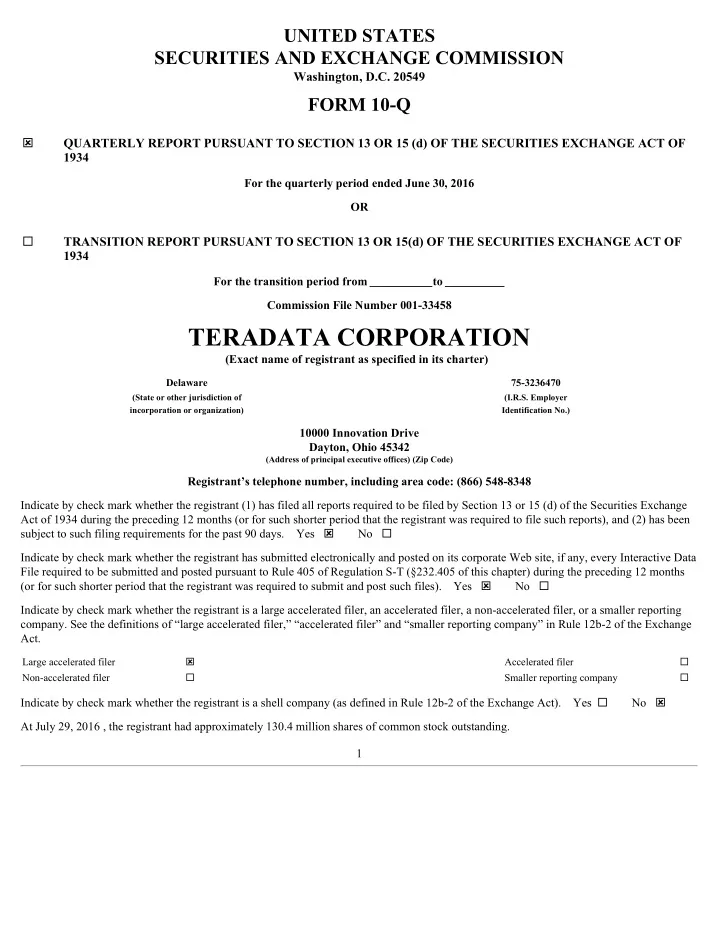
UNITED STATES SECURITIES AND EXCHANGE COMMISSION Washington, D.C. 20549 FORM 10-Q QUARTERLY REPORT PURSUANT TO SECTION 13 OR 15 (d) OF THE SECURITIES EXCHANGE ACT OF 1934 For the quarterly period ended June 30, 2016 OR TRANSITION


slide-1
SLIDE 1

UNITED STATES SECURITIES AND EXCHANGE COMMISSION

Washington, D.C. 20549

FORM 10-Q

ý QUARTERLY REPORT PURSUANT TO SECTION 13 OR 15 (d) OF THE SECURITIES EXCHANGE ACT OF 1934

For the quarterly period ended June 30, 2016 OR

¨ TRANSITION REPORT PURSUANT TO SECTION 13 OR 15(d) OF THE SECURITIES EXCHANGE ACT OF 1934

For the transition period from to Commission File Number 001-33458

TERADATA CORPORATION

(Exact name of registrant as specified in its charter)

Delaware 75-3236470

(State or other jurisdiction of (I.R.S. Employer incorporation or organization) Identification No.)

10000 Innovation Drive Dayton, Ohio 45342

(Address of principal executive offices) (Zip Code)

Registrant’s telephone number, including area code: (866) 548-8348 Indicate by check mark whether the registrant (1) has filed all reports required to be filed by Section 13 or 15 (d) of the Securities Exchange Act of 1934 during the preceding 12 months (or for such shorter period that the registrant was required to file such reports), and (2) has been subject to such filing requirements for the past 90 days. Yes ý No ¨ Indicate by check mark whether the registrant has submitted electronically and posted on its corporate Web site, if any, every Interactive Data File required to be submitted and posted pursuant to Rule 405 of Regulation S-T (§232.405 of this chapter) during the preceding 12 months (or for such shorter period that the registrant was required to submit and post such files). Yes ý No ¨ Indicate by check mark whether the registrant is a large accelerated filer, an accelerated filer, a non-accelerated filer, or a smaller reporting

  • company. See the definitions of “large accelerated filer,” “accelerated filer” and “smaller reporting company” in Rule 12b-2 of the Exchange

Act.

Large accelerated filer ý Accelerated filer ¨ Non-accelerated filer ¨ Smaller reporting company ¨

Indicate by check mark whether the registrant is a shell company (as defined in Rule 12b-2 of the Exchange Act). Yes ¨ No ý At July 29, 2016 , the registrant had approximately 130.4 million shares of common stock outstanding. 1

slide-2
SLIDE 2

TABLE OF CONTENTS PART I—FINANCIAL INFORMATION

Description Page

Item 1. Financial Statements Condensed Consolidated Statements of Income (Loss) (Unaudited) Three and Six Months Ended June 30, 2016 and 2015 3 Condensed Consolidated Statements of Comprehensive Income (Loss) (Unaudited) Three and Six Months Ended June 30, 2016 and 2015 4 Condensed Consolidated Balance Sheets (Unaudited) June 30, 2016 and December 31, 2015 5 Condensed Consolidated Statements of Cash Flows (Unaudited) Six Months Ended June 30, 2016 and 2015 6 Notes to Condensed Consolidated Financial Statements (Unaudited) 7 Item 2. Management’s Discussion and Analysis of Financial Condition and Results of Operations 18 Item 3. Quantitative and Qualitative Disclosures About Market Risk 29 Item 4. Controls and Procedures 29 PART II—OTHER INFORMATION

Description Page

Item 1. Legal Proceedings 29 Item 1A. Risk Factors 29 Item 2. Unregistered Sales of Equity Securities and Use of Proceeds 30 Item 3. Defaults Upon Senior Securities 30 Item 4. Mine Safety Disclosures 30 Item 5. Other Information 30 Item 6. Exhibits 31 Signatures 32

2

slide-3
SLIDE 3

Table of Contents Part 1—FINANCIAL INFORMATION

Item 1. Financial Statements.

Teradata Corporation Condensed Consolidated Statements of Income (Loss) (Unaudited)

Three Months Ended June 30, Six Months Ended June 30,

In millions, except per share amounts

2016 2015 2016 2015 Revenue Product revenue $ 228 $ 256 $

422 $ 497

Service revenue 371 367

722 708

Total revenue 599 623 1,144 1,205 Costs and operating expenses Cost of products 89 93 167 202 Cost of services 200 203 398 399 Selling, general and administrative expenses 172 190 346 374 Research and development expenses 51 59 108 122 Impairment of goodwill, acquired intangibles and other assets — 340 80 340 Total costs and operating expenses 512 885 1,099 1,437 Income (loss) from operations 87 (262) 45 (232) Other (expense) income, net Interest expense (4) (2) (7) (3) Interest income 2 1 3 2 Other income (expense), net — 14 (1) 14 Total other (expense) income, net (2) 13 (5) 13 Income (loss) before income taxes 85 (249) 40 (219) Income tax expense 21 16 22 24 Net income (loss) $ 64 $ (265) $ 18 $ (243) Net income (loss) per weighted average common share Basic $ 0.49 $ (1.87) $ 0.14 $ (1.69) Diluted $ 0.49 $ (1.87) $ 0.14 $ (1.69) Weighted average common shares outstanding Basic 129.8 141.9 129.6 143.6 Diluted 131.5 141.9 131.2 143.6

See Notes to Condensed Consolidated Financial Statements (Unaudited). 3

slide-4
SLIDE 4

Table of Contents Teradata Corporation Condensed Consolidated Statements of Comprehensive Income (Loss) (Unaudited)

Three Months Ended June 30, Six Months Ended June 30,

In millions

2016 2015 2016 2015 Net income (loss) $ 64 $ (265) $ 18 $ (243) Other comprehensive income (loss): Foreign currency translation adjustments (2) 9 6 (22) Securities: Unrealized gain (loss) on securities, before tax — 4 — (5) Unrealized gain (loss) on securities, tax portion — (1) — 2 Unrealized gain (loss) on securities, net of tax — 3 — (3) Defined benefit plans: Defined benefit plan adjustment, before tax 2 — 2 2 Defined benefit plan adjustment, tax portion (1) — (1) — Defined benefit plan adjustment, net of tax 1 — 1 2 Other comprehensive income (loss) (1) 12 7 (23) Comprehensive income (loss) $ 63 $ (253) $ 25 $ (266)

See Notes to Condensed Consolidated Financial Statements (Unaudited). 4

slide-5
SLIDE 5

Table of Contents Teradata Corporation Condensed Consolidated Balance Sheets (Unaudited)

In millions, except per share amounts

June 30, 2016 December 31, 2015 Assets Current assets Cash and cash equivalents $ 909 $ 839 Accounts receivable, net 465 580 Inventories 37 49 Assets held for sale 130 214 Other current assets 54 52 Total current assets 1,595 1,734 Property and equipment, net 129 143 Capitalized software, net 192 190 Goodwill 384 380 Acquired intangible assets, net 15 22 Deferred income taxes 48 41 Other assets 19 17 Total assets $ 2,382 $ 2,527 Liabilities and stockholders’ equity Current liabilities Current portion of long-term debt $ 30 $ 30 Short-term borrowings — 180 Accounts payable 104 96 Payroll and benefits liabilities 125 120 Deferred revenue 430 367 Liabilities held for sale 43 58 Other current liabilities 87 102 Total current liabilities 819 953 Long-term debt 552 567 Pension and other postemployment plan liabilities 88 89 Long-term deferred revenue 16 15 Deferred tax liabilities 17 28 Other liabilities 26 26 Total liabilities 1,518 1,678 Commitments and contingencies (Note 7) Stockholders’ equity Preferred stock: par value $0.01 per share, 100.0 shares authorized, no shares issued and outstanding at June 30, 2016 and December 31, 2015, respectively — — Common stock: par value $0.01 per share, 500.0 shares authorized, 129.5 and 130.7 shares issued at June 30, 2016 and December 31, 2015, respectively 1 1 Paid-in capital 1,178 1,128 Accumulated deficit (246) (204) Accumulated other comprehensive loss (69) (76) Total stockholders’ equity 864 849 Total liabilities and stockholders’ equity $ 2,382 $ 2,527

See Notes to Condensed Consolidated Financial Statements (Unaudited). 5

slide-6
SLIDE 6

Table of Contents Teradata Corporation Condensed Consolidated Statements of Cash Flows (Unaudited)

Six Months Ended June 30,

In millions

2016 2015 Operating activities Net income (loss) $ 18 $ (243) Adjustments to reconcile net income (loss) to net cash provided by operating activities: Depreciation and amortization 65 84 Stock-based compensation expense 33 30 Excess tax benefit from stock-based compensation (2) — Deferred income taxes (15) (18) Gain on investments — (15) Impairment of goodwill, acquired intangibles and other assets 80 340 Changes in assets and liabilities: Receivables 122 109 Inventories 11 (8) Current payables and accrued expenses (10) (28) Deferred revenue 64 74 Other assets and liabilities (16) (23) Net cash provided by operating activities 350 302 Investing activities Expenditures for property and equipment (17) (29) Proceeds from sales of property and equipment 5 — Additions to capitalized software (36) (30) Business acquisitions and other investing activities, net (4) 14 Net cash used in investing activities (52) (45) Financing activities Repurchases of common stock (51) (308) Proceeds from long-term borrowings — 600 Repayments of long-term borrowings (15) (247) Repayments of credit facility borrowings (180) (220) Excess tax benefit from stock-based compensation 2 — Other financing activities, net 16 14 Net cash used in financing activities (228) (161) Effect of exchange rate changes on cash and cash equivalents — (9) Increase in cash and cash equivalents 70 87 Cash and cash equivalents at beginning of period 839 834 Cash and cash equivalents at end of period $ 909 $ 921

See Notes to Condensed Consolidated Financial Statements (Unaudited). 6

slide-7
SLIDE 7

Table of Contents Notes to Condensed Consolidated Financial Statements (Unaudited)

  • 1. Basis of Presentation

These statements have been prepared pursuant to the rules and regulations of the U.S. Securities and Exchange Commission (“SEC”) and, in accordance with those rules and regulations, do not include all information and footnote disclosures normally included in annual financial statements prepared in accordance with accounting principles generally accepted in the United States of America (“GAAP”). In the opinion of management, the condensed consolidated financial statements reflect all adjustments, consisting only of normal recurring adjustments, necessary to fairly state the results of operations, financial position and cash flows of Teradata Corporation (“Teradata” or the “Company”) for the interim periods presented herein. The year-end 2015 condensed consolidated balance sheet data was derived from audited financial statements, but does not include all disclosures required by GAAP. The preparation of condensed consolidated financial statements in conformity with GAAP requires management to make use of estimates and assumptions that affect the reported amounts and disclosures. Actual results may vary from these estimates. These condensed consolidated interim financial statements should be read in conjunction with the consolidated financial statements and notes thereto included in Teradata’s most recent Annual Report on Form 10-K for the fiscal year ended December 31, 2015 (the “ 2015 Annual Report”). The results of operations for any interim period are not necessarily indicative of the results of operations to be expected for the full year.

  • 2. New Accounting Pronouncements

Revenue Recognition. In May 2014, the Financial Accounting Standards Board ("FASB") issued new guidance that affects any entity that either enters into contracts with customers to transfer goods or services or enters into contracts for the transfer of nonfinancial assets unless those contracts are within the scope of other standards. The new guidance will supersede the revenue recognition requirements in the current revenue recognition guidance, and most industry-specific guidance. In addition, the existing requirements for the recognition of a gain or loss

  • n the transfer of nonfinancial assets that are not in a contract with a customer are amended to be consistent with the guidance on recognition

and measurement in this update. The core principle of the guidance is that an entity should recognize revenue to depict the transfer of promised goods or services to customers in an amount that reflects the consideration to which the entity expects to be entitled in exchange for those goods or services. To achieve that core principle, the FASB defines a five step process which includes the following: (1) identify the contract with a customer, (2) identify the performance obligations in the contract, (3) determine the transaction price, (4) allocate the transaction price to the performance obligations in the contract, and (5) recognize revenue when (or as) the entity satisfies a performance

  • bligation.

In July 2015, the FASB issued a one-year delay in the effective date of the new standard. Under this guidance, the new revenue standard will be effective for annual reporting periods beginning after December 15, 2017, with early application permitted. The standard allows entities to apply the standard retrospectively for all periods presented or alternatively an entity is permitted to recognize the cumulative effect of initially applying the guidance as an opening balance sheet adjustment to retained earnings in the period of initial application.

I n March 2016, the FASB issued an update that amends and clarifies the implementation guidance on principal versus agent considerations

for reporting revenue gross rather than net. In April 2016, the FASB issued an update that amends and clarifies the identification of performance obligations and accounting for licenses of intellectual property. In May 2016, the FASB issued an update which addresses the narrow-scope improvements to the guidance on collectibility, non-cash consideration, and completed contracts at transition. Additionally, the amendments in this update provide a practical expedient for contract modifications at transition and an accounting policy election related to the presentation of sales taxes and other similar taxes collected from

  • customers. All updates issued in 2016 have the same deferred effective date.

7

slide-8
SLIDE 8

Table of Contents The Company is currently evaluating the impact on its consolidated financial position, results of operations and cash flows, as well as the method of transition that will be used in adopting the standard.

  • Leases. In February 2016, the FASB issued new guidance which requires a lessee to account for leases as finance or operating leases. Both

leases will result in the lessee recognizing a right-of-use asset and a corresponding lease liability on its balance sheet, with differing methodology for income statement recognition. For lessors, the standard modifies the classification criteria and the accounting for sales-type and direct financing leases. Entities will classify leases to determine how to recognize lease-related revenue and expense. This standard is effective for public entities for fiscal years, and interim periods within those years, beginning after December 15, 2018, and early adoption is

  • permitted. A modified retrospective approach is required for leases existing or entered into after the beginning of the earliest comparative

period in the Consolidated Financial Statements. The Company is currently assessing the impact of this update on its Consolidated Financial Statements. Stock Compensation: Improvements to Employee Share-Based Payment Accounting. In March 2016, the FASB issued an update which simplifies several aspects of the accounting for share-based payment transactions, including the income tax consequences, classification of awards as either equity or liabilities, and classification on the Statements of Cash Flows. Under the new standard, income tax benefits and deficiencies are to be recognized in the income statement and the tax effects of exercised or vested awards should be treated as discrete items in the reporting period in which they occur. This provision is to be applied prospectively. Excess tax benefits should be recognized regardless

  • f whether the benefit reduces taxes payable in the current period, along with any valuation allowance, on a modified retrospective basis as a

cumulative-effect adjustment to the retained earnings as of the date of adoption. Excess tax benefits should be classified along with other income tax cash flows as an operating activity. This provision can be applied prospectively or retrospectively for all periods presented. The standard is effective for public entities for annual reporting periods beginning after December 15, 2016, and interim periods therein. Early adoption is permitted. The Company is currently assessing the impact of this update on its Consolidated Financial Statements. Recently Adopted Guidance Accounting for Share-based Payments with Performance Targets . In June 2014, the FASB issued new guidance that requires that a performance target that affects vesting and that could be achieved after the requisite service period, be treated as a performance condition. A reporting entity should apply existing guidance as it relates to awards with performance conditions that affect vesting to account for such

  • awards. As such, the performance target should not be reflected in estimating the grant-date fair value of the award. Compensation cost

should be recognized in the period in which it becomes probable that the performance target will be achieved and should represent the compensation cost attributable to the periods for which the requisite service has already been rendered. The Company adopted this guidance

  • n January 1, 2016. This amendment did not have an impact on the Company's consolidated financial statements.

Income Statement Presentation by Eliminating the Concept of Extraordinary Items . This update eliminates from GAAP the concept of extraordinary items. The Company adopted this guidance on January 1, 2016. This amendment did not have an impact on the Company's results of operations. Simplifying the Presentation of Debt Issuance Costs. To simplify presentation of debt issuance costs, the amendments in this update require that debt issuance costs related to a recognized debt liability be presented in the balance sheet as a direct deduction from the carrying amount of that debt liability, consistent with debt discounts. The recognition and measurement guidance for debt issuance costs are not affected by the amendments in this update. The Company adopted this guidance on January 1, 2016 on a retrospective basis. Debt issuance costs of $3 million have been presented as a deduction from the carrying value of the related long-term liabilities in our Consolidated Balance Sheets as of December 31, 2015 and June 30, 2016, respectively. Intangibles, Goodwill and Other Internal-Use Software . The amendments in this update provide guidance to customers about whether a cloud computing arrangement includes a software license. If a cloud computing arrangement includes a software license, then the customer should account for the software license element of the arrangement consistent with the acquisition of other software licenses. If a cloud computing arrangement does not include a software license, the customer should account for the arrangement as a service contract. The guidance will 8

slide-9
SLIDE 9

Table of Contents not change current guidance for a customer’s accounting for service contracts. The Company adopted this guidance on January 1, 2016. This amendment did not have an impact on the Company's consolidated financial statements. Business Combinations . In September 2015, the FASB issued new guidance that eliminates the requirement that an acquirer in a business combination account for measurement-period adjustments retrospectively. An acquirer will recognize a measurement-period adjustment during the period in which it determines the amount of the adjustment.

  • 3. Supplemental Financial Information

As of

In millions

June 30, 2016 December 31, 2015 Inventories Finished goods $ 21 $ 32 Service parts 16 17 Total inventories $ 37 $ 49 Deferred revenue Deferred revenue, current $ 430 $ 367 Long-term deferred revenue 16 15 Total deferred revenue $ 446 $ 382 Above amounts exclude assets and liabilities held for sale. Refer to Note 13 for further information on the Company's assets and liabilities held for sale.

  • 4. Goodwill and Acquired Intangible Assets

The following table identifies the activity relating to goodwill by operating segment:

In millions Balance, December 31, 2015 Adjustments Currency Translation Adjustments Balance, June 30, 2016 Goodwill Americas Data and Analytics

$ 251 $ — $ — $ 251

International Data and Analytics

129 — 4 133

Total goodwill

$ 380 $ — $ 4 $ 384

In the fourth quarter of 2015, the Company committed to a plan to exit the marketing applications business, which met the criteria for held for sale and continued to be reported under continuing operations. Not included in the table above is $ 57 million at June 30, 2016 and $ 113 million at December 31, 2015 for goodwill that has been classified as held for sale. See Note 13 for additional disclosures related to goodwill that has been classified as held for sale. 9

slide-10
SLIDE 10

Table of Contents Acquired intangible assets were specifically identified when acquired, and are deemed to have finite lives. The gross carrying amount and accumulated amortization for Teradata’s acquired intangible assets were as follows:

June 30, 2016 December 31, 2015

In millions

Amortization Life (in Years) Gross Carrying Amount Accumulated Amortization and Currency Translation Adjustments Gross Carrying Amount Accumulated Amortization and Currency Translation Adjustments Acquired intangible assets Intellectual property/developed technology 1 to 7 $ 71 $ (58) $ 83 $ (63) Customer relationships 3 to 10 — — 3 (3) Trademarks/trade names 5 1 (1) 1 (1) In-process research and development 5 5 (3) 5 (3) Total acquired intangible assets $ 77 $ (62) $ 92 $ (70)

The gross carrying amount of acquired intangibles was reduced by certain intangible assets previously acquired that became fully amortized and were removed from the balance sheet. Not included in the table above is $ 25 million at June 30, 2016 and $44 million at December 31, 2015 for intangible assets that were classified as held for sale. See Note 13 for additional disclosures related to intangible assets that have been classified as held for sale. The aggregate amortization expense (actual and estimated) for acquired intangible assets is as follows:

Three Months Ended June 30, Six Months Ended June 30,

In millions

2016 2015 2016 2015 Amortization expense $ 2 $ 11 $ 7 $ 22 Actual For the years ended (estimated)

In millions

2015 2016 2017 2018 2019 Amortization expense $ 40 $ 10 $ 7 $ 3 $ 2

  • 5. Income Taxes

Income tax provisions for interim periods are based on estimated annual income tax rates, adjusted to reflect the effects of any significant infrequent or unusual items which are required to be discretely recognized within the current interim period. The Company’s intention is to permanently reinvest its foreign earnings outside of the United States. As a result, the effective tax rates in the periods presented are largely based upon the forecasted pre-tax earnings mix and allocation of certain expenses in various taxing jurisdictions where the Company conducts its business that apply a broad range of statutory income tax rates, a large majority of which are less than the U.S. statutory rate. The effective tax rate is as follows:

Three Months Ended June 30, Six Months Ended June 30,

In millions

2016 2015 2016 2015 Effective tax rate 24.7% (6.4)% 55.0% (11.0)%

For the three months ended June 30, 2016 , there were no discrete tax items. For the six months ended June 30, 2016 , there was a discrete tax item resulting from the $76 million impairment recorded in the first quarter, of which $57 million is related to non-deductible goodwill and $19 million is related to intangible assets for which $6 million of deferred tax benefit has been recorded. For the three and six months ended June 30, 2015, there was a discrete 10

slide-11
SLIDE 11

Table of Contents tax item resulting from the $340 million goodwill impairment recorded in the second quarter, of which $318 million related to non-deductible goodwill and $22 million was for tax deductible goodwill for which $8 million of deferred tax benefit has been recorded. The increase in the effective tax rate was primarily driven by the differential in the discrete tax impact of the goodwill impairment period over period.

  • 6. Derivative Instruments and Hedging Activities

As a portion of Teradata’s operations is conducted outside the United States and in currencies other than the U.S. dollar, the Company is exposed to potential gains and losses from changes in foreign currency exchange rates. In an attempt to mitigate the impact of currency fluctuations, the Company uses foreign exchange forward contracts to hedge transactional exposures resulting predominantly from foreign currency denominated inter-company receivables and payables. The forward contracts are designated as fair value hedges of specified foreign currency denominated inter-company receivables and payables and generally mature in three months or less. The Company does not hold or issue derivative financial instruments for trading purposes, nor does it hold or issue leveraged derivative instruments. By using derivative financial instruments to hedge exposures to changes in exchange rates, the Company exposes itself to credit risk. The Company manages exposure to counterparty credit risk by entering into derivative financial instruments with highly rated institutions that can be expected to fully perform under the terms of the applicable contracts. All derivatives are recognized in the consolidated balance sheets at their fair value. The fair values of foreign exchange contracts are based on market spot and forward exchange rates and represent estimates of possible value that may not be realized in the future. Changes in the fair value of derivative financial instruments, along with the loss or gain on the hedged asset or liability, are recorded in current period earnings. The notional amounts represent agreed-upon amounts on which calculations of dollars to be exchanged are based, and are an indication of the extent of Teradata’s involvement in such instruments. These notional amounts do not represent amounts exchanged by the parties and, therefore, are not a measure of the instruments. Across its portfolio of contracts, Teradata has both long and short positions relative to the U.S. dollar. As a result, Teradata’s net involvement is less than the total contract notional amount of the Company’s foreign exchange forward contracts. The following table identifies the contract notional amount of the Company’s foreign exchange forward contracts:

As of

In millions

June 30, 2016 December 31, 2015 Contract notional amount of foreign exchange forward contracts $ 100 $ 138 Net contract notional amount of foreign exchange forward contracts $ 7 $ 25

The fair value of derivative assets and liabilities recorded in other current assets and accrued liabilities at June 30, 2016 and December 31, 2015 , were not material. Gains and losses from the Company’s fair value hedges (foreign currency forward contracts and related hedged items) were immaterial for the three and six months ended June 30, 2016 and June 30, 2015 . Gains and losses from foreign exchange forward contracts are fully recognized each period and reported along with the offsetting gain or loss of the related hedged item, either in cost of products or in other income (expense), depending on the nature of the related hedged item.

  • 7. Commitments and Contingencies

In the normal course of business, the Company is subject to proceedings, lawsuits, governmental investigations, claims and other matters, including those that relate to the environment, health and safety, employee benefits, export compliance, intellectual property, tax matters and

  • ther regulatory compliance and general matters.

Guarantees and Product Warranties. Guarantees associated with the Company’s business activities are reviewed for appropriateness and impact to the Company’s financial statements. Periodically, the Company’s customers enter into various leasing arrangements coordinated with a leasing company. In some instances, the Company guarantees the leasing company a minimum value at the end of the lease term on the leased equipment. As of June 30, 2016 , 11

slide-12
SLIDE 12

Table of Contents the maximum future payment obligation of this guaranteed value and the associated liability balance was $3 million . The Company provides its customers a standard manufacturer’s warranty and records, at the time of the sale, a corresponding estimated liability for potential warranty costs. Estimated future obligations due to warranty claims are based upon historical factors such as labor rates, average repair time, travel time, number of service calls and cost of replacement parts. For each consummated sale, the Company recognizes the total customer revenue and records the associated warranty liability under other current liabilities in the balance sheet using pre- established warranty percentages for that product class. The following table identifies the activity relating to the warranty reserve for the six months ended June 30 :

In millions 2016 2015 Warranty reserve liability Beginning balance at January 1 $ 6 $ 7 Provisions for warranties issued 4 4 Settlements (in cash or in kind) (5) (5) Balance at June 30 $ 5 $ 6

The Company also offers extended and/or enhanced coverage to its customers in the form of maintenance contracts. The Company accounts for these contracts by deferring the related maintenance revenue over the extended and/or enhanced coverage period. Costs associated with maintenance support are expensed as incurred. Amounts associated with these maintenance contracts are not included in the table above. In addition, the Company provides its customers with certain indemnification rights. In general, the Company agrees to indemnify the customer if a third party asserts patent or other infringement on the part of the customer for its use of the Company’s products. The Company has entered into indemnification agreements with the officers and directors of its subsidiaries. From time to time, the Company also enters into agreements in connection with its acquisition and divesture activities that include indemnification obligations by the Company. The fair value of these indemnification obligations is not readily determinable due to the conditional nature of the Company’s potential obligations and the specific facts and circumstances involved with each particular agreement, and as such the Company has not recorded a liability in connection with these indemnification arrangements. Historically, payments made by the Company under these types of agreements have not had a material effect on the Company’s consolidated financial condition, results of operations or cash flows.

  • 8. Fair Value Measurements

Fair value measurements are established utilizing a three-tier fair value hierarchy, which prioritizes the inputs used in measuring fair value. These tiers include: Level 1, defined as observable inputs such as quoted prices in active markets for identical assets or liabilities; Level 2, defined as significant other observable inputs, such as quoted prices in active markets for similar assets or liabilities, or quoted prices in less- active markets for identical assets; and Level 3, defined as unobservable inputs in which little or no market data exists, therefore requiring an entity to develop its own assumptions. Financial assets and liabilities are classified in their entirety based on the lowest level of input that is significant to the fair value measurement. The Company’s assets and liabilities measured at fair value on a recurring basis include money market funds and foreign currency exchange

  • contracts. A portion of the Company’s excess cash reserves are held in money market funds which generate interest income based on the

prevailing market rates. Money market funds are included in cash and cash equivalents in the Company’s balance sheet. Money market fund holdings are measured at fair value using quoted market prices and are classified within Level 1 of the valuation hierarchy. When deemed appropriate, the Company minimizes its exposure to changes in foreign currency exchange rates through the use of derivative financial instruments, specifically, foreign exchange forward contracts. The fair value of these contracts are measured at the end of each interim reporting period using observable inputs other than quoted prices, specifically market spot and forward exchange rates. As such, these derivative instruments are 12

slide-13
SLIDE 13

Table of Contents classified within Level 2 of the valuation hierarchy. Fair value gains for open contracts are recognized as assets and fair value losses are recognized as liabilities. The fair value derivative assets and liabilities recorded in other current assets and accrued liabilities at June 30, 2016 and December 31, 2015 , were not material. Any realized gains or losses would be mitigated by corresponding gains or losses on the underlying exposures. The Company’s assets measured at fair value on a recurring basis and subject to fair value disclosure requirements at June 30, 2016 and December 31, 2015 were as follows:

Fair Value Measurements at Reporting Date Using

In millions

Total Quoted Prices in Active Markets for Identical Assets (Level 1) Significant Other Observable Inputs (Level 2) Significant Unobservable Inputs (Level 3) Assets Money market funds, June 30, 2016 $ 402 $ 402 $ — $ — Money market funds, December 31, 2015 $ 351 $ 351 $ — $ —

  • 9. Debt

Teradata's $600 million term loan is payable in quarterly installments, which commenced on March 31, 2016 , with all remaining principal due in March 2020 . The outstanding principal amount under the term loan agreement bears interest at a floating rate based upon a negotiated base rate or a Eurodollar rate plus a margin based on the leverage ratio of the Company. As of June 30, 2016 , the term loan principal

  • utstanding was $585 million and carried an interest rate of 1.8750% . Unamortized deferred issuance costs of approximately $2 million are

being amortized over the five -year term of the loan. The Company was in compliance with all covenants as of June 30, 2016 . Annual contractual maturities of principal on the term loan outstanding at June 30, 2016 are as follows:

In millions

Amounts Due 2016 $ 15 2017 30 2018 60 2019 68 2020 412 Total $ 585

Teradata’s term loan is recognized on the Company’s balance sheet at its unpaid principal balance, and is not subject to fair value

  • measurement. However, given that the loan carries a variable rate, the Company estimates that the unpaid principal balance of the term loan

would approximate its fair value. If measured at fair value in the financial statements, the Company’s term loan would be classified as Level 2 in the fair value hierarchy. Teradata's revolving credit facility (the “Credit Facility”) has a borrowing capacity of $400 million . The Credit Facility ends on March 25, 2020 at which point any remaining outstanding borrowings would be due for repayment unless extended by agreement of the parties for up to two additional one -year periods. The interest rate charged on borrowings pursuant to the Credit Facility can vary depending on the interest rate option the Company chooses to utilize and the Company’s leverage ratio at the time of the borrowing. In the near term, Teradata would anticipate choosing a floating rate based on the London Interbank Offered Rate (“LIBOR”). The Credit Facility is unsecured and contains certain representations and warranties, conditions, affirmative, negative and financial covenants, and events of default customary for such facilities. 13

slide-14
SLIDE 14

Table of Contents As of June 30, 2016 , the Company had no borrowings outstanding under the Credit Facility, leaving $400 million in additional borrowing capacity available. Unamortized deferred costs on the original credit facility and new lender fees of approximately $1 million are being amortized over the five -year term of the credit facility. The Company was in compliance with all covenants as of June 30, 2016 .

  • 10. Earnings per Share

Basic earnings per share is calculated by dividing net income by the weighted average number of shares outstanding during the reported

  • period. The calculation of diluted earnings per share is similar to basic earnings per share, except that the weighted average number of shares
  • utstanding includes the dilution from potential shares resulting from stock options, restricted stock awards and other stock awards. The

components of basic and diluted earnings per share are as follows:

Three Months Ended June 30, Six Months Ended June 30,

In millions, except per share amounts

2016 2015 2016 2015 Net income (loss) attributable to common stockholders $ 64 $ (265) $ 18 $ (243) Weighted average outstanding shares of common stock 129.8 141.9 129.6 143.6 Dilutive effect of employee stock options, restricted stock and other stock awards 1.7 — 1.6 — Common stock and common stock equivalents 131.5 141.9 131.2 143.6 Income (loss) per share: Basic $ 0.49 $ (1.87) $ 0.14 $ (1.69) Diluted $ 0.49 $ (1.87) $ 0.14 $ (1.69)

For the three and six months ended June 30, 2015, due to the net loss attributable to Teradata common stockholders, due to the goodwill impairment charge, potential common shares that would cause dilution, such as employee stock options, restricted stock and other stock awards, have been excluded from the diluted share count because their effect would have been anti-dilutive. For the three months ended June 30, 2015, the fully diluted shares would have been 144.4 million , and for the six months ended June 30, 2015, the fully diluted shares would have been 146.1 million. Options to purchase 5.1 million and 5.4 million shares of common stock for the three and six months ended June 30, 2016 and 2.9 million and 3 million shares of common stock for the three and six months ended June 30, 2015 were not included in the computation of diluted earnings per share because their exercise prices were greater than the average market price of the common shares for the period, and therefore would have been anti-dilutive.

  • 11. Segment and Other Supplemental Information

Effective January 1, 2016, Teradata implemented an organizational change in which it now manages the Company's business under two geographic regions and the marketing applications division (prior to its completed sale on July 1, 2016); which are also the Company’s

  • perating segments: (1) Americas Data and Analytics (North America and Latin America); (2) International Data and Analytics (Europe,

Middle East, Africa, Asia Pacific and Japan); and (3) Marketing Applications. For purposes of discussing results by segment, management excludes the impact of certain items, consistent with the manner by which management evaluates the performance of each segment. This format is useful to investors because it allows analysis and comparability of operating trends. It also includes the same information that is used by Teradata management to make decisions regarding the segments and to assess financial performance. The chief operating decision maker evaluates the performance of the segments based on revenue and multiple profit measures, including segment gross margin. For management reporting purposes assets are not allocated to the segments. Prior period segment information has been reclassified to conform to the current period presentation. Going forward, following the sale of the marketing applications business, Teradata will manage its business in two operating segments: (1) Americas region (North America and Latin America); and (2) International region (Europe, Middle East, Africa, Asia Pacific and Japan). 14

slide-15
SLIDE 15

Table of Contents The following table presents segment revenue and segment gross margin for the Company:

Three Months Ended June 30, Six Months Ended June 30,

In millions

2016 2015 2016 2015 Segment revenue Americas Data and Analytics $ 325 $ 348 $ 620 $ 684 International Data and Analytics 239 237 455 445 Total Data and Analytics 564 585 1,075 1,129 Marketing Applications 35 38 69 76 Total revenue 599 623 1,144 1,205 Segment gross margin Americas Data and Analytics 183 204 347 383 International Data and Analytics 116 118 213 211 Total Data and Analytics 299 322 560 594 Marketing Applications 16 16 33 31 Total segment gross margin 315 338 593 625 Stock-based compensation costs (3) (3) (7) (7) Amortization of acquisition-related intangible assets costs — (6) (2) (11) Acquisition, integration and reorganization-related costs (2) (2) (5) (3) Selling, general and administrative expenses 172 190 346 374 Research and development expenses 51 59 108 122 Impairment of goodwill, acquired intangibles and other assets — 340 80 340 Income (loss) from operations $ 87 $ (262) $ 45 $ (232)

On July 1, 2016, Teradata completed the sale of our Marketing Applications business to exclusively focus on our data and analytics business as part of our business transformation plan. See note 14 for additional details. The following table presents revenue by product and services for the Company:

Three Months Ended June 30, Six Months Ended June 30,

In millions

2016 2015 2016 2015 Products (software and hardware) (1) $ 228 $ 256 $ 422 $

497

Consulting services 192 194 371

366

Maintenance services 179 173 351

342

Total services 371 367 722 708 Total revenue $ 599 $ 623 $ 1,144 $ 1,205

(1) Our analytic database software and hardware products are often sold and delivered together as an integrated technology solution in the form

  • f a “node” of capacity. Accordingly, it is impracticable to provide the breakdown of revenue from various types of software and hardware

products.

  • 12. Reorganization and Business Transformation

In the fourth quarter of 2015, the Company announced a plan to realign Teradata’s business by reducing its cost structure and focusing on the Company’s core data and analytics business. This business transformation includes exiting the marketing applications business (see Note 13), rationalizing costs, and modifying the Company’s go-to-market approach. The Company incurred the following costs for the six months ended June 30, 2016 related to these actions:

  • $10 million for employee severance and other employee-related costs,

15

slide-16
SLIDE 16

Table of Contents

  • $80 million charge for asset write-downs, and
  • $19 million for professional services, legal and other associated costs.

From the amounts incurred above, $80 million was for non-cash write-downs of goodwill, acquired intangibles and other assets in the first quarter of 2016. In addition to the costs and charges incurred above, the Company made cash payments of $16 million for employee severance that did not have a material impact on its Statement of Operations due to Teradata accounting for its postemployment benefits under Accounting Standards Codification 712, Compensation - Nonretirement Postemployment Benefits (“ASC 712”), which uses actuarial estimates and defers the immediate recognition of gains or losses. Because the Company accounts for postemployment benefits under ASC 712, it did not record any liability associated with ASC 420, Exit or Disposal Cost Obligations .

  • 13. Assets and Liabilities Held for Sale

In the fourth quarter of 2015, the Company committed to a plan to exit the marketing applications business. The Company determined that it was in the long-term best interests of the Company and its shareholders to realign Teradata’s business by focusing on the Company’s core data and analytics business. The assets and liabilities for this business, which are included within our marketing applications segment, were classified as held for sale in the fourth quarter of 2015 and, therefore, the corresponding depreciation and amortization expense was ceased at that time. The anticipated divestiture is not presented as discontinued operations in our consolidated financial statements, because it does not have a major effect on the Company's operations and financial results. For the six months ended June 30, 2016 , we generated revenue from these assets of $69 million . Additionally, for the six months ended June 30, 2016 we recognized operating loss from these assets of $112 million (includes loss from impairment of goodwill and acquired intangibles of $76 million ). When an asset is classified as held for sale, the asset’s carrying amount is evaluated and adjusted to the lower of its carrying amount or fair value less costs to sell. On April 22, 2016, the Company entered into a definitive Asset Purchase Agreement (the “Purchase Agreement”) with TMA Solutions, L.P., a Cayman Islands exempted limited partnership and affiliate of Marlin Equity Partners (“Marlin Equity”) to sell the marketing applications business for $90 million in cash, subject to a post-closing adjustment for working capital, debt and other metrics, which is currently estimated at $92 million . The Company performed a goodwill impairment analysis on the business to be disposed of based

  • n the fair value as determined using the Purchase Agreement. As a result of this analysis, the Company recognized an impairment
  • f goodwill of $ 57 million in the first quarter of 2016. The remaining goodwill of $ 57 million is disclosed in the assets held for sale in the

Consolidated Balance Sheets. In addition, in the first quarter of 2016, acquired intangible assets were reduced by $ 19 million to adjust the carrying amount of the disposal group's net assets and liabilities down to its fair value less cost to sell. No further adjustment was required in the second quarter of 2016 to either goodwill or acquired intangible assets. A summary of the carrying amounts of assets and liabilities held for sale on our consolidated balance sheets as of June 30, 2016 related to the anticipated divestiture discussed above is detailed below: 16

slide-17
SLIDE 17

Table of Contents

As of As of

In millions

June 30, 2016 December 31, 2015 Current assets held for sale Accounts receivable, net $ 35 $ 41 Other current assets 2 3 Total current assets held for sale 37 44 Property and equipment, net 11 12 Goodwill 57 113 Acquired intangibles, net 25 44 Other assets — 1 Total assets held for sale $ 130 $ 214 Current liabilities held for sale Accounts payable 4 10 Payroll and benefits liabilities 4 12 Deferred Revenue 28 30 Other current liabilities 2 5 Total current liabilities held for sale 38 57 Other liabilities 5 1 Total liabilities held for sale $ 43 $ 58

  • 14. Subsequent Events

On July 1, 2016, pursuant to the Purchase Agreement, Teradata completed the previously announced sale of Teradata’s marketing applications business to Marlin Equity. The purchase price received for this business was approximately $92 million in cash, which includes a post-closing adjustment for working capital, debt and other metrics. The final cash to be received is subject to change depending on the finalization of working capital and transaction costs. In connection with the closing of the transaction, the parties have entered into a transition services agreement, pursuant to which Teradata will provide certain services to Marlin Equity, including accounting, human resources, order processing and invoicing and information technology services for a service period of up to 15 months after the closing of the transaction. The Company expects to record tax expense of approximately $18 million in the third quarter of 2016 related to this transaction. The tax expense associated with the gain on sale of the marketing applications business assets, of which $13 million is cash taxes due to having zero tax basis in goodwill, was calculated based on the amount of proceeds allocated to the various jurisdictions in accordance with the Purchase Agreement at the local statutory rates. The actual tax expense to be reported in the third quarter of 2016 is subject to change pending final determination of the net asset value of the marketing applications business, finalization of the working capital, transaction costs and other adjustments. 17

slide-18
SLIDE 18

Table of Contents Item 2. Management’s Discussion and Analysis of Financial Condition and Results of Operations (“MD&A”). You should read the following discussion in conjunction with the Condensed Consolidated Financial Statements and the notes to those statements included elsewhere in this Quarterly Report on Form 10-Q. This Quarterly Report on Form 10-Q contains certain statements that are forward-looking within the meaning of the Private Securities Litigation Reform Act of 1995. Certain statements contained in the MD&A are forward-looking statements that involve risks and uncertainties. The forward-looking statements are not historical facts, but rather are based on current expectations, estimates, assumptions and projections about our industry, business and future financial results. Our actual results could differ materially from the results contemplated by these forward-looking statements due to a number of factors, including those discussed in other sections of this Quarterly Report on Form 10-Q and in the 2015 Annual Report on Form 10-K. Second Quarter Financial Overview As more fully discussed in later sections of this MD&A, the following were significant financial items for the second quarter of 2016 :

  • Total revenue was $599 million for the second quarter of 2016 , down 4% from the second quarter of 2015 , with an underlying 11%

decrease in product revenue and a 1% increase in services revenue.

  • Gross margin decreased to 51.8% in the second quarter of 2016 from 52.5% in the second quarter of 2015 , driven by lower product gross

margin.

  • Operating income was $87 million in the second quarter of 2016 , compared to operating loss of $(262) million in the second quarter of

2015 , driven by an impairment loss on goodwill in the second quarter of 2015.

  • Net income in the second quarter of 2016 was $64 million , compared to net loss of $265 million in the second quarter of 2015 .

Strategic Overview Teradata’s strategy is based around a core belief: that analytics and data unleash the potential of great companies. We empower companies to achieve high-impact business outcomes through scalable analytics on an agile data foundation. Through our business-outcome focus and consultative approach, our goal is to serve as a trusted advisor to both the business and technical leaders in our customers’ organizations. Our business and analytical solutions are ideally suited for the world’s largest companies, as they have the most complex analytics requirements and the need to scale. Here, we can provide unique capabilities to solve a broad range of business problems, and this is where our value proposition is most compelling. Our strategy is to provide a differentiated set of offerings to this target market through three key modes of customer engagement: business solutions, analytical architecture expertise, and technology solutions.

  • Business Solutions: that deliver high-value business outcomes realized by engaging with business users through solution-based

selling that leverages analytic consulting and repeatable analytical IP

  • Analytical Architecture Expertise: best-in-class architecture consulting to help customers build an optimized analytical ecosystem

independent of technology, leveraging both open source and commercial solutions

  • Technology Solutions: best-of-breed technology and services to deliver an analytical ecosystem deployed in a hybrid cloud
  • architecture. Our technology solutions will build upon our market-leading data warehouse database.

Our strategy builds on our world-class data warehouse heritage and positions Teradata as an analytics company that delivers high-value business outcomes at scale. We deliver our solutions on-premises via the cloud and "as a service", offering customers choice in how they deploy a Teradata analytics environment and leverage the power of our solutions. These flexible delivery options are designed to extend our market opportunity. 18

slide-19
SLIDE 19

Table of Contents In support of our strategy, we will optimize our go-to-market and sales approach to improve effectiveness in demand creation and address new and expanded market opportunities, such as with our consultative business solutions and cloud offerings. We will continue investing in partnerships to increase the number of solutions available on Teradata platforms, maximize customer value, and increase our market coverage. We believe that our more consultative, solution-selling approach and modes of customer engagement that support customers’ choice in procuring and deploying analytics will best position us to be our customers’ trusted advisor and partner of choice for architecting, implementing, and managing their analytic solutions. Future Trends We believe that future demand for our analytic data platforms will increase due to high levels of data growth being driven by new types of data, such as big data and the internet of things, including: machine-generated data, sensor data, data from connected devices, social network data, internet text and search indexing, call detail records, genomics, biological research, medical records, seismic/exploration data, photography and video archives, and large scale e-commerce data. Analytic environments are becoming more complex to design and manage as there are increasing types of analytic tools and techniques, multiple data management systems both on-premises and in the cloud, varying service level requirements, and the growth and volume of data. This complexity drives the need for an overall architecture to manage such environments. Demand for value-added services is growing as customers seek help with evolving their analytic architectures, rapidly deploying their analytic architectural solutions, and increasingly look to purchase analytic capabilities “as a service". Overall, analytics are growing in importance as global businesses seek new means to drive business value from the ever-increasing amounts and types of data, and, as a result, we expect Teradata’s leadership position and investments in our strategic areas of focus to position us for future growth. This growth, however, is not expected to be without its challenges from general economic conditions, competitive pressures, alternative technologies, and other risks and uncertainties. We have seen a shift in the market and in customers’ buying patterns with respect to large capital investments and related services. Currently, we believe that the greatest challenges for future revenue growth relate to pressures on large capital expenditures and the way customers want to purchase and deploy analytic technologies. We believe that a number of factors have contributed to the pressures on large capital expenditures and the resulting slowdown in our revenue growth, including: the evolving information technology market, as customers focus investments in their analytical ecosystems on products which have lower average selling prices than traditional on-premises integrated data warehouse ("IDW") environments, and changing customer behavior as buying decisions are shifting from IT to business users. Overall, we believe that the IDW will remain a critical part of companies’ analytical ecosystems and Teradata’s technology is highly differentiated with our ability to handle the concurrency and service level agreements of hundreds to thousands of mission-critical users and

  • applications. Further, we believe the Company has the opportunity for continued revenue growth from both the expansion of our existing

customers’ analytical ecosystems (through growth in IDW, Teradata private and public cloud, Teradata big data analytics, our business and analytical solutions, and our value-added services) as well as the addition of new customers. Teradata has expanded our offerings as well as

  • ur pricing options to make it easier and to provide more flexibility for customers to buy and expand with Teradata including cloud offerings

and subscription pricing. There is risk that pricing and competitive pressures on our solutions could increase in the future as major customers evaluate and rationalize their analytics infrastructure, particularly to the extent that cost becomes a top focus and lower-cost alternatives are more seriously and frequently considered. However, such alternatives generally do not enable companies to perform mission-critical, complex business analytic workloads to address mission-critical analytics, discovery analytics, and data management such as those enabled by Teradata’s offerings. As the market continues to evolve, we could be challenged to generate revenue growth shorter term as customers purchase in 19

slide-20
SLIDE 20

Table of Contents smaller deal sizes, and some of our customers shift from upfront perpetual licenses to recurring subscription models for both on-premises and cloud offerings. As described below, we are also transforming our go-to-market approach to better position Teradata with both business buyers and IT buyers, and increase wallet share with our existing customers as well as add more customers. To meet this challenge, we will focus on execution and monitoring our progress with respect to this evolution, as well as working to infuse talent into our organization with key skill sets to support

  • ur strategy.

We continue to believe that analytics will remain a high priority for companies and longer term will drive growth for Teradata’s leading

  • solutions. Moreover, we continue to be committed to new product development and achieving a positive yield from our research and

development spending and resources, which are intended to drive future demand. In addition, we will continue to optimize our go-to-market structure and manage our cost structure as we work to broaden our product and services portfolios and market penetration. As a portion of the Company’s operations and revenue occur outside the United States, and in currencies other than the U.S. dollar, the Company is exposed to fluctuations in foreign currency exchange rates. Based on currency rates as of July 29, 2016, Teradata is expecting less than one point of negative impact from currency translation on our full year projected revenue growth rate. Business Transformation During 2015, the Company announced a plan to realign Teradata's business by reducing its cost structure and focusing on the Company's core data and analytics business. In addition to exiting the marketing applications business, this plan is intended to lead to a comprehensive transformation of the Company that will place it on a trajectory of meaningful revenue growth, by building on our strengths in high performance data analytics and consulting services, advancing our technology leadership positions, and expanding our market opportunities. This transformation plan addresses the challenges of the analytical ecosystem, cloud, software-only, and open source. It also addresses customers’ changing behaviors in how they buy, consume, and deploy analytic solutions. To empower companies to achieve high-impact business outcomes, we will be providing differentiated offerings to the market through three key modes of customer engagement: Business Solutions, Analytical Architecture Expertise, and Technology Solutions. Our Business Solutions and Analytical Architecture Expertise are expected to pull through our Technology Solutions. Our core database technology remains a key element of our strategy, and we will continue to deliver our best-in-class data analytics at scale. In addition, our broad-reaching transformation is intended to drive change across our Company, including in the following key areas:

  • Cloud - We plan to continue to expand our data warehouse offerings in the public cloud and in Teradata’s managed cloud
  • environments. We released our initial software-only version of Teradata on a public cloud during the first quarter of 2016, and we

plan to make our fully scalable version of Teradata available on public clouds later in 2016. We are building new services for cloud migration as well as for design, implementation and management of cloud and hybrid cloud environments.

  • On premises data warehouse - We are in process of making it easier to buy, expand, and seamlessly upgrade data warehouses -

through pricing options, software-only, and Teradata Labs innovation. We expect that our recently announced Intelliflex platform architecture will provide more flexible configurations and seamless expansions of our customers’ IDW environments, and our software-only version of Teradata will also allow us to expand with both new and existing customers.

  • Analytical ecosystem - We intend to add to our software and service offerings that focus on enabling customers to easily load and

integrate data and to manage their analytical ecosystem through products such as Unity, QueryGrid, and Listener. These offerings help connect and manage the ecosystem including not only Teradata IDW environments, but also with Aster and open source alternatives to help manage and extract value from the data. Additionally, the analytical ecosystem portfolio will become a foundation to enable hybrid cloud use cases. 20

slide-21
SLIDE 21

Table of Contents We expect the mix of our revenues to shift toward cloud, analytical ecosystem, and analytic consulting services over time, as these are faster growing markets. We believe this shift also will help increase our recurring revenue. Another element that is critical to Teradata's successful transformation plan is modifying our go-to-market efforts to a more consultative approach to better address the increasing relevance of business buyers and to help customers build analytical ecosystems that include our own technologies as well as open source and other commercial solutions. We have actions underway to adjust our go-to-market efforts to address these new approaches and align to the way customers want to buy. The Company has reviewed and rationalized our expense structure and is now moving from a cost reduction initiative to a cost management approach as it invests for Teradata’s future, including investments to support our cloud-based initiatives, analytical solutions, realignment of

  • ur go-to-market approach, and modernizing our infrastructure.

On July 1, 2016, Teradata completed the sale of our Marketing Applications business to exclusively focus on our data and analytics business, in support of our transformation plans. Results of Operations for the Three Months Ended June 30, 2016 Compared to the Three Months Ended June 30, 2015 Revenue

% of % of

In millions

2016 Revenue 2015 Revenue Product revenue $ 228 38.1% $ 256 41.1% Service revenue 371 61.9% 367 58.9% Total revenue $ 599 100% $ 623 100%

Teradata revenue decreased $24 million or 4% in the second quarter of 2016 compared to the second quarter of 2015 . Foreign currency fluctuations had a 1% adverse impact on revenue in the second quarter. Product revenue decreased 11% in the second quarter of 2016 from the prior-year period primarily due to a decrease in large capital expenditure transactions, predominantly in the United States. As discussed under the future trends section of this MD&A, our revenue has been impacted by our customers focus on less capital intensive options like cloud, subscription, rental and usage-based models. Many customers have delayed or reduced on-premises purchases to evaluate these other

  • ptions. This shift is being addressed by our business transformation strategy and could impact our quarterly revenue comparisons as some

revenue we would normally recognize in a given quarter may now be spread over a number of periods. Services revenue increased 1% in the second quarter of 2016 compared to the prior-year period. This was primarily due to a 3% increase in maintenance revenue from the prior period, partially offset by a 1% decrease in consulting revenue. Gross Margin

% of % of

In millions

2016 Revenue 2015 Revenue Gross margin Product gross margin $ 139 61.0% $ 163 63.7% Service gross margin 171 46.1% 164 44.7% Total gross margin $ 310 51.8% $ 327 52.5%

The product gross margin decrease was driven by deal and product mix. The services gross margin increase was primarily driven by lower cost of parts for maintenance services and improved utilization in consulting services. The prior period was also impacted by investments in

  • ur marketing applications business, which resulted in lower margins in the prior period.

21

slide-22
SLIDE 22

Table of Contents Operating Expenses

% of % of

In millions

2016 Revenue 2015 Revenue Operating expenses Selling, general and administrative expenses $ 172 28.7% $ 190 30.5% Research and development expenses 51 8.5% 59 9.5% Impairment of goodwill — —% 340 54.6% Total operating expenses $ 223 37.2% $ 589 94.5%

The decrease in Selling, General and Administrative ("SG&A") expense of $18 million was primarily due to cost reduction initiatives, offset by increase in Marketing Applications business divestiture expenses and annual incentive payment accruals. Research and Development ("R&D") expenses decreased $8 million due to cost reduction initiatives and higher software capitalization of $3 million. No impairment charges were recorded in the second quarter of 2016. The Company recorded a $340 million impairment for goodwill during the quarter ended June 30, 2015. Other (Expense) Income, net

In millions

2016 2015 Gain on securities $ — $ 15 Interest income 2 1 Interest expense (4) (2) Other — (1) Other (expense) income, net $ (2) $ 13

Other expense in the second quarter of 2016 arose primarily from $4 million in interest expense on long-term debt. Other income in the second quarter of 2015 arose primarily from a $15 million gain on the sale of an equity investment. Provision for Income Taxes Income tax provisions for interim periods are based on estimated annual income tax rates, adjusted to reflect the effects of any significant infrequent or unusual items which are required to be discretely recognized within the current interim period. The Company’s intention is to permanently reinvest its foreign earnings outside of the United States. As a result, the effective tax rates in the periods presented are largely based upon the forecasted pre-tax earnings mix between the United States and other foreign taxing jurisdictions where the Company conducts its business under its current structure. The Company estimates its full-year effective tax rate for 2016 to be approximately 36%, which takes into consideration, among other things, the forecasted earnings mix by jurisdiction for 2016 and the discrete tax impact to our effective rate resulting from the $57 million non-deductible goodwill impairment, which resulted in no tax benefit. This estimate also includes the estimated $18 million discrete tax impact that will occur in the third quarter as a result of the sale of the Marketing Applications business. The forecasted tax rate is based on the overseas profits being taxed at an overall effective tax rate of approximately 13%, as compared to the federal statutory tax rate of 35% in the United States. The effective tax rate for the three months ended June 30, 2016 and June 30, 2015 were as follows:

2016 2015 Effective tax rate 24.7% (6.4)%

There were no material discrete tax items for the three months ended June 30, 2016. For the three months ended June 30, 2015, the effective tax rate includes a discrete tax impact resulting from the $340 million goodwill impairment, of which $318 million is related to non- deductible goodwill. The difference in the effective tax rate 22

slide-23
SLIDE 23

Table of Contents period over period was primarily driven by the discrete tax impact from the non-deductible goodwill impairment recorded in the second quarter of 2015. Revenue and Gross Margin by Operating Segment Effective January 1, 2016, Teradata implemented an organizational change in which it now manages the Company's business under two geographic regions and the marketing applications division (prior to its completed sale on July 1, 2016); which are also the Company’s

  • perating segments: (1) Americas Data and Analytics (North America and Latin America); (2) International Data and Analytics (Europe,

Middle East, Africa, Asia Pacific and Japan); and (3) Marketing Applications. For purposes of discussing results by segment, management excludes the impact of certain items, consistent with the manner by which management evaluates the performance of each segment. This format is useful to investors because it allows analysis and comparability of operating trends. It also includes the same information that is used by Teradata management to make decisions regarding the segments and to assess financial performance. The chief operating decision maker evaluates the performance of the segments based on revenue and multiple profit measures, including segment gross margin. For management reporting purposes assets are not allocated to the segments. Our segment results are reconciled to total company results reported under U.S. generally accepted accounting principles (“GAAP”) in Note 11of Notes to Condensed Consolidated Financial Statements (Unaudited). Prior period segment information has been reclassified to conform to the current period presentation. Going forward, following the sale of the marketing applications business, Teradata will manage its business in two operating segments: (1) Americas region (North America and Latin America); and (2) International region (Europe, Middle East, Africa, Asia Pacific and Japan). The following table presents revenue and operating performance by segment for the three months ended June 30 :

% of % of

In millions

2016 Revenue 2015 Revenue Segment revenue Americas Data and Analytics $ 325 54.3% $ 348 56.0% International Data and Analytics 239 39.9% 237 38.0% Total Data and Analytics 564 94.2% 585 93.9% Marketing Applications 35 5.8% 38 6.1% Total segment revenue $ 599 100% $ 623 100% Segment gross margin Americas Data and Analytics $ 183 56.3% $ 204 58.6% International Data and Analytics 116 48.5% 118 49.8% Total Data and Analytics 299 53.0% 322 55.0% Marketing Applications 16 45.7% 16 42.1% Total segment gross margin $ 315 52.6% $ 338 54.3%

Americas Data and Analytics: Revenue decreased 7% in the second quarter of 2016 from the second quarter of 2015 , which included a 1% adverse revenue impact from foreign currency fluctuations. The revenue decline was driven by a decline in large capital expenditure transaction revenue in the second quarter of 2016 as compared to second quarter of 2015. Segment gross margins were down from second quarter of 2015 driven by decrease in product gross margin. The decline in the product gross margin was driven by deal and product mix. International Data and Analytics: Revenue increased 1% in the second quarter of 2016 from the second quarter of 2015 , which included a 1% adverse revenue impact from foreign currency fluctuations. The revenue increase was driven by improved revenues in the Asia Pacific region in the second quarter of 2016 as compared to second quarter of 2015. Segment gross margins were down from second quarter of 2015 driven by a decrease in product gross margin. The decline in the product gross margin was driven by deal and product mix. Service margins were flat as compared to the second quarter of 2015. Marketing Applications: Revenue decreased 8% in the second quarter of 2016 from the second quarter of 2015 . The revenue decrease included a 1% adverse revenue impact from foreign currency fluctuations. The decline in 23

slide-24
SLIDE 24

Table of Contents revenue was driven by lower recurring revenues in the second quarter of 2016 as compared to the second quarter of 2015 . The overall segment gross margin increase is primarily driven by higher product and professional services margins. In the second quarter of 2015 the Company made investments to help better position the Company to go broader in the market, which resulted in lower service margins in 2015. Results of Operations for the Six Months Ended June 30, 2016 Compared to the Six Months Ended June 30, 2015 Revenue

% of % of

In millions

2016 Revenue 2015 Revenue Product revenue $ 422 36.9% $ 497 41.2% Service revenue 722 63.1% 708 58.8% Total revenue $ 1,144 100% $ 1,205 100%

Teradata revenue decreased $61 million or 5% during the six months ended June 30, 2016 compared to the six months ended June 30, 2015. Foreign currency fluctuations had a 1% adverse impact on revenue in the first six months. Product revenue decreased 15% in the first six months of 2016 from the prior-year period primarily due to a decrease in large capital expenditure transactions, primarily in the U.S. As discussed under the future trends section of this MD&A, our revenue has been impacted by our customers focus on less capital intensive

  • ptions like cloud, subscription, rental and usage-based models. Many customers have delayed or reduced on-premises purchases to evaluate

these other options. This shift is being addressed by our business transformation strategy and could impact our year-over-year revenue comparisons as some revenue we would normally recognize in a given period may now be spread over a number of periods. Services revenue increased 2% in the first six months of 2016 compared to the prior-year period. This was primarily due to a 3% increase in maintenance revenue from the prior period. Gross Margin

% of % of

In millions

2016 Revenue 2015 Revenue Gross margin Product gross margin $ 255 60.4% $ 295 59.4% Service gross margin 324 44.9% 309 43.6% Total gross margin $ 579 50.6% $ 604 50.1%

The product gross margin increase as a percent of revenue was driven by deal and product mix. The services gross margin increase was primarily driven by improved utilization of our professional service associates in the international region and lower cost of parts for maintenance services. Operating Expenses

% of % of

In millions

2016 Revenue 2015 Revenue Operating expenses Selling, general and administrative expenses $ 346 30.2% $ 374 31.0% Research and development expenses 108 9.5% 122 10.1% Impairment of goodwill, acquired intangibles and other assets 80 7.0% 340 28.2% Total operating expenses $ 534 46.7% $ 836 69.4%

The decrease in SG&A expense of $28 million was primarily due to cost reduction initiatives, offset by an increase in Marketing Applications business divestiture expenses and annual incentive payment accruals. R&D expenses decreased $14 million due to cost reduction initiatives and $6 million of software capitalization. 24

slide-25
SLIDE 25

Table of Contents During the first quarter of 2016, the Company entered into a definitive Asset Purchase Agreement with TMA Solutions, L.P., a Cayman Islands exempted limited partnership and affiliate of Marlin Equity Partners (“Marlin Equity”) to sell the marketing applications business for $90 million in cash, subject to a post-closing adjustment for working capital, debt and other metrics, which is currently estimated at $92

  • million. The Company performed a goodwill impairment analysis on the business to be disposed of based on the fair value as determined

using the Asset Purchase Agreement. As a result of this analysis, the Company recognized an impairment of goodwill of $ 57 million in the first quarter of 2016. In addition, in the first quarter of 2016, acquired intangible assets were reduced by $ 19 million to adjust the carrying amount of the disposal group's net assets and liabilities down to its fair value less cost to sell. In 2016, the Company also recorded a $4 million impairment charge related to the sale of its corporate plane that was completed in the second quarter of 2016. The Company recorded a $340 million impairment of goodwill during the quarter ended June 30, 2015. Other (Expense) Income, net

In millions

2016 2015 Gain on securities $ — $ 15 Interest income 3 2 Interest expense (7) (3) Other (1) (1) Other (expense) income, net $ (5) $ 13

Other expense in the first six months of 2016 arose primarily from $7 million in interest expense on long-term debt. Other income in the first six months of 2015 arose primarily from a $15 million gain on the sale of an equity investment. Provision for Income Taxes The effective tax rate for the six months ended June 30, 2016 and June 30, 2015 were as follows:

2016 2015 Effective tax rate 55.0% (11.0)%

For the six months ended June 30, 2016, the effective tax rate includes a discrete tax impact resulting from the $76 million impairment of goodwill and acquired intangibles recorded in the first quarter, of which $57 million is related to non-deductible goodwill and $19 million is related to impairment of intangibles, for which a tax benefit of $6 million was recorded. For the six months ended June 30, 2015, the effective tax rate includes a discrete tax impact resulting from the $340 million goodwill impairment reflected in the second quarter, of which $318 million is related to non-deductible goodwill and $22 million relates to tax-deductible goodwill, for which a tax benefit of $8 million was

  • recorded. The difference in the effective tax rate period over period was primarily driven by the difference in the discrete tax impact from the

non-deductible goodwill impairment recorded in the first quarter of 2016 versus the second quarter of 2015. Revenue and Gross Margin by Operating Segment The following table presents revenue and operating performance by segment for the six months ended June 30 : 25

slide-26
SLIDE 26

Table of Contents

% of % of

In millions

2016 Revenue 2015 Revenue Segment revenue Americas Data and Analytics $ 620 54.2% $ 684 56.9% International Data and Analytics 455 39.8% 445 36.9% Total Data and Analytics 1,075 94.0% 1,129 93.7% Marketing Applications 69 6.0% 76 6.3% Total segment revenue $ 1,144 100% $ 1,205 100% Segment gross margin Americas Data and Analytics $ 347 56.0% $ 383 56.0% International Data and Analytics 213 46.8% 211 47.4% Total Data and Analytics 560 52.1% 594 52.6% Marketing Applications 33 47.8% 31 40.8% Total segment gross margin $ 593 51.8% $ 625 51.9%

Americas Data and Analytics: Revenue decreased 9% in the first six months of 2016 as compared to the first six months of 2015, which included a 1% adverse revenue impact from foreign currency fluctuations. The revenue decline was driven by a decline in large capital expenditure transaction revenue in the first six months of 2016 as compared to first six months of 2015. Segment gross margins were flat as compared to first six months of 2015. International Data and Analytics: Revenue increased 2% in the first six months of 2016 as compared to the first six months of 2015, which included a 2% adverse revenue impact from foreign currency fluctuations. The revenue increase was driven by improved revenues in the European and Asia Pacific regions in the first six months of 2016 as compared to first six months of 2015. Segment gross margins were down from the first six months of 2015 driven by a decrease in product gross margin. The decline in product gross margin was driven by deal and product mix. Service margins increased as compared to first six months in 2015 due to improved utilization of our professional service associates in the international region. Marketing Applications: Revenue decreased 9% in the first six months of 2016 as compared to the first six months of 2015. The revenue decrease included a 1% adverse revenue impact from foreign currency fluctuations. The decline in revenue was driven by lower recurring revenues in the first six months of 2016 as compared to the first six months of 2015. The overall segment gross margin increase is primarily driven by higher product and professional services margins. In the first half of 2015 the Company made investments to help better position the Company to go broader in the market, which resulted in lower service margins in 2015. Financial Condition, Liquidity and Capital Resources Cash provided by operating activities increased by $48 million in the six months ended June 30, 2016 compared to the six months ended June 30, 2015 . The increase in cash provided by operating activities was primarily due to changes in working capital. Teradata’s management uses a non-GAAP measure called “free cash flow,” which is not a measure defined under GAAP. We define free cash flow as net cash provided by operating activities, less capital expenditures for property and equipment, and additions to capitalized software, as one measure of assessing the financial performance of the Company, and this may differ from the definition used by other

  • companies. The components that are used to calculate free cash flow are GAAP measures taken directly from the Condensed Consolidated

Statements of Cash Flows (Unaudited). We believe that free cash flow information is useful for investors because it relates the operating cash flow of the Company to the capital that is spent to continue and improve business operations. In particular, free cash flow indicates the amount of cash available after capital expenditures, for among other things, investments in the Company’s existing businesses, strategic acquisitions and repurchase of Teradata common stock. Free cash flow does not represent the residual cash flow available for discretionary expenditures since there may be other non-discretionary expenditures that are not deducted from the measure. This non-GAAP measure should not be considered a substitute for, or superior to, cash flows from operating activities under GAAP. 26

slide-27
SLIDE 27

Table of Contents The table below shows net cash provided by operating activities and capital expenditures for the following periods:

Six Months Ended June 30,

In millions

2016 2015 Net cash provided by operating activities $ 350 $ 302 Less: Expenditures for property and equipment (17) (29) Additions to capitalized software (36) (30) Free cash flow $ 297 $ 243

Financing activities and certain other investing activities are not included in our calculation of free cash flow. These other investing activities included $4 million of additional release of funds from previous acquisitions in the six months ended June 30, 2016 as compared to proceeds

  • f $15 million from the sale of an investment in the six months ended June 30, 2015.

Teradata’s financing activities for the six months ended June 30, 2016 consisted of cash outflows for share repurchases, payments on credit facility borrowings and long-term debt. The Company purchased 2.6 million shares of its common stock at an average price per share of $23.70 in the six months ended June 30, 2016 and 7.0 million shares at an average price per share of $42.90 in the six months ended June 30, 2015 . The first program (the “dilution offset program”), allows the Company to repurchase Teradata common stock to the extent of cash received from the exercise of stock options and the Teradata Employee Stock Purchase Plan (“ESPP”) to offset dilution from shares issued pursuant to these plans. As of June 30, 2016 , under the Company’s second share repurchase program (the “general share repurchase program”), the Company had $528 million of authorization remaining to repurchase outstanding shares of Teradata common stock. Share repurchases made by the Company are reported on a trade date basis. Our share repurchase activity depends on factors such as our working capital needs, our cash requirements for capital investments, our stock price, and economic and market conditions. Proceeds from the ESPP and the exercise of stock options were $19 million for the six months ended June 30, 2016 . These proceeds are included in other financing activities, net in the Condensed Consolidated Statements of Cash Flows (Unaudited). Additionally, during the six months ended June 30, 2016 , the Company repaid $180 million against the principal balance of its revolving credit facility (the "Credit Facility") and $15 million on its term loan, which is discussed further below. Our total in cash and cash equivalents held outside the United States in various foreign subsidiaries was $894 million as of June 30, 2016 and $819 million as of December 31, 2015 . The remaining balance held in the United States was $15 million as of June 30, 2016 and $20 million as of December 31, 2015 . Under current tax laws and regulations, if cash and cash equivalents and short-term investments held outside the United States are distributed to the United States in the form of dividends or otherwise, we would be subject to additional United States income taxes (subject to an adjustment for foreign tax credits) and possible foreign withholding taxes. As of June 30, 2016 , we have not provided for the United States federal tax liability on approximately $1.2 billion of foreign earnings that are considered permanently reinvested outside of the United States. Management believes current cash, cash flows from operations and the $400 million available under the Credit Facility will be sufficient to satisfy future working capital, research and development activities, capital expenditures, pension contributions, and other financing requirements for at least the next twelve months. The Company principally holds its cash and cash equivalents in bank deposits and highly- rated money market funds. The Company’s ability to generate positive cash flows from operations is dependent on general economic conditions, competitive pressures, and other business and risk factors described in the Company’s 2015 Annual Report on Form 10-K (the “ 2015 Annual Report”), and elsewhere in this Quarterly Report. If the Company is unable to generate sufficient cash flows from operations, or otherwise to comply with the terms of the credit facility and term loan agreement, the Company may be required to seek additional financing alternatives. 27

slide-28
SLIDE 28

Table of Contents Long-term Debt. Teradata's $600 million term loan is payable in quarterly installments, which commenced on March 31, 2016 , with all remaining principal due in March 2020 . The outstanding principal amount under the term loan agreement bears interest at a floating rate based upon a negotiated base rate or a Eurodollar rate plus a margin based on the leverage ratio of the Company. As of June 30, 2016 , the term loan principal outstanding was $585 million and carried an interest rate of 1.8750% . Unamortized deferred issuance costs of approximately $2 million are being amortized over the five -year term of the loan. The Company was in compliance with all covenants as of June 30, 2016 . Teradata's Credit Facility has a borrowing capacity of $400 million . The Credit Facility ends on March 25, 2020 at which point any remaining outstanding borrowings would be due for repayment unless extended by agreement of the parties for up to two additional one-year

  • periods. The interest rate charged on borrowings pursuant to the Credit Facility can vary depending on the interest rate option the Company

chooses to utilize and the Company’s leverage ratio at the time of the borrowing. In the near term, Teradata would anticipate choosing a floating rate based on the London Interbank Offered Rate (“LIBOR”). The Credit Facility is unsecured and contains certain representations and warranties, conditions, affirmative, negative and financial covenants, and events of default customary for such facilities. As of June 30, 2016 , the Company had no borrowings outstanding under the Credit Facility, leaving $400 million in additional borrowing capacity available. Unamortized deferred costs on the original credit facility and new lender fees of approximately $1 million are being amortized over the five-year term of the credit facility. The Company was in compliance with all covenants as of June 30, 2016 . Contractual and Other Commercial Commitments. There has been no significant change in our contractual and other commercial commitments as described in the 2015 Annual Report. Our guarantees and product warranties are discussed in Note 7 of Notes to Condensed Consolidated Financial Statements (Unaudited). Critical Accounting Policies and Estimates Our financial statements are prepared in accordance with GAAP. In connection with the preparation of these financial statements, we are required to make assumptions, estimates and judgments that affect the reported amounts of assets, liabilities, revenues, expenses and the related disclosure of contingent liabilities. These assumptions, estimates and judgments are based on historical experience and assumptions that are believed to be reasonable at the time. However, because future events and their effects cannot be determined with certainty, the determination of estimates requires the exercise of judgment. Our critical accounting policies are those that require assumptions to be made about matters that are highly uncertain. Different estimates could have a material impact on our financial results. Judgments and uncertainties affecting the application of these policies and estimates may result in materially different amounts being reported under different conditions

  • r circumstances. Our management periodically reviews these estimates and assumptions to ensure that our financial statements are presented

fairly and are materially correct. In many cases, the accounting treatment of a particular transaction is specifically dictated by GAAP and does not require significant management judgment in its application. There are also areas in which management’s judgment in selecting among available alternatives would not produce a materially different result. The significant accounting policies and estimates that we believe are the most critical to aid in fully understanding and evaluating our reported financial results are discussed in the 2015 Annual Report. Teradata’s senior management has reviewed these critical accounting policies and related disclosures and determined that there were no significant changes in our critical accounting policies in the six months ended June 30, 2016 . Also, there were no significant changes in our estimates associated with those policies, except as discussed below. During the first quarter of 2016, the Company entered into a definitive Asset Purchase Agreement with Marlin Equity to sell the marketing applications business for $90 million in cash, subject to a post-closing adjustment for working capital, debt and other metrics, which is currently estimated at $92 million. The Company performed a goodwill impairment analysis on the business to be disposed of based on the revised fair value. As a result of this analysis, the Company recognized an impairment of goodwill of $ 57 million in the first quarter of 2016. In addition, acquired intangible assets were reduced in the first quarter of 2016 by $ 19 million to adjust the carrying amount of 28

slide-29
SLIDE 29

Table of Contents the disposal group's net assets and liabilities down to its fair value less cost to sell. No further adjustments were required in the second quarter

  • f 2016 to either goodwill or intangible assets.

The Company will continue to evaluate goodwill on an annual basis as of the beginning of its fourth quarter, and whenever events or changes in circumstances, such as significant adverse changes in operating results, market conditions or changes in management’s business strategy, indicate that there may be an indicator of impairment. It is possible that the assumptions used by management related to the evaluation may change or that actual results may vary significantly from management’s estimates. As a result, additional impairment charges may occur in the future. New Accounting Pronouncements See discussion in Note 2 of Notes to Condensed Consolidated Financial Statements (Unaudited) for new accounting pronouncements. Item 3. Quantitative and Qualitative Disclosures About Market Risk. There have not been any material changes to the market risk factors previously disclosed in Part II, Item 7A of the Company’s 2015 Annual Report on Form 10-K. Item 4. Controls and Procedures. Evaluation of Disclosure Controls and Procedures Teradata maintains a system of disclosure controls and procedures (as defined in Rules 13a-15(e) and 15d-15(e) of the Securities Exchange Act of 1934 (the “Exchange Act”)) that are designed to provide reasonable assurance that information required to be disclosed in its reports filed or submitted under the Exchange Act is recorded, processed, summarized and reported, within the time periods specified in the SEC’s rules and forms, and that such information is accumulated and communicated to management, including, as appropriate, the Chief Executive Officer and the Chief Financial Officer, to allow timely decisions regarding required disclosures. In designing and evaluating the disclosure controls and procedures, management recognizes that any controls and procedures, no matter how well designed and operated, can provide

  • nly reasonable assurance of achieving the desired control objectives.

Based on their evaluation, our Chief Executive Officer and Chief Financial Officer have concluded that our disclosure controls and procedures were effective to provide reasonable assurance as of June 30, 2016 . Changes in Internal Control over Financial Reporting There have been no changes in our internal control over financial reporting that occurred during the last fiscal quarter ended June 30, 2016 that have materially affected, or are reasonably likely to materially affect, our internal control over financial reporting. Part II—OTHER INFORMATION Item 1. Legal Proceedings. The information required by this item is included in the material under Note 7 of Notes to Condensed Consolidated Financial Statements (Unaudited) of this Quarterly Report on Form 10-Q and is incorporated herein by reference. Item 1A. Risk Factors. In addition to the other information set forth in this report, you should carefully consider the factors discussed in Part I, Item 1A of the Company's 2015 Annual Report on Form 10-K, which could materially affect the business, financial condition, cash flows or future results. The risks described in the 2015 Form 10-K are not the only risks facing the Company. Additional risks and uncertainties not currently known to us or that we currently deem to be immaterial also may materially adversely affect the business, financial condition, cash flows and/or

  • perating results of the Company. The risk factor below is an update to our 2015 Form 10-K.

Risks Relating to the Referendum of the United Kingdom’s Membership of the European Union 29

slide-30
SLIDE 30

Table of Contents On June 23, 2016, the United Kingdom (the “U.K.”) held a referendum in which voters approved an exit from the European Union (the “E.U.”), commonly referred to as “Brexit”. As a result of the referendum, it is expected that the British government will begin negotiating the terms of the U.K.’s withdrawal from the E.U. The announcement of Brexit caused significant volatility in global stock markets and currency exchange rate fluctuations that resulted in the strengthening of the U.S. dollar against foreign currencies in which we conduct business. The strengthening of the U.S. dollar relative to other currencies may adversely affect our operating results. The announcement of Brexit may also create global economic uncertainty, which may cause our customers to closely monitor their costs and reduce their spending budgets on our products and services. Any of these effects of Brexit, among others, could adversely affect our business, financial condition, operating results and cash flows. Item 2. Unregistered Sales of Equity Securities and Use of Proceeds. Purchase of Company Common Stock During the second quarter of 2016 , the Company executed purchases of 600 thousand shares of its common stock at an average price per share of $24.80 under the two share repurchase programs that were authorized by our Board of Directors. The first program (the “dilution

  • ffset program”), allows the Company to repurchase Teradata common stock to the extent of cash received from the exercise of stock options

and the Teradata Employee Stock Purchase Plan (“ESPP”) to offset dilution from shares issued pursuant to these plans. As of June 30, 2016 , under the Company’s second share repurchase program (the “general share repurchase program”), the Company had $528 million of authorization remaining to repurchase outstanding shares of Teradata common stock. Share repurchases made by the Company are reported

  • n a trade date basis.

Section 16 officers occasionally sell vested shares of restricted stock to the Company at the current market price to cover their withholding

  • taxes. For the six months ended June 30, 2016 , the total of these purchases was 5,846 shares at an average price of $23.51 per share.

The following table provides information relating to the Company’s share repurchase programs for the six months ended June 30, 2016 :

Total Number

  • f Shares

Purchased Average Price Paid per Share Total Number

  • f Shares

Purchased as Part of Publicly Announced Dilution Offset Program Total Number

  • f Shares

Purchased as Part of Publicly Announced General Share Repurchase Program Maximum Dollar Value that May Yet Be Purchased Under the Dilution Offset Program Maximum Dollar Value that May Yet Be Purchased Under the General Share Repurchase Program Month First Quarter Total 2,003,600

$

23.38 103,600 1,900,000 $ 9,929,458 $ 528,496,830 April 2016 —

$

— — — $ 11,452,458 $ 528,496,830 May 2016 —

$

— — — $ 17,490,342 $ 528,496,830 June 2016 600,000

$

24.80 600,000 — $ 4,171,541 $ 528,496,830 Second Quarter Total 600,000

$

24.80 600,000 — $ 4,171,541 $ 528,496,830

Item 3. Defaults Upon Senior Securities. None Item 4. Mine Safety Disclosures. None Item 5. Other Information. None 30

slide-31
SLIDE 31

Table of Contents Item 6. Exhibits.

Reference Number per Item 601 of Regulation S-K

Description 2.1 Form of Separation and Distribution Agreement between Teradata Corporation and NCR Corporation (incorporated by reference to Exhibit 10.1 to the Current Report on Form 8-K dated September 11, 2007 (SEC file number 001-33458)). 3.1 Amended and Restated Certificate of Incorporation of Teradata Corporation as amended and restated on September 24, 2007 (incorporated by reference to Exhibit 3.1 to the Current Report on Form 8-K dated September 25, 2007 (SEC file number 001-33458)). 3.2 Amended and Restated By-Laws of Teradata Corporation, as amended and restated on April 26, 2016 (incorporated by reference to Exhibit 3.1 to the Current Report on Form 8-K dated [August 1], 2016). 3.3 Asset Purchase Agreement, by and between Teradata Corporation and TMA Solutions, L.P., dated as of April 22 (incorporated by reference to Exhibit 2.1 to the Current Report on Form 8-K dated April 22, 2016).** 3.4* Teradata 2012 Stock Incentive Plan (Amended and Restated as of February 22, 2016) (incorporated by reference from the Proxy Statement of Teradata Corporation filed with the SEC on March 4, 2016). 3.5* Form of Director Restricted Share Unit Grant Statement under the Teradata 2012 Stock Incentive Plan (incorporated by reference to Exhibit 10.2 to the Current Report on Form 8-K dated April 29, 2016.) 3.6* Agreement dated as of May 5, 2016 between Michael F. Koehler and the Company (incorporated by reference to Exhibit 10.1 to the Current Report on Form 8-K dated May 5, 2016.) 3.7* Separation Agreement dated as of August 1, 2016 between Robert Fair and the Company (incorporated by reference to Exhibit 10.1 to the Current Report on Form 8-K dated August 1, 2016). 3.8* Separation Agreement dated as of August 1, 2016 between Rick Morton and the Company. 4.1 Common Stock Certificate of Teradata Corporation (incorporated by reference to Exhibit 4.1 to the Quarterly Report on Form 10-Q dated November 13, 2007 (SEC file number 001-33458)). 31.1 Certification pursuant to Rule 13a-14(a), dated August 9, 2016. 31.2 Certification pursuant to Rule 13a-14(a), dated August 9, 2016. 32 Certification pursuant to 18 U.S.C. Section 1350 as adopted pursuant to Section 906 of the Sarbanes-Oxley Act of 2002, dated August 9, 2016. 101 Interactive data files pursuant to Rule 405 of Regulation S-T: (i) the Condensed Consolidated Statements of Income (Loss) for the three and six month period ended June 30, 2016 and 2015, (ii) the Condensed Consolidated Statements of Comprehensive Income (Loss) for the three and six month period ended June 30, 2016 and 2015, (iii) the Condensed Consolidated Balance Sheets at June 30, 2016 and December 31, 2015, (iv) the Condensed Consolidated Statements of Cash Flows for the six month periods ended June 30, 2016 and 2015 and (v) the notes to the Condensed Consolidated Financial Statements. * Management contracts or compensatory plans, contracts or arrangements. ** Schedules have been omitted pursuant to Item 601(b)(2) of Regulation S-K. The Company hereby undertakes to furnish supplementary copies of any of the omitted schedules upon request by the U.S. Securities and Exchange Commission

31

slide-32
SLIDE 32

Table of Contents SIGNATURES Pursuant to the requirements of the Securities Exchange Act of 1934, the registrant has duly caused this report to be signed on its behalf by the undersigned thereunto duly authorized.

TERADATA CORPORATION Date: August 9, 2016 By:

/s/ Stephen M. Scheppmann

Stephen M. Scheppmann Executive Vice President and Chief Financial Officer

32

slide-33
SLIDE 33

SEPARATION AGREEMENT This Separation Agreement (this “ Agreement ”) is made and entered into as of August 1, 2016 (the “ Effective Date ”), by and between Rick Morton (the “ Executive ”) and Teradata Corporation (the “ Company ”). The Company and Executive are sometimes collectively referred to herein as the Parties and individually as a Party. As used in this Agreement, the term “ affiliate ” shall mean any entity controlled by, controlling, or under common control with, the Company. WHEREAS , Executive and the Company have determined to provide for the termination of Executive’s employment with the Company and its affiliates on the terms and subject to the conditions set forth herein. NOW, THEREFORE , in consideration of the foregoing recitals, the mutual promises contained herein, and for other good and valuable consideration, the receipt and adequacy of which are hereby acknowledged, the Parties hereto agree as follows:

  • 1. Separation . Effective as of the Effective Date, Executive’s employment with the Company and its affiliates shall end

and Executive shall cease to be an employee and officer of any and all of the foregoing without any further action or notice. In addition, effective as of as the Effective Date, Executive hereby resigns from (a) any and all directorships Executive may hold with the Company’s affiliates and (b) all positions Executive may hold with any other entities for which the Company or its affiliates have requested Executive to perform services. Executive hereby agrees to execute any and all documentation to effectuate such resignations upon request by the Company, but he shall be treated for all purposes as having so resigned on the Effective Date, regardless of when or whether he executes any such documentation.

  • 2. Accrued Benefits . The Company will pay and provide to Executive the following payments and benefits:

(a) Salary and Vacation Pay . Within 7 calendar days after the Effective Date, or such earlier date as required by law, the Company will issue to Executive his final paycheck, reflecting (i) his earned but unpaid base salary through the Effective Date, and (ii) his accrued but unused vacation pay through the Effective Date. (b) Expense Reimbursements . Within 30 calendar days following the Effective Date, the Company will reimburse Executive for any reasonable unreimbursed business expenses actually and properly incurred by Executive in connection with carrying out his duties with the Company through the Effective Date in accordance with the Company’s applicable business expense reimbursement policies, which expenses will be submitted by Executive to the Company with supporting receipts and/or documentation no later than 10 calendar days after the Effective Date. (c) Other Benefits . All Company-provided benefits shall cease to accrue on the Effective Date, including but not limited to accrual of vacation, short or long-term disability leave, and other benefits. To the extent not theretofore paid or provided, the Company shall pay or provide, or cause to be paid or provided, to Executive any amounts or benefits required to be paid or provided or which Executive is eligible to receive under the Company’s (or an affiliate’s) retirement plans or welfare benefit plans, in each case in accordance with the terms, conditions and normal procedures of each such plan and based on accrued and vested benefits through the Effective Date. The Company will continue to provide the existing level of health and dental insurance benefits through the Effective Date and will subsidize Executive’s health insurance under COBRA for eighteen months at the current contribution rate, as further discussed in Section 3(c) below. Executive will receive information regarding election of benefit continuation separately.

  • 3. Severance Benefits . In consideration of, and subject to and conditioned upon Executive’s timely execution and non-

revocation of the general release attached as Exhibit A to this Agreement and incorporated herein (the “ Release ”) and the effectiveness of such Release as provided in Section 4 of this Agreement, and provided that Executive has fully complied with his

  • bligations set forth in Section 6 of this Agreement, the Company will pay or provide to Executive the following payments and

benefits, which Executive acknowledges and agrees constitute adequate and valuable consideration, in and of themselves, for the promises contained in this Agreement. The amounts due under this Section 3(a) shall not be subject to offset for compensation earned by Executive from another employer, provided that Executive remains in full compliance with Section 6 hereof. (a) Severance . The Company shall pay to Executive an amount equal to $380,000, payable in equal installments in accordance with the Company’s normal payroll procedures over the one-year period following the Effective Date, with the first installment commencing on the first payroll date to occur on or immediately after the date the Release becomes effective and irrevocable in accordance with its terms. The first installment shall include all amounts accrued after the Effective Date to the date of such installment and the remaining installments shall be payable as otherwise scheduled assuming that payments had begun on the first regular payroll date after the Effective Date. (b) SCP Incentive . Executive will be eligible to receive an incentive under the Company’s Solutions Compensation

slide-34
SLIDE 34

Plan (“ SCP ”), in accordance with the applicable terms, conditions and procedures of SCP ( i.e. , for a termination with an effective date on or before the 15th of any calendar month, the SCP incentive is determined based on performance for the portion of the fiscal year ending on the last day of the immediately preceding month). Executive’s SCP incentive shall be payable in a single lump sum at the time provided in the SCP. (c) Health Insurance Coverage . If Executive timely elects continued health and dental coverage under COBRA, the Company will subsidize Executive’s COBRA premiums to continue his coverage (including coverage for his eligible dependents, if applicable) (the “ COBRA Premiums ”), such that Executive will only be obligated to pay the contributions required of active employees for the eighteen-month period starting on the Effective Date (the “ COBRA Premium Period ”). The COBRA Premium Period runs concurrently with the COBRA continuation period. During the period the Company provides Executive with this coverage, an amount equal to the applicable COBRA Premiums (or such other amounts as may be required by law) will be included in Executive’s income for tax purposes to the extent required by applicable law and the Company may withhold taxes from Executive’s other compensation for this purpose. The Company specifically reserves the right at its sole discretion to amend, suspend, discontinue or terminate the health and dental plan or any or all benefits under the plan at any time, without either the prior consent of, or any prior notice to, any employee, and to make or amend rules for administration of the plan; provided, however, that if the Company terminates its health and dental plan during the COBRA Premium Period, then, within 30 calendar days after the termination of the plan, the Company will make a single lump sum cash payment to Executive equal to the cost that the Company

  • therwise would have incurred hereunder (in the absence of the termination of the plan) to subsidize Executive’s COBRA Premiums

for the period of time from the effective date of termination of the plan through the last day of the COBRA Premium Period. (d) Equity Awards . Solely for purposes of determining Executive’s rights with respect to the outstanding equity awards held by Executive as of the Effective Date under the Company’s equity compensation plans: (i) Executive shall receive an extra year of vesting credit for purposes of calculating the vesting of service-based restricted share units and stock options (but not for purposes of determining the vesting treatment of performance-based restricted share units, which shall be as set forth under the terms of such agreements), (ii) Executive shall be deemed to have terminated employment as a result of his “retirement” for purposes

  • f determining the vesting treatment of the equity awards, and (iii) all vested stock options (including those that vest pursuant to the
  • peration of this Section 3(d)) shall remain exercisable until the earlier of three years after the Effective Date or the expiration of the

remainder of the stated ten-year term. The Parties acknowledge and agree that Exhibit B provides a complete and accurate listing of all outstanding equity awards held by Executive as of the Effective Date (the “ Equity Awards ”), along with the applicable pro- ration factors for Executive’s restricted share units, and the number of vested shares underlying Executive’s stock options, after application of this Section 3(d). Any vested restricted share units will be paid to Executive in accordance with the terms, and subject to the conditions, of the applicable award agreements, including the 6-month delay on payouts for service-based restricted share

  • units. The Company shall have no obligation to grant additional equity compensation awards to the Executive for the 2016-2017

long-term equity program grant cycle or any subsequent cycle. (e) Career Transition Services . For up to one-year following the Effective Date, Executive will be entitled to participate in the Company’s outplacement assistance program for officers and senior executives, with outplacement services provided by the Company’s selected outplacement services provider, and subject to the same terms and conditions as applicable to Company officers and senior executives in the event of a reduction-in-force.

  • 4. Release of Claims . Executive agrees that, as a condition to Executive’s right to receive the payments and benefits set

forth in Section 3 of this Agreement, within 21 calendar days following the Effective Date (the “ Release Period ”), Executive shall execute and deliver the Release to the Company. If Executive fails to execute and deliver the Release to the Company during the Release Period, or if the Release is revoked by Executive or otherwise does not become effective and irrevocable in accordance with its terms, then Executive will not be entitled to any payment or benefit under Section 3 of this Agreement.

  • 5. Effect on Other Severance Arrangements . Executive acknowledges that the payments and arrangements contained in

this Agreement will constitute full and complete satisfaction of any and all amounts properly due and owing to Executive as a result

  • f his employment with the Company and its affiliates and the termination thereof. Except as provided in the immediately following

sentence, Executive agrees that, as of the Effective Date, this Agreement supersedes and replaces the severance terms under any plan, program, policy or practice or contract or agreement of the Company and its affiliates, and that Company and its affiliates have no further obligations to Executive under any plan, program, policy or practice or contract or agreement, including without limitation, the Company’s Reduction-In-Force Program and the Company’s Change in Control Severance Plan (the “ CIC Plan ”). The Parties acknowledge and agree that, as of the Effective Date, Executive shall no longer participate in the CIC Plan, and if a change in control occurs after the Effective Date, Executive shall have no right to benefits under the CIC Plan.

  • 6. Covenants and Restrictions .

(a) Confidential Information and Trade Secrets . The Parties acknowledge and agree that, (i) Executive had access to the most confidential and proprietary information and highest level trade secrets of the Company, (ii) Executive participated in the

slide-35
SLIDE 35

development of the Company’s strategic plans and possess knowledge of technical innovations, (iii) Executive has managed strategic relationships with key Company clients and prospects and acquired detailed knowledge of the business plans and unreported information about the Company’s customers, (iv) Executive hired and assisted in the personal development of key employees, (v) the Company invested considerable resources in Executive’s training and executive development, and significant resources in the development of the trade secret information and documents in which Executive was personally involved, and (vi) throughout Executive’s employment, the Company took the necessary and appropriate steps to safeguard the disclosure or use of this confidential information outside the Company. Executive acknowledges and agrees that (A) he is subject to the confidentiality and non-disclosure obligations Executive agreed to in connection with his employment with the Company, in which he agreed not to disclose the Company’s trade secrets or confidential information during or following the termination of employment, and (B) state law and federal law (the Economic Espionage Act) also prohibit the unlawful use or misappropriation of confidential or trade secret

  • information. Executive hereby specifically reaffirms his obligations under these contractual and statutory provisions not to disclose,

use, or otherwise leverage any Company confidential, proprietary or trade secret information or related documents in any capacity. For purposes of this Section 6, the term “ Company ” means the Company and its affiliates. (b) Non-Competition; Non-Solicitation . As a condition of receiving the Equity Awards and accepting benefits thereunder, Executive agreed in the award agreements governing the Equity Awards (the “ Equity Agreements ”) that during his employment with the Company and, to the extent permitted by applicable law, for a period of 12 months after the Effective Date (or if applicable law mandates a maximum time that is shorter than twelve months, then for a period of time equal to that shorter maximum period), regardless of the reason for termination, Executive will not, without the prior written consent of the Chief Executive Officer of the Company: (i) render services directly or indirectly to, or become employed by, any Competing Organization (as defined below) to the extent such services or employment involves the development, manufacture, marketing, sale, advertising or servicing of any product, process, system or service which is the same or similar to, or competes with, a product, process, system or service manufactured, sold, serviced or otherwise provided by the Company to its customers and upon which Executive worked or in which Executive participated during the last 2 years of employment with the Company; (ii) directly or indirectly recruit, hire, solicit

  • r induce, or attempt to induce, any exempt employee of the Company to terminate his or her employment with or otherwise cease

his or her relationship with the Company; or (iii) solicit the business of any firm or company with which Executive worked during the preceding 2 years while employed by the Company, including customers of the Company (Sections 6(b)(i)-(iii) collectively, the “ Restrictive Covenants ”). The Equity Agreements provide that if Executive breaches any of the Restrictive Covenants, then in addition to any liability Executive may have for damages arising from such breach and in addition to any other remedies available to the Company under the Equity Agreements or otherwise, and to the extent permitted under applicable law: (A) any unvested restricted share units will be immediately forfeited, and, to the extent permitted by applicable law, Executive agreed to pay to the Company the fair market value of any share units that vested and that were paid during the 12 months prior to the Effective Date, (B) performance-based restricted shares units would be forfeited if the breach occurred prior to the end of a performance period and Executive would not receive the pro-rata portion of the payout based on actual performance results, and (C) Executive’s outstanding stock options will be cancelled, and Executive will pay to the Company the excess of the fair market value on the date of exercise

  • ver the exercise price of any option shares received in connection with the exercise of a stock option on or after the date which is 12

months prior to the date of the breach. Executive agrees that if he breaches any of the Restrictive Covenants or any of the terms of this Section 6, the Company is entitled to seek all of the remedies provided in the Equity Agreements and any other remedies available to it. (c) Competing Organization . As used in this Section 6, “ Competing Organization ” means an organization identified as a Competing Organization by the Chief Executive Officer as set forth on Exhibit C and incorporated herein, and any

  • ther person or organization which is engaged in or about to become engaged in research on or development, production, marketing,

leasing, selling or servicing of a product, process, system or service which is the same or similar to or competes with a product, process, system or service manufactured, sold, serviced or otherwise provided by the Company to its customers; subject to any exceptions as granted in writing by the Chief Executive Officer, in the Chief Executive Officer’s sole discretion. (d) Insider Trading Policy . Under federal securities laws and the Company’s insider trading policy (CMP #922 (Insider Trading)), Executive is prohibited from trading in Company securities while in possession of material, inside information about the Company. Given Executive’s current position with the Company, he has access to highly-confidential and material information regarding the Company’s results, financial outlook and strategic business plans. As a result, Executive is restricted from trading in Company securities until the after the close of business on the day when the Company announces its third quarter financial results. (e) Stock Ownership Guidelines . Executive shall cease to be subject to the Company’s Stock Ownership Guidelines, effective as of the Effective Date. (f) Non-Disparagement . Executive agrees to refrain from publishing or providing any oral or written statements about the Company, its affiliates, or any of their officers, directors, managers, employees, agents or representatives that are

slide-36
SLIDE 36

disparaging, slanderous, libelous or defamatory, or that disclose private or confidential information about their business affairs, or that constitute an intrusion into their private lives, or that give rise to unreasonable publicity about their private lives, or that place them in a false light before the public, or that constitute a misappropriation of their name or likeness. Neither the Company nor its affiliates shall publish or provide any oral or written statements about Executive that are disparaging, slanderous, libelous or defamatory, or that disclose private or confidential information about Executive’s business or personal affairs, or that constitute an intrusion into Executive’s private life, or that give rise to unreasonable publicity about Executive’s private life, or that place Executive in a false light before the public or that constitute a misappropriation of Executive’s name or likeness. (g) Confidentiality . Executive agrees to keep this Agreement confidential and not to disclose its contents to anyone except immediate family, an executive outplacement counselor, personal financial consultants or attorneys, provided that such persons agree in advance to keep said information confidential and not disclose it to others. (h) Return of Property and Information . Executive acknowledges that confidential information is the exclusive property of the Company. On or before the Effective Date, or at the request of the Company at any time, Executive shall promptly return to the Company all property then in Executive’s possession, custody or control belonging to the Company, including all confidential information; provided, however, that (i) Executive shall be entitled to keep his Company-issued mobile telephone and personal computer (subject to the removal of all files and information contained therein by the Company, to its sole satisfaction, within a reasonable period of time following the Effective Date), and (ii) the Company shall cooperate with Executive as necessary to permit Executive to retain for his personal purposes the telephone number currently associated with his Company-issued mobile

  • telephone. Executive shall not retain any copies of correspondence, memorandum, reports, notebooks, drawings, photographs or
  • ther documents in any form whatsoever (including information contained in computer or other electronic memory or on any

computer or electronic storage device) relating in any way to the affairs of the Company and which were entrusted to Executive or

  • btained by Executive at any time during Executive’s employment with the Company.
  • 7. Miscellaneous .

(a) Section 409A . The intent of the Parties is that payments and benefits under this Agreement comply with Section 409A of the Internal Revenue Code of 1986, as amended (“ Section 409A ”), or are exempt therefrom and, accordingly, to the maximum extent permitted, this Agreement will be interpreted and administered so as to be in compliance therewith. For purposes of Section 409A, each installment paid pursuant to Section 3 of this Agreement shall be treated as a separate payment. If Executive notifies the Company (with specificity as to the reason therefor) that Executive believes that any provision of this Agreement would cause Executive to incur any additional tax or interest under Section 409A and the Company concurs with such belief or the Company (without any obligation whatsoever to do so) independently makes such determination, the Company will, after consulting with Executive, reform such provision in a manner that is economically neutral to the Company to attempt to comply with Section 409A through good faith modifications to the minimum extent reasonably appropriate to conform with Section 409A. The Parties hereby acknowledge and agree that the payments and benefits due to Executive under Section 3 above are payable or provided on account of Executive’s “separation from service” within the meaning of Section 409A. Notwithstanding any provision

  • f this Agreement to the contrary, if Executive is determined by the Company to be a “specified employee” within the meaning of

Section 409A, then any payment under this Agreement that is considered nonqualified deferred compensation subject to Section 409A will be paid no earlier than (1) the date that is six months after the date of Executive’s separation from service, or (2) the date

  • f Executive’s death. In no event may Executive, directly or indirectly, designate the calendar year of any payment under this

Agreement. (b) Withholding . The Company or its affiliates, as applicable, may withhold from any amounts payable or benefits provided under this Agreement such federal, state, local, foreign or other taxes as will be required to be withheld pursuant to any applicable law or regulation. Notwithstanding the foregoing, Executive will be solely responsible and liable for the satisfaction of all taxes, interest and penalties that may be imposed on Executive in connection with this Agreement (including any taxes, interest and penalties under Section 409A), and neither the Company nor its affiliates will have any obligation to indemnify or otherwise hold Executive harmless from any or all of such taxes, interest or penalties. (c) Severability . In construing this Agreement, if any portion of this Agreement will be found to be invalid or unenforceable, the remaining terms and provisions of this Agreement will be given effect to the maximum extent permitted without considering the void, invalid or unenforceable provision. (d) Successors . This Agreement is personal to Executive and without the prior written consent of the Company will not be assignable by Executive other than by will or the laws of descent and distribution. This Agreement will inure to the benefit of and be enforceable by Executive’s surviving spouse, heirs and legal representatives. This Agreement will inure to the benefit of and be binding upon the Company and its affiliates, and their respective successors and assigns. (e) Final and Entire Agreement; Amendment . This Agreement, together with the Exhibits and the Equity

slide-37
SLIDE 37

Agreements, represents the final and entire agreement between the Parties with respect to the subject matter hereof and supersedes all prior agreements, negotiations and discussions between the Parties hereto and/or their respective counsel with respect to the subject matter hereof. Executive has not relied upon any representations, promises or agreements of any kind except those set forth herein in signing this Agreement. Any amendment to this Agreement must be in writing, signed by duly authorized representatives

  • f the Parties, and stating the intent of the Parties to amend this Agreement.

(f) Governing Law; Jurisdiction . This Agreement shall be governed by and construed in accordance with the laws

  • f the State of Ohio, without reference to conflict of laws principles. Each Party agrees that any dispute related to this Agreement or

the Equity Agreements will be subject to resolution through the Company’s Internal Dispute Resolution provisions, including final stage arbitration rather than litigation, as set forth in the Company’s internal policies and the Equity Agreements. In the event that the Company is required to enforce its rights in a court of law, each Party (i) agrees that any action shall be brought exclusively in the courts of the State of Ohio or of the United States of America for the Southern District of Ohio, (ii) accepts for itself and in respect of its property, generally and unconditionally, the jurisdiction of those courts, and (iii) irrevocably waives any objection, including, without limitation, any objection to the laying of venue or based on the grounds of forum non conveniens , which it may now or hereafter have to the bringing of any action in those jurisdictions. (g) Notices . All notices and other communications hereunder will be in writing and will be given by hand delivery

  • r via e-mail to the other Party or by registered or certified mail, return receipt requested, postage prepaid, or by overnight courier,

addressed as follows: If to Executive: at Executive’s most recent address on the records of the Company; If to the Company: General Counsel/Notices Teradata Corporation 10000 Innovation Drive Miamisburg, Ohio 45342 Attn: Legal Notices Email: Law.notices@teradata.com

  • r to such other address as either Party will have furnished to the other in writing in accordance herewith. Notice and

communications will be effective on the date of delivery if delivered by hand or e-mail, on the first business day following the date

  • f dispatch if delivered utilizing overnight courier, or three business days after having been mailed, if sent by registered or certified

mail. (h) Counterparts . This Agreement may be executed in one or more counterparts (including by means of facsimile

  • r other electronic transmission), each of which will be deemed an original, but all of which taken together will constitute one
  • riginal instrument.

(i) Representation By Counsel . Each of the Parties acknowledges that it or he has had the opportunity to consult with legal counsel of his choice prior to the execution of this Agreement. Without limiting the generality of the foregoing, Executive acknowledges that he has had the opportunity to consult with his own independent legal counsel to review this Agreement for purposes of compliance with the requirements of Section 409A or an exemption therefrom, and that he is relying solely on the advice

  • f his independent legal counsel for such purposes. Moreover, the Parties acknowledge that they have participated jointly in the

negotiation and drafting of this Agreement. If any ambiguity or question of intent or interpretation arises, this Agreement shall be construed as if drafted jointly by the parties hereto, and no presumption or burden of proof shall arise favoring or disfavoring any Party by virtue of the authorship of any of the provisions of this Agreement. [SIGNATURE PAGE FOLLOWS] IN WITNESS WHEREOF, the Parties hereto have each executed this Agreement as of the date first above written. TERADATA CORPORATION By:______________________________ Its:______________________________

slide-38
SLIDE 38

EXECUTIVE ______________________________ Rick Morton EXHIBIT A RELEASE OF CLAIMS I have been notified my employment with Teradata Corporation (“ Teradata ”) will be terminated. In exchange for severance benefits provided under the Separation Agreement between myself and Teradata dated August 1, 2016 (the “ Separation Agreement ”), I acknowledge and agree to the following: 1. I may sign and submit this Release of Claims (“ Release ”) at any time during the 21 days after my termination. 2. I understand this Release does not constitute an admission by Teradata of any liability, violation of any federal or state laws,

  • r any other civil wrong.

3. I may revoke this Release during the seven days after I sign it by delivering written notice to Teradata in accordance with Section 5(e) of the Agreement no later than the close of business on the seventh day after signature. This Release will not become effective or enforceable until the expiration of that seven-day period. I understand that my severance benefits will be processed after the expiration of the seven-day period. 4. I release and discharge Teradata, its affiliates, successors, and each of their fiduciaries, stockholders, directors, officers, agents, and employees (“ Released Parties ”), from all claims, causes of action, suits, damages, rights to monetary or equitable relief, known or unknown, including access to Teradata’s internal dispute resolution process, for anything occurring up to and including the date on which I sign this Release. Without limiting the prior sentence, this release covers all claims I have, have ever had, or may now have, for or related in any way to my employment or the end of my employment with the Company, including but not limited to all claims for age discrimination under the Age Discrimination in Employment Act; Title VII of the Civil Rights Act of 1964; the Family and Medical Leave Act; the Employee Retirement Income Security Act (“ ERISA ”), any similar state or local Fair Employment statute or ordinance; any claim of wrongful discharge, discrimination, harassment, retaliation, breach of implied or express promises, defamation, invasion of privacy and intentional or negligent infliction of emotional distress; all claims for lost or unpaid wages, overtime, bonuses, or statutory penalties; and any claims of coverage under any of Teradata’s commercial automobile liability insurance policies. Without limiting the foregoing Paragraph, I represent that I understand that this Release specifically releases and waives any claims of age discrimination, known or unknown, that I may have against the Released Parties as of the date I sign this

  • Agreement. This Release specifically includes a waiver of rights and claims under the Age Discrimination in Employment

Act of 1967, as amended , and the Older Workers Benefit Protection Act. I acknowledges that as of the date I sign this Release, I may have certain rights or claims under the Age Discrimination in Employment Act, 29 U.S.C. §626 and I voluntarily relinquishes any such rights or claims by signing this Release. 5. Teradata advises me to consult with an attorney prior to signing this Release. By signing this Release I understand I am giving up and waiving legal rights. I have either freely chosen not to consult with an attorney or I have decided to sign after discussing this Release with my attorney. 6. This Release does not prevent me from: (a) responding accurately and fully to any question, inquiry or request for information when required by legal process; (b) disclosing information to regulatory bodies; or (c) filing a charge with the Equal Employment Opportunity Commission concerning claims of discrimination or participating in any manner in an investigation, hearing or proceeding or affect the rights of the EEOC to enforce the civil rights laws. However, I waive my right to recover any damages or other relief in any claim or suit brought by any federal agency, such as the EEOC or any state

  • r local agency, on my behalf, under Title VII of the Civil Rights Act of 1964, the Age Discrimination in Employment Act

(ADEA), the Americans with Disabilities Act (ADA), the Equal Pay Act, or any other federal, state or municipal discrimination law. 7. As used in this Release, “Teradata” includes its parents, subsidiaries, affiliates, divisions, past and present directors, officers, agents and employees.

slide-39
SLIDE 39

8. This Release and the Agreement represent the entire agreement between me and Teradata relating to the end of my employment and, with the exception of any agreements relating to arbitration of employment-related disputes, or trade secrets and preserving the confidentiality of Teradata information, supersedes all prior written or oral understandings, statements or agreements. I have read this Release and I understand its terms. I enter into and sign this Release knowingly, voluntarily, and with full knowledge

  • f its contents.

Signature of Associate Social Security Number Non-Teradata E-mail Address Date Associate Name (Printed) Associate QuickLook ID Non-Teradata Telephone Number Human Resources Acknowledgment of Receipt: Human Resources Representative Title Date NOTE: The original document, when signed by both employee and Human Resources Representative should be returned to the Teradata HR Service Center, for inclusion in the employee’s Personnel File. Teradata HR Service Center 10000 Innovation Drive Dayton, Ohio 45342 EXHIBIT B TREATMENT OF OUTSTANDING EQUITY AWARDS EXHIBIT C COMPETING ORGANIZATIONS

slide-40
SLIDE 40

For purposes of the restrictive covenant provisions in Teradata compensation plans and agreements that refer to “Competing Organizations” as identified by the Chief Executive Officer, the following companies, including their operating subsidiaries, are identified as “Competing Organizations”, excluding any company on the list below that Teradata’s Chief Executive Officer determines to be engaged primarily in the business of marketing applications and related services: COMPETING ORGANIZATIONS Accenture Actian Corporation Amazon.com, Inc. Cloudera, Inc. Cognizant Technology Solutions Corp. EMC Corporation (including Greenplum) Hewlett Packard (HP) (including Vertica) Hortonworks, Inc. IBM (including Netezza and Unica) Microsoft Corporation Oracle Corporation (including Responsys) SAP (including Sybase) SAS Institute, Inc. 1

slide-41
SLIDE 41

Exhibit 31.1 CERTIFICATION OF CHIEF EXECUTIVE OFFICER PURSUANT TO SECURITIES EXCHANGE ACT RULE 13a-14 I, Victor L. Lund, certify that: 1. I have reviewed this quarterly report on Form 10-Q of Teradata Corporation; 2. Based on my knowledge, this report does not contain any untrue statement of a material fact or omit to state a material fact necessary to make the statements made, in light of the circumstances under which such statements were made, not misleading with respect to the period covered by this report; 3. Based on my knowledge, the financial statements, and other financial information included in this report, fairly present in all material respects the financial condition, results of operations and cash flows of the registrant as of, and for, the periods presented in this report; 4. The registrant’s other certifying officers and I are responsible for establishing and maintaining disclosure controls and procedures (as defined in Exchange Act Rules 13a-15(e) and 15d-15(e)) and internal control over financial reporting (as defined in Exchange Act Rules 13a-15(f) and 15d-15(f)) for the registrant and have: a) designed such disclosure controls and procedures, or caused such disclosure controls and procedures to be designed under our supervision, to ensure that material information relating to the registrant, including its consolidated subsidiaries, is made known to us by others within those entities, particularly during the period in which this report is being prepared; b) designed such internal control over financial reporting, or caused such internal control over financial reporting to be designed under our supervision, to provide reasonable assurance regarding the reliability of financial reporting and the preparation of financial statements for external purposes in accordance with generally accepted accounting principles; c) evaluated the effectiveness of the registrant’s disclosure controls and procedures and presented in this report our conclusions about the effectiveness of the disclosure controls and procedures, as of the end of the period covered by this report based on such evaluation; and d) disclosed in this report any change in the registrant’s internal control over financial reporting that occurred during the registrant’s most recent fiscal quarter (the registrant’s fourth fiscal quarter in the case of an annual report) that has materially affected, or is reasonably likely to materially affect, the registrant’s internal control over financial reporting; 5. The registrant’s other certifying officers and I have disclosed, based on our most recent evaluation of internal control over financial reporting, to the registrant’s auditors and the audit committee of the registrant’s board of directors (or persons performing the equivalent functions): a) all significant deficiencies and material weaknesses in the design or operation of internal control over financial reporting which are reasonably likely to adversely affect the registrant’s ability to record, process, summarize and report financial information; and any fraud, whether or not material, that involves management or other employees who have a significant role in the registrant’s internal control over financial reporting. Date: August 9, 2016 /s/ Victor L. Lund Victor L. Lund Chief Executive Officer

slide-42
SLIDE 42

Exhibit 31.2 CERTIFICATION OF CHIEF FINANCIAL OFFICER PURSUANT TO SECURITIES EXCHANGE ACT RULE 13a-14 I, Stephen M. Scheppmann, certify that: 1. I have reviewed this quarterly report on Form 10-Q of Teradata Corporation; 2. Based on my knowledge, this report does not contain any untrue statement of a material fact or omit to state a material fact necessary to make the statements made, in light of the circumstances under which such statements were made, not misleading with respect to the period covered by this report; 3. Based on my knowledge, the financial statements, and other financial information included in this report, fairly present in all material respects the financial condition, results of operations and cash flows of the registrant as of, and for, the periods presented in this report; 4. The registrant’s other certifying officers and I are responsible for establishing and maintaining disclosure controls and procedures (as defined in Exchange Act Rules 13a-15(e) and 15d-15(e)) and internal control over financial reporting (as defined in Exchange Act Rules 13a-15(f) and 15d-15(f)) for the registrant and have: a) designed such disclosure controls and procedures, or caused such disclosure controls and procedures to be designed under our supervision, to ensure that material information relating to the registrant, including its consolidated subsidiaries, is made known to us by others within those entities, particularly during the period in which this report is being prepared; b) designed such internal control over financial reporting, or caused such internal control over financial reporting to be designed under our supervision, to provide reasonable assurance regarding the reliability of financial reporting and the preparation of financial statements for external purposes in accordance with generally accepted accounting principles; c) evaluated the effectiveness of the registrant’s disclosure controls and procedures and presented in this report our conclusions about the effectiveness of the disclosure controls and procedures, as of the end of the period covered by this report based on such evaluation; and d) disclosed in this report any change in the registrant’s internal control over financial reporting that occurred during the registrant’s most recent fiscal quarter (the registrant’s fourth fiscal quarter in the case of an annual report) that has materially affected, or is reasonably likely to materially affect, the registrant’s internal control over financial reporting; 5. The registrant’s other certifying officers and I have disclosed, based on our most recent evaluation of internal control over financial reporting, to the registrant’s auditors and the audit committee of the registrant’s board of directors (or persons performing the equivalent functions): a) all significant deficiencies and material weaknesses in the design or operation of internal control over financial reporting which are reasonably likely to adversely affect the registrant’s ability to record, process, summarize and report financial information; and any fraud, whether or not material, that involves management or other employees who have a significant role in the registrant’s internal control over financial reporting. Date: August 9, 2016 /s/ Stephen M. Scheppmann Stephen M. Scheppmann Executive Vice President and Chief Financial Officer

slide-43
SLIDE 43

Exhibit 32 CERTIFICATION PURSUANT TO 18 U.S.C. SECTION 1350, AS ADOPTED PURSUANT TO SECTION 906 OF THE SARBANES-OXLEY ACT OF 2002 In connection with the Quarterly Report of Teradata Corporation, a Delaware corporation (the “Company”), on Form 10-Q for the period ended June 30, 2016 as filed with the U.S. Securities and Exchange Commission on the date hereof (the “Report”), each of the undersigned officers of the Company does hereby certify, pursuant to 18 U.S.C. § 1350 (section 906 of the Sarbanes-Oxley Act of 2002), that: (1) the Report fully complies with the requirements of section 13(a) or 15(d) of the Securities Exchange Act of 1934; and (2) the information contained in the Report fairly presents, in all material respects, the financial condition and results of operations of the Company. The foregoing certification (i) is given to such officers’ knowledge, based upon such officers’ investigation as such officers reasonably deem appropriate; and (ii) is being furnished solely pursuant to 18 U.S.C. § 1350 (section 906 of the Sarbanes-Oxley Act of 2002) and is not being filed as part of the Report or as a separate disclosure document. Date: August 9, 2016 /s/ Victor L. Lund Victor L. Lund Chief Executive Officer Date: August 9, 2016 /s/ Stephen M. Scheppmann Stephen M. Scheppmann Executive Vice President and Chief Financial Officer A signed original of this written statement required by Section 906, or other document authenticating, acknowledging, or otherwise adopting the signatures that appear in typed form within the electronic version of this written statement required by Section 906, has been provided to Teradata Corporation and will be retained by Teradata Corporation and furnished to the United States Securities and Exchange Commission or its staff upon request.