TERADATA CORPORATION (Exact name of registrant as specified in its - - PDF document

teradata corporation
SMART_READER_LITE
LIVE PREVIEW

TERADATA CORPORATION (Exact name of registrant as specified in its - - PDF document

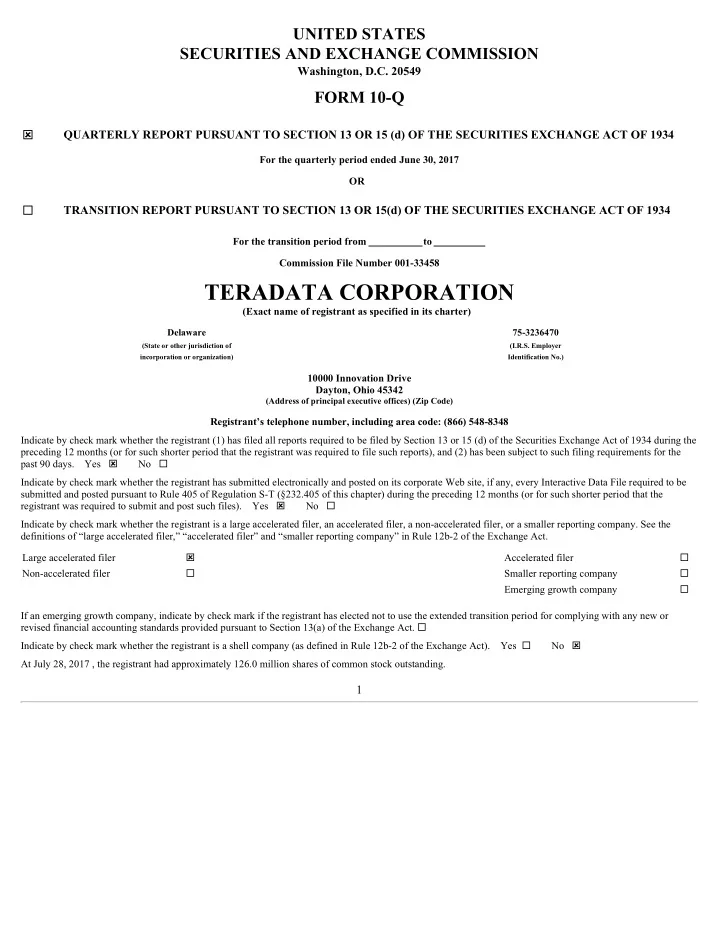
UNITED STATES SECURITIES AND EXCHANGE COMMISSION Washington, D.C. 20549 FORM 10-Q QUARTERLY REPORT PURSUANT TO SECTION 13 OR 15 (d) OF THE SECURITIES EXCHANGE ACT OF 1934 For the quarterly period ended June 30, 2017 OR TRANSITION


slide-1
SLIDE 1

UNITED STATES SECURITIES AND EXCHANGE COMMISSION

Washington, D.C. 20549

FORM 10-Q

ý

QUARTERLY REPORT PURSUANT TO SECTION 13 OR 15 (d) OF THE SECURITIES EXCHANGE ACT OF 1934

For the quarterly period ended June 30, 2017 OR

¨

TRANSITION REPORT PURSUANT TO SECTION 13 OR 15(d) OF THE SECURITIES EXCHANGE ACT OF 1934

For the transition period from to Commission File Number 001-33458

TERADATA CORPORATION

(Exact name of registrant as specified in its charter)

Delaware 75-3236470

(State or other jurisdiction of (I.R.S. Employer incorporation or organization) Identification No.)

10000 Innovation Drive Dayton, Ohio 45342

(Address of principal executive offices) (Zip Code)

Registrant’s telephone number, including area code: (866) 548-8348 Indicate by check mark whether the registrant (1) has filed all reports required to be filed by Section 13 or 15 (d) of the Securities Exchange Act of 1934 during the preceding 12 months (or for such shorter period that the registrant was required to file such reports), and (2) has been subject to such filing requirements for the past 90 days. Yes ý No ¨ Indicate by check mark whether the registrant has submitted electronically and posted on its corporate Web site, if any, every Interactive Data File required to be submitted and posted pursuant to Rule 405 of Regulation S-T (§232.405 of this chapter) during the preceding 12 months (or for such shorter period that the registrant was required to submit and post such files). Yes ý No ¨ Indicate by check mark whether the registrant is a large accelerated filer, an accelerated filer, a non-accelerated filer, or a smaller reporting company. See the definitions of “large accelerated filer,” “accelerated filer” and “smaller reporting company” in Rule 12b-2 of the Exchange Act. Large accelerated filer ý Accelerated filer ¨ Non-accelerated filer ¨ Smaller reporting company ¨ Emerging growth company ¨ If an emerging growth company, indicate by check mark if the registrant has elected not to use the extended transition period for complying with any new or revised financial accounting standards provided pursuant to Section 13(a) of the Exchange Act. ¨ Indicate by check mark whether the registrant is a shell company (as defined in Rule 12b-2 of the Exchange Act). Yes ¨ No ý At July 28, 2017 , the registrant had approximately 126.0 million shares of common stock outstanding.

1

slide-2
SLIDE 2

TABLE OF CONTENTS PART I—FINANCIAL INFORMATION

Description Page

Item 1. Financial Statements Condensed Consolidated Statements of (Loss) Income (Unaudited) Three and Six Months Ended June 30, 2017 and 2016 3 Condensed Consolidated Statements of Comprehensive Income (Unaudited) Three and Six Months Ended June 30, 2017 and 2016 4 Condensed Consolidated Balance Sheets (Unaudited) June 30, 2017 and December 31, 2016 5 Condensed Consolidated Statements of Cash Flows (Unaudited) Six Months Ended June 30, 2017 and 2016 6 Notes to Condensed Consolidated Financial Statements (Unaudited) 7 Item 2. Management’s Discussion and Analysis of Financial Condition and Results of Operations 16 Item 3. Quantitative and Qualitative Disclosures About Market Risk 29 Item 4. Controls and Procedures 29 PART II—OTHER INFORMATION

Description Page

Item 1. Legal Proceedings 29 Item 1A. Risk Factors 29 Item 2. Unregistered Sales of Equity Securities and Use of Proceeds 29 Item 3. Defaults Upon Senior Securities 30 Item 4. Mine Safety Disclosures 30 Item 5. Other Information 30 Item 6. Exhibits 31 Signatures 32

2

slide-3
SLIDE 3

Table of Contents Part 1—FINANCIAL INFORMATION

Item 1. Financial Statements.

Teradata Corporation Condensed Consolidated Statements of (Loss) Income (Unaudited)

Three Months Ended June 30, Six Months Ended June 30,

In millions, except per share amounts

2017 2016 2017 2016 Revenue Product and cloud revenue $ 166 $ 243 $

332 $ 451

Service revenue 347 356

672 693

Total revenue 513 599 1,004 1,144 Costs and operating expenses Cost of product and cloud 72 101 148 190 Cost of services 199 188 390 375 Selling, general and administrative expenses 165 172 320 346 Research and development expenses 78 51 148 108 Impairment of goodwill, acquired intangibles and other assets — — — 80 Total costs and operating expenses 514 512 1,006 1,099 (Loss) income from operations (1) 87 (2) 45 Other expense, net Interest expense (4) (4) (7) (7) Interest income 3 2 5 3 Other expense (1) — (1) (1) Total other expense, net (2) (2) (3) (5) (Loss) income before income taxes (3) 85 (5) 40 Income tax expense 1 21 1 22 Net (loss) income $ (4) $ 64 $ (6) $ 18 Net (loss) income per weighted average common share Basic $ (0.03) $ 0.49 $ (0.05) $ 0.14 Diluted $ (0.03) $ 0.49 $ (0.05) $ 0.14 Weighted average common shares outstanding Basic 127.9 129.8 129.2 129.6 Diluted 127.9 131.5 129.2 131.2

See Notes to Condensed Consolidated Financial Statements (Unaudited). 3

slide-4
SLIDE 4

Table of Contents Teradata Corporation Condensed Consolidated Statements of Comprehensive Income (Unaudited)

Three Months Ended June 30, Six Months Ended June 30,

In millions

2017 2016 2017 2016 Net (loss) income $ (4) $ 64 $ (6) $ 18 Other comprehensive income (loss): Foreign currency translation adjustments 5 (2) 10 6 Defined benefit plans: Defined benefit plan adjustment, before tax 1 2 2 2 Defined benefit plan adjustment, tax portion — (1) — (1) Defined benefit plan adjustment, net of tax 1 1 2 1 Other comprehensive income (loss) 6 (1) 12 7 Comprehensive income $ 2 $ 63 $ 6 $ 25

See Notes to Condensed Consolidated Financial Statements (Unaudited). 4

slide-5
SLIDE 5

Table of Contents Teradata Corporation Condensed Consolidated Balance Sheets (Unaudited)

In millions, except per share amounts

June 30, 2017 December 31, 2016 Assets Current assets Cash and cash equivalents $ 1,085 $ 974 Accounts receivable, net 356 548 Inventories 42 34 Other current assets 65 65 Total current assets 1,548 1,621 Property and equipment, net 143 138 Capitalized software, net 150 187 Goodwill 401 390 Acquired intangible assets, net 21 11 Deferred income taxes 51 49 Other assets 24 17 Total assets $ 2,338 $ 2,413 Liabilities and stockholders’ equity Current liabilities Current portion of long-term debt $ 45 $ 30 Accounts payable 97 103 Payroll and benefits liabilities 129 139 Deferred revenue 431 369 Other current liabilities 90 88 Total current liabilities 792 729 Long-term debt 508 538 Pension and other postemployment plan liabilities 107 96 Long-term deferred revenue 10 14 Deferred tax liabilities 14 33 Other liabilities 35 32 Total liabilities 1,466 1,442 Commitments and contingencies (Note 7) Stockholders’ equity Preferred stock: par value $0.01 per share, 100.0 shares authorized, no shares issued and outstanding at June 30, 2017 and December 31, 2016, respectively — — Common stock: par value $0.01 per share, 500.0 shares authorized, 126.3 and 130.6 shares issued at June 30, 2017 and December 31, 2016, respectively 1 1 Paid-in capital 1,266 1,220 Accumulated deficit (318) (161) Accumulated other comprehensive loss (77) (89) Total stockholders’ equity 872 971 Total liabilities and stockholders’ equity $ 2,338 $ 2,413

See Notes to Condensed Consolidated Financial Statements (Unaudited). 5

slide-6
SLIDE 6

Table of Contents Teradata Corporation Condensed Consolidated Statements of Cash Flows (Unaudited)

Six Months Ended June 30,

In millions

2017 2016 Operating activities Net (loss) income $ (6) $ 18 Adjustments to reconcile net (loss) income to net cash provided by operating activities: Depreciation and amortization 70 65 Stock-based compensation expense 35 33 Deferred income taxes (20) (15) Impairment of goodwill, acquired intangibles and other assets — 80 Changes in assets and liabilities: Receivables 192 122 Inventories (8) 11 Current payables and accrued expenses (13) (10) Deferred revenue 58 64 Other assets and liabilities 1 (19) Net cash provided by operating activities 309 349 Investing activities Expenditures for property and equipment (30) (17) Proceeds from sale of property and equipment — 5 Additions to capitalized software (4) (36) Business acquisitions and other investing activities, net (18) (4) Net cash used in investing activities (52) (52) Financing activities Repurchases of common stock (151) (51) Repayments of long-term borrowings (15) (15) Repayments of credit facility borrowings — (180) Other financing activities, net 12 19 Net cash used in financing activities (154) (227) Effect of exchange rate changes on cash and cash equivalents 8 — Increase in cash and cash equivalents 111 70 Cash and cash equivalents at beginning of period 974 839 Cash and cash equivalents at end of period $ 1,085 $ 909

See Notes to Condensed Consolidated Financial Statements (Unaudited). 6

slide-7
SLIDE 7

Table of Contents Notes to Condensed Consolidated Financial Statements (Unaudited)

  • 1. Basis of Presentation

These statements have been prepared pursuant to the rules and regulations of the United States Securities and Exchange Commission (“SEC”) and, in accordance with those rules and regulations, do not include all information and footnote disclosures normally included in annual financial statements prepared in accordance with accounting principles generally accepted in the United States of America (“GAAP”). In the

  • pinion of management, the condensed consolidated financial statements reflect all adjustments, consisting only of normal recurring

adjustments, necessary to fairly state the results of operations, financial position and cash flows of Teradata Corporation (“Teradata” or the “Company”) for the interim periods presented herein. The year-end 2016 condensed consolidated balance sheet data was derived from audited financial statements, but does not include all disclosures required by GAAP. The preparation of condensed consolidated financial statements in conformity with GAAP requires management to make use of estimates and assumptions that affect the reported amounts and

  • disclosures. Actual results may vary from these estimates.

These condensed consolidated interim financial statements should be read in conjunction with the consolidated financial statements and notes thereto included in Teradata’s most recent Annual Report on Form 10-K for the fiscal year ended December 31, 2016 (the “ 2016 Annual Report”). The results of operations for any interim period are not necessarily indicative of the results of operations to be expected for the full

  • year. Prior period amounts have been restated to conform to the current year presentation. As a result of the Company's early adoption of

Accounting Standards Update 2016-09, Improvements to Employee Share-Based Payment Accounting , in the fourth quarter of 2016, retroactively to January 1, 2016, the restatement of prior year results resulted in a change in net cash provided by operating activities and net cash used by financing activities of $2 million for the six months ended June 30, 2016.

  • 2. New Accounting Pronouncements

Revenue Recognition. In May 2014, the Financial Accounting Standards Board ("FASB") issued new guidance that affects any entity that either enters into contracts with customers to transfer goods or services or enters into contracts for the transfer of nonfinancial assets unless those contracts are within the scope of other standards. The new guidance will supersede the revenue recognition requirements in the current revenue recognition guidance, and most industry-specific guidance. In addition, the existing requirements for the recognition of a gain or loss

  • n the transfer of nonfinancial assets that are not in a contract with a customer are amended to be consistent with the guidance on recognition

and measurement in this update. The core principle of the guidance is that an entity should recognize revenue to depict the transfer of promised goods or services to customers in an amount that reflects the consideration to which the entity expects to be entitled in exchange for those goods or services. To achieve that core principle, the FASB defines a five-step process which includes the following: (1) identify the contract with a customer, (2) identify the performance obligations in the contract, (3) determine the transaction price, (4) allocate the transaction price to the performance obligations in the contract, and (5) recognize revenue when (or as) the entity satisfies a performance

  • bligation.

The new revenue standard will be effective for annual reporting periods beginning after December 15, 2017, with early application permitted. The standard allows entities to apply the standard retrospectively for all periods presented or alternatively an entity is permitted to recognize the cumulative effect of initially applying the guidance as an opening balance sheet adjustment to retained earnings in the period of initial application (modified retrospective method). The Company plans to adopt the new accounting guidance effective January 1, 2018 by utilizing the modified retrospective method. The Company is currently evaluating the impact on its consolidated financial position, results of operations and cash flows. Although the Company is still evaluating the impact on its consolidated financial statements, the Company believes the most significant impacts may include the following items: 7

slide-8
SLIDE 8

Table of Contents

  • As the Company transitions to the new go-to-market offerings, such as subscription-based licenses rather than perpetual licenses, the

Company could potentially see a more significant impact in the amount of revenue recognized over time under the current rules but upfront under the new rules. This impact could result in revenue that is adjusted to retained earnings in the period of adoption and therefore not recognized in future periods or restated to prior periods due to the Company applying the modified retrospective method of adoption;

  • The Company currently expenses contract acquisition costs and believes that the requirement to defer incremental contract

acquisition costs and recognize them over the term of the contract to which the costs relate could have an impact, especially as the Company transitions to longer-term, over-time revenue contracts;

  • The amount of revenue allocated to the delivered items and recognized upfront utilizing the relative selling price model is limited to

the amount that is not contingent upon the delivery of additional items or meeting other specified performance conditions ( i.e ., the non-contingent amount) under current rules. Under the new rules, the amounts allocated to delivered items and recognized upfront could be higher if it is probable that a significant reversal in the amount of revenue recognized will not occur in future periods upon the delivery of additional items or meeting other specified performance conditions; and

  • The new standard will impact our internal control environment, including our financial statement disclosure controls, business

process controls, new systems and processes, and enhancements to existing systems and processes. The Company does not expect that the new standard will result in substantive changes in our performance obligations or the amounts of revenue allocated between multiple performance obligations, with the exception of contingent revenue discussed above. The Company is still in the process of evaluating and quantifying these impacts, and our initial assessment may change as the Company continues with implementing new systems, processes, accounting policies and internal controls. Presentation of Net Periodic Pension Cost and Net Periodic Post-retirement Benefit Cost. In March 2017, the FASB issued accounting guidance for “Compensation – Retirement Benefits (Topic 715): Improving the Presentation of Net Periodic Pension Cost and Net Periodic Post-retirement Benefit Cost”. The amendment requires the service cost component of net periodic benefit cost be presented in the same income statement line item as other employee compensation costs arising from services rendered during the period and other components of the net periodic benefit cost be presented separately from the line item that includes the service cost and outside of any subtotal of operating

  • income. For public entities, the amendments are effective for interim and annual reporting periods beginning after December 15, 2017. The

Company is currently evaluating this guidance to determine the impact it may have on its consolidated financial statements. Stock Compensation. In May 2017, the FASB issued accounting guidance for "Compensation—Stock Compensation (Topic 718) - Scope of Modification Accounting". The amendments in this update provide guidance about which changes to the terms or conditions of a share-based payment award require an entity to apply modification accounting in Topic 718. The current disclosure requirements in Topic 718 apply regardless of whether an entity is required to apply modification accounting under the amendments in this update. The amendments in this update are effective for all entities for annual periods, and interim periods within those annual periods, beginning after December 15, 2017. Early adoption is permitted, including adoption in any interim period. The Company is currently evaluating this guidance to determine the impact it may have on its consolidated financial statements. Recently Adopted Guidance Simplifying the measurement for goodwill . In January 2017, the FASB issued guidance to simplify the accounting for the impairment of

  • goodwill. The guidance removes Step 2 of the goodwill impairment test, which requires a hypothetical purchase price allocation. A goodwill

impairment will now be the amount by which a reporting unit’s carrying value exceeds its fair value, not to exceed the carrying amount of

  • goodwill. The guidance is required to be applied prospectively and is effective for periods beginning after December 15, 2019, with early

adoption permitted. The Company elected to early adopt this accounting guidance effective January 1, 2017. The Company does not expect any impact from the adoption of the new accounting guidance on its consolidated financial statements. 8

slide-9
SLIDE 9

Table of Contents

  • 3. Supplemental Financial Information

As of

In millions

June 30, 2017 December 31, 2016 Inventories Finished goods $ 29 $ 20 Service parts 13 14 Total inventories $ 42 $ 34 Deferred revenue Deferred revenue, current $ 431 $ 369 Long-term deferred revenue 10 14 Total deferred revenue $ 441 $ 383

  • 4. Goodwill and Acquired Intangible Assets

The following table identifies the activity relating to goodwill by operating segment:

In millions Balance, December 31, 2016 Adjustments Currency Translation Adjustments Balance, June 30, 2017 Goodwill Americas Data and Analytics

$ 251 $ 7 $ — $ 258

International Data and Analytics

139 — 4 143

Total goodwill

$ 390 $ 7 $ 4 $ 401

During the second quarter of 2017, the Company recorded additional goodwill of $7 million , for an immaterial acquisition that occurred during the period. Acquired intangible assets were specifically identified when acquired, and are deemed to have finite lives. The gross carrying amount and accumulated amortization for Teradata’s acquired intangible assets were as follows:

June 30, 2017 December 31, 2016

In millions

Amortization Life (in Years) Gross Carrying Amount Accumulated Amortization and Currency Translation Adjustments Gross Carrying Amount Accumulated Amortization and Currency Translation Adjustments Acquired intangible assets Intellectual property/developed technology 2 to 5 $ 36 $ (16) $ 71 $ (61) Trademarks/trade names 5 — — 1 (1) In-process research and development 5 5 (4) 5 (4) Total acquired intangible assets $ 41 $ (20) $ 77 $ (66)

During the second quarter of 2017, the Company recorded additional intangibles of $13 million , for intellectual property related to an immaterial acquisition that occurred during the period. 9

slide-10
SLIDE 10

Table of Contents The aggregate amortization expense (actual and estimated) for acquired intangible assets is as follows:

Three Months Ended June 30, Six Months Ended June 30,

In millions

2017 2016 2017 2016 Amortization expense $ 1 $ 2 $ 3 $ 7 Actual For the years ended (estimated)

In millions

2016 2017 2018 2019 2020 2021 2022 Amortization expense $ 10 $ 8 $ 5 $ 4 $ 3 $ 3 $ 1

  • 5. Income Taxes

Income tax provisions for interim periods are based on estimated annual income tax rates, adjusted to reflect the effects of any significant infrequent or unusual items which are required to be discretely recognized within the current interim period. The Company’s intention is to permanently reinvest its foreign earnings outside of the United States ("U.S."). As a result, the effective tax rates in the periods presented are largely based upon the forecasted pre-tax earnings mix and allocation of certain expenses in various taxing jurisdictions where the Company conducts its business that apply a broad range of statutory income tax rates, a large majority of which are less than the U.S. statutory rate. The effective tax rate is as follows:

Three Months Ended June 30, Six Months Ended June 30,

In millions

2017 2016 2017 2016 Effective tax rate (33.3)% 24.7% (20.0)% 55.0%

For the three and six months ended June 30, 2017 , no material non-recurring discrete tax items were recorded. Discrete tax items related to interest accruals on uncertain tax positions and equity based compensation resulted in income tax expense of $1 million , on a pre-tax net loss

  • f $3 million and $5 million for the three and six months ended June 30 2017, causing a negative tax rate of (33.3)% and (20.0)% for the

respective periods. For the three months ended June 30, 2016, there was a $1.0 million favorable tax benefit recognized due to the release of a reserve taken for a previously uncertain tax position. For the six months ended June 30, 2016, there were discrete tax items resulting from the $76 million intangible asset impairment recorded in the first quarter of 2016, of which $57 million was related to non-deductible goodwill and $19 million was related to intangible assets for which $6 million of deferred tax benefit had been recorded. In addition, there was a $2 million favorable tax benefit recognized due to the release of a reserve taken for a previously uncertain tax position.

  • 6. Derivative Instruments and Hedging Activities

As a portion of Teradata’s operations is conducted outside the U.S. and in currencies other than the U.S. dollar, the Company is exposed to potential gains and losses from changes in foreign currency exchange rates. In an attempt to mitigate the impact of currency fluctuations, the Company uses foreign exchange forward contracts to hedge transactional exposures resulting predominantly from foreign currency denominated inter-company receivables and payables. The forward contracts are designated as fair value hedges of specified foreign currency denominated inter-company receivables and payables and generally mature in three months or less. The Company does not hold or issue derivative financial instruments for trading purposes, nor does it hold or issue leveraged derivative instruments. By using derivative financial instruments to hedge exposures to changes in exchange rates, the Company exposes itself to credit risk. The Company manages exposure to counterparty credit risk by entering into derivative financial instruments with highly rated institutions that can be expected to fully perform under the terms of the applicable contracts. 10

slide-11
SLIDE 11

Table of Contents All derivatives are recognized in the consolidated balance sheets at their fair value. The fair values of foreign exchange contracts are based on market spot and forward exchange rates and represent estimates of possible value that may not be realized in the future. Changes in the fair value of derivative financial instruments, along with the loss or gain on the hedged asset or liability, are recorded in current period earnings. The notional amounts represent agreed-upon amounts on which calculations of dollars to be exchanged are based, and are an indication of the extent of Teradata’s involvement in such instruments. These notional amounts do not represent amounts exchanged by the parties and, therefore, are not a measure of the instruments. Across its portfolio of contracts, Teradata has both long and short positions relative to the U.S. dollar. As a result, Teradata’s net involvement is less than the total contract notional amount of the Company’s foreign exchange forward contracts. The following table identifies the contract notional amount of the Company’s foreign exchange forward contracts:

As of

In millions

June 30, 2017 December 31, 2016 Contract notional amount of foreign exchange forward contracts $ 137 $ 156 Net contract notional amount of foreign exchange forward contracts $ 15 $ 16

The fair value of derivative assets and liabilities recorded in other current assets and accrued liabilities at June 30, 2017 and December 31, 2016 , were not material. Gains and losses from the Company’s fair value hedges (foreign currency forward contracts and related hedged items) were immaterial for the three and six months ended June 30, 2017 and June 30, 2016 . Gains and losses from foreign exchange forward contracts are fully recognized each period and reported along with the offsetting gain or loss of the related hedged item, either in cost of products or in other income (expense), depending on the nature of the related hedged item.

  • 7. Commitments and Contingencies

In the normal course of business, the Company is subject to proceedings, lawsuits, governmental investigations, claims and other matters, including those that relate to the environment, health and safety, employee benefits, export compliance, intellectual property, tax matters and

  • ther regulatory compliance and general matters.

The Company, through internal processes, discovered certain questionable expenditures for travel, gifts and other expenses at one of its international subsidiaries doing business in a single foreign country, Turkey. Teradata promptly initiated an internal investigation into the matter, with the assistance of outside counsel and forensic accountants, to determine whether the expenditures may have violated the U.S. Foreign Corrupt Practices Act (“FCPA”) or other potentially applicable anti-corruption laws. In late February 2017, the Company voluntarily contacted the SEC and the U.S. Department of Justice (“DOJ”) to alert them to the relevant events and the Company's internal investigation. Teradata has periodically updated the government regarding the status of the Company's internal investigation and findings, including remedial actions and terminations, and plans to continue to cooperate fully. Based on information known at this time, it is currently believed that the questionable expenditures were limited to a single subsidiary’s business operations in Turkey and involved specific individuals who are no longer with the Company. Teradata’s operations in Turkey have constituted less than one half of one percent of consolidated revenues each year as reported by the Company since 2012. Under the circumstances, Teradata currently does not anticipate a material adverse effect on its business or financial condition as a result of this matter; however, the ultimate resolution of this matter with the DOJ and SEC cannot be predicted. Any determination that the Company’s operations

  • r activities are not in compliance with existing laws or regulations could result in the imposition of fines, civil and criminal penalties, and

equitable remedies, including disgorgement or injunctive relief. Guarantees and Product Warranties. Guarantees associated with the Company’s business activities are reviewed for appropriateness and impact to the Company’s financial statements. Periodically, the Company’s customers enter into various leasing arrangements coordinated with a leasing company. In some instances, the Company guarantees 11

slide-12
SLIDE 12

Table of Contents the leasing company a minimum value at the end of the lease term on the leased equipment. As of June 30, 2017 , the maximum future payment obligation of this guaranteed value and the associated liability balance was $4 million . The Company provides its customers a standard manufacturer’s warranty and records, at the time of the sale, a corresponding estimated liability for potential warranty costs. Estimated future obligations due to warranty claims are based upon historical factors such as labor rates, average repair time, travel time, number of service calls and cost of replacement parts. For each consummated sale, the Company recognizes the total customer revenue and records the associated warranty liability under other current liabilities in the balance sheet using pre- established warranty percentages for that product class. The following table identifies the activity relating to the warranty reserve for the six months ended June 30 :

In millions 2017 2016 Warranty reserve liability Beginning balance at January 1 $ 5 $ 6 Provisions for warranties issued 3 4 Settlements (in cash or in kind) (4) (5) Balance at June 30 $ 4 $ 5

The Company also offers extended and/or enhanced coverage to its customers in the form of maintenance contracts. The Company accounts for these contracts by deferring the related maintenance revenue over the extended and/or enhanced coverage period. Costs associated with maintenance support are expensed as incurred. Amounts associated with these maintenance contracts are not included in the table above. In addition, the Company provides its customers with certain indemnification rights. In general, the Company agrees to indemnify the customer if a third-party asserts patent or other infringement on the part of the customer for its use of the Company’s products. The Company has entered into indemnification agreements with the officers and directors of its subsidiaries. From time to time, the Company also enters into agreements in connection with its acquisition and divesture activities that include indemnification obligations by the Company. The fair value of these indemnification obligations is not readily determinable due to the conditional nature of the Company’s potential obligations and the specific facts and circumstances involved with each particular agreement, and as such the Company has not recorded a liability in connection with these indemnification arrangements. Historically, payments made by the Company under these types of agreements have not had a material effect on the Company’s consolidated financial condition, results of operations or cash flows. Concentrations of Risk . The Company is potentially subject to concentrations of credit risk on accounts receivable and financial instruments such as hedging instruments, and cash and cash equivalents. Credit risk includes the risk of nonperformance by counterparties. The maximum potential loss may exceed the amount recognized on the balance sheet. Exposure to credit risk is managed through credit approvals, credit limits, selecting major international financial institutions (as counterparties to hedging transactions) and monitoring

  • procedures. Teradata’s business often involves large transactions with customers, and if one or more of those customers were to default in its
  • bligations under applicable contractual arrangements, the Company could be exposed to potentially significant losses. However,

management believes that the reserves for potential losses were adequate at June 30, 2017 and December 31, 2016. The Company is also potentially subject to concentrations of supplier risk. Our hardware components are assembled exclusively by Flextronics International Ltd. (“Flextronics”). Flextronics procures a wide variety of components used in the manufacturing process on behalf

  • f the Company. Although many of these components are available from multiple sources, Teradata utilizes preferred supplier relationships

to provide more consistent and optimal quality, cost and delivery. Typically, these preferred suppliers maintain alternative processes and/or facilities to ensure continuity of supply. Given the Company’s strategy to outsource its manufacturing activities to Flextronics and to source certain components from single suppliers, a disruption in production at Flextronics or at a supplier could impact the timing of customer shipments and/or Teradata’s operating results. In addition, a significant change 12

slide-13
SLIDE 13

Table of Contents in the forecasts to any of these preferred suppliers could result in purchase obligations for components that may be in excess of demand.

  • 8. Fair Value Measurements

Fair value measurements are established utilizing a three-tier fair value hierarchy, which prioritizes the inputs used in measuring fair value. These tiers include: Level 1, defined as observable inputs such as quoted prices in active markets for identical assets or liabilities; Level 2, defined as significant other observable inputs, such as quoted prices in active markets for similar assets or liabilities, or quoted prices in less- active markets for identical assets; and Level 3, defined as unobservable inputs in which little or no market data exists, therefore requiring an entity to develop its own assumptions. Financial assets and liabilities are classified in their entirety based on the lowest level of input that is significant to the fair value measurement. The Company’s assets and liabilities measured at fair value on a recurring basis include money market funds and foreign currency exchange

  • contracts. A portion of the Company’s excess cash reserves are held in money market funds which generate interest income based on the

prevailing market rates. Money market funds are included in cash and cash equivalents in the Company’s balance sheet. Money market fund holdings are measured at fair value using quoted market prices and are classified within Level 1 of the valuation hierarchy. When deemed appropriate, the Company minimizes its exposure to changes in foreign currency exchange rates through the use of derivative financial instruments, specifically, foreign exchange forward contracts. The fair value of these contracts are measured at the end of each interim reporting period using observable inputs other than quoted prices, specifically market spot and forward exchange rates. As such, these derivative instruments are classified within Level 2 of the valuation hierarchy. Fair value gains for open contracts are recognized as assets and fair value losses are recognized as liabilities. The fair value derivative assets and liabilities recorded in other current assets and accrued liabilities at June 30, 2017 and December 31, 2016 , were not material. Any realized gains or losses would be mitigated by corresponding gains or losses on the underlying exposures. The Company’s assets measured at fair value on a recurring basis and subject to fair value disclosure requirements at June 30, 2017 and December 31, 2016 were as follows:

Fair Value Measurements at Reporting Date Using

In millions

Total Quoted Prices in Active Markets for Identical Assets (Level 1) Significant Other Observable Inputs (Level 2) Significant Unobservable Inputs (Level 3) Assets Money market funds, June 30, 2017 $ 489 $ 489 $ — $ — Money market funds, December 31, 2016 $ 473 $ 473 $ — $ —

13

slide-14
SLIDE 14

Table of Contents

  • 9. Earnings per Share

Basic earnings per share is calculated by dividing net income by the weighted average number of shares outstanding during the reported

  • period. The calculation of diluted earnings per share is similar to basic earnings per share, except that the weighted average number of shares
  • utstanding includes the dilution from potential shares resulting from stock options, restricted stock awards and other stock awards. The

components of basic and diluted earnings per share are as follows:

Three Months Ended June 30, Six Months Ended June 30,

In millions, except per share amounts

2017 2016 2017 2016 Net loss attributable to common stockholders $ (4) $ 64 $ (6) $ 18 Weighted average outstanding shares of common stock 127.9 129.8 129.2 129.6 Dilutive effect of employee stock options, restricted stock and other stock awards — 1.7 — 1.6 Common stock and common stock equivalents 127.9 131.5 129.2 131.2 Loss per share: Basic $ (0.03) $ 0.49 $ (0.05) $ 0.14 Diluted $ (0.03) $ 0.49 $ (0.05) $ 0.14

For the three and six months ended June 30, 2017, due to the net loss attributable to Teradata common stockholders, potential common shares that would cause dilution, such as employee stock options, restricted stock and other stock awards, have been excluded from the diluted share count because their effect would have been anti-dilutive. The fully diluted shares would have been 129.5 million and 130.7 million for the three and six months ended June 30, 2017. Options to purchase 4.5 million shares of common stock for the three and six months ended June 30, 2017 and 5.1 million and 5.4 million shares of common stock for the three and six months ended June 30, 2016 were not included in the computation of diluted earnings per share because their exercise prices were greater than the average market price of the common shares for the period, and therefore would have been anti-dilutive.

  • 10. Segment and Other Supplemental Information

Effective July 1, 2016, following the sale of the marketing applications business, Teradata is managing its business in two operating segments: (1) Americas region (North America and Latin America); and (2) International region (Europe, Middle East, Africa, Asia Pacific and Japan). For purposes of discussing results by segment, management excludes the impact of certain items, consistent with the manner by which management evaluates the performance of each segment. This format is useful to investors because it allows analysis and comparability of operating trends. It also includes the same information that is used by Teradata management to make decisions regarding the segments and to assess financial performance. The chief operating decision maker evaluates the performance of the segments based on revenue and multiple profit measures, including segment gross profit. For management reporting purposes assets are not allocated to the segments. 14

slide-15
SLIDE 15

Table of Contents The following table presents segment revenue and segment gross margin for the Company:

Three Months Ended June 30, Six Months Ended June 30,

In millions

2017 2016 2017 2016 Segment revenue Americas Data and Analytics $ 271 $ 325 $ 538 $ 620 International Data and Analytics 242 239 466 455 Total Data and Analytics 513 564 1,004 1,075 Marketing Applications — 35 — 69 Total revenue 513 599 1,004 1,144 Segment gross profit Americas Data and Analytics 158 194 309 369 International Data and Analytics 107 121 207 223 Total Data and Analytics 265 315 516 592 Marketing Applications — 17 — 34 Total segment gross profit 265 332 516 626 Stock-based compensation costs (3) (4) (7) (8) Amortization of acquisition-related intangible assets costs — — — (2) Acquisition, integration, reorganization and transformation-related costs (2) (2) (4) (5) Amortization of capitalized software costs (18) (16) (39) (32) Selling, general and administrative expenses 165 172 320 346 Research and development expenses 78 51 148 108 Impairment of goodwill, acquired intangibles and other assets — — — 80 (Loss) income from operations $ (1) $ 87 $ (2) $ 45

Prior period segment information has been reclassified to conform to the current period presentation. Certain items, including amortization of certain capitalized software costs, were excluded from segment gross profit to conform to the way the Company manages and reviews the results by segment. The following table presents a further disaggregation of revenue for the Company:

Three Months Ended June 30, Six Months Ended June 30,

In millions

2017 2016 2017 2016 Product - rights to upgrades, subscription and cloud $ 75 $ 69 $ 151 $ 139 Maintenance - software and hardware 182 174 358 342 Total recurring revenue 257 243 509 481 Product - perpetual licenses and hardware 91 154 181 274 Consulting services 165 167 314 320 Marketing applications — 35 — 69 Total revenue $ 513 $ 599 $ 1,004 $ 1,144

15

slide-16
SLIDE 16

Table of Contents

  • 11. Reorganization and Business Transformation

In the fourth quarter of 2015, the Company announced a plan to realign Teradata’s business by reducing its cost structure and focusing on the Company’s core data and analytics business. This business transformation included exiting the marketing applications business, rationalizing costs, and modifying the Company’s go-to-market approach. The Company incurred the following costs for the six months ended June 30:

Six Months Ended June 30, In millions 2017 2016 Employee severance and other employee related cost $ 2 $ 10 Asset write-downs 6 80 Professional services, legal and other transformation costs 18 19 Total reorganization and business transformation cost $ 26 $ 109

For the six months ended June 30, 2017, costs incurred above includes $8 million for an inventory charge and other associated transformation costs related to the discontinuation of Teradata's prior hardware platforms. In addition to the costs and charges incurred above, the Company made cash payments of less than $1 million for the six months ended June 30, 2017 and $16 million for the six months ended June 30, 2016 for employee severance that did not have a material impact on its Statement of Operations due to Teradata's accounting for its postemployment benefits under Accounting Standards Codification 712, Compensation - Nonretirement Postemployment Benefits (“ASC 712”), which uses actuarial estimates and defers the immediate recognition of gains or losses.

  • 12. Subsequent Events

From July 1, 2017 through August 3, 2017, the Company purchased 1,279,206 shares of its common stock at an average price per share of $32.03 , and a total cost of approximately $41 million . As of August 3, 2017 the Company had approximately $341 million of share repurchase authorization remaining. Item 2. Management’s Discussion and Analysis of Financial Condition and Results of Operations (“MD&A”). You should read the following discussion in conjunction with the Condensed Consolidated Financial Statements and the notes to those statements included elsewhere in this Quarterly Report on Form 10-Q. This Quarterly Report on Form 10-Q contains certain statements that are forward-looking within the meaning of the Private Securities Litigation Reform Act of 1995. Certain statements contained in the MD&A are forward-looking statements that involve risks and uncertainties. The forward-looking statements are not historical facts, but rather are based on current expectations, estimates, assumptions and projections about our industry, business and future financial results. Our actual results could differ materially from the results contemplated by these forward-looking statements due to a number of factors, including those discussed in other sections of this Quarterly Report on Form 10-Q and in the 2016 Annual Report on Form 10-K. The Company does not undertake any obligation to publicly update or revise any forward-looking statements, whether as a result of new information, future events

  • r otherwise.

16

slide-17
SLIDE 17

Table of Contents Second Quarter Financial Overview As more fully discussed in later sections of this MD&A, the following were significant financial items for the second quarter of 2017 :

  • Total revenue was $513 million for the second quarter of 2017 , down 14% from the second quarter of 2016 , with an underlying 32%

decrease in product and cloud revenue and a 3% decrease in services revenue, in part due to the sale of the marketing applications business.

  • Gross margin decreased to 47.2% in the second quarter of 2017 from 51.8% in the second quarter of 2016 , driven by a decrease in both

product and cloud and services gross margin.

  • Operating expenses increased by 9% in the second quarter of 2017 due to the Company no longer capitalizing certain software

development costs as well as additional spend for strategic initiatives.

  • Operating loss was $1 million in the second quarter of 2017 , compared to operating income of $87 million in the second quarter of 2016 .
  • Net loss in the second quarter of 2017 was $4 million , compared to net income of $64 million in the second quarter of 2016

Strategic Overview Teradata’s strategy is based around our core belief that analytics and data unleash the potential of great companies. We empower companies to achieve high-impact business outcomes through scalable analytics on an agile data foundation. Through our focus on leading with business

  • utcomes and a consultative approach, our goal is to serve as a trusted advisor to both the business and technical leaders in our customers’
  • rganizations. Our business analytics solutions are ideally suited for the world’s largest companies as they have the largest and most complex

analytics challenges, and therefore provide the largest revenue opportunities for Teradata. Our strategy is to provide a differentiated set of offerings to this target market through a portfolio of data and analytics solutions, including the following:

  • Hybrid Cloud : leading technology and services to deliver an analytic ecosystem deployed in a hybrid cloud architecture, including
  • fferings such as managed cloud, private cloud, public cloud, and on premises software and hardware;
  • Business Analytics Solutions : deliver high-value business outcomes realized by engaging with business users through solution-

based selling that leverages analytic consulting and repeatable analytical intellectual property ("IP"); and

  • Ecosystem Architecture Consulting : best-in-class architecture consulting expertise to help customers build optimized analytical

ecosystems independent of technology, leveraging both open source and commercial solutions. We deliver our solutions on-premises, via the cloud, and "as a service"; offering customers choice in how they deploy a Teradata analytics environment and leverage the power of our solutions. These flexible delivery options are designed to extend our market opportunity. In support of our strategy, we are continuing to optimize our go-to-market and sales approach to improve effectiveness in demand creation and address new and expanded market opportunities, such as with our consultative business solutions and cloud offerings. We will continue investing in partnerships to increase the number of solutions available on Teradata platforms, maximize customer value, and increase our market coverage. We believe that our more consultative, solution-selling approach and portfolio of offerings that support customers’ choice in procuring and deploying analytics will best position us to be our customers’ trusted advisor and partner of choice for architecting, implementing, and managing their analytic solutions. In summary, our long-term strategic objectives are to:

  • deliver business outcomes for our customers through technology-enabled analytics at scale,

17

slide-18
SLIDE 18

Table of Contents

  • by focusing on companies with the largest analytic opportunities,
  • by offering market-leading hybrid cloud technology,
  • that is enabled by a world class go-to-market sales and support team,
  • with the ultimate goal of generating revenue, earnings, and cash flow growth.

Future Trends We believe that future demand for our analytic solutions will increase based on the growth of new, high volume data sources such as sensor and machine-generated data, and based on data and analytics enabled use cases in areas such as patient service experience insights and specialty pharmacy analytics for healthcare companies, raw materials and yield optimization for semiconductor manufacturers, and natural language processing for better speech recognition and document classification to improve process automation at the retail bank. Analytic environments are becoming more complex to design and manage due to increasing types of analytic tools and techniques, multiple data management systems both on premises and in the cloud, commercial and open source technologies to be integrated, varying service-level requirements, and the escalating growth in the volume of data. This complexity drives the need for an overall architecture to manage such

  • environments. Demand for value-added consulting and services is increasing as customers seek help with evolving their analytic

architectures, rapidly deploying their analytic architectural solutions, increasingly look to purchase analytic capabilities “as a service", and strive to get value out of all their data. Overall, analytics are growing in importance as global businesses seek new means to drive business value from the ever-increasing amounts and types of data. As a result, we expect that Teradata’s leadership status and investments in our strategic areas of focus will position us for future growth. This anticipated growth, however, is not expected to be without its challenges from general economic conditions, competitive pressures, alternative technologies and deployment options, and other risks and uncertainties. Over the past few years, we have seen a shift in the market that included a reduction in customers’ large capital investments in traditional data analytic systems and related services. Specifically, customers have been focusing investments in their analytical ecosystems on products which have lower average selling prices than traditional integrated data warehouse ("IDW") environments, and changing their buying behavior with decisions shifting from IT to business users who typically want operating expense purchasing options. As a result, our revenue has been impacted by our customers’ focus on less capital- intensive options like cloud, subscription-based licenses, rental and usage-based models. In addition, an increasing percentage of our customers want to buy easy-to-use, vendor managed, on-line delivery “as-a-service” analytics rather than traditional on-premises analytic

  • systems. One of the greatest challenges for predicting future revenue growth relates to the rate at which customers adopt and change the way

they purchase and deploy analytic technologies. In the short term, we expect revenue to decline as customers shift to these new recurring revenue models where revenue is recognized over multiple years. Longer term, we expect the year-over-year mix of revenues to normalize as more customers transition to these new purchasing models. Overall, we believe that the IDW will remain a critical part of companies’ analytical ecosystems and Teradata’s technology is highly differentiated with our ability to handle the concurrency and service-level agreements of hundreds to thousands of mission-critical users and

  • applications. Further, we believe the Company has the opportunity for future revenue growth from both the expansion of our existing

customers’ analytical ecosystems, from both business users as well as IT, and from the addition of new customers. Teradata has expanded our

  • fferings as well as our pricing options to make it easier for customers to buy and expand with Teradata including flexible offerings such as

availability in the cloud and subscription-based licensing programs. Our approach is to offer subscription-based licensing to provide more flexible and easier purchasing options for customers. Our subscription-based license has portability across deployment options. In other words, as business or operating needs change, that license can be originally deployed on-premises, as ‘software only’ on commodity hardware that customers procure, in our managed cloud, or in the public cloud and that at a future date move the license to a different deployment option without additional payment. This flexibility allows our customers to deploy “Teradata 18

slide-19
SLIDE 19

Table of Contents Everywhere"™". Teradata is the first company in our industry to offer database license portability for the hybrid cloud. There is risk that pricing and competitive pressures on our solutions could increase in the future as major customers evaluate and rationalize their analytics infrastructure, particularly to the extent that cost becomes the top focus and lower-cost/lower performing alternatives are more seriously and frequently considered. However, such alternatives generally do not enable companies to perform mission-critical, complex analytic workloads to address customer's needed business outcomes from large-scale analytics, discovery analytics, and data management such as those enabled by Teradata’s portfolio of offerings. As the market continues to evolve, we may be challenged to generate revenue growth shorter term as customers purchase in smaller deal sizes, and more of our customers shift from upfront perpetual licenses to over-time subscription licenses at a pace which is difficult to predict. We continue to believe that analytics will remain a high priority for companies and longer term will drive growth for Teradata’s leading

  • solutions. Moreover, we continue to be committed to new product development and achieving a positive yield from our research and

development spending and resources, which are intended to drive future demand. As described above, we continue to transform our go-to- market approach to better position Teradata with both business buyers and IT buyers, and to expand with our existing customers as well as add new customers. In addition, we will continue to optimize our go-to-market structure to focus on the largest analytic opportunities, and to manage our cost structure as we broaden our product and consulting services portfolio and market penetration. As a portion of the Company’s operations and revenue occur outside the U.S. and in currencies other than the U.S. dollar, the Company is exposed to fluctuations in foreign currency exchange rates. Based on currency rates as of July 28, 2017, Teradata is not expecting any impact from currency translation on our full-year projected revenue growth rate. Business Transformation Teradata continues to advance in the execution stage of our business transformation plan. As described above, we are strengthening our consultative approach to selling data analytics that enable high-impact business outcomes for our customers and are extending our portfolio

  • f hybrid cloud solutions. We have realigned and continue to optimize our go-to-market approach to improve sales effectiveness and achieve

better financial results. We will continue to invest in and prioritize initiatives that strengthen our ability to be our customers’ trusted advisor for data and analytics. Our broad-reaching transformation is driving change across our Company, including in the following key areas:

  • Cloud - We continue to expand our data warehouse offerings in the public cloud and in Teradata’s managed cloud environments.

With our Teradata Everywhere initiative, we offer our customers greater flexibility and agility through the same Teradata database that we offer on-premises, in a managed cloud, public cloud, or private cloud environment. Teradata Everywhere is designed to speed time to value, save costs, and encourage analytics use throughout the organization. Through Teradata IntelliCloud™, our newest managed cloud offering, we provide data and analytic software as a service (SaaS), expanding customers’ hybrid cloud options. We also offer services for cloud migration as well as for design, implementation and management of cloud and hybrid cloud

  • environments. Teradata IntelliCloud is currently available in Amazon's AWS and Microsoft's Azure cloud environments as well as in

Teradata’s cloud, in support of offering customers’ choice in how they can purchase our software.

  • On-premises data warehouse - We have introduced methods to make it easier to buy, expand, and seamlessly upgrade data
  • warehouses. Our IntelliFlex™ platform architecture is providing more flexible configurations and seamless expansions of our

customers’ IDW environments, and the software-only version of our Teradata database is allowing us to expand with both new and existing customers.

  • Analytical ecosystem - We are adding to our data load and integration software and service offerings capabilities that manage

customers' analytical ecosystems with products such as Teradata Unity ™ , 19

slide-20
SLIDE 20

Table of Contents QueryGrid ™ , and Listener™. These offerings help customers integrate data and manage their analytic ecosystem to better extract value from their data. We expect the mix of our revenues to shift toward subscription-based licenses, cloud, analytical ecosystem, and analytic consulting services

  • ver time, as these are faster growing markets, which we believe will help increase our recurring revenue over time.

One of Teradata’s key strategic initiatives is to enable analytics for companies by making it easier to buy and easier to grow from traditional

  • n-premises deployments to hybrid cloud solutions. These subscription licenses and hybrid solutions offer simplified and consistent

approaches with operating expense buying alternatives in addition to traditional capital intensive outlays. This strategy is beginning to move

  • ur revenues away from traditional, upfront revenue sales and deployment models to a model where revenue is recognized over time, which

has contributed to a revenue decline that is expected to continue in the short-term as customers transition to these new purchasing models. Another element that is critical to Teradata's successful transformation plan is modifying our go-to-market efforts to a more consultative approach to better address the increasing relevance of business buyers and to help customers build analytical ecosystems that include our own technologies as well as open source and other commercial solutions. We have adjusted our go-to-market efforts to address these new approaches and to align with the way we believe that our customers want to buy data analytics solutions. In 2017, we are re-investing into the business after significantly reducing our cost structure in 2016. We have reviewed and rationalized the Company's expense structure and are investing for Teradata’s future, including investments to support our cloud-based initiatives, analytical solutions, realignment of our go-to-market approach, and modernizing our infrastructure. Teradata has introduced additional financial and performance measures to allow for greater transparency regarding the progress we are making toward achieving our strategic objectives, which will continue to evolve as our business transformation progresses. These financial and performance measures currently include the following:

  • TCore - is a metric that tracks a consistent unit of consumption across all of Teradata’s products over the wide variety of

configuration and deployment options, both on-premises and in the cloud. It is determined from the number of physical central processing unit ("CPU") cores in a system and adjusted/reduced by the underlying hardware platform's input/output ("I/O") throughput performance capabilities.

  • Annual Recurring Revenue ("ARR") - is the annual value at a point in time of all of our recurring contracts, including

maintenance, software upgrade rights, subscription licenses, rental and cloud and excludes managed services.

  • Product ARR - is the annual value at a point in time of all product related and cloud recurring contracts, including software upgrade

rights, subscription licenses, rental and cloud.

  • Recurring Revenue as a Percentage of Total Revenue - revenue from all recurring contracts, including maintenance/support,

software upgrade rights, subscription licenses, rental and cloud divided by total Company revenue.

  • Perpetual Equivalent Contract Value - represents the estimated value the Company would have recognized as revenue if the

customer had purchased certain subscription licenses, rental or cloud under historical purchasing practices ( i.e. , under perpetual license purchasing options) and is calculated as follows:

  • The value is based only on new incremental contracts with a minimum 1-year commitment that are executed during the

period.

  • For software subscription license and rental agreements, we apply the calculated discount for each transaction to the perpetual

list prices for software and hardware. 20

slide-21
SLIDE 21

Table of Contents

  • For cloud offerings, we apply the calculated discount for the transaction to the perpetual list prices for software only,

excluding charges for hosting, infrastructure and support services.

  • For all transactions, we exclude maintenance, software upgrades and recognized revenue in the period.
  • In all instances, the perpetual equivalent value cannot exceed the contract value of the applicable transaction.
  • Business Consulting Revenue Growth - revenue growth from our strategic service offerings around analytics consulting and

business consulting. Although the revenue from Business Consulting represents a small percent of total Company revenue, it is a leading indicator of future TCore (consumption) growth and measures our effectiveness of becoming a “Trusted Advisor” within our customers and targeted prospects. Results of Operations for the Three Months Ended June 30, 2017 Compared to the Three Months Ended June 30, 2016 Revenue

% of % of

In millions

2017 Revenue 2016 Revenue Product and cloud revenue $ 166 32.4% $ 243 40.6% Service revenue 347 67.6% 356 59.4% Total revenue $ 513 100% $ 599 100%

Teradata revenue decreased $86 million or 14% in the second quarter of 2017 compared to the second quarter of 2016 , in part due to the sale

  • f the marketing applications business on July 1, 2016. Product and cloud revenue decreased 32% in the second quarter of 2017 from the

prior-year period. As discussed under the future trends section of this MD&A, our revenue has been impacted by our customers' focus on less capital intensive buying options like cloud, subscription-based licenses, rental and usage-based models. We closed approximately $58 million

  • f perpetual equivalent contract value in the quarter. This shift is being addressed by our business transformation strategy and continues to

impact our quarterly revenue comparisons as some revenue that we would normally recognize in a given quarter may now be spread over a number of periods. Services revenue decreased 3% in the second quarter of 2017 compared to the prior-year period. The decrease in services was in large part due to the sale of the marketing applications business. Included below are financial and performance growth metrics for the second quarter of 2017 that Teradata is tracking as part of its business transformation strategy:

  • We had $257 million (50% of total revenue) of recurring revenue in the second quarter of 2017, which is 7% growth (in constant

currency) from $243 million (41% of total revenue) in the second quarter of 2016. We expect recurring revenue to grow high single digits in 2017.

  • Total Business Consulting revenue increased 24% from the second quarter of 2016. We expect Business Consulting revenue to grow

approximately 20% in 2017.

  • We expect approximately $225 million to $250 million of perpetual equivalent contract value during 2017. We had $108 million of

perpetual equivalent contract value in the first half of 2017.

  • We expect ARR of $1.1 billion by the end of the year with approximately one third of that being product ARR. We expect product

ARR to grow approximately 25% for 2017.

  • We expect TCore growth of almost 20% from our 2016 year-end installed base.

Gross Profit

% of % of

In millions

2017 Revenue 2016 Revenue Product and cloud gross profit $ 94 56.6% $ 142 58.4% Service gross profit 148 42.7% 168 47.2% Total gross profit $ 242 47.2% $ 310 51.8%

21

slide-22
SLIDE 22

Table of Contents The product and cloud gross profit variance was driven by incremental amortization of previously capitalized software development costs,

  • ffset by the impact of product and deal mix. During the second quarter of 2017 we had more customers purchasing our IntelliFlex offering

rather than our prior 2000 Series appliance, resulting in increased margins. Additionally, the second quarter of 2016 included a significant low margin hardware only transaction. Service gross profit was negatively impacted by investments that we are making in our consulting business to drive increased consumption of Teradata's products. Service gross profit was also impacted by routine consulting projects where we incurred and expensed certain consulting services costs before we will recognize the corresponding revenue in addition to lower utilization in the Americas region. Operating Expenses

% of % of

In millions

2017 Revenue 2016 Revenue Selling, general and administrative expenses $ 165 32.2% $ 172 28.7% Research and development expenses 78 15.2% 51 8.5% Total operating expenses $ 243 47.4% $ 223 37.2%

The decrease in Selling, General and Administrative ("SG&A") expense was primarily due to the exit of the marketing applications business. This was partially offset by an increase in marketing spend and regional selling expense due to investments in demand creation, primarily in the Americas region, as well as additional spend to support our new strategy. The overall decrease in SG&A was more than offset by an increase in research and development ("R&D") expenses primarily due to strategic investments in managed and public cloud in addition to the impact from the Company no longer capitalizing certain software development costs as a result of a movement to agile development

  • methodologies. The Company did not capitalize any R&D costs in the second quarter of 2017 compared to $17 million in the second quarter
  • f 2016. These development costs are now expensed as incurred as R&D expense.

Other Expense, net

In millions

2017 2016 Interest income $ 3 $ 2 Interest expense (4) (4) Other (1) — Other expense, net $ (2) $ (2)

Other expense in the second quarter of 2017 and 2016 is comprised of interest expense on long-term debt partially offset by interest income earned on our cash and cash equivalents. Provision for Income Taxes Income tax provisions for interim periods are based on estimated annual income tax rates, adjusted to reflect the effects of any significant infrequent or unusual items which are required to be discretely recognized within the current interim period. The Company’s intention is to permanently reinvest its foreign earnings outside of the U.S. As a result, the effective tax rates in the periods presented are largely based upon the forecasted pre-tax earnings mix between the U.S. and other foreign taxing jurisdictions where the Company conducts its business under its current structure. The Company estimates its full-year effective tax rate for 2017 to be approximately 5%, which takes into consideration, among other things, the forecasted earnings mix by jurisdiction for 2017. The forecasted tax rate is based on the overseas profits being taxed at an overall effective tax rate of approximately 22%, as compared to the federal statutory tax rate of 35% in the U.S. The effective tax rate for the three months ended June 30, 2017 and June 30, 2016 were as follows:

2017 2016 Effective tax rate (33.3)% 24.7%

22

slide-23
SLIDE 23

Table of Contents For the three months ended June 30, 2017, no material non-recurring discrete tax items were recorded. Discrete tax items related to interest accruals on uncertain tax positions and equity based compensation resulted in income tax expense for the three months ended June 30, 2017

  • f $1 million, on a pre-tax net loss of $3 million, causing a negative tax rate of (33.3)%.

For the three months ended June 30, 2016, there was a $1 million favorable tax benefit recognized due to the release of a reserve taken for a previously uncertain tax position. Revenue and Gross Profit by Operating Segment Effective July 1, 2016, following the sale of the marketing applications business, Teradata is managing its business in two operating segments: (1) Americas region (North America and Latin America); and (2) International region (Europe, Middle East, Africa, Asia Pacific and Japan). For purposes of discussing results by segment, management excludes the impact of certain items, consistent with the manner by which management evaluates the performance of each segment. This format is useful to investors because it allows analysis and comparability of operating trends. It also includes the same information that is used by Teradata management to make decisions regarding the segments and to assess financial performance. The chief operating decision maker evaluates the performance of the segments based on revenue and multiple profit measures, including segment gross profit. For management reporting purposes assets are not allocated to the

  • segments. Our segment results are reconciled to total company results reported under U.S. generally accepted accounting principles

(“GAAP”) in Note 10 of Notes to Condensed Consolidated Financial Statements (Unaudited). The following table presents revenue and operating performance by segment for the three months ended June 30 :

% of % of

In millions

2017 Revenue 2016 Revenue Segment revenue Americas Data and Analytics $ 271 52.8% $ 325 54.3% International Data and Analytics 242 47.2% 239 39.9% Total Data and Analytics 513 100.0% 564 94.2% Marketing Applications — —% 35 5.8% Total segment revenue $ 513 100% $ 599 100% Segment gross profit Americas Data and Analytics $ 158 58.3% $ 194 59.7% International Data and Analytics 107 44.2% 121 50.6% Total Data and Analytics 265 51.7% 315 55.9% Marketing Applications — —% 17 48.6% Total segment gross profit $ 265 51.7% $ 332 55.4%

Americas Data and Analytics: Revenue decreased 17% in the second quarter of 2017 from the second quarter of 2016 . As discussed in the future trends section of this MD&A, the revenue decline was driven by our customers' focus on less capital-intensive options as well as customers moving to our cloud, subscription licenses, rental and usage-based options. Segment gross profit as a percentage of revenues were lower driven by a higher mix of services versus product revenue and a lower services margin rate. Service margins were impacted by investments that we are making in our consulting business to drive increased consumption of Teradata's products in addition to lower utilization. International Data and Analytics: Revenue increased 1% in the second quarter of 2017 from the second quarter of 2016 , which included a 3% adverse revenue impact from foreign currency fluctuations. The revenue increase was driven by improved revenues in Europe, Middle East and Africa as well as the Asia Pacific region in the second quarter of 2017 as compared to second quarter of 2016. Segment gross profit as a percentage of revenues were down in the second quarter of 2017 driven by investments that we are making in our consulting business to drive increased consumption of Teradata's products. Additionally, similar to the first quarter of 2017, we continued to 23

slide-24
SLIDE 24

Table of Contents experience an increase in consulting projects where we incurred and expensed certain consulting services costs before we will recognize the corresponding revenue. Marketing Applications: The marketing applications business was sold on July 1, 2016. Results of Operations for the Six months ended June 30, 2017 Compared to the Six months ended June 30, 2016 Revenue

% of % of

In millions

2017 Revenue 2016 Revenue Product and cloud revenue $ 332 33.1% $ 451 39.4% Service revenue 672 66.9% 693 60.6% Total revenue $ 1,004 100% $ 1,144 100%

Teradata revenue decreased $140 million or 12% during the six months ended June 30, 2017 compared to the six months ended June 30, 2016 , in part due to the sale of the marketing applications business on July 1, 2016. Product and cloud revenue decreased 26% in the first six month of 2017 from the prior-year period. In addition, as discussed under the future trends section of this MD&A, our revenue has been impacted by our customers' focus on less capital intensive buying options as well as customers moving to our cloud, subscription-based licenses, rental and usage-based options. We closed approximately $108 million of perpetual equivalent contract value for these subscription- based options in the six months ended June 30, 2017. This shift is being addressed by our business transformation strategy and continues to impact our prior period revenue comparisons as some revenue that we would normally recognize in a given period may now be spread over a number of periods. Services revenue decreased 3% in the first six months of 2017 compared to the prior-year period. The decrease in services was in large part due to the sale of the marketing applications business. Gross Profit

% of % of

In millions

2017 Revenue 2016 Revenue Product and cloud gross profit $ 184 55.4% $ 261 57.9% Service gross profit 282 42.0% 318 45.9% Total gross profit $ 466 46.4% $ 579 50.6%

The product and cloud gross profit variance was driven by incremental amortization of previously capitalized software development costs partially offset by favorable product and deal mix. During the first half of 2017 we had more customers purchasing our IntelliFlex offering rather than our prior 2000 Series appliance, resulting in increased margins. The prior period of 2016 included a significant low margin hardware only deal. Service gross profit was negatively impacted by investments that we are making in our consulting business to drive increased consumption of Teradata's products. Service gross profit was also impacted by routine consulting projects where we incurred and expensed certain consulting services costs before we will recognize the corresponding revenue in addition to lower utilization in the Americas region. Operating Expenses

% of % of

In millions

2017 Revenue 2016 Revenue Selling, general and administrative expenses $ 320 31.9% $ 346 30.2% Research and development expenses 148 14.7% 108 9.4% Impairment of goodwill, acquired intangibles and other assets — —% 80 7.0% Total operating expenses $ 468 46.6% $ 534 46.6%

24

slide-25
SLIDE 25

Table of Contents The decrease in SG&A expense was primarily due to the exit of the marketing applications business. This was partially offset by an inventory charge and other transformation associated costs related to the discontinuation of our prior hardware platforms as well as an increase in marketing spend and regional selling expense due to investments in demand creation, primarily in the Americas region. R&D expenses were higher primarily due to the impact from the Company no longer capitalizing certain software development costs as a result of a movement to agile development methodologies. The Company did not capitalize any R&D costs in the first six months of 2017 compared to $33 million in the prior period. These development costs are now expensed as incurred as R&D expense. The increase in R&D expense is also due to new strategic initiatives around managed and public cloud in the current period. During the first quarter of 2016, the Company recognized an impairment of goodwill of $57 million and acquired intangible assets of $19 million related to the sale of the marketing applications business. The Company also recorded a $4 million impairment charge related to its corporate plane that was classified as held for sale. Other Expense, net

In millions

2017 2016 Interest income $ 5 $ 3 Interest expense (7) (7) Other (1) (1) Other expense, net $ (3) $ (5)

Other expense in the first six months of 2017 and 2016 is comprised of interest expense on long-term debt partially offset by interest income earned on our cash and cash equivalents. Provision for Income Taxes The effective tax rate for the six months ended June 30, 2017 and 2016 were as follows:

2017 2016 Effective tax rate (20.0)% 55.0%

For the six months ended June 30, 2017, no material non-recurring discrete tax items were recorded. Discrete tax items related to interest accruals on uncertain tax positions and equity based compensation resulted in income tax expense in the first six months of 2017 of $1 million, on a pre-tax net loss of $5 million, causing a negative tax rate of (20.0)%. For the six months ended June 30, 2016, there were discrete tax items resulting from the $76 million impairment recorded in the first quarter

  • f 2016, of which $57 million was related to non-deductible goodwill and $19 million was related to intangible assets for which $6 million of

deferred tax benefit had been recorded. In addition, there was a $2 million favorable tax benefit recognized due to the release of a reserve taken for a previously uncertain tax position. Revenue and Gross Profit by Operating Segment The following table presents revenue and operating performance by segment for the six months ended June 30 : 25

slide-26
SLIDE 26

Table of Contents

% of % of

In millions

2017 Revenue 2016 Revenue Segment revenue Americas Data and Analytics $ 538 53.6% $ 620 54.2% International Data and Analytics 466 46.4% 455 39.8% Total Data and Analytics 1,004 100.0% 1,075 94.0% Marketing Applications — —% 69 6.0% Total segment revenue $ 1,004 100% $ 1,144 100% Segment gross profit Americas Data and Analytics $ 309 57.4% $ 369 59.5% International Data and Analytics 207 44.4% 223 49.0% Total Data and Analytics 516 51.4% 592 55.1% Marketing Applications — —% 34 49.3% Total segment gross profit $ 516 51.4% $ 626 54.7%

Americas Data and Analytics: Revenue decreased 13% in the first six months of 2017 as compared to the first six months of 2016 . As discussed in the future trends section of this MD&A, the revenue decline was driven by our customers' focus on less capital-intensive options like cloud, subscription licenses, rental and usage-based models. The majority of subscription-based transactions signed in the first half of 2017 were in the Americas region. Segment gross profit as a percentage of revenues were lower driven by a higher mix of services versus product revenue and a lower services margin rate. Service margins were impacted by investments that we are making in our consulting business to drive increased consumption of Teradata's products in addition to lower utilization. International Data and Analytics: Revenue increased 2% in the first six months of 2017 from the first six months of 2016 , which included a 3% adverse revenue impact from foreign currency fluctuations. The revenue increase was driven by improved revenues in Europe, Middle East and Africa as well as the Asia Pacific region in the first six months of 2017 as compared to first six months of 2016. Segment gross profit as a percentage of revenues were down in the first six months of 2017 driven by investments that we are making in our consulting business to drive increased consumption of Teradata's products as well as an increase in consulting projects where we incurred and expensed certain consulting services costs before we will recognize the corresponding revenue. Marketing Applications: The marketing applications business was sold on July 1, 2016. Financial Condition, Liquidity and Capital Resources Cash provided by operating activities decreased by $40 million in the six months ended June 30, 2017 compared to the six months ended June 30, 2016. The decrease in cash provided by operating activities was primarily due to our net loss (adjusted for non-cash items such as depreciation and impairment of goodwill and other assets), which was partially offset by strong collections of receivables. Teradata’s management uses a non-GAAP measure called “free cash flow,” which is not a measure defined under GAAP. We define free cash flow as net cash provided by operating activities, less capital expenditures for property and equipment, and additions to capitalized software, as one measure of assessing the financial performance of the Company, and this may differ from the definition used by other

  • companies. The components that are used to calculate free cash flow are GAAP measures taken directly from the Condensed Consolidated

Statements of Cash Flows (Unaudited). We believe that free cash flow information is useful for investors because it relates the operating cash flow of the Company to the capital that is spent to continue and improve business operations. In particular, free cash flow indicates the amount of cash available after capital expenditures, for among other things, investments in the Company’s existing businesses, strategic acquisitions and repurchase of Teradata common stock. Free cash flow does not represent the residual cash flow available for discretionary expenditures since there may be other non-discretionary expenditures that are not deducted from the measure. This non-GAAP measure should not be considered a substitute for, or superior to, cash flows from operating activities under GAAP. 26

slide-27
SLIDE 27

Table of Contents The table below shows net cash provided by operating activities and capital expenditures for the following periods:

Six Months Ended June 30,

In millions

2017 2016 Net cash provided by operating activities $ 309 $ 349 Less: Expenditures for property and equipment (30) (17) Additions to capitalized software (4) (36) Free cash flow $ 275 $ 296

In the fourth quarter of 2016, the Company began moving towards more frequent releases of its products, which significantly shortens the

  • pportunity to capitalize software development costs. Due to the shorter development cycle and focus on rapid production associated with

agile development, the Company does not anticipate capitalizing significant amounts of external use software development costs in future periods due to the relatively short duration between the completion of the working model and the point at which a product is ready for general

  • release. These costs are currently expensed as research and development costs and are included as a component of cash provided by operating
  • activities. This change does not impact the methodology of the free cash flow calculation. Financing activities and certain other investing

activities are not included in our calculation of free cash flow. For the first six months ended June 30, 2017, other investing activities included $17 million for an immaterial acquisition and $1 million o f additional release of funds from a previous acquisition. For the first six months ended June 30, 2016 , other investing activities included $4 million o f additional release of funds from previous acquisitions. Teradata’s financing activities for the six months ended June 30, 2017 primarily consisted of cash outflows for share repurchases and payments on long-term debt. The prior period also included payments on credit facility borrowings. At June 30, 2017 , the Company had no

  • utstanding borrowings on the revolving credit facility. The Company purchased 5.1 million shares of its common stock at an average price

per share of $29.40 in the six months ended June 30, 2017 and 2.6 million shares at an average price per share of $23.70 in the six months ended June 30, 2016 under the two share repurchase programs that were authorized by our Board of Directors. The first program (the “dilution offset program”), allows the Company to repurchase Teradata common stock to the extent of cash received from the exercise of stock options and the Teradata Employee Stock Purchase Plan (“ESPP”) to offset dilution from shares issued pursuant to these plans. As of June 30, 2017 , under the Company’s second share repurchase program (the “general share repurchase program”), the Company had $382 million of authorization remaining to repurchase outstanding shares of Teradata common stock. Share repurchases made by the Company are reported on a trade date basis. Our share repurchase activity depends on factors such as our working capital needs, our cash requirements for capital investments, our stock price, and economic and market conditions. The Company intends to repurchase up to $300 million a dditional shares of its stock under the general share repurchase program in the second half of the year. Shares will be purchased with cash from U.S.

  • perations as well as funds provided through Teradata’s revolving credit facility.

Proceeds from the ESPP and the exercise of stock options were $12 million for the six months ended June 30, 2017 and $19 million for the six months ended June 30, 2016 . These proceeds are included in other financing activities, net in the Condensed Consolidated Statements of Cash Flows (Unaudited). Our total in cash and cash equivalents held outside the U.S. in various foreign subsidiaries was $1,036 million as of June 30, 2017 and $957 million as of December 31, 2016 . The remaining balance held in the U.S. was $49 million as of June 30, 2017 and $17 million as of December 31, 2016 . Under current tax laws and regulations, if cash and cash equivalents held outside the U.S. are distributed to the U.S. in the form of dividends or otherwise, we would be subject to additional U.S. income taxes (subject to an adjustment for foreign tax credits) and possible foreign withholding taxes. As of June 30, 2017 , we have not provided for the U.S. federal tax liability on approximately $1.3 billion

  • f foreign earnings that are considered permanently reinvested outside of the U.S.

Management believes current cash, cash generated from operations and the $400 million available under the Credit Facility will be sufficient to satisfy future working capital, research and development activities, capital 27

slide-28
SLIDE 28

Table of Contents expenditures, pension contributions, and other financing requirements for at least the next twelve months. The Company principally holds its cash and cash equivalents in bank deposits and highly-rated money market funds. The Company’s ability to generate positive cash flows from operations is dependent on general economic conditions, competitive pressures, and other business and risk factors described in the Company’s 2016 Annual Report on Form 10-K (the “ 2016 Annual Report”), and elsewhere in this Quarterly Report. If the Company is unable to generate sufficient cash flows from operations, or otherwise to comply with the terms of the credit facility and term loan agreement, the Company may be required to seek additional financing alternatives. Long-term Debt. Teradata's term loan is payable in quarterly installments, which commenced on March 31, 2016 , with all remaining principal due in March 2020 . The outstanding principal amount under the term loan agreement bears interest at a floating rate based upon a negotiated base rate or a Eurodollar rate plus a margin based on the leverage ratio of the Company. As of June 30, 2017 , the term loan principal outstanding was $555 million and carried an interest rate of 2.6250% . Unamortized deferred issuance costs of approximately $1 million are being amortized over the five-year term of the loan. Teradata's Credit Facility has a borrowing capacity of $400 million . The Credit Facility ends on March 25, 2020 at which point any remaining outstanding borrowings would be due for repayment unless extended by agreement of the parties for up to two additional one-year

  • periods. The interest rate charged on borrowings pursuant to the Credit Facility can vary depending on the interest rate option the Company

chooses to utilize and the Company’s leverage ratio at the time of the borrowing. In the near term, Teradata would anticipate choosing a floating rate based on the London Interbank Offered Rate (“LIBOR”). The Credit Facility is unsecured and contains certain representations and warranties, conditions, affirmative, negative and financial covenants, and events of default customary for such facilities. As of June 30, 2017 , the Company had no borrowings outstanding under the Credit Facility, leaving $400 million in additional borrowing capacity available. Unamortized deferred costs on the original credit facility and new lender fees of approximately $1 million are being amortized over the five-year term of the credit facility. The Company was in compliance with all covenants as of June 30, 2017. Contractual and Other Commercial Commitments. There has been no significant change in our contractual and other commercial commitments as described in the 2016 Annual Report. Our guarantees and product warranties are discussed in Note 7 of Notes to Condensed Consolidated Financial Statements (Unaudited). Critical Accounting Policies and Estimates Our financial statements are prepared in accordance with GAAP. In connection with the preparation of these financial statements, we are required to make assumptions, estimates and judgments that affect the reported amounts of assets, liabilities, revenues, expenses and the related disclosure of contingent liabilities. These assumptions, estimates and judgments are based on historical experience and assumptions that are believed to be reasonable at the time. However, because future events and their effects cannot be determined with certainty, the determination of estimates requires the exercise of judgment. Our critical accounting policies are those that require assumptions to be made about matters that are highly uncertain. Different estimates could have a material impact on our financial results. Judgments and uncertainties affecting the application of these policies and estimates may result in materially different amounts being reported under different conditions

  • r circumstances. Our management periodically reviews these estimates and assumptions to ensure that our financial statements are presented

fairly and are materially correct. In many cases, the accounting treatment of a particular transaction is specifically dictated by GAAP and does not require significant management judgment in its application. There are also areas in which management’s judgment in selecting among available alternatives would not produce a materially different result. The significant accounting policies and estimates that we believe are the most critical to aid in fully understanding and evaluating our reported financial results are discussed in the 2016 Annual Report. Teradata’s senior management has reviewed these critical accounting policies and related disclosures and determined that there were no significant changes in our critical accounting policies in the six months ended June 30, 2017 . 28

slide-29
SLIDE 29

Table of Contents New Accounting Pronouncements See discussion in Note 2 of Notes to Condensed Consolidated Financial Statements (Unaudited) for new accounting pronouncements. Item 3. Quantitative and Qualitative Disclosures About Market Risk. There have not been any material changes to the market risk factors previously disclosed in Part II, Item 7A of the Company’s 2016 Annual Report on Form 10-K. Item 4. Controls and Procedures. Evaluation of Disclosure Controls and Procedures Teradata maintains a system of disclosure controls and procedures (as defined in Rules 13a-15(e) and 15d-15(e) of the Securities Exchange Act of 1934 (the “Exchange Act”)) that are designed to provide reasonable assurance that information required to be disclosed in its reports filed or submitted under the Exchange Act is recorded, processed, summarized and reported, within the time periods specified in the SEC’s rules and forms, and that such information is accumulated and communicated to management, including, as appropriate, the Chief Executive Officer and the Chief Financial Officer, to allow timely decisions regarding required disclosures. In designing and evaluating the disclosure controls and procedures, management recognizes that any controls and procedures, no matter how well designed and operated, can provide

  • nly reasonable assurance of achieving the desired control objectives.

Based on their evaluation, our Chief Executive Officer and Chief Financial Officer have concluded that our disclosure controls and procedures were effective to provide reasonable assurance as of June 30, 2017 . Changes in Internal Control over Financial Reporting There have been no changes in our internal control over financial reporting that occurred during the last fiscal quarter ended June 30, 2017 that have materially affected, or are reasonably likely to materially affect, our internal control over financial reporting. Part II—OTHER INFORMATION Item 1. Legal Proceedings. The information required by this item is included in the material under Note 7 of Notes to Condensed Consolidated Financial Statements (Unaudited) of this Quarterly Report on Form 10-Q and is incorporated herein by reference. Item 1A. Risk Factors. There have not been any material changes to the risk factors previously disclosed in Part I, Item IA of the Company's Annual Report on Form 10-K. Item 2. Unregistered Sales of Equity Securities and Use of Proceeds. Purchase of Company Common Stock During the second quarter of 2017 , the Company executed purchases of 3,747,388 shares of its common stock at an average price per share

  • f $28.74 under the two share repurchase programs that were authorized by our Board of Directors. The first program (the “dilution offset

program”), allows the Company to repurchase Teradata common stock to the extent of cash received from the exercise of stock options and the Teradata Employee Stock Purchase Plan (“ESPP”) to offset dilution from shares issued pursuant to these plans. As of June 30, 2017 , under the Company’s second share repurchase program (the “general share repurchase program”), the Company had $382 million of authorization remaining to repurchase outstanding shares of Teradata common stock. Share repurchases made by the Company are reported

  • n a trade date basis.

29

slide-30
SLIDE 30

Table of Contents On July 27, 2017, the Company announced its intention to repurchase up to $300 million a dditional shares of its stock under the the general share repurchase program, in the second half of the year. From July 1, 2017 through August 3, 2017, the Company purchased 1,279,206 shares of its common stock at an average price per share of $32.03 , and a total cost of approximately $41 million . As of August 3, 2017 the Company had approximately $341 million of share repurchase authorization remaining. Section 16 officers occasionally sell vested shares of restricted stock to the Company at the current market price to cover their withholding

  • taxes. For the six months ended June 30, 2017 , the total of these purchases was 30,554 shares at an average price of $31 per share.

The following table provides information relating to the Company’s share repurchase programs for the six months ended June 30, 2017 :

Total Number

  • f Shares

Purchased Average Price Paid per Share Total Number

  • f Shares

Purchased as Part of Publicly Announced Dilution Offset Program Total Number

  • f Shares

Purchased as Part of Publicly Announced General Share Repurchase Program Maximum Dollar Value that May Yet Be Purchased Under the Dilution Offset Program Maximum Dollar Value that May Yet Be Purchased Under the General Share Repurchase Program Month First Quarter Total 1,386,710

$

31.21 536,710 850,000 $ 4,285,712 $ 485,012,249 April 2017 480,000

$

29.47 — 480,000 $ 5,968,126 $ 470,867,209 May 2017 2,869,655

$

28.74 150,000 2,719,655 $ 1,600,051 $ 399,607,079 June 2017 397,733

$

27.88 — 397,733 $ 4,143,214 $ 381,678,537 Second Quarter Total 3,747,388

$

28.74 150,000 3,597,388 $ 4,143,214 $ 381,678,537

Item 3. Defaults Upon Senior Securities. None Item 4. Mine Safety Disclosures. None Item 5. Other Information. None 30

slide-31
SLIDE 31

Table of Contents Item 6. Exhibits.

Reference Number per Item 601 of Regulation S-K

Description 2.1 Form of Separation and Distribution Agreement between Teradata Corporation and NCR Corporation (incorporated by reference to Exhibit 10.1 to the Current Report on Form 8-K dated September 11, 2007 (SEC file number 001-33458)). 3.1 Amended and Restated Certificate of Incorporation of Teradata Corporation as amended and restated on September 24, 2007 (incorporated by reference to Exhibit 3.1 to the Current Report on Form 8-K dated September 25, 2007 (SEC file number 001- 33458)). 3.2 Amended and Restated By-Laws of Teradata Corporation, as amended and restated on July 26, 2016 (incorporated by reference to Exhibit 3.1 to the Current Report on Form 8-K dated August 1, 2016). 4.1 Common Stock Certificate of Teradata Corporation (incorporated by reference to Exhibit 4.1 to the Quarterly Report on Form 10-Q dated November 13, 2007 (SEC file number 001-33458)). 10.1* Settlement Terms issued by Augsburg Labour Court with respect to Teradata Corporation, Teradata GmbH and Hermann Wimmer dated March 29, 2017 and entered as of April 4, 2017 (incorporated by reference to Exhibit 10.1 to Amendment No. 1 to the Current Report on Form 8-K/A dated April 6, 2017). 10.2* Form of Restricted Share Unit Agreement Under the Teradata 2012 Stock Incentive Plan, approved on April 18, 2017. 10.3 Fourth Amendment to Revolving Credit Agreement dated as of July 25, 2017. 10.4 Fourth Amendment to Term Loan Agreement dated as of July 25, 2017. 31.1 Certification pursuant to Rule 13a-14(a), dated August 4, 2017. 31.2 Certification pursuant to Rule 13a-14(a), dated August 4, 2017. 32 Certification pursuant to 18 U.S.C. Section 1350 as adopted pursuant to Section 906 of the Sarbanes-Oxley Act of 2002, dated August 4, 2017. 101 Interactive data files pursuant to Rule 405 of Regulation S-T: (i) the Condensed Consolidated Statements of (Loss) Income for the three and six month period ended June 30, 2017 and 2016, (ii) the Condensed Consolidated Statements of Comprehensive Income for the three and six month period ended June 30, 2017 and 2016, (iii) the Condensed Consolidated Balance Sheets at June 30, 2017 and December 31, 2016, (iv) the Condensed Consolidated Statements of Cash Flows for the six month periods ended June 30, 2017 and 2016 and (v) the notes to the Condensed Consolidated Financial Statements. * Management contracts or compensatory plans, contracts or arrangements.

31

slide-32
SLIDE 32

Table of Contents SIGNATURES Pursuant to the requirements of the Securities Exchange Act of 1934, the registrant has duly caused this report to be signed on its behalf by the undersigned thereunto duly authorized.

TERADATA CORPORATION Date: August 4, 2017 By:

/s/ Stephen M. Scheppmann

Stephen M. Scheppmann Executive Vice President and Chief Financial Officer

32

slide-33
SLIDE 33

Form of Restricted Share Unit Agreement Under the Teradata 2012 Stock Incentive Plan You have been awarded a number of restricted Share Units (the “Share Units”) under the Teradata 2012 Stock Incentive Plan (the “Plan”), as described on the restricted share unit information page on the website of Teradata’s third party Plan administrator, subject to the terms and conditions of this Restricted Share Unit Agreement (this “Agreement”) and the Plan. Capitalized terms used but not otherwise defined herein shall have the meanings ascribed to such terms in the Plan.

  • 1. One-half of the Share Units will become non-forfeitable (“Vested”) on each of the first two anniversaries of the Date of Grant (each

such anniversary a “Vesting Date”), subject to such rounding conventions as may be implemented from time-to-time by the third party Plan administrator, and provided that you are continuously employed by Teradata or any of its affiliate companies (referred to collectively herein as “Teradata”) until each such Vesting Date.

  • 2. If your employment with Teradata terminates prior to a Vesting Date due to (i) your death, or (ii) a disability for which you qualify

for benefits under the Teradata Long-Term Disability Plan or another long-term disability plan sponsored by Teradata (“Disability”), then, upon such termination of employment, the remaining unvested Share Units will become fully Vested. If your employment with Teradata terminates prior to a Vesting Date due to your Retirement then, upon such termination of employment, a pro rata portion of the Share Units will become fully Vested. For purposes of this Agreement, “Retirement” means termination by you of your employment with Teradata ( other than, if applicable to you, for Good Reason (as described below) following a Change in Control) at or after age 55 with the consent of the Compensation & Human Resource Committee of the Teradata Board of Directors (the “Committee”) . The pro rata portion of the Share Units that will become fully Vested upon Retirement will be determined by multiplying (x) the number of unvested Share Units that would have Vested on the next Vesting Date had you remained employed with Teradata by (y) a fraction, the numerator of which is the number of full and partial months of employment you completed commencing with the Vesting Date that occurred immediately prior to your termination (or, if none, commencing on the date of grant of this award (“Date of Grant”)), and the denominator of which is twelve (12) months (subject to such rounding conventions as may be implemented from time-to-time by the third party Plan administrator). For purposes of determining any pro rata Vesting of your Share Units, your period of employment with Teradata shall not include any leave of absence, other than an approved leave of absence from which Teradata reasonably expects that you will return to perform services for Teradata. Notwithstanding any provision in this Agreement to the contrary, in the event a Change in Control occurs and this restricted Share Unit award is not assumed, converted or replaced by the continuing entity, the remaining unvested Share Units shall become fully Vested immediately prior to the Change in Control. In the event of a Change in Control wherein this restricted Share Unit award is assumed, converted or replaced by the continuing entity, if your employment is terminated by Teradata other than for Cause or Disability during the twenty-four (24) months following the Change in Control, the remaining unvested Share Units shall become fully Vested immediately upon your termination of employment. If you are a participant in the Teradata Change in Control Severance Plan, a Teradata Severance Policy or a similar arrangement that defines “Good Reason” in the context of a resignation following a Change in Control and you terminate your employment for Good Reason as so defined within twenty-four (24) months following a Change in Control, the remaining unvested Share Units shall become fully Vested immediately upon your termination of employment. To the extent that the Share Units have not yet vested pursuant to Sections 1 and 2 above, they shall be forfeited automatically without further action or notice, if you cease to be employed by Teradata prior to an applicable Vesting Date other than as provided in this Section 2.

  • 3. Except as may be otherwise provided in this Section 3, when Vested, the Share Units will be paid to you within thirty (30) days after

each applicable Vesting Date in Shares (such that one Share Unit equals one Share). To the extent that the Share Units become Vested pursuant to Section 2 of this Agreement and your right to receive payment of Vested Share Units constitutes a “deferral of compensation” within the meaning of Section 409A of the Code, then payment of such Share Units shall be subject to the following rules: (i) the Share Units will be paid to you within thirty (30) days after the earlier of (a) your “separation from service” within the meaning of Section 409A of the Code, or (b) the applicable Vesting Date; (ii) notwithstanding the foregoing, if the Share Units become payable as a result of your “separation from service” within the meaning of Section 409A of the Code (other than as a result of death), and you are a “specified employee” as determined under Teradata's policy for determining specified employees on the date of separation from service, the Share Units shall be paid on the first business day after the date that is six (6) months following your “separation from service” within the meaning of Section 409A of the Code; and (iii) Teradata may, in its sole discretion and to the extent permitted by Treasury Regulation § 1.409A-3(j)(4)(ix)(B), terminate this Agreement and pay all outstanding Share Units to you within thirty (30) days before or twelve (12) months after a “change in the ownership,” a “change in the effective control” or a “change in the ownership of a substantial portion of the assets” of Teradata within the meaning of Section 409A of the Code.

  • 4. By accepting this award, unless disclosure is required or permitted by applicable law or regulation, you agree to keep this Agreement

confidential and not to disclose its contents to anyone except your attorney, your immediate family, or your financial consultant, provided such persons agree in advance to keep such information confidential and not disclose it to others. The Share Units will be forfeited if you violate the terms and conditions of this Section 4. Notwithstanding the foregoing, nothing contained in this Agreement or any other Teradata

slide-34
SLIDE 34

agreement, policy, practice, procedure, directive or instruction shall prohibit you from reporting possible violations of federal, state or local laws or regulations to any federal, state or local governmental agency or commission (a “Government Agency”) or from making other disclosures that are protected under the whistleblower provisions of federal, state or local laws or regulations. You do not need prior authorization of any kind to make any such reports or disclosures and you are not required to notify Teradata that you have made such reports

  • r disclosures. Nothing in this Agreement limits any right you may have to receive a whistleblower award or bounty for information provided

to any Government Agency.

  • 5. The Share Units may not be sold, transferred, pledged, assigned or otherwise alienated, except by beneficiary designation, will or by

the laws of descent and distribution upon your death. As soon as practicable after a Vesting Date, Teradata will instruct its Transfer Agent and/or its third party Plan administrator to record on your account the number of Shares underlying the number of Share Units to be paid to you in Shares and such Shares will be freely transferable.

  • 6. Any cash dividends declared before an applicable Vesting Date on the Shares underlying the Share Units shall not be paid currently,

but shall be converted into additional Share Units. Any Share Units resulting from such conversion (the “Dividend Units”) will be considered Share Units for purposes of this Agreement and will be subject to all of the terms, conditions and restrictions set forth herein. As of each date that Teradata would otherwise pay the declared dividend on the Shares underlying the Share Units (the “Dividend Payment Date”) in the absence of the reinvestment requirements of this Section 6, the number of Dividend Units will be determined by dividing the amount of dividends otherwise attributable to the Share Units but not paid on the Dividend Payment Date by the Fair Market Value of Teradata’s common stock on the Dividend Payment Date.

  • 7. Teradata has the right to deduct or cause to be deducted from, or collect or cause to be collected, with respect to the taxation of any

Share Units, any federal, state, local, foreign or other taxes required by the laws of the United States or any other country to be withheld or paid with respect to the Share Units, and you or your legal representative or beneficiary will be required to pay any such amounts. By accepting this award, you consent and direct that, if you are paid through Teradata’s United States payroll system at the time the Share Units Vest, Teradata’s stock plan administrator may withhold or sell the number of Share Units from your award as Teradata, in its sole discretion, deems necessary to satisfy such withholding requirements. If you are paid through a non-United States Teradata payroll system, you agree that Teradata may satisfy any withholding obligations by withholding cash from your compensation otherwise due to you or by any other action as it may deem necessary to satisfy any withholding obligation.

  • 8. The Share Units will be forfeited if your employment is terminated by Teradata for Cause or if the Committee determines that you

engaged in misconduct in connection with your employment with Teradata. Further, if your employment is terminated by Teradata for Cause, then, to the extent demanded by the Committee in its sole discretion and permitted by applicable law, you shall (a) return to Teradata all Shares that you have not disposed of that have been acquired pursuant to this Agreement during the twelve (12) months prior to the date of your termination of employment, and (b) with respect to any Shares acquired pursuant to this Agreement during the twelve (12) months prior to the date of your termination of employment and that you have disposed of, pay to Teradata in cash the Fair Market Value of such Shares

  • n the date acquired.
  • 9. As a recipient of this equity award, you recognize that you have access to highly confidential, proprietary and non-public information
  • f Teradata and its customers, including strategic plans, customer lists, research and development plans, and other information not made

available to the general public and from which Teradata derives value. For purposes of this Agreement, this information is defined as “Trade Secret Information.” To protect Teradata’s investment in Trade Secret Information, and in exchange for the Share Units, you agree that the following restrictions will apply during your employment with Teradata and, to the extent permitted by applicable law, for a period of twelve (12) months after the date that you cease to be employed by Teradata for any reason (the “Termination Date”) (or if applicable law mandates a maximum time that is shorter than twelve (12) months, then for a period of time equal to that shorter maximum period): (a) You will not, without the prior written consent of the Chief Executive Officer of Teradata, render services directly or indirectly to, or become employed by, any Competing Organization of Teradata (as defined in this Section 9 below) to the extent such services or employment involves the development, manufacture, marketing, sale, advertising or servicing of any product, process, system or service which is the same or similar to, or competes with, a product, process, system or service manufactured, sold, marketed, serviced or otherwise provided by Teradata to its customers and upon which you worked or in which you participated during the last twelve (12) months of your Teradata employment. (This restriction is specifically intended to protect the value of and Teradata’s investment in Trade Secret Information to which you had access as an employee of Teradata). NOTWITHSTANDING THE FOREGOING, THE RESTRICTION SET FORTH IN THIS SECTION 9(a) SHALL NOT APPLY IF YOU ARE EMPLOYED BY TERADATA IN CALIFORNIA. (b) You will not, without the prior written consent of the Chief Executive Officer of Teradata, directly or indirectly recruit, hire, solicit

  • r induce, or attempt to induce, any exempt employee of Teradata to terminate his or her employment with or otherwise cease his or her

relationship with Teradata. (This restriction is specifically intended to protect the value of the information you obtained while a Teradata employee regarding the skills, experience and knowledge of Teradata employees, which is Trade Secret Information, and Teradata’s investment in developing these employees). NOTWITHSTANDING THE FOREGOING, THE RESTRICTION SET FORTH IN THIS SECTION 9(b) SHALL NOT APPLY IF YOU ARE EMPLOYED BY TERADATA IN CALIFORNIA.

slide-35
SLIDE 35

(c) You will not, without the prior written consent of the Chief Executive Officer of Teradata, solicit the business of any firm or company with which you worked during the preceding twelve (12) months of employment at Teradata, if such firm or company was a customer of Teradata, by using Teradata Trade Secret Information. (This restriction is specifically intended to protect the value of the identity

  • f Teradata customers, their needs, interests, strategic plans, etc., all of which is Trade Secret Information you acquired as a Teradata

employee with access to such information). If you breach the terms of this Section 9, you agree that in addition to any liability you may have for damages arising from such breach, any unvested Share Units will be immediately forfeited, and, to the extent permitted by applicable law, you agree to pay to Teradata the Fair Market Value of any Share Units that Vested during the twelve (12) months prior to the Termination Date. Such Fair Market Value shall be determined as of each applicable Vesting Date. As used in this Section 9, “Competing Organization” means a person or organization which is engaged in or about to become engaged in research on or development, production, marketing, leasing, selling or servicing of a product, process, system or service which is the same

  • r similar to or competes with a product, process, system or service manufactured, sold, serviced or otherwise provided by Teradata to its

customers and is therefore a competitor of Teradata. This includes but is not limited to persons or organizations identified as a “Competing Organization” in a list prepared by the Chief Executive Officer of Teradata for the year in which your employment with Teradata terminates. This list is maintained by the Teradata Law Department.

  • 10. By accepting this award, you agree that, where permitted by local law, any controversy or claim arising out of or related to your

employment relationship with Teradata shall be resolved by first exhausting any Teradata internal dispute resolution process and policy, and then by arbitration pursuant to such policy. If you are employed in the United States, the arbitration shall be pursuant to the Teradata dispute resolution policy and the then current rules of the American Arbitration Association and shall be held in the city of the location of the headquarters of Teradata. If you are employed outside the United States, where permitted by local law, the arbitration shall be conducted in the regional headquarters city of the business unit in which you work. The arbitration shall be held before a single arbitrator who is an attorney knowledgeable in employment law. The arbitrator’s decision and award shall be final and binding and may be entered in any court having jurisdiction. For arbitrations held in the United States, issues of arbitrability shall be determined in accordance with the federal substantive and procedural laws relating to arbitration; all other aspects shall be interpreted in accordance with the laws of the state in which the headquarters of Teradata is located. Each party shall bear its own attorney’s fees associated with the arbitration, and other costs and expenses of the arbitration shall be borne as provided by the rules of the American Arbitration Association for an arbitration held in the United States, or similar applicable rules for an arbitration held outside the United States. Notwithstanding the preceding subparagraph, you acknowledge that if you breach Section 9, Teradata will sustain irreparable injury and will not have an adequate remedy at law. As a result, you agree that in the event of your breach of Section 9 Teradata may, in addition to any

  • ther remedies available to it, bring an action in a court of competent jurisdiction for equitable relief to preserve the status quo pending

appointment of an arbitrator and completion of an arbitration. You stipulate to the exclusive jurisdiction and venue of the state and federal courts located in the location from which Teradata’s equity program is administered, for any such proceedings.

  • 11. You may designate one or more beneficiaries to receive all or part of any Share Units to be distributed in case of your death, and

you may change or revoke such designation at any time. In the event of your death, any Share Units distributable hereunder that are subject to such a designation will be distributed to such beneficiary or beneficiaries in accordance with this Agreement. Any other Share Units not designated by you will be distributable to your estate. If there is any question as to the legal right of any beneficiary to receive a distribution hereunder, the Share Units in question may be transferred to your estate, in which event Teradata will have no further liability to anyone with respect to such Share Units.

  • 12. The provisions of this Agreement are severable. If any provision of this Agreement is held to be unenforceable or invalid by a court
  • r other tribunal of competent jurisdiction (including an arbitration tribunal), it shall be severed and shall not affect any other part of this

Agreement, which will be enforced as permitted by law.

  • 13. The terms of this award of Share Units as evidenced by this Agreement may be amended by the Teradata Board of Directors or the

Committee.

  • 14. The number of Share Units and the number and kind of Shares covered by this Agreement shall be subject to adjustment as provided

in Section 15 of the Plan.

  • 15. In the event of a conflict between the terms and conditions of this Agreement and the terms and conditions of the Plan, the terms and

conditions of the Plan shall prevail, except that with respect to matters involving choice of law the terms and conditions of Section 10 of this Agreement shall prevail.

  • 16. You shall not possess any incidents of ownership (including, without limitation, dividend and voting rights) in the Shares underlying

the Share Units until such Shares have been delivered to you in accordance with this Agreement. The obligations of Teradata under this Agreement will be merely that of an unfunded and unsecured promise of Teradata to deliver Shares in the future following Vesting of the Share Units, and your rights will be no greater than those of an unsecured general creditor. No assets of Teradata will be held or set aside as security for the obligations of Teradata under this Agreement.

slide-36
SLIDE 36
  • 17. Nothing contained in this Agreement shall confer upon you any right with respect to continuance of employment by Teradata, nor

limit or affect in any manner the right of Teradata to terminate your employment or adjust your compensation.

  • 18. By accepting any benefit under this Agreement, you and each person claiming under or through you shall be conclusively deemed to

have indicated their acceptance and ratification of, and consent to, all of the terms and conditions of this Agreement and the Plan and any action taken under this Agreement or the Plan by the Committee, the Board of Directors or Teradata, in any case in accordance with the terms and conditions of this Agreement.

  • 19. Teradata may, in its sole discretion, decide to deliver any documents related to current or future participation in the Plan by

electronic means. You hereby consent to receive such documents by electronic delivery and agree to participate in the Plan through an on-line

  • r electronic system established and maintained by Teradata or a third party designated by Teradata.

1

slide-37
SLIDE 37

EXECUTION VERSION FOURTH AMENDMENT TO REVOLVING CREDIT AGREEMENT This FOURTH AMENDMENT TO REVOLVING CREDIT AGREEMENT (this “ Amendment ”) is entered into as of July 25, 2017, by and among Teradata Corporation, a Delaware corporation (the “ Borrower ”), each undersigned lender under the Revolving Credit Agreement referenced below (each, a “ Consenting Lender ”) and Bank of America, N. A., as administrative agent for the Lenders under the Revolving Credit Agreement referenced below (in such capacity, the “ Administrative Agent ”). RECITALS

  • A. The Borrower, the Administrative Agent and certain financial institutions are party to that certain Revolving Credit

Agreement dated as of March 25, 2015 (as previously amended, the “ Revolving Credit Agreement ”). Unless otherwise specified herein, capitalized terms used in this Amendment shall have the meanings ascribed to them by the Revolving Credit Agreement.

  • B. The Borrower has requested that the Consenting Lenders party hereto amend the terms of the Revolving Credit

Agreement as set forth below. C The Borrower, the Administrative Agent and the undersigned Consenting Lenders wish to amend the Revolving Credit Agreement on the terms and conditions set forth below.

  • D. Now, therefore, in consideration of the mutual execution hereof and other good and valuable consideration, the parties

hereto agree as follows:

  • 1. Amendments to Revolving Credit Agreement . Upon the Effective Date (as defined below) the Revolving Credit

Agreement is hereby amended as follows: (a) Section 1.01 of the Revolving Credit Agreement shall be amended by deleting the current definition of “Consolidated EBITDA” in its entirety and inserting the following defined term in alphabetical order: “ Consolidated EBITDA ” means, for any trailing twelve month (or other specified) measurement period, the net income (loss) of the Borrower and the Subsidiaries for such period plus (a) to the extent deducted in computing such consolidated net income and without duplication, the sum of (i) income tax expense, (ii) Consolidated Cash Interest Expense, (iii) depreciation and amortization expense, (iv) extraordinary losses during such measurement period and nonrecurring noncash charges during such period (provided that any cash expenditure in respect of any such noncash charge will be deducted in computing Consolidated EBITDA for a period in which such expenditure is made), (v) non-cash stock option and other equity-based employee compensation expense, and (vi) solely for any measurement period including one or more

  • f the fiscal quarters specified in sub-clauses (A) and (B) of this clause (vi), the amount of any Acquisition, integration,

reorganization and transformation related costs deducted (and not added back) in such measurement period in computing Consolidated Net Income in each applicable fiscal quarter included in such measurement period (as set forth in the Borrower’s earnings press release for the fiscal quarter): (A) previously reported in such earnings press releases for each of the fiscal quarters ending June 30, 2016, September 30, 2016, December 31, 2016, and March 31, 2017, and (B) an additional amount for each of the fiscal quarters ending June 30, 2017, September 30, 2017 and December 31, 2017 that, when added to the amounts referred to in sub-clause (A), does not exceed $40,000,000 in the aggregate, minus (b) to the extent added in computing such consolidated net income and without duplication, the sum of (i) income tax benefit and (ii) extraordinary or nonrecurring gains during such period, all as determined on a consolidated basis in accordance with GAAP.

  • 2. Representations and Warranties of the Borrower . The Borrower represents and warrants that on and as of the

Effective Date: (a) the execution, delivery and performance by the Borrower of this Amendment have been duly authorized by all necessary corporate action and this Amendment (and the Revolving Credit Agreement as amended hereby) is a legal, valid and binding obligation of the Borrower enforceable against the Borrower in accordance with its terms, subject to applicable bankruptcy, insolvency, reorganization, moratorium or other laws affecting creditors’ rights generally and subject to general principles of equity, regardless of whether considered in a proceeding in equity or at law; (b) after giving effect hereto, each of the representations and warranties of the Borrower and each other Loan Party

slide-38
SLIDE 38

contained in Article III of the Revolving Credit Agreement or in any other Loan Document are true and correct on and as of the Effective Date, except to the extent that such representations and warranties specifically refer to an earlier date, in which case they are true and correct as of such earlier date; and (c) no Default has occurred and is continuing.

  • 3. Effective Date . This Amendment shall become effective on the date (the “ Effective Date ”) upon which all of

the following conditions have been satisfied: (a) the execution and delivery hereof by the Borrower, the Administrative Agent and Consenting Lenders constituting at least Required Lenders; and (b) the execution and delivery by the Guarantors of an Affirmation of Guaranty in the form of Exhibit A attached hereto.

  • 4. Reference to and Effect upon the Revolving Credit Agreement .

(a) Except as specifically amended above, the Revolving Credit Agreement and the other Loan Documents shall remain in full force and effect and are hereby ratified and confirmed. Each party to the Loan Documents shall hereafter have and perform the obligations, and be entitled to the rights and remedies, applicable to it pursuant to the terms and conditions of the Loan Documents as amended hereby. (b) The execution, delivery and effectiveness of this Amendment shall not operate as a waiver of any right, power

  • r remedy of the Administrative Agent or any Lender under the Revolving Credit Agreement or any Loan Document, nor constitute

a waiver of any provision of the Revolving Credit Agreement or any Loan Document, except as specifically set forth herein. Upon the effectiveness of this Amendment, each reference in the Revolving Credit Agreement to “this Agreement”, “hereunder”, “hereof”, “herein” or words of similar import, or in the Revolving Loan Agreement or any other Loan Document to “Revolving Credit Agreement”, “Credit Agreement”, “thereunder”, “thereof”, “therein” (in reference to the “Revolving Credit Agreement” or the “Credit Agreement”) or words of similar import shall mean and be a reference to the Revolving Credit Agreement as amended hereby.

  • 5. Costs and Expenses . The Borrower hereby affirms its obligation under Section 9.03 of the Revolving Credit

Agreement to reimburse the Administrative Agent for all reasonable out-of-pocket expenses incurred by the Administrative Agent in connection with the preparation, negotiation, execution and delivery of this Amendment, including but not limited to the reasonable fees, charges and disbursements of counsel (including the allocated costs and expenses of in-house counsel) for the Administrative Agent with respect thereto.

  • 6. Governing Law . This Amendment shall be construed in accordance with and governed by the law of the State of

New York.

  • 7. Headings . Section headings in this Amendment are included herein for convenience of reference only and shall

not constitute a part of this Amendment for any other purpose.

  • 8. Counterparts . This Amendment may be executed in any number of counterparts, each of which when so

executed shall be deemed an original but all such counterparts shall constitute one and the same instrument. Delivery of an executed counterpart of a signature page of this Amendment by telecopy, pdf or other electronic imaging means shall be effective as delivery

  • f a manually executed counterpart of this Amendment.

[signature pages follow] IN WITNESS WHEREOF, the parties have executed this Amendment as of the date and year first above written. TERADATA CORPORATION, as Borrower By: /s/ Laura Jividen

slide-39
SLIDE 39

Name: Laura Jividen Title: VP, Tax & Treasury BANK OF AMERICA, N.A., as Administrative Agent By: /s/ Bridgett J. Manduk Mowry Name: Bridgett J. Manduk Mowry Title: Vice President BANK OF AMERICA, N.A., as a Consenting Lender By: /s/ Molly Daniello Name: Molly Daniello Title: Vice President The Bank of Tokyo-Mitsubishi UFJ, Ltd. As a Consenting Lender By: /s/ Matthew Antioco Name: Matthew Antioco Title: Director CITIBANK, N.A., as a Consenting Lender By: /s/ James Walsh Name: James Walsh Title: Managing Director and Vice President HSBC Bank USA, N.A., as a Consenting Lender By: /s/ Devin Moore Name: Devin Moore Title: Vice President JPMORGAN CHASE BANK N.A., as a Consenting Lender By: /s/ Justin Burton Name: Justin Burton Title: Vice President

slide-40
SLIDE 40

Wells Fargo Bank, N.A., as a Consenting Lender By: /s/ Lacy Houstoun Name: Lacy Houstoun Title: Director U.S. BANK NATIONAL ASSOCIATION, as a Consenting Lender By: /s/ Matt S. Scullin Name: Matt S. Scullin Title: Vice President Standard Chartered Bank, as a Consenting Lender By: /s/ Daniel Mattern Name: Daniel Mattern Title: Associate Director Standard Chartered Bank EXHIBIT A AFFIRMATION OF GUARANTY July 25, 2017 Each of the undersigned (the “ Guarantors ”) hereby (a) acknowledges receipt of a copy of that certain Fourth Amendment to Revolving Credit Agreement, dated as of the date hereof (the “ Amendment ”), relating to the Revolving Credit Agreement, dated as of March 25, 2015 (as amended prior to the date hereof, the “ Revolving Credit Agreement ”) referred to therein, (b) consents to the Amendment and each of the transactions referenced therein, (c) reaffirms its obligations under the Guaranty and (d) agrees that all references therein or in any other Loan Document to the “Revolving Credit Agreement” shall mean and be a reference to the Revolving Credit Agreement as amended by the Amendment. Capitalized terms used herein, but not

  • therwise defined herein, shall have the meanings ascribed to such terms in the Revolving Credit Agreement, as amended by the
  • Amendment. Although the Guarantors have been informed of the matters set forth herein and have acknowledged and consented to

same, each Guarantor understands that neither the Administrative Agent nor any Lender has any obligation to inform the Guarantors

  • f such matters in the future or to seek any Guarantor’s acknowledgment or consent to future amendments or waivers, and nothing

herein shall create such a duty. [signature page follows] TERADATA INTERNATIONAL, INC. , a Delaware corporation By: /s/ Laura Jividen Name: Laura Jividen Title: VP, Tax & Treasury TERADATA OPERATIONS, INC. , a Delaware corporation By: /s/ Laura Jividen Name: Laura Jividen Title: VP, Tax & Treasury

slide-41
SLIDE 41

TERADATA US, INC. , a Delaware corporation By: /s/ Laura Jividen Name: Laura Jividen Title: VP, Tax & Treasury 1

slide-42
SLIDE 42

EXECUTION VERSION FOURTH AMENDMENT TO TERM LOAN AGREEMENT This FOURTH AMENDMENT TO TERM LOAN AGREEMENT (this “ Amendment ”) is entered into as of July 25, 2017 by and among Teradata Corporation, a Delaware corporation (the “ Borrower ”), each undersigned lender under the Term Loan Agreement referenced below (each, a “ Consenting Lender ”) and JPMorgan Chase Bank, N.A., as administrative agent for the Lenders under the Term Loan Agreement referenced below (the “ Administrative Agent ”).

RECITALS

A. The Borrower, the Administrative Agent and certain financial institutions are party to that certain Term Loan Agreement dated as of March 25, 2015 (as previously amended, the “ Term Loan Agreement ”). Unless otherwise specified herein, capitalized terms used in this Amendment shall have the meanings ascribed to them by the Term Loan Agreement. B. The Borrower has requested that the Consenting Lenders party hereto amend the terms of the Term Loan Agreement as set forth below. C. The Borrower, the Administrative Agent and the undersigned Consenting Lenders wish to amend the Term Loan Agreement on the terms and conditions set forth below. D. Now, therefore, in consideration of the mutual execution hereof and other good and valuable consideration, the parties hereto agree as follows:

  • 1. Amendment to Term Loan Agreement . Upon the Effective Date (as defined below) the definition of

“Consolidated EBITDA” in Section 1.01 of the Term Loan Agreement shall be amended by deleting the current definition of “Consolidated EBITDA” in its entirety and inserting the following defined term in alphabetical order: “ Consolidated EBITDA ” means, for any trailing twelve month (or other specified) measurement period, the net income (loss) of the Borrower and the Subsidiaries for such period plus (a) to the extent deducted in computing such consolidated net income and without duplication, the sum of (i) income tax expense, (ii) Consolidated Cash Interest Expense, (iii) depreciation and amortization expense, (iv) extraordinary losses during such measurement period and nonrecurring noncash charges during such period (provided that any cash expenditure in respect of any such noncash charge will be deducted in computing Consolidated EBITDA for a period in which such expenditure is made), (v) non-cash stock option and other equity-based employee compensation expense, and (vi) solely for any measurement period including one or more of the fiscal quarters specified in sub-clauses (A) and (B) of this clause (vi), the amount of any Acquisition, integration, reorganization and transformation related costs deducted (and not added back) in such measurement period in computing Consolidated Net Income in each applicable fiscal quarter included in such measurement period (as set forth in the Borrower’s earnings press release for the fiscal quarter): (A) previously reported in such earnings press releases for each of the fiscal quarters ending June 30, 2016, September 30, 2016, December 31, 2016, and March 31, 2017, and (B) an additional amount for each of the fiscal quarters ending June 30, 2017, September 30, 2017 and December 31, 2017 that, when added to the amounts referred to in sub-clause (A), does not exceed $40,000,000 in the aggregate, minus (b) to the extent added in computing such consolidated net income and without duplication, the sum of (i) income tax benefit and (ii) extraordinary or nonrecurring gains during such period, all as determined on a consolidated basis in accordance with GAAP.

  • 2. Representations and Warranties of the Borrower . The Borrower represents and warrants that on and as of the

Effective Date: (a) the execution, delivery and performance by the Borrower of this Amendment have been duly authorized by all necessary corporate action and this Amendment (and the Term Loan Agreement as amended hereby) is a legal, valid and binding obligation of the Borrower enforceable against the Borrower in accordance with its terms, subject to applicable bankruptcy, insolvency, reorganization, moratorium or other laws affecting creditors’ rights generally and subject to general principles of equity, regardless of whether considered in a proceeding in equity or at law; (b) each of the representations and warranties of the Borrower and each other Loan Party contained in Article III of the Term Loan Agreement or in any other Loan Document are true and correct on and as of the Effective Date, except to the extent that such representations and warranties specifically refer to an earlier date, in which case they are true and correct as of such earlier date; and (c) no Default has occurred and is continuing.

slide-43
SLIDE 43
  • 3. Effective Date . This Amendment shall become effective on the date (the “ Effective Date ”) upon which all of

the following conditions have been satisfied: (a) the execution and delivery hereof by the Borrower, the Administrative Agent and Consenting Lenders constituting at least Required Lenders; and (b) the execution and delivery by the Guarantors of an Affirmation of Guaranty in the form of Exhibit A attached hereto.

  • 4. Reference to and Effect Upon the Term Loan Agreement .

(a) Except as specifically amended above, the Term Loan Agreement and the other Loan Documents shall remain in full force and effect and are hereby ratified and confirmed. Each party to the Loan Documents shall hereafter have and perform the obligations, and be entitled to the rights and remedies, applicable to it pursuant to the terms and conditions

  • f the Loan Documents as amended hereby.

(b) The execution, delivery and effectiveness of this Amendment shall not operate as a waiver of any right, power or remedy of the Administrative Agent or any Lender under the Term Loan Agreement or any Loan Document, nor constitute a waiver of any provision of the Term Loan Agreement or any Loan Document, except as specifically set forth

  • herein. Upon the effectiveness of this Amendment, each reference in the Term Loan Agreement to “this Agreement”,

“hereunder”, “hereof”, “herein” or words of similar import shall mean and be a reference to the Term Loan Agreement as amended hereby.

  • 5. Costs and Expenses . The Borrower hereby affirms its obligation under Section 9.03 of the Term Loan

Agreement to reimburse the Administrative Agent for all reasonable out-of-pocket expenses incurred by the Administrative Agent in connection with the preparation, negotiation, execution and delivery of this Amendment, including but not limited to the reasonable fees, charges and disbursements of counsel (including the allocated costs and expenses of in-house counsel) for the Administrative Agent with respect thereto.

  • 6. Governing Law . This Amendment shall be construed in accordance with and governed by the law of the State of

New York.

  • 7. Headings . Section headings in this Amendment are included herein for convenience of reference only and shall

not constitute a part of this Amendment for any other purpose.

  • 8. Counterparts . This Amendment may be executed in any number of counterparts, each of which when so

executed shall be deemed an original but all such counterparts shall constitute one and the same instrument. Delivery of an executed counterpart of a signature page of this Amendment by telecopy, pdf or other electronic imaging means shall be effective as delivery

  • f a manually executed counterpart of this Amendment.

[signature pages follow] IN WITNESS WHEREOF, the parties have executed this Amendment as of the date and year first above written. TERADATA CORPORATION, as Borrower By: /s/ Laura Jividen Name: Laura Jividen Title: VP, Tax & Treasury JPMORGAN CHASE BANK, N.A., as Administrative Agent By: /s/ Justin Burton Name: Justin Burton

slide-44
SLIDE 44

Title: Vice President BANK OF AMERICA, N.A. By: /s/ Molly Daniello Name: Molly Daniello Title: Vice President The Bank of Tokyo-Mitsubishi UFJ, Ltd. By: /s/ Matthew Antioco Name: Matthew Antioco Title: Director CITIBANK, N.A. By: /s/ James Walsh Name: James Walsh Title: Managing Director and Vice President HSBC Bank USA, N.A. By: /s/ Devin Moore Name: Devin Moore Title: Vice President Standard Chartered Bank By: /s/ Daniel Mattern Name: Daniel Mattern Title: Associate Director Standard Chartered Bank Wells Fargo Bank, N.A. By: /s/ Lacy Houstoun Name: Lacy Houstoun Title: Director U.S. BANK NATIONAL ASSOCIATION By: /s/ Matt S. Scullin Name: Matt S. Scullin Title: Vice President The Huntington National Bank

slide-45
SLIDE 45

By: /s/ Joshua Emerson Name: Joshua Emerson Title: Vice President Siemens Financial Services, Inc. By: /s/ Maria Levy Name: Maria Levy Title: Vice President By: /s/ Richard Holston Name: Richard Holston Title: Vice President EXHIBIT A AFFIRMATION OF GUARANTY July 25, 2017 Each of the undersigned (the “ Guarantors ”) acknowledges receipt of a copy of that certain Fourth Amendment to Term Loan Agreement dated as of the date hereof (the “ Amendment ”) relating to the Term Loan Agreement dated as of March 25, 2015 (as amended, the “ Term Loan Agreement ”) referred to therein, consents to the Amendment and each of the transactions referenced therein, hereby reaffirms its obligations under the Guaranty and agrees that all references therein or in any other Loan Document to the “Term Loan Agreement” shall mean and be a reference to the Term Loan Agreement as amended by the

  • Amendment. Capitalized terms used herein, but not otherwise defined herein, shall have the meanings ascribed to such terms in the

Term Loan Agreement, as amended by the Amendment. Although the Guarantors have been informed of the matters set forth herein and have acknowledged and consented to same, each Guarantor understands that neither the Administrative Agent nor any Lender has any obligation to inform the Guarantors of such matters in the future or to seek any Guarantor’s acknowledgment or consent to future amendments or waivers, and nothing herein shall create such a duty. [signature page follows] TERADATA INTERNATIONAL, INC. , a Delaware corporation By: /s/ Laura Jividen Name: Laura Jividen Title: VP, Tax & Treasury TERADATA OPERATIONS, INC. , a Delaware corporation By: /s/ Laura Jividen Name: Laura Jividen Title: VP, Tax & Treasury TERADATA US, INC. , a Delaware corporation

slide-46
SLIDE 46

By: /s/ Laura Jividen Name: Laura Jividen Title: VP, Tax & Treasury

slide-47
SLIDE 47

Exhibit 31.1 CERTIFICATION OF CHIEF EXECUTIVE OFFICER PURSUANT TO SECURITIES EXCHANGE ACT RULE 13a-14 I, Victor L. Lund, certify that: 1. I have reviewed this quarterly report on Form 10-Q of Teradata Corporation; 2. Based on my knowledge, this report does not contain any untrue statement of a material fact or omit to state a material fact necessary to make the statements made, in light of the circumstances under which such statements were made, not misleading with respect to the period covered by this report; 3. Based on my knowledge, the financial statements, and other financial information included in this report, fairly present in all material respects the financial condition, results of operations and cash flows of the registrant as of, and for, the periods presented in this report; 4. The registrant’s other certifying officer(s) and I are responsible for establishing and maintaining disclosure controls and procedures (as defined in Exchange Act Rules 13a-15(e) and 15d-15(e)) and internal control over financial reporting (as defined in Exchange Act Rules 13a-15(f) and 15d-15(f)) for the registrant and have: a) designed such disclosure controls and procedures, or caused such disclosure controls and procedures to be designed under our supervision, to ensure that material information relating to the registrant, including its consolidated subsidiaries, is made known to us by others within those entities, particularly during the period in which this report is being prepared; b) designed such internal control over financial reporting, or caused such internal control over financial reporting to be designed under our supervision, to provide reasonable assurance regarding the reliability of financial reporting and the preparation of financial statements for external purposes in accordance with generally accepted accounting principles; c) evaluated the effectiveness of the registrant’s disclosure controls and procedures and presented in this report our conclusions about the effectiveness

  • f the disclosure controls and procedures, as of the end of the period covered by this report based on such evaluation; and

d) disclosed in this report any change in the registrant’s internal control over financial reporting that occurred during the registrant’s most recent fiscal quarter (the registrant’s fourth fiscal quarter in the case of an annual report) that has materially affected, or is reasonably likely to materially affect, the registrant’s internal control over financial reporting; 5. The registrant’s other certifying officer(s) and I have disclosed, based on our most recent evaluation of internal control over financial reporting, to the registrant’s auditors and the audit committee of the registrant’s board of directors (or persons performing the equivalent functions): a) all significant deficiencies and material weaknesses in the design or operation of internal control over financial reporting which are reasonably likely to adversely affect the registrant’s ability to record, process, summarize and report financial information; and b) any fraud, whether or not material, that involves management or other employees who have a significant role in the registrant’s internal control over financial reporting. . Date: August 4, 2017 /s/ Victor L. Lund Victor L. Lund President and Chief Executive Officer

slide-48
SLIDE 48

Exhibit 31.2 CERTIFICATION OF CHIEF FINANCIAL OFFICER PURSUANT TO SECURITIES EXCHANGE ACT RULE 13a-14 I, Stephen M. Scheppmann, certify that: 1. I have reviewed this quarterly report on Form 10-Q of Teradata Corporation; 2. Based on my knowledge, this report does not contain any untrue statement of a material fact or omit to state a material fact necessary to make the statements made, in light of the circumstances under which such statements were made, not misleading with respect to the period covered by this report; 3. Based on my knowledge, the financial statements, and other financial information included in this report, fairly present in all material respects the financial condition, results of operations and cash flows of the registrant as of, and for, the periods presented in this report; 4. The registrant’s other certifying officer(s) and I are responsible for establishing and maintaining disclosure controls and procedures (as defined in Exchange Act Rules 13a-15(e) and 15d-15(e)) and internal control over financial reporting (as defined in Exchange Act Rules 13a-15(f) and 15d-15(f)) for the registrant and have: a) designed such disclosure controls and procedures, or caused such disclosure controls and procedures to be designed under our supervision, to ensure that material information relating to the registrant, including its consolidated subsidiaries, is made known to us by others within those entities, particularly during the period in which this report is being prepared; b) designed such internal control over financial reporting, or caused such internal control over financial reporting to be designed under our supervision, to provide reasonable assurance regarding the reliability of financial reporting and the preparation of financial statements for external purposes in accordance with generally accepted accounting principles; c) evaluated the effectiveness of the registrant’s disclosure controls and procedures and presented in this report our conclusions about the effectiveness

  • f the disclosure controls and procedures, as of the end of the period covered by this report based on such evaluation; and

d) disclosed in this report any change in the registrant’s internal control over financial reporting that occurred during the registrant’s most recent fiscal quarter (the registrant’s fourth fiscal quarter in the case of an annual report) that has materially affected, or is reasonably likely to materially affect, the registrant’s internal control over financial reporting; 5. The registrant’s other certifying officer(s) and I have disclosed, based on our most recent evaluation of internal control over financial reporting, to the registrant’s auditors and the audit committee of the registrant’s board of directors (or persons performing the equivalent functions): a) all significant deficiencies and material weaknesses in the design or operation of internal control over financial reporting which are reasonably likely to adversely affect the registrant’s ability to record, process, summarize and report financial information; and b) any fraud, whether or not material, that involves management or other employees who have a significant role in the registrant’s internal control over financial reporting. Date: August 4, 2017 /s/ Stephen M. Scheppmann Stephen M. Scheppmann Executive Vice President and Chief Financial Officer

slide-49
SLIDE 49

Exhibit 32 CERTIFICATION PURSUANT TO 18 U.S.C. SECTION 1350, AS ADOPTED PURSUANT TO SECTION 906 OF THE SARBANES-OXLEY ACT OF 2002 In connection with the Quarterly Report of Teradata Corporation, a Delaware corporation (the “Company”), on Form 10-Q for the period ended June 30, 2017 as filed with the U.S. Securities and Exchange Commission on the date hereof (the “Report”), each of the undersigned officers of the Company does hereby certify, pursuant to 18 U.S.C. § 1350 (section 906 of the Sarbanes-Oxley Act of 2002), that: (1) the Report fully complies with the requirements of section 13(a) or 15(d) of the Securities Exchange Act of 1934; and (2) the information contained in the Report fairly presents, in all material respects, the financial condition and results of operations of the Company. The foregoing certification (i) is given to such officers’ knowledge, based upon such officers’ investigation as such officers reasonably deem appropriate; and (ii) is being furnished solely pursuant to 18 U.S.C. § 1350 (section 906 of the Sarbanes-Oxley Act of 2002) and is not being filed as part of the Report or as a separate disclosure document. Date: August 4, 2017 /s/ Victor L. Lund Victor L. Lund Preseident and Chief Executive Officer Date: August 4, 2017 /s/ Stephen M. Scheppmann Stephen M. Scheppmann Executive Vice President and Chief Financial Officer A signed original of this written statement required by Section 906, or other document authenticating, acknowledging, or otherwise adopting the signatures that appear in typed form within the electronic version of this written statement required by Section 906, has been provided to Teradata Corporation and will be retained by Teradata Corporation and furnished to the United States Securities and Exchange Commission or its staff upon request.