Research on Social Emotional and Academic Development: Present and - - PowerPoint PPT Presentation

research on social emotional and academic development
SMART_READER_LITE
LIVE PREVIEW

Research on Social Emotional and Academic Development: Present and - - PowerPoint PPT Presentation

Research on Social Emotional and Academic Development: Present and Future Mark T. Greenberg Ph.D. Bennett Chair of Prevention Science Pennsylvania State University What I Will Discuss What is SEAD? Why is SEAD needed? How


slide-1
SLIDE 1

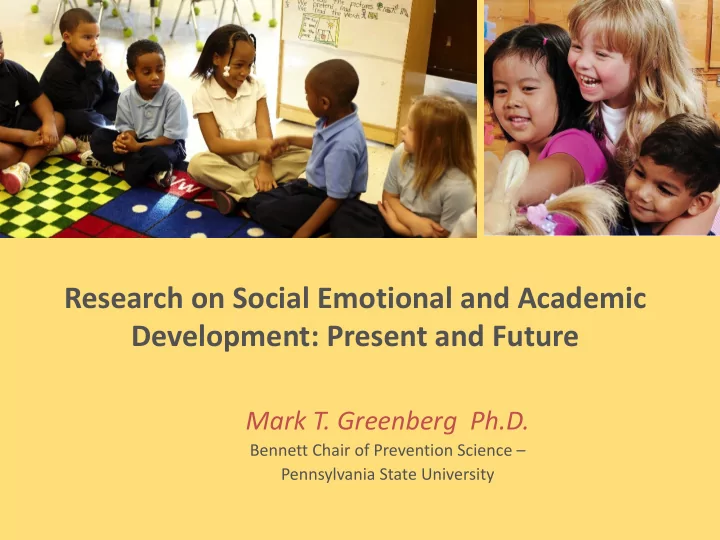
Research on Social Emotional and Academic Development: Present and Future

Mark T. Greenberg Ph.D.

Bennett Chair of Prevention Science – Pennsylvania State University
slide-2
SLIDE 2

What I Will Discuss

  • What is SEAD?
  • Why is SEAD needed?
  • How Effective is SEAD?
  • Is SEAD Cost-Effective?
  • Translational Research – Nurturing This Work

in U.S. Classrooms, Schools, & Districts

slide-3
SLIDE 3

Self-awareness Self- management

Form positive relationships, work in teams, deal effectively with conflict Make ethical, constructive choices about personal and social behavior Manage emotions and behaviors to achieve

  • ne’s goals

Show understanding and empathy for others Build citizenship through social engagement

SEAD: Knowledge, Skills, Attitudes and Behavior

Recognize one’s emotions, attiitudes/mindsets,values, and strengths

slide-4
SLIDE 4

Developmental Framework for Young Adult Success

slide-5
SLIDE 5

SEL CURRICULUM & INSTRUCTION

Contexts and Experiences

5

SELF- MANAGEMENT SELF- AWARENESS RESPONSIBLE DECISION- MAKING RELATIONSHIP SKILLS SOCIAL AWARENESS

Social and Emotional Learning (SEL)

slide-6
SLIDE 6

Logic Model: How Does SEAD Enhance Academic Performance and Development?

SEAD Approaches:

  • Explicit SEL Skills

Instruction

  • Integration with Academic

Curriculum Areas

  • Quality Teacher

Instructional Practices

  • Organizational, Culture,

and Climate Strategies SEL Skill Acquisition: Five Competence Areas Improved Attitudes: Self, Others, Learning, and Schools Enhanced Learning Environment: Supportive, Engaging, and Participatory Positive Social Relationships Fewer Conduct Problems Less Emotional Distress Improved Academic Performance Positive Health- Related Behaviors

slide-7
SLIDE 7

A National Teacher Survey on How Social and Emotional Learning Can Empower Children and Transform Schools May 2013

slide-8
SLIDE 8

SEL: The Missing Piece

  • 95% of teachers believe that social and

emotional skills are teachable to all children

  • Teachers believe a larger focus on SEL will

have major positive effect on:

– school attendance and graduation (80%), – life success (87 percent) – college preparation (78%) – academic success (75%)

The Missing Piece: A National Teacher Survey on How Social and Emotional Learning Can Empower Children and Transform Schools. Civic Enterprises, 2013

slide-9
SLIDE 9

2011 Meta-Analysis of 213 studies involving school-based, universal SEL programs including over 270,000 students in K-12 revealed:

Science Links SEL to Student Gains:

  • Social-emotional skills
  • Improved attitudes about self, others, and school
  • Positive classroom behavior
  • 11 percentile-point gain on standardized achievement

tests And Reduced Risks for Failure:

  • Conduct problems
  • Emotional distress

Source: Durlak, Weissberg, et al.. (2011) The impact of enhancing students’ social and emotional learning: A meta-analysis of school- based universal interventions. Child Development: 82 (1), 405-432.

SEL Improves Behavior and Learning

9

slide-10
SLIDE 10

Equity and Reducing Inequality

The Brookings/AEI Bipartisan Consensus Statement

“OPPORTUNITY, RESPONSIBILITY, AND SECURITY: A CONSENSUS PLAN FOR REDUCING POVERTY AND RESTORING THE AMERICAN DREAM”

“Ways to support poor children to improve self advancement:

1. Increase public investment in preschool and postsecondary ed. 2. Educate the whole child to promote social-emotional and character development as well as academic skills. 3. Modernize the organization and accountability of education. 4. Close resource gaps to reduce education gaps.”

slide-11
SLIDE 11

US Department of Labor. (1999). (SCANS) report: What work requires of schools.

21st Century and Workforce Skills

On the SCANS Report, half of the 16 skills are social and emotional in nature and are considered essential to life success. Skill categories include:

  • Self-esteem
  • Integrity
  • Self-management
  • Sociability
  • Responsibility
  • Listening
  • Decision-making
  • Problem solving

11

slide-12
SLIDE 12

20 year study of children in 4 US locations. An 8-item teacher rating of social competence in Kindergarten uniquely predicted key young adult outcomes across multiple domains:

12

SEC Predicts Future Labor Market Outcomes

Jones., Greenberg,& Crowley, (2015). Early Social-Emotional Functioning and Public Health. American Journal of Public Health,.

Kindergartners with higher SEL competence were more likely to:

§

graduate from high school

§

complete a college degree

§

  • btain stable employment in young adulthood

And less likely to be

§

living in public housing

§

receiving public assistance

§

involved with police

§

in a detention facility

slide-13
SLIDE 13

“This research (20 year longitudinal study of the relationship between SEL competence and adult

  • utcomes) tells us that helping young children develop

social and emotional skills is one of the most important things we can do as a society to prepare children for a healthy future.” The Robert Wood Johnson Foundation, 2015

slide-14
SLIDE 14

SEL and Employability

“The Labor market increasingly rewards social skills. Since 1980, jobs with high social skills requirements have experienced greater relative growth throughout the wage distribution…The reason is that skill in human interaction is largely based on tacit knowledge and…a capacity that psychologists call “theory of mind.” David Deming, “The Growing Importance of Social Skills in the Labor Market,”

slide-15
SLIDE 15

The Economic Value of SEL

  • “The aggregate result also shows considerable

benefits relative to costs, with an average benefit-cost ratio of about 11 to 1 among the six

  • interventions. This means that, on average, for

every dollar invested equally across the six SEL interventions, there is a return of eleven dollars, a substantial economic return.”

Source: Belfield, evin et al., 2015 (p. 5)

$1 Invested = $11 Return

slide-16
SLIDE 16

A Poll !

  • 1. Are people with better social and emotional skills more

likely to succeed in school and life?

  • 2. Can social and emotional skills be taught?
  • 3. Will children be better prepared for college, careers and life if

we teach social, emotional, and academic skills? THUS, Focusing on building the social and emotional competence of our children is our greatest hope for improving education and successful lives in America.

slide-17
SLIDE 17

“In theory there is no difference between theory and practice; in practice, there is.”

Yogi Berra

slide-18
SLIDE 18

Guidance for Selecting Evidence-Based Programs and Practices

slide-19
SLIDE 19

Lessons Learned From Research and Practice

§ Across many evidence-based programs, fidelity matters § The best outcomes are associated with high fidelity practitioners § High fidelity results from careful attention to implementation of evidence-based programs, practices, and policies

slide-20
SLIDE 20

Understand the Right Conditions for SEAD To Thrive in U.S. Schools

slide-21
SLIDE 21

SEL CURRICULUM & INSTRUCTION

SELF- MANAGEMENT SELF-AWARENESS RESPONSIBLE DECISION-MAKING RELATIONSHIP SKILLS

SOCIAL

AWARENESS

Social and Emotional Learning (SEL)

Contexts and Experiences

slide-22
SLIDE 22

School Design, Culture, Climate and Learning Factors

  • SEL programs and practices will not grow and

germinate in the wrong situation

  • Need to Understand Keys to System/Organizational

Change

  • Principal Leadership Training is a Key Factor
  • Need to Understand Key Issue is Relationships and

Administrators “Walking the Talk”

slide-23
SLIDE 23

Teacher Well-Being and Awareness Social and Emotional Skill Development Effective Conditions for Learning/Norms

  • f Caring

A Holistic Picture: Supporting Effective Social and Academic Development and Well Being

slide-24
SLIDE 24

The Stress and Well-Being of Teachers

  • There is a serious crisis of teacher retention
  • Teaching is now rated as a highly stressful profession -

46% report excessive daily stress (Gallup)

  • Teacher satisfaction dropped 23 percentage points

between 2008 and 2012- to lowest level in 25 years

  • We need to support Teacher’s Own SEAD and

professional growth

  • 6 Randomized Trials show that we can increase

teacher’s well-being and enjoyment of teaching

  • Policy/Research Day on This Topic- Dec 9th here in DC
slide-25
SLIDE 25

Stages of Implementation

§ Exploration § Installation § Initial Implementation § Full Implementation § Sustainability

Implementation occurs in stages:

Fixsen, Naoom, Blase, Friedman, & Wallace, 2005

3 – 6 Years

slide-26
SLIDE 26

Summary and Future Research

slide-27
SLIDE 27

Summary: What We Know & Next Steps

  • SEL Research Has Advanced Dramatically in the Past Two

Decades

  • High Quality Evidence-Based Programs Exist
  • Translational Research isNecessary to Bring SEAD Programs &

Policies to Wide-Scale Implementation with Fidelity and Sustainability

  • This Requires Both Policy Change and Infrastructural

Development

  • Infrastructural Development is Necessary For Both

Practice/Translational Research and Implementation in Our Nations Schools and Communities

slide-28
SLIDE 28

Future Research Issues

  • Innovations in Programs, Practices, and Policies at

the Middle and High School Levels

  • Integrating SEL Programs and Practices for Adults

with Programs and Practices for Children/Youth

  • Creating Community-Level Change by linking SEL

Concepts with Community Services

  • New and Improved Assessment of SEL

competencies (Practical, Usable, Predictive)

slide-29
SLIDE 29

Social and Emotional Skills are linked to academic achievement, productivity and collegiality at work, positive health indicators, and civic participation, and are nurtured through life and school…….. Developing these skills should thus be an explicit goal of public education. This can be achieved through research and policy initiatives involving better defining and measuring these skills; designing broader curricula to promote these skills; ensuring that teachers’ preparation and professional support are geared toward developing these skills in their students…..

Economic Policy Institute, 2016 Garcia & Weiss, Making Whole-Child Education the Norm.