The problem absolutely how did You must correct but Where you - - PDF document

the problem
SMART_READER_LITE
LIVE PREVIEW

The problem absolutely how did You must correct but Where you - - PDF document

The Future of Community- Engaged & Practice-Based Research: Challenges and Opportunities The Future of Community - Engaged Research May 2, 2011 Johns Hopkins University Lawrence W. Green University of California at San Francisco


slide-1
SLIDE 1

1 of 10

The Future of Community- Engaged & Practice-Based Research: Challenges and Opportunities

“The Future of Community-Engaged Research”

May 2, 2011 Johns Hopkins University

Lawrence W. Green University of California at San Francisco

The Challenges & Opportunities

 The two biggest challenges:

 To close the gap between what policy makers,

program planners, practitioners and communities need & what they are getting from our research

 The obesity epidemic

 The two biggest opportunities

 Extend CBPR principles to work with policy

makers, program planners & practitioners in use

  • f natural experiments

 Combine CBPR with multi-site RCT methods that

expand the external validity of the results

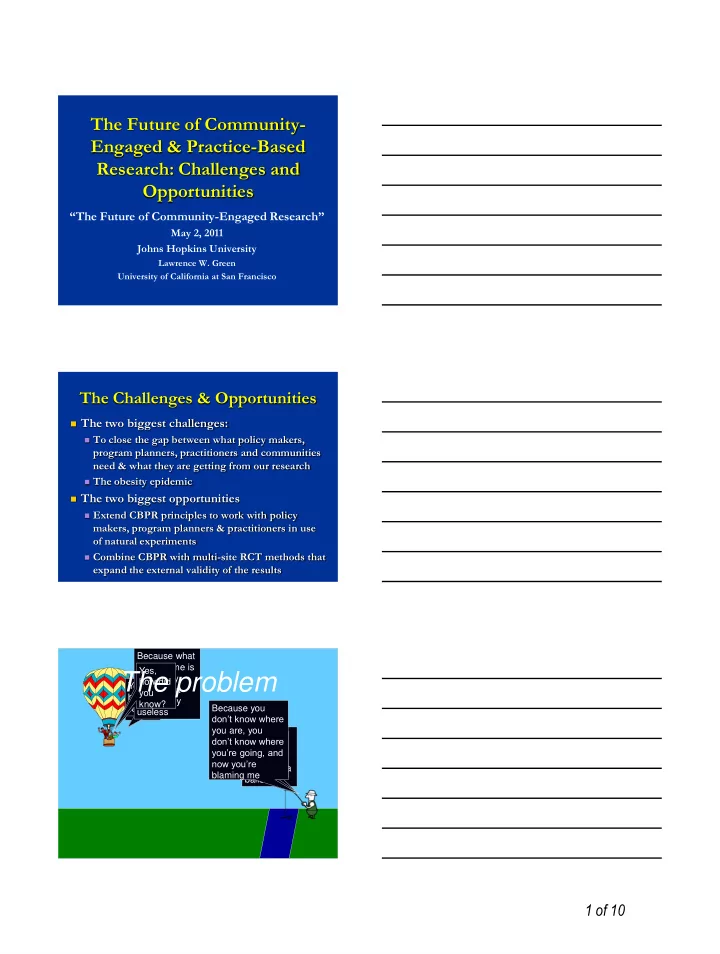
Where am I? You’re 30 metres above the ground in a balloon You must be a researcher Yes. How did you know? Because what you told me is absolutely correct but completely useless You must be a policy maker Yes, how did you know? Because you don’t know where you are, you don’t know where you’re going, and now you’re blaming me

The problem

slide-2
SLIDE 2

2 of 10

 Narrow focus: Lack of attention to larger

systems context

 Lacking details of implementation process  Lack of relevance to real world  Many studies focus on one intervention, but

  • besity may require a combination of

interventions; in fact, some things appear not to work when tested alone, but are essential ingredients in a more comprehensive program

Problems Identified by IOM Report* (www.nap.edu)

*Institute of Medicine. Bridging the Evidence Gap in Obesity Prevention: A Framework to Inform Decision Making. Washington, DC: The National Academies Press, 2010.

IOM Conclusions about Status of Evidence

 The current evidence lacks the power to set a clear

direction for obesity prevention across a range of target populations

 This lack of evidence for effectiveness seen as a lack

  • f effectiveness

 It is difficult to fund, conduct & publish research on

community, environmental, and policy-based obesity prevention initiatives

 Assessing or reporting on the generalizability of

research results to other populations or settings has not been given priority

Types of Community-Engaged Evidence for Health Research

 Participatory research evidence

 Community-Based Participatory Research (CBPR)  Practice-based or action research

 Surveillance evidence  Population diagnostic evidence  Program evaluation evidence

 Multi-component  Continuous quality improvement  How context effects (moderates) outcomes

slide-3
SLIDE 3

3 of 10

Three Paradoxes

 The internal validity--external validity paradox

 The more rigorously controlled a study testing the

efficacy of an intervention, the less reality-based it becomes, so it cannot be taken to scale or generalized

 The specificity – generalizability paradox

 The more relevant and particular to the local context,

the less generalizable to other contexts

 The homophily -- social distancing paradox

 The effectiveness of indigenous community health

workers draws on their commonalities with the community, but they are sometimes seen as losing that

Granted, a living legend. But what has he done for his people?

Six Questions About CBPR

1 What is it? Define participatory research, CBPR.

 2 What is the added value for health behavior research?  3 What predicts outcomes in CBPR? What are successful

methods to establish CBPR, measure CBPR-related outcomes

 4 What sustains effective partnerships?  5 The Intersection of CBPR and translational research: What is

the cutting edge in community engagement in translating health behavior research to practice?

 Innovations in health behavior research targeting improvements

in minority health and health disparities using CBPR

 Measurement issues in CBPR  Challenges, opportunities for health behavior research & CBPR

slide-4
SLIDE 4

4 of 10

“It’s simple, Dr. Green. Just chip away anything that doesn’t look like health education.”

I”It’s easy, Green, just chip away at anything that doesn’t look like CBPR”

Definition and Standards of Participatory Research for Health*

Systematic investigation… Actively involving people in a co-learning process… For the purpose of action conducive to health

  • -not just involving people more intensively

as subjects of research or evaluation

*Green, George, Daniel, et al., Participatory Research…Ottawa: Royal Society of Canada, 1997. www.lgreen.net/guidelines.html “To begin with, I would like to express my sincere thanks and deep appreciation for the opportunity to meet with you. While there are still profound differences between us, the very fact of my presence here tonight is a major breakthrough.”

Professor to Community

slide-5
SLIDE 5

5 of 10

Gary Larson

“I want you to quit smoking and lose 35 pounds. Then I want you to come back and tell me how the hell you did it.”

Caption adapted from Bizarro, Universal Press, 1997.

  • 1. What constitutes CBPR?
  • 2. What is the added value?
  • 3. What predicts

successful outcomes?

  • 4. What sustains

it?

  • 5. What translates it

into policy or changes in practice?

  • 6. Challenges and opportunities

for health behavior research

slide-6
SLIDE 6

6 of 10

The Spheres of Practice-Based, Community-Based, Academic & Participatory Research

Practice- Based Research Community- Based Research Participatory Research Highly Controlled Academic Research CBPR

Number of Publications on CBPR Based on Scopus Search*

50 100 150 200 250 300 350 400 450 1987 1989 1990 1991 1992 1993 1994 1995 1996 1997 1998 1999 2000 2001 2002 2003 2004 2005 2006 2007 2008 2009 2010

Publications on CBPR

Publications

*Based on unpublished Scopus review by Doug Brugge, Tufts U., 2011.

Top 9 journals publishing CBPR papers

 Progress in Community Health Partnerships:

Research, Education & Action (87)

 American Journal of Public Health (49)  Journal of Health Care for the Poor and Underserved

(33)

 Health Promotion Practice (30)  Environmental Health Perspectives (29)  Ethnicity and Disease (26)  Health Education and Behavior (25)  American Journal of Preventive Medicine (21)  Journal of Urban Health (21)

*Based on unpublished Scopus review by Doug Brugge, 2011

slide-7
SLIDE 7

7 of 10

Second Tier of CBPR Journals*

 Social Science and Medicine (16)  Journal of Empirical Research on Human Research

Ethics (14)

 AIDS Education and Prevention (14)  Family and Community Health (14)  American Journal of Community Psychology (13)  American Journal of Bioethics (13)  Cancer (13)  Journal of General Internal Medicine (13) *Based on unpublished Scopus review by Doug Brugge, 2011

Authors publishing most CBPR articles*

 Minkler, M. (23)  Israel, B.A. (21)  Parker, E.A. (15)  Jones, L. (13)  Hergenrather, K.C. (11)  Rhodes, S.D. (10)  Schulz, A.J. (10)  Flicker, S. (9)  Macaulay, A.C. (8)  Wallerstein, N. (8)

Rhodes, S.D. (7)

Eng, E. (7)

Travers, R. (7)

Wells, K.B. (6)

Senturia, K. (6)

Montano, J. (6)

Farquhar, S.A. (6)

Sullivan, M. (6)

Shiu-Thornton, S. (6)

Vasquez, V.B. (6)

Horowitz, C.R. (6)

Christopher, S. (6) *Scopus

Institutions with Most CBPR Publications

Univ Michigan School of Public Health (47) & Univ Michigan, Ann Arbor (29)

UCLA (35) & UCLA Sch Public Health (20) & David Geffin School of Medicine at UCLA (19)

UC Berkeley (33)

University of Toronto (31)

RAND Corporation (23)

The University of British Columbia (23)

Univ of North Carolina at Chapel Hill (22)

Univ of Illinois at Chicago (22)

Univ California, San Francisco (20)

Johns Hopkins Bloomberg School of Public Health (18) & JHU (15)

Mount Sinai School of Medicine (18)

University of Washington Seattle (18)

CDC (18)

Columbia Univ (18) & Med Center (12)

University of New Mexico (18)

Wake Forest Univ School of Medicine (16)

University of Pennsylvania (15)

Harvard School of Public Health (15)

University of Manitoba (14)

University of Florida (14)

University of South Carolina (14)

George Washington University (13)

VA Medical Center (13)

National Inst Environmental Health Sci (13)

Charles R. Drew Univ of Med and Science (12)

University of Arizona (12)

Meharry Medical College (12)

University of Maryland (11)

slide-8
SLIDE 8

8 of 10 Subject Areas with Most CBPR Pubs*

Medicine & Public Health (1,056)

Social Sciences (407)

Nursing (187)

Environmental Science (141)

Psychology (118)

Agricultural and Biological Sciences (54)

Health Professions (53)

Biochemistry, Genetics and Molecular Biology (49)

Business, Management and Accounting (33)

Economics, Econometrics and Finance (22)

Earth and Planetary Sciences (19)

Engineering (19)

Pharmacology, Toxicology and Pharmaceutics (13)

Immunology and Microbiology (12)

Neuroscience (12)

Computer Science (9)

Arts and Humanities (6)

Dentistry (5) *Scopus

Subject Areas with Most CBPR Pubs

Medicine & Public Health (1,056)

Social Sciences (407)

Nursing (187)

Environmental Science (141)

Psychology (118)

Agricultural and Biological Sciences (54)

Health Professions (53)

Biochemistry, Genetics and Molecular Biology (49)

Business, Management and Accounting (33)

Economics, Econometrics and Finance (22)

Earth and Planetary Sciences (19)

Engineering (19)

Pharmacology, Toxicology and Pharmaceutics (13)

Immunology and Microbiology (12)

Neuroscience (12)

Computer Science (9)

Arts and Humanities (6)

Dentistry (5)

Energy (4)

Chemical Engineering (3)

Chemistry (2)

Multidisciplinary, Mathematics, Materials Science, Decision Sciences, Vetenary (1)

Undefined (26) *Scopus

The Lenses of Scientists, Health Professionals and Lay People

Objective Indicators

  • f Health

Subjective Indicators

  • f Health

Professional, Scientific Layperson

slide-9
SLIDE 9

9 of 10

Closing the Gaps Between Population & Scientists or Practitioners’ Perception of Needs, and Funders’ Assessments

A

*Green & Kreuter, Health Promotion Planning, 3rd ed., Mayfield, 1999. “Actual needs”

Resources, feasibilities, policy People’s perceived needs, priorities

A

Reconciling Perceived Needs, “Actual Needs,” & Resources

Participatory research

Action

Advocacy for regulation &

  • rganizational

development Health education

People’s perceived needs, priorities

“Actual needs”

Resources, feasibilities, policy

Policy Research &

Surveillance

Source: Green LW & Kreuter MW. Health Program Planning, 4th edition, 2004.

New (neglected) Evidence Forms

 Participatory research evidence

 Community-Based Participatory Research  Practice-based or action research

 Surveillance evidence  Population diagnostic evidence  Program evaluation evidence

 Multi-component evaluations  Continuous quality improvement  How context effects (moderates) outcomes

slide-10
SLIDE 10

10 of 10

Uses of Evidence & Theory in Population-Based, Diagnostic, Planning & Evaluation Models*

  • 1. Assess Needs & Capacities
  • f Population
  • 2. Assess Causes (X)

& Resources

  • 3. Design &

Implement Program

  • 4. Evaluate

Program

Reconsider X Program Evidence & Effectiveness Studies, and use of Theory Evidence from Etiologic Research Evidence from community

  • r population

Evidence from Efficacy Studies, and Use of Theory to Fill Gaps

*Green & Kreuter, Health Program Planning. 4th ed. NY: McGraw-Hill, 2005, Fig. 5-1.

Reasons for Surveillance as a Challenge and an Opportunity

 For CBPR

 Communities need/want more particular, local data  CBPR projects usually can’t afford to do population

surveys, much less time-series surveys

 For health behavior research

 Provides the most powerful alternative to RCTs for

population-level change & community interventions

 Provides the most credible source of evidence for

external validity and dissemination of practice-based evidence

Change in Per Capita Cigarette Consumption

California & Massachusetts vs Other 48 States, 1984-1996

  • 25
  • 20
  • 15
  • 10
  • 5

5 Percent Reduction

Other 48 States California Massachusetts

1984-1988 1990-1992 1992-1996

slide-11
SLIDE 11

11 of 10

http://www.cdc.gov/tobacco

New (neglected) Evidence Forms

 Participatory research evidence

 Community-Based Participatory Research  Practice-based or action research

 Surveillance evidence  Population diagnostic evidence  Program evaluation evidence

 Multi-component evaluations  Continuous quality improvement  How context effects (moderates) outcomes

Quality of life

Phase 1 Social Assessment

Health Educational strategies Policy regulation

  • rganization

Health Program

Phase 4a Intervention Alignment

Output Longer-term health outcome Short-term social impact Short-term impact Process Input Long-term social impact

Phase 5 Implementation Phase 6 Process evaluation Phase 7 Impact and outcome evaluation

Predisposing Reinforcing Enabling

Phase 3 Educational & Ecological Assessment

Behavior Environment

Precede Evidence Tasks: Specifying needs as measurable baselines, objectives & targets for evaluation.

Phase 4b Administrative & Policy Assessment

Proceed Evaluation Tasks: Monitoring & Continuous Quality Improvement

Phase 2 Epidemiological, Behavioral and Environmental Assessment

Genetics

PRECEDE-PROCEED as both Logic Model and Procedural Model

slide-12
SLIDE 12

12 of 10

New (neglected) Evidence Forms

 Participatory research evidence

 Community-Based Participatory Research  Practice-based or action research

 Surveillance evidence  Population diagnostic evidence  Program evaluation evidence

 Multi-component evaluations  Continuous quality improvement  How context effects (moderates) outcomes

Intervention

  • r Program

Mediator Mediator Outcome Variable(s) Moderators

Mediating and Moderating Variables

Moderators

Green & Kreuter, Health Program Planning: An Educational and Ecological

  • Approach. 4th ed. New York: McGraw-Hill, 2005. Green & Glasgow, E&HP, 2006.

Challenges to “Best Practices” from Controlled Trials*

 Challenge of translating “best practices” from science to

practitioner behavior, and to public health

 …of generalizing from research in one place, with one

population, to other places, people and circumstances

 …of imposing experimental controls to generate “best

practices” for community and population efforts

 Recommend “best practices” with “best processes” of

locally-specific, diagnostic-planning procedures & CBPR to adapt efficacy-tested interventions to moderating variables…

*Green LW. From research to ‘best practices’… Am J H Behav, 25: 2001. http://www.ajhb.org/

slide-13
SLIDE 13

13 of 10

The Multi-Site Translational Community Trial (mTCT) Proposal*

 Blends the internal validity advantages of

 Cluster randomized trial or multi-site RCT  Fidelity to the function (but not the form) of an efficacy-

tested intervention

 With the external validity advantages of

 Diversity of settings, cultures, circumstances  Adaptation of the form (not the function) of the efficacy-

tested intervention

 With some sacrifice of CBPR degrees of freedom

*Katz DL et al. From controlled trial to community adoption…Am J Public Health, in press, 2011.

The mTCT for Practice-Based, Community-Based, Academic to Participatory Research

Practice- Based Research Community- Based Research Participatory Research Highly Controlled Academic Research CBPR

Aligning Evidence* with (and deriving it from) Practice: Matching, Mapping, Pooling & Patching

 Matching ecological levels of a system or community

with RCT evidence of efficacy for interventions at those levels

 Mapping theory to the causal chain to fill gaps in the

evidence for effectiveness of interventions

 Pooling experience to blend interventions to fill gaps

in evidence for the effectiveness of programs in similar situations

 Patching pooled interventions with indigenous

wisdom and professional judgment about plausible causes & interventions to fill gaps in the program for the specific population

*Green & Kreuter, Health Program Planning: An Educational and Ecological

  • Approach. 4th ed. NY: McGraw-Hill, 2005, Chapter 5. Green & Glasgow, 2006.
slide-14
SLIDE 14

14 of 10

“A university’s values are most clearly described by its promotion and tenure policy and by the criteria used to evaluate faculty members”

  • -Conrad Weiser et. al.

Scholarship Unbound for the 21st Century, 2000

The Ultimate Litmus Test for University Values Scholarship in the Health Professions*

 “Federal funders of research and academic institutions

should recognize and reward faculty scholarship related to public health practice research”

 “Academic institutions should develop criteria for

recognizing and rewarding faculty scholarship related to service activities that strengthen public health practice”

 “Schools of public health should provide increased

academic recognition and reward for policy-related activities.”

*Institute of Medicine, The Future of the Public’s Health in the 21st Century. (Washington, DC: National Academies Press, 2002).

The Case for Participatory and Practice-Based Research

 “Participatory approach at the front-end of the

research pipeline is the best assurance of relevance and utilization of the research at the

  • ther end of the pipeline.”

 Commission on Community-Engaged Scholarship in the Health Professions.

Linking Scholarship and Communities: Report of the Commission on Community-Engaged Scholarship in the Health Professions. Seattle: Community-Campus Partnerships for Health, 2005.

 “If we want more evidence-based practice…  …we need more practice-based evidence”

 AJPH, 2006

slide-15
SLIDE 15

15 of 10

6 Challenges & Opportunities

 Reform the research funding priorities  Reform publication criteria  Reform the criteria for inclusion & weighting of

studies into systematic reviews & research syntheses;

 Reform the derivation and qualification of practice

guidelines from the systematic reviews;

 Reform the academic promotion & tenure criteria

& weights given to community- & practice-based research;

 Reform the research training of students & fellows in

methods of practice-based and participatory research

A Vision

 A future in which we would not need to ask

how to get more evidence-based practice…

 Rather, how to engage students,

practitioners, patients and communities in a participatory process of practice-based research and program evaluation?

 How to adapt the “best practices”

guidelines through best processes of collecting data to diagnose the behavioral needs of their patients & communities…

The Vision (expanded)

 How to match evidence-based interventions

to those needs, filling gaps in the evidence with the use of theory , mutual consultation, and prospective testing of complementary interventions

 The cumulative, building-block tradition of

evidence-based medicine from RCTs would be complemented by parallel strengthening and support of a tradition of participatory research & evaluation conducted in practice settings.