Research groups and opportunities for crop-livestock research Gbola - - PowerPoint PPT Presentation

research groups and opportunities for crop livestock
SMART_READER_LITE
LIVE PREVIEW

Research groups and opportunities for crop-livestock research Gbola - - PowerPoint PPT Presentation

Research groups and opportunities for crop-livestock research Gbola Adesogan and Marjatta Eilitt Feed the Future Innovation Lab for Livestock Systems Institute of Food and Agricultural Sciences (IFAS) University of Florida Photo Credit Goes


slide-1
SLIDE 1

Photo Credit Goes Here
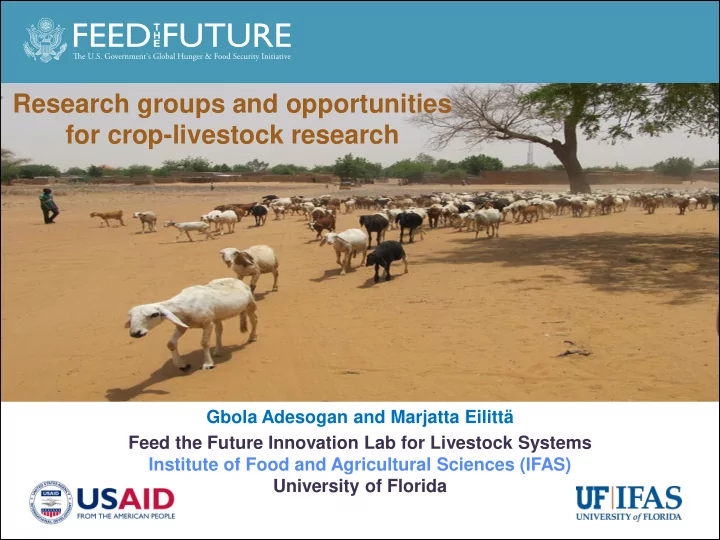
Gbola Adesogan and Marjatta Eilittä Feed the Future Innovation Lab for Livestock Systems Institute of Food and Agricultural Sciences (IFAS) University of Florida

Research groups and opportunities for crop-livestock research

slide-2
SLIDE 2

OUTLINE

  • Feed the Future Innovation Lab for Livestock

Systems

  • Context: Changing crop-livestock systems
  • Gaps and Opportunities
  • Lessons Learned
slide-3
SLIDE 3

FEED THE FUTURE INNOVATION LAB FOR LIVESTOCK SYSTEMS

slide-4
SLIDE 4

VISION AND APPROACH

  • To intensify sustainably smallholder livestock systems through

innovative research, technology application, and capacity building.

  • To increase animal-sourced food production in order to increase the

incomes, livelihoods, nutrition and health of vulnerable people. Achieved through:

  • Country-focused research programs with priorities set in a gender-

informed, participatory manner.

  • One Health and food systems approaches.
slide-5
SLIDE 5

OBJECTIVE AND APPROACH

  • To achieve sustainable improvements in livestock productivity,

health, marketing and consumption to increase the incomes, health and nutrition of vulnerable livestock holders.

  • Additional goals:
  • Increasing the resilience of vulnerable populations
  • Reducing the environmental impact of livestock systems

Approach: Integrated, interdisciplinary, involves researchers from across the University

slide-6
SLIDE 6

TARGET COUNTRIES

  • West Africa – Burkina Faso and Niger
  • East Africa – Ethiopia and Rwanda (Tanzania)
  • Asia – Nepal and Cambodia
  • Efforts focus on the three main systems in target

countries

  • Pastoral
  • Mixed crop-livestock
  • Peri-urban, intensive
slide-7
SLIDE 7

AREAS OF INQUIRY

  • Animal-Source food (ASF) Production and

Marketing

  • Livestock Disease Management and Food

Safety

  • Enabling Policies for Livestock
  • Future Livestock Systems
slide-8
SLIDE 8

CROSS-CUTTING THEMES

  • The Role of Gender in Livestock

Systems Research

  • Human and Institutional Capacity

Development (HICD)

  • Human Health and Nutrition
slide-9
SLIDE 9
slide-10
SLIDE 10

IFAS

Livestock Systems Innovation Lab Animal Sciences IFAS Global Agric & Biological Engineering Agron-

  • my

Entomology Food and Resource Economics

African studies Gender working group OGRE (UFIC) College

  • f Public

Health Large animal clinical sciences

  • Inst. of

Sustain- able food Systems

Emerging Pathogens Institute

slide-11
SLIDE 11

TYPES OF AWARDS WE PROVIDE

  • Competitive (RFA-based) grants
  • Reach grants ($1,000,000 for 4 years)
  • Focus grants ($100,000 for 1 year)
  • Non-competitive funds for strategic partnerships and initiatives
  • Non-competitive funds for the UF
slide-12
SLIDE 12

EFFORTS TO DATE

  • Research priorities determined for all 6 countries
  • Scoping visits
  • Innovation Platform meetings
  • Ethiopia, Rwanda, and Nepal research projects are awarded
  • Cambodia RFA ongoing
  • Burkina Faso and Niger RFA: this month
slide-13
SLIDE 13

CONTEXT FOR RESEARCH: CHANGING CROP-LIVESTOCK SYSTEMS

EXAMPLES FROM WEST AFRICA

slide-14
SLIDE 14

BACKGROUND: COMPONENTS

  • Complexity of components and

interactions

  • Complexity of context
  • Change and drivers
slide-15
SLIDE 15

BACKGROUND: PATHWAYS TO INTEGRATION

  • Processes of

intensification evident but variability: regions, countries, locations

  • West Africa
  • Implications for

research

slide-16
SLIDE 16

BACKGROUND: BROADER VIEW ON INTEGRATION

  • Space: far or close?
  • Ownership: same or different?
  • Time: simultaneous or not?
  • Management: by whom?

Integration Space Time

Management

Owner- ship

slide-17
SLIDE 17

DRIVERS FOR CHANGE: POPULATION

Source: Abdi et al., 2014

slide-18
SLIDE 18

DRIVERS FOR CHANGES: RESOURCE AVAILABILITY

slide-19
SLIDE 19

BACKGROUND: PATHWAYS

Source: Tarawali, 2012

slide-20
SLIDE 20

UNDERLYING DYNAMICS: LIVESTOCK MOVEMENT

  • By nomadic and

semi-nomadic herders

  • Involves herds of

sedentary farmers

  • Profound impact on

Integration of crops and livestock

slide-21
SLIDE 21

POSSIBLE CONSEQUENCES

  • Human and livestock population growth
  • Resource squeeze: pastures, crop residues, water
  • Creation of demand for feed – interaction with supply changes
  • Crop farmers adding livestock, livestock farmers crops
  • Crop residues increasingly used on farm, for livestock – soil

fertility impacts?

  • Impacts on gender roles (milk?), livestock markets, prices
  • Manure contracts monetarized
slide-22
SLIDE 22

RESEARCH GAPS AND OPPORTUNITIES

slide-23
SLIDE 23

RESEARCH GAPS

  • Feed: synergies/tradeoffs, evaluation, variety development, increasing

productivity, processing, conservation, feed markets – and incentives

  • Rangeland improvement and management – including policies
  • Disease impacts from changing systems
  • Understanding and developing markets for livestock products (milk, meat)
slide-24
SLIDE 24

FEED IS NUMBER 1 PRIORITY IN ALL LSIL TARGET COUNTRIES

  • Total quantity
  • Seasonality
  • Quality
  • Safety

Choice of species, cropping system, management have large implications on the system Associated issues:

  • Business models; market
  • pportunities, and

consequent impacts

  • Additional benefits
  • Incentives
slide-25
SLIDE 25

FEED ISSUES AT HEART OF INTEGRATION

Increased food, fuel and feed demand and population (%) in West Africa, from 2000 to 2010

Country Food Fuel Feed Total population Burkina Faso 34.4 27.0 22.0 33.4 Ghana 19.9 19.4 18.6 33.2 Guinea 14.8 5.1 29.2 27.3 Liberia 2.7 20.8 23.2 40.3 Mali 38.8 7.5 26.0 36.1 Mauritania 13.5 14.5 5.0 30.9 Niger 46.0 44.0 22.4 42.0 Nigeria 11.2 6.7 13.2 28.1 Senegal 17.8 4.8 8.6 30.8 Sierra Leone 54.3 2.2 48.5 41.6

Source: Abdi et al., 2014

slide-26
SLIDE 26

AVAILABILITY OF FEED RESOURCES IN SW BURKINA FASO

Amole and Ayantunde, 2014

slide-27
SLIDE 27
  • 1. DUAL-PURPOSE CROPS
  • Food and feed (and soil fertility) – cowpeas, groundnuts
  • Food: Taste preferences, marketability, storability
  • Feed: Biomass production, improving stover / stem/

haulm/ pericarp digestibility, development of feed products

  • Soil fertility: N-fixation
  • BMR hybrids / low ferulate hybrids?
slide-28
SLIDE 28
  • 2. SUSTAINABLE CEREAL/GRASS-LEGUME

INTERCROPS AND ROTATIONS

  • Legumes: Without food use, have found little

adoption (cf. Mucuna), despite proven benefits (e.g., N fixation, higher yields, less weeds, etc.)

  • Continued intensification - demand for feed will

improve adoption? Marketability will incentivize?

  • Cereals/grasses: improving digestibility
slide-29
SLIDE 29

C4 VS. C3 GRASSES

(%) Bermudagrass (C4) Orchardgrass (C3) NDF 73.3 59.6 ADF 36.8 33.8 CP 10.4 12.8 TDN 52.9 65

M= mesophyll, E= epidermis, B= parenchyma bundle sheath, S= sclerenchyma, V= vascular tissue and C= cuticle.

Leaf blades after 48 h of rumen fluid incubation Leaf blades after 48 h of rumen fluid incubation Akin, 1989 Akin, 1989

*Bermudagrass: Hay, early head; Dairy NRC (2001) *Orchardgrass: Hay, sun-cured early bloom; Beef NRC (1998)

slide-30
SLIDE 30

LOCATION-APPROPRIATE SOD-BASED ROTATION SYSTEMS

  • UF developed system; in testing in SE USA
  • Bahiagrass with legumes
slide-31
SLIDE 31
  • 3. TAILORED FORAGES AND

FORAGE CONSERVATION

  • Drought / heat tolerant varieties
  • Reclamation of land
  • Expanding adapted forages (borgu)
  • Stockpiling (limpograss, Hemarthria)
  • Silage: simple construction solutions using innovations (BMR, low ferulate)
slide-32
SLIDE 32
  • 4. FEED SAFETY: MULTIDISCIPLINARY EFFORTS

Estimated milk production loss after 1 month of exposure to aflatoxin

(Whitlow, 2013)

slide-33
SLIDE 33

IMPROVED FEED SAFETY

18 19 20

Control Aflatox Aflatox + Clay

Milk yield, kg/d

25 26 27 28 29 30 31

Control Aflatox Aflatox + Yeast product

Queiroz et al., 2012 Ogunade et al., 2015

Dietary aflatoxin B1 (75 ppb) effects

  • n milk production
slide-34
SLIDE 34

FEED SAFETY DURING DROUGHTS

1.Aflatoxins 2.Nitrates 3.Prussic acid

Source: Bienkowski, 2012 (Scientific American)

10 20 30 40 50 60 70 2011 2012

% of corn samples with aflatoxin levels > 20 ppb in MO

50 100 150 200 2011 2012

Cattle killed by nitrate poisoning in IA

slide-35
SLIDE 35

FEED SAFETY (SILAGE) & DISEASE (RUST)

No Medium High

40 50 60 70 No rust Med rust High rust 67 63 60 Effect on digestibility

1 2 3 4 5 No rust Medium High

FDA limit

Effect on aflatoxin (ppm)

slide-36
SLIDE 36

DISEASE IMPACTS FROM CHANGING SYSTEMS

  • Impacts from intensification, changing pastoral routes,

increasing numbers of peri-urban farms – and increasing concerns over ASF

  • Diverse general priorities – identified during LSIL

prioritization:

  • Surveillance
  • One Health
  • Diagnostic capacity
  • Policies: import regulations + enforcement
  • Residues and antimicrobial resistance
slide-37
SLIDE 37

PRIORITIES: ANIMAL DISEASES

  • Transboundary diseases an important concern for many

countries: FMD and PPR especially

  • Zoonotic: Especially Tuberculosis and Brucellosis
  • Newcastle Disease, Avian Influenza
  • Others: Environmental Enteropathy
  • Strong interest in food safety: milk, meat
slide-38
SLIDE 38

PRIORITIES: PPR

  • Global Eradication program
  • Field test thermostable vaccine (Thermovac) + capacity

building for scaling + epidemiological targeting + intensive delivery – high herd immunity

  • Efforts starting in Uganda with BVI
  • Second country TBN
slide-39
SLIDE 39

LESSONS LEARNED

  • Context and system important
  • Participate in interdisciplinary groups outside your comfort zone
  • Alleviating negative impacts of intensification of crop-livestock

systems: livestock housing, environmental enteropathy

  • Pastoralists: improving pastureland + looking at impacts on

extremism

  • Focus on policy implications, from the onset
  • Do not focus on new technologies/practices only, but also their implications
  • n/adaptations for or from US or other countries
  • Do not forget to look back – developed technologies may be important for

US conditions, e.g., AFLASAFE

slide-40
SLIDE 40

heifer.org

soschildrensfamily.org Wordpress.com

wordpress.com

ILRI

slide-41
SLIDE 41