
SLIDE 1
Overview of Livestock Status in South Sudan
22 July 2015 UNOCHA meeting hall, Juba
Sileshi Mekonnen FAO Livestock Program Coordinator
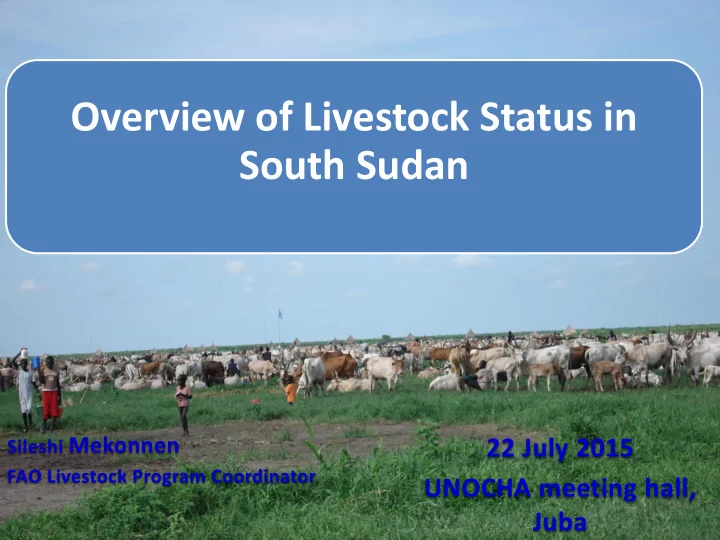
Overview of Livestock Status in South Sudan Sileshi Mekonnen 22 - - PowerPoint PPT Presentation
Overview of Livestock Status in South Sudan Sileshi Mekonnen 22 July 2015 FAO Livestock Program Coordinator UNOCHA meeting hall, Juba Background Livestock population in South Sudan Cattle 11,816,672 Sheep 12,611,522 Goats 13,974,135
22 July 2015 UNOCHA meeting hall, Juba
Sileshi Mekonnen FAO Livestock Program Coordinator
Livestock population in South Sudan 6th largest lives tock herd in Africa Highest per capita livestock holding on the continent (FAO report 2012) About 65% of HHs in South Sudan own livestock
Contribute 15% to the GDP (GRSS Growth Strategy 2010-
2012) Cattle 11,816,672 Sheep 12,611,522 Goats 13,974,135 38,402,329
Role of Livestock: signify status and wealth, and serve as the main livelihood asset for pastoralist communities. Livestock are sold for cash, slaughter for cultural practices, exchange for grain, used as payment for penalties, given for dowry. Despite vast potential livestock products do not meet the local demands.
Migration pattern
Traditional migration:
during dry season to search pasture and water. Non-traditional migration: occurs due to conflicts or other factors Impacts: livestock diseases spread, conflict between farmers and migrants, affects TOT between grain and livestock prices
Internal and external parasites are common affecting production of livestock. Therefore, need special attention
South Sudan, FAO took a leading role in provision of emergency veterinary services in the country.
CAHWs which are the main frontline service providers to the affected livestock owners.
surveillance in at‐risk areas.
Support the scaling-up of vaccination and treatment activities in South Sudan
launched in January 2015 in all states in SS.
collaboration with partners
Vaccination: 2,659,462
Shoats: 837,196 Poultry: 7,807 Cattle: 1,814,459
Treatment: 261,765
Shoats: 202,366 Poultry: 5,697 Cattle: 202,366
Target livestock for vaccination in remaining months
Cattle: 3,669,600 Shoats: 2,105,400 Poultry: 49,900 Dogs: 21,000 Target HHs: 103,900 Train 1,600 CAHWs Veterinary kits: >4,000
Continue livestock vaccination and treatment in a well-strategic and planned manner
Strengthening animal health delivery system Link CAHWs with private veterinary drug vendors and set up cost-recovery system Assess the impact of the current crisis on the pastoral livestock system Conflict risk mapping exercise in relation to livestock movements
Conduct an assessment on gender roles in farming, fishing and pastoralist communities Re-stocking for women headed households who lost their assets Strengthen Cross-border TADs surveillance
Improve livestock production (meat, milk & eggs) through provision of better feed, access to water and animal health care.
To increase resilience of pastoralist livelihoods to shocks
Increased production