Renewable Energy: Update, Politics, and Investment Opportunities - - PowerPoint PPT Presentation
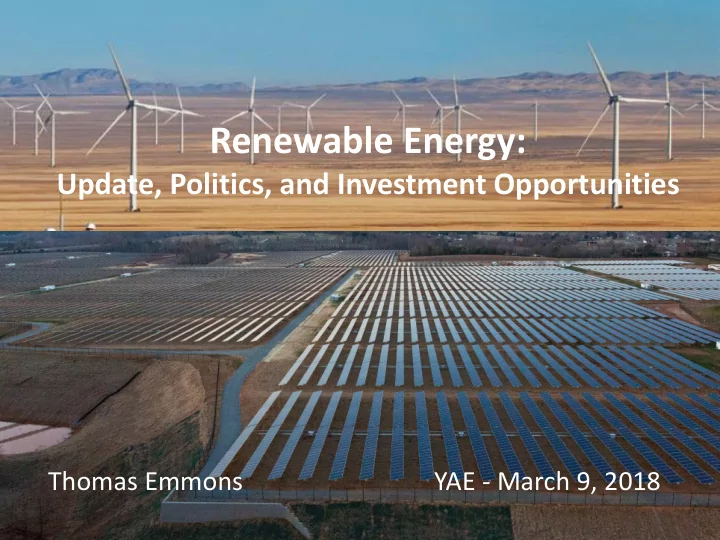
Renewable Energy: Update, Politics, and Investment Opportunities Thomas Emmons YAE - March 9, 2018 Renewables are Rapidly Replacing Fossil Fuels Installed Operating Generating Capacity Replacement of Fossil Fuels by Renewables Renewables
Solar Wind
Natural Gas 44% Coal 23% Nuclear 9% Hydro 9% Wind 7% Solar, etc 4% Other 4%
Renewables are Rapidly Replacing Fossil Fuels
Source: GTM Research, FERC Office of Energy Projects, American Wind Energy Association, Bloomberg New Energy Finance, EIA
- Renewables (wind, solar, biomass, and geothermal)
accounted for only ~11% of installed operating generating capacity in the U.S. as of December 2017
- Renewables accounted for ~57% of all U.S. new installed
capacity from 2015 – 2017 Replacement of Fossil Fuels by Renewables Installed Operating Generating Capacity
Natural Gas Coal Other
- Installations in 2017 down from a record 15 GW in 2016;
despite that, 73% CAGR in capacity since 2011
– 10,000 20,000 30,000 40,000 50,000 60,000 2011 2012 2013 2014 2015 2016 2017E
U.S. Cumulative Solar Capacity (MWdc)
Growth of Solar Growth of Wind
- Wind capacity has increased twenty-fold since 2001
– 20,000 40,000 60,000 80,000 100,000
2001 2002 2003 2004 2005 2006 2007 2008 2009 2010 2011 2012 2013 2014 2015 2016 2017E
U.S. Cumulative Wind Capacity (MW)
0% 10% 20% 30% 40% 50% 60% 70% 80% 90% 100% 2011 2012 2013 2014 2015 2016 2017 Share of New Capacity Additions
Renewable le Energy Capacit ity Buil ilt, , by Technolo logy
Source: Bloomberg New Energy Finance; Business Council for Sustainable Energy
Solar Costs Continue to Fall
$0 $10 $20 $30 $40 $50 $60 $70 $80 1977 1979 1981 1983 1985 1987 1989 1991 1993 1995 1997 1999 2001 2003 2005 2007 2009 2011 2013 2015 2017 $ Cost per Watt
5 10 15 20 25 30 35 40 ₵USD / kWh Residential Solar Levelized Cost of Energy US Average Residential Electricity Price
Falling Cost of Solar Systems and Rising Retail Rates Declining Costs to Deliver Projects Globally
$0 $1 $2 $3 $4 $5 $6 2008 2009 2010 2011 2012 2013 2014 2015 2016 2017 $ Cost per Watt
$0 $1 $2 $3 $4 2010 2011 2012 2013 2014 2015 2016 2017
Price Benchmark for Fixed-axis, Utility-scale PV Systems (real 2016 US$/W)
Wind Energy Costs Are Fall lling
- Bigger, taller turbines
- Improved technology and efficiency
- Lower costs – manufacturing economies
Renewables are Cost Competitive: LCOE Unsubsidized
Wind - onshore Natural gas - CCGT 40 80 120 160 200 240
- Solar is now cheaper than coal on a levelized cost of energy (LCOE) basis: $54/MWh vs. $66/MWh. Solar costs
continue to fall.
- Onshore wind benchmark is “tied” with CCGT, but with strong wind resources can achieve LCOEs as low as
$33/MWh, even cheaper than natural gas($49/MWh).
Source: Bloomberg New Energy Finance. Developed in partnership with The Business Council for Sustainable Energy. As of 1H2017.
Solar PV Coal Nuclear LCOE range 1H 2017 benchmark 2H 2016 benchmark $/mWh
Corporate Procurement of Renewable Energy
Renewable capacity contracted by corporations, 2017 Largest corporate offtakers, 2017
- Apple contracted 560MW of renewable energy in 2017, more than any other corporation. It signed the largest PPA ever between a
corporation and a utility – a 235MW PV plant with NV Energy under the utility’s GreenEnergy Rider.
- Google signed PPAs for 536MW, to offset 100% of its global electricity demand. Kimberly-Clark, T-Mobile, General Mills and Cummins all
signed their first PPAs in 2017.
- RE100: Corporations pledging to reach 100% renewable energy. Notable names: Ikea, Adobe, BofA, BMW, Bloomberg, Burberry, Citi,
Coca-Cola, ClifBar, Danone, Ebay, Facebook, GM, Goldman Sachs, Google, HP, J&J, JPM, Kellogg, LEGO, Mars, Microsoft, Morgan Stanley, Nestle, Nike, P&G, Starbucks, Visa, Walmart, etc.
Source: Bloomberg New Energy Finance. Developed in partnership with The Business Council for Sustainable Energy. Note: Charts show offsite PPAs only
0.1 0.3 0.1 0.2 0.1 0.6 1.5 2.4 2.9 3 1 2 3 9 2008 9 10 11 12 13 14 15 16 17 Solar Wind Other Cumulative (GW) Cumulative (GW) 4 12 3.2 356 200 536 245 160 152 45 62 100 100 Apple Inc Google Inc Kimberly-Clark Facebook Inc 35 200 6 General Motors Co 200 MW T-Mobile USA Anheuser-Busch InBev NV Bay Area Rapid Transit General Mills Target Corp Solar Wind
Corp rporate Renewable le Energy Use sers, Largest by St State
Source: David Gardner and Associates, April 2017 Walmart: 6 Target: 6 IKEA: 6 Amazon: 4 Google: 4
Fir irst US Offshore Win ind Proje ject – Blo lock Is Isla land
More Offshore Win ind Proje jects Comin ing
- “South Fork”, LI, selling to LIPA (developed by Deepwater Wind)
- 90MW, 30 mi east of Montauk, connecting at East Hampton
- NJ: New Gov. Murphy reversed Gov. Christie’s stance, calling for 3.5GW by 2030
- NY Masterplan: 800MW by 2020; 2.4GW by 2030;
- MA: goal of 1.6GW by 2027
- Significant economic activity on land, revitalizing ports (Quonset Point, RI)
Next xt: : Flo loatin ing Offshore Win ind Turb rbines
Transmission Projects – Stranded Win ind
Texas CREZ – Captured St Stranded Win ind
Cost: $8 billion Distance: 3600 miles Capacity: 18.5 GW Completed: 2014
Other Baseload Renewable Energy Sources
- Hydropower
- Now 9% of load; few new being built
- Environmental impact
- Geothermal
- Tapping subsurface heat to generate electricity
- Mostly in West; base load; small contributor
- Combustion or gasification of organic materials
- Wood-burning power plants (incl. pelletized wood as coal
substitute)
- Forest management; pine beetle in West/Canada
- Waste to Energy (many types)
- Methane capture (and pipeline injection, or fuel generator)
- Anaerobic Digestion (manure, food waste, etc.)
- Landfill gas
- MSW/RDF processed to various fuel forms
Politics: Federal Tax Incentives - Supporting Renewables
Wind:
- 2.3c/kWh production tax credit (PTC)
- Since 1992 (escalated with inflation)
Solar:
- 30% investment tax credit (ITC)
- Since 2005
Benefit: attracted large cash investors (~40% of project cost) into generation projects, who received tax shelter in lieu of cash. (JPMorgan Chase has been a large US “tax investor”.) Extended in 2015 for 4 years, phasing out by 2021 Early House versions of the Tax Cut and Jobs Act of Dec 2017 included changes to the phase-out, but it was ultimately left intact.
Tariffs on Imported Solar Cells and Modules
- 4-year tariff on imported PV solar cells and modules, from all countries
- Consensus: a minor, temporary, politically-motivated cost increase for the solar industry
- Tariff Schedule over 4 years: 30%, 25%, 20%, 15%
- First 2.5GW of imports each year are exempt from tariffs (~20% of imports)
- Many developers have stockpiled components for the next 1-2 years
- Increases solar TOTAL installation costs by ~5-10% (as cells/modules are a fraction of the costs)
- Tariff is MUCH lower than plaintiffs requested (their ask would have doubled the cost)
- Only 1000 people employed in manufacturing solar cells/modules vs. ~250,000 in total US solar (installers, services, etc.)
- Hurts the larger installation businesses more than helped the small US manufacturing businesses
- Will it bring jobs? TBD: Days later, Jinko Solar (China) announced a $410mm deal with Jacksonville FL to build a factory there.
Source: GTM Research, Bloomberg New Energy Finance 1,920 3,371 4,764 6,253 7,501 15,088 11,888 10,136 11,936 12,613 12,637 13,941 2,000 4,000 6,000 8,000 10,000 12,000 14,000 16,000 2011 2012 2013 2014 2015 2016 2017E 2018E 2019E 2020E 2021E 2022E
Historical and Forecast U.S. Solar Installations (MWdc)
State Policies Driving Renewables Adoption
WA: 15% x 2020* OR: 50%x 2040*
(large utilities)
CA: 50% x 2030 MT: 15% x 2015 NV: 25% x 2025* UT: 20% x 2025*† AZ: 15% x 2025* ND: 10% x 2015 NM: 20%x 2020 (IOUs) HI: 100% x 2045 CO: 30% by 2020 (IOUs) *† OK: 15% x 2015 MN:26.5% x 2025 (IOUs)
31.5% x 2020 (Xcel)
MI: 15% x 2021*† WI: 10% 2015 MO:15% x 2021 IA: 105 MW IN: 10% x 2025† IL: 25% x 2026 OH: 12.5% x 2026 NC: 12.5% x 2021 (IOUs) VA: 15% x 2025† KS: 20% x 2020 ME: 40% x 2017
29 States + DC have RPS
(8 states have goals) Renewable portfolio standards (laws) Renewable portfolio goals
DC TX: 5,880 MW x 2015* SD: 10% x 2015 SC: 2% 2021 NH: 24.8 x 2025 VT: 75% x 2032 MA: 15% x 2020(new resources) 6.03% x 2016 (existing resources) RI: 38.5% x 2035 CT: 27% x 2020 NY:50% x 2030 PA: 18% x 2021† NJ: 20.38% RE x 2020
+ 4.1% solar by 2027
DE: 25% x 2026* MD: 25% x 2020 DC: 50% x 2032
State Renewable Portfolio Standards (RPS) Through 2025, RPS will drive new capacity for 189,800 GWh of renewable energy
Oth ther State/Local Programs
- Net energy metering (NEM)
- Encourages rooftop/distributed solar
- Consumers can effectively sell power back to utility at retail/wholesale rate
- “Behind the meter” – meter runs backward if generation > consumption
- Mandatory in 38 states + DC
- +9 states either allow NEM, or have related rules
- Community Solar in 16 states
- Facilitates larger projects; subscribers enjoy bill credits (like NEM)
- Targeted incentives/mandates – push state goal/problem
- Solar
- Offshore wind
- CA - dairy manure
- NC - swine manure
- Carbon Tax: WA legislation introduced, but not passed
- Cap and Trade
- CA – only state with its own
- RGGI – regional states’ alliance
- Western Climate Initiative – regional states’ alliance
Regional C Cap and Trade Alliances
DC Political Stances – What Effect?
Clean Power Plan (Obama’s GHG reduction targets for each state)
- Not being implemented by EPA
- Renewables grew rapidly without it
- Many states looking medium/long term, and reducing GHG anyway
- Opportunity loss: removes some pressure, impetus, urgency
- Federal vacuum is rousing/energizing state activists
- COP21 (Paris Accord)
- US announced withdrawal
- US cannot withdraw until Nov 2020
- Sparked the formation of the US Climate Alliance, 16 states pledging to
meet the goals of COP21 and Climate Action Plan
- Sparked the formation of “America’s Pledge” and “We Are Still In,”
initiatives led and financed by Michael Bloomberg to represent American states, cities, businesses, and universities (over 1/3 of population/GDP) in fulfilling COP21, in lieu of the Federal Government.
- Bloomberg Foundation replaced the $15mm US contribution to the UN, and
will finance the reporting requirement.
- Michael Bloomberg appointed UN Special Envoy for Climate Action
In Integration: Renewable les, EV, , and Battery ry Storage
Battery ry Storage is is Here, , Growing, g, Gettin ing Cheaper
Tesla Gigafactory in NV - $5bn, 5.5mm sf, JV with Panasonic, 6500 jobs; 150 GWh/yr
2017:~$200/MWh
Tesla building a 129 mWh battery in Australia (3x next largest)
Ele lectric Vehic icle Adoption is is Fast Growing
US: 2016 – 159k (0.9% US car sales) US: 2017 – 200k ( 1.2% US car sales) up 26% CA: from 10,000 EV to 300,000 EV in 5 yrs CA target: 1.5mm EV by 2015; 5mm EV by 2030 CA: 15,000 EV chargers now; need 250,000 by 2025; SCE/PG&E/SDG&E asking for $1bn over 5yrs in rate base
Summary - Types of In Investment Opportunities
Overall
- Many start-ups, optimistic forecasts; new management teams
- Volatile, faddish, competitive, missed targets
Developer Public Equity
- A few public, including some Canadian; several ETFs
- Most are private, PE/infra fund backed
Manufacturers/Installers Public Equity
- Competitive, commoditized
- Chinese/US PV mfgrs; EU/US/Chinese wind mfgrs; US installers; GE/Siemens
Yieldco Public Equity
- Building a portfolio of cash-generating assets – market became competitive, stock
prices fell, and it became harder to find accretive investments
- A few successes, others languished, or were distress-sold to private equity.
Private Equity Investments
- Via funds and fund co-investments – equity/infra (primarily institutional)
- Examples: Blackrock, LS, DESRI, GIP (a few pure RE, many mixed energy/infra)
Debt
- Private debt dominated by banks/insurance companies – direct, not funds
- Public debt – rare due to non-investment-grade credits
- Mezzanine debt (2nd lien/holding co. project-based) - via funds
Equity in in Developers
Illustrations only, not investment recommendations. SunEdison (bankrupt) Innergex $1.4bn Transalta Renewables $1.4bn Northland $2.9bn
- Most US developers
are private, PE backed.
- Some are integrated
with funds.
- Several active/listed
in Canada
Equity in in Solar In Installers
Illustrations only, not investment recommendations.
Vivent Sunrun
- Competitive
- Hard to differentiate
- Vendor finance driven
Equity in in Yie ieldcos
Illustrations only, not investment recommendations.
Pattern (PEGI $1.7bn) 8point3 ($1.0bn) (sold) Brookfield ($5.5bn) TerraForm Global ($.9bn) (sold) Nextera Energy Partners ($2bn) TerraForm Power ($1.7bn) (sold)
A few successful. Many victims of: few accretive assets, market distrust, low stock price, inability to grow. Several sold in distress to PE funds.
ETFs
Guggenheim Solar ETF First Trust Global Wind Energy ETF Illustrations only, not investment recommendations.
Equity in in Equipment Manufacturers
SunPower $1.0bn FirstSolar $7.1bn Canadian Solar $0.9bn Hanwha Q Cells $0.7bn Illustrations only, not investment recommendations. Jinko Solar $0.6bn Vestas $15bn Siemens $109bn (not pure-play) Goldwind $1bn
Tesla Equity
Illustration only, not investment an recommendation.