Hybridizing Renewable Energy and The Grid: Research Hybridizing - - PowerPoint PPT Presentation

hybridizing renewable energy and the grid research
SMART_READER_LITE
LIVE PREVIEW

Hybridizing Renewable Energy and The Grid: Research Hybridizing - - PowerPoint PPT Presentation

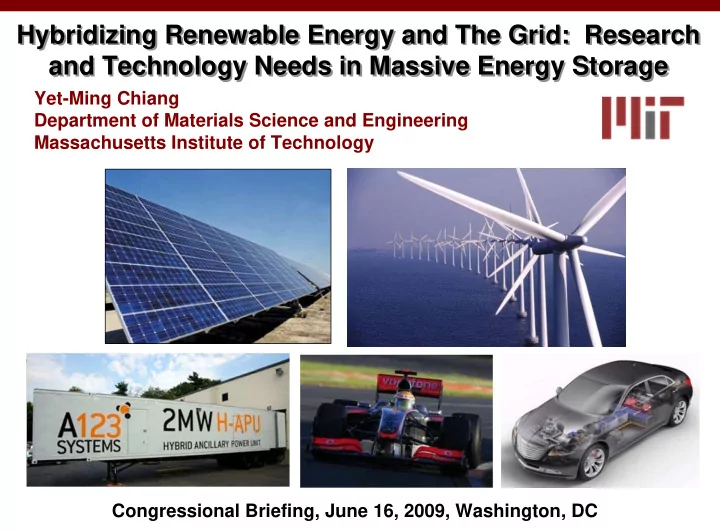
Hybridizing Renewable Energy and The Grid: Research Hybridizing Renewable Energy and The Grid: Research and Technology Needs in Massive Energy Storage and Technology Needs in Massive Energy Storage Yet-Ming Chiang Department of Materials


slide-1
SLIDE 1

Yet-Ming Chiang Department of Materials Science and Engineering Massachusetts Institute of Technology

Hybridizing Renewable Energy and The Grid: Research and Technology Needs in Massive Energy Storage Hybridizing Renewable Energy and The Grid: Research and Technology Needs in Massive Energy Storage

Congressional Briefing, June 16, 2009, Washington, DC

slide-2
SLIDE 2

Two huge industries are transforming….

Battery Industry

Storage is the problem and the solution...

slide-3
SLIDE 3

Consider That Vehicles Have Multiple Levels of Electrification

ICE HEV PHEV BEV

engine battery

3

Toyota Prius Honda Insight Ford Escape A123/Hymotion conversion GM Volt Chrysler 200C Tesla Roadster Chrysler Circuit Fisker Karma TH!NK City

slide-4
SLIDE 4

Ratio of Power(kW) to Stored Energy(kWh) Varies from ~100 (HEV) to ~1 (BEV)*

HEV PHEV EV Charge- depleting Charge- sustaining

*Comparison: The Design P/E is ~0.25 for Wind, Solar

slide-5
SLIDE 5

Similarly, the Grid will be Hybridized

Where storage can help

Wind and Solar are Intermittent Sources (not “dispatchable”)

US: 3% renewables

slide-6
SLIDE 6

Frequency Regulation Example (GE)

Frequency Regulation: Frequent charge and discharge pulses, but net energy transferred is zero. Analogous to a hybrid electric vehicle (HEV)… Load following is longer‐term analog to regulation: vary generation to meet hour‐to‐hour variations in load

slide-7
SLIDE 7

Impact of Storage Time Constant: Wind+Battery Example (NEDO)

slide-8
SLIDE 8

Comparing Time Constant and Total Power for Automotive and Grid

8

EV P H E V

HEV

slide-9
SLIDE 9

Recent example: Impact of DOE Basic Science

slide-10
SLIDE 10

Recent Advances in Li-Ion Batteries for Transportation

“Extreme” pack engineering using commodity laptop cells, individually cooled and monitored

Example: Tesla Roadster

Derivatives of oxide chemistry from previous generation Li-ion (aim to improve safety, life)

Examples:

  • Lithium Nickel Cobalt

Aluminum (SAFT, PEVE)

  • Lithium Manganese Spinel

(LG, NEC, Hitachi)

  • Lithium Manganese Nickel

Cobalt (Sanyo)

  • Mixtures of various oxides

New chemistries that are intrinsically safer, high power, long-life, low-cost

Example: Nanoscale Olivines Engineering solution New Chemistry Improve 1st Gen Chemistry

slide-11
SLIDE 11

Electric

slide-12
SLIDE 12

Formula 1 Racing: Pushing the Outer Performance Envelope of Hybrid Electric Drive

  • 2009: McLaren-Mercedes

teams with A123 Systems to develop KERS (Kinetic Energy Recovery Systems)

  • Opening race of 2009 season

in Melbourne, AUS

  • Lewis Hamilton, 2008 World

Champion, starts in 18th position (out of 20) and finishes 4th

slide-13
SLIDE 13

Kinetic Energy Recovery System (KERS) in Action

Battery State-of-Charge

Mercedes High Performance Engines

Melbourne March 2009

slide-14
SLIDE 14

Frequency Regulation with the World’s largest Li-Ion Battery

  • 2 MW power, 90% round-trip efficiency
  • 0.5 MWh stored energy
  • 82,000 cylindrical cells
  • 1.2 tonnes cathode material
  • 2.3 x 10¹⁷ nanoparticles (40 nm dia.)
slide-15
SLIDE 15

Why science breakthroughs still needed for automotive……

15 kWh for 40 mile PHEV 75 kWh for 200 mile BEV Range (miles) x 300 Wh/mile 0.8 (20% reserve capacity)

= =

÷

110 Wh/kg 136 kg for 40 mile PHEV 681 kg for 200 mile BEV

= =

÷

220 Wh/L 68 L for 40 mile PHEV 341 L for 200 mile BEV

= = x

US$0.50/Wh US$7500 for 40 mile PHEV US$37,500 for 200 mile BEV

= =

Energy Mass Volume Cost

Not to mention that charging a 75 kWh pack in 1h takes 75 kW; in 5 min takes 900 kW….. Typical of current Li-ion Target cost

(too heavy!) (too big!) (too expensive!)

~Similar cost to Na-S

slide-16
SLIDE 16

Massive Energy Storage Is Even More Demanding in Terms of Scalability, Cost, Safety, Life

A123 Multi- MW Li- Ion Battery System E V PHEV H E V

Main MES Options:

  • Pumped Hydro
  • Compressed Air
  • Sodum-sulfur
  • Redox flow
  • Lithium-ion

Why Electrochemical Storage:

  • Higher energy density

than all but nuclear

  • Use it anywhere
  • Can be safe, long-life
  • Can use low-cost, earth-

abundant materials Challenge: No current system combines all of these attributes in the same battery

slide-17
SLIDE 17

Interdependence in the Energy Ecosystem

Grid-scale energy storage PHEV, E-REV, EV

slide-18
SLIDE 18