
SLIDE 1
Capital Markets Event
TI Fluid Systems plc
24 September 2019
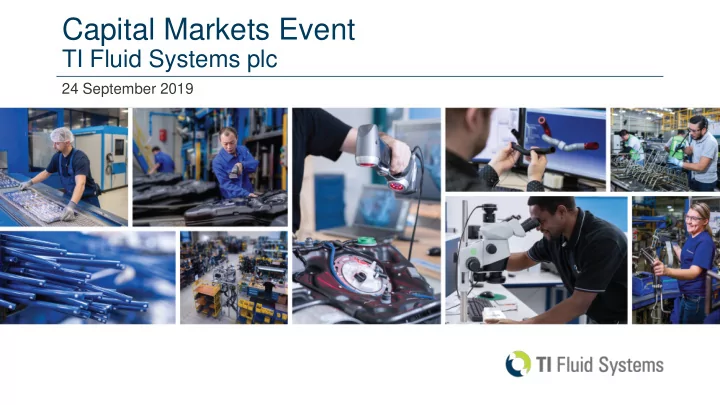
Capital Markets Event TI Fluid Systems plc 24 September 2019 - - PowerPoint PPT Presentation
Capital Markets Event TI Fluid Systems plc 24 September 2019 Todays Objectives Providing detail around our products, competitive strengths and markets to enhance Product Overview understanding of why we consistently generate strong
TI Fluid Systems plc
24 September 2019
Today’s Objectives
2
Product Overview Providing detail around our products, competitive strengths and markets to enhance understanding of why we consistently generate strong profitability and cash flow Outperform global light vehicle production Background on TI Fluid Systems’ confidence in our ability to continue to deliver revenue
Electrification Review of our Electrification Strategy, recent successes and our confidence that in the medium to long term, this will provide a higher level of revenue outperformance Financial Performance Continue emphasis on the resiliency of our business with strong margins and leading cash flow generation
24 September 2019
Agenda
3
Timing Event Presenter
2:00 PM Welcome and Introduction Bill Kozyra Chief Executive Officer 2:05 PM – 2:20 PM Group Overview Bill Kozyra Segment Overview 2:20 PM – 2:35 PM
Stefan Rau Executive VP, FCS 2:35 PM – 2:50 PM
Hans Dieltjens Executive VP, FTDS 2:50 PM – 3:05 PM Financial Performance Tim Knutson Chief Financial Officer 3:05 PM Summary Bill Kozyra 3:05 PM – 3:15 PM Q&A 3:15 PM – 4:00 PM Product Tour
24 September 2019
Introductions – Today’s Presenters
4
Bill Kozyra CEO and President Tim Knutson Chief Financial Officer Stefan Rau Executive VP, FCS Hans Dieltjens Executive VP, FTDS
Bill was appointed as CEO and President of TI Fluid Systems in June
a number of senior executive positions, including that of President and CEO of Continental AG North America and senior roles at ITT Automotive and Bosch Braking Systems. Bill has 42 years of automotive experience. Tim joined the Group in November 2008 and has served as Chief Financial Officer. Prior to joining TI Fluid Systems, Tim was CFO of Meridien Automotive Systems. Prior to this position, Tim held a number of senior finance positions at Delphi Corporation. Tim has 30 years of automotive experience. Stefan was appointed as Executive VP of FCS in January 2019. Stefan joined TI Fluid Systems in 2002. He progressed his career with various roles in operations and engineering. Prior to his appointment as Executive VP, Stefan was the Managing Director of FCS Europe. Stefan has over 20 years of automotive experience. Hans has been the Executive VP of Fuel Tank & Delivery Systems since
senior level operational, technical and sales positions within the Group and at Hoogovens Aluminium Duffel. Hans has 22 years of automotive experience.
24 September 2019
a) Automotive Megatrends b) Technology c) Global Platforms d) China
6
2018 Revenue €3.5 B 2018
margin 10.8% 2018
€146 M Current Market Cap. ~ €1 B
TI Fluid Systems plc has approximately 100 years of automotive fluid systems expertise We have award-winning technologies and products aligned with automotive megatrends, including new product offerings designed for hybrid electric vehicle (“HEV”) and electric vehicle (“EV”) applications We are a leading global supplier of automotive fluid storage, carrying and delivery systems for the light vehicle automotive market, with strong market shares across all key products We believe our market diversity is unparalleled and leading competitive flexible cost structure demonstrates the resilience of our business
24 September 2019
7
Performance-critical products that cannot be easily replaced
vehicle
& delivery module at the back of the vehicle
thermal products in the front of the vehicle
OEM using proven technology
products compared to the price of a vehicle
size of the vehicle i.e. larger vehicles such as an SUV typically require longer lines and a larger fuel tank system
they are performance-critical and cannot be easily replaced
24 September 2019
Focused on highly engineered fluid storage, carrying and delivery systems for light vehicles
8
Fluid Carrying Systems (“FCS”)
58% of 2018 Revenue
Fuel Tank and Delivery Systems (“FTDS”)
42% of 2018 Revenue
Designs, engineers and manufactures brake and fuel lines, engine lines as well as thermal fluid products for vehicles, primarily with a EV strategic focus Designs, engineers and produces fuel tank systems and pump and module fuel delivery systems for vehicles, primarily with a HEV strategic focus The Group
two key divisions: FCS and FTDS
24 September 2019
a) Automotive Megatrends b) Technology c) Global Platforms d) China
10
Global factors driving Long Term Growth
Short Term Long Term Growth in Emerging Economies Tighter Environmental Regulations Globalisation China Economic Slowdown Trade Tariff Uncertainty Fear of Global Slowdown
Macro Economic Factors driving Short Term Headwinds
Electrification
Business positioned
well for both the short term and long term environment
24 September 2019
11
Source: IHS Markit.H1 2018 and H2 2019 Overall global light vehicle production market remains challenging as evidenced in H2 2018 and H1 2019. Macroeconomic headwinds have impacted the market with short term regulatory changes, China slow down and trade conflict 2020 Global Factors impacting 2019 global light vehicle production to potentially continue into 2020, although importantly, China direction not known 2020 Regions 1. Europe - potential market weakness from exports (dependent on China) as well as continuation of economic uncertainties
trade conflict. Although, new government incentives could provide favourable impact
vehicles and pick up trucks
Short term global light vehicle production impacted by China and trade conflict
24 September 2019
56.3 54.5 57.1 58.6 61.6 64.2 66.8 70.6 67.5 59.4 74.3 76.9 81.5 84.7 87.4 88.8 93.1 95.2 94.2 90.1 90.4 93.0 95.9 98.8 20 40 60 80 100 120
12
Long-term automotive production expected to grow 2%+ and TI Fluid Systems expecting to
Global light vehicle production 2000-2023 millions of units 2.9% Historical CAGR 2.3% CAGR North America Europe Japan & Korea China Other Asia Pacific Rest of World
Note: Presentation subject to rounding Source: IHS Markit.24 September 2019
a) Automotive Megatrends b) Technology c) Global Platforms d) China
14
Highly diversified customer base with no single customer making up > 12% of revenue
customer making up > 12% of revenue facilitates revenue consistency
efficient design process and competitive advantages
products 2018 Revenue by Customer 12%
Daimler
10%
Hyundai
10%
Volkswagen
9%
FCA
9%
Ford
8% 7%
General Motors
7%
PSA
5%
Toyota
4%
BMW
17%
Other OEMs
2%Aftermarket
Renault-Nissan
Source: Company estimates24 September 2019
15
provide a logistics advantage with strong barrier to entry and cost competitiveness
creating “sticky business model”
programmes supports margins and free cash flow
Supplying to almost every brand of vehicle produced around the globe
24 September 2019
a) Automotive Megatrends b) Technology c) Global Platforms
17
Consistent revenue outperformance versus global light vehicle production with megatrends, technology, global platforms and position in China Automotive Megatrends Technology Global Platforms
Engineered Performance- Critical Products
Technology leader
efficiency requirements
reduction requirements
global vehicle platforms
engineering and customer relationships
1 2 3 China Position
established leadership in Chinese market
4
Medium to Long Term
agnostic in ICE, HEV and EV
providing addressable market growth opportunity
24 September 2019
a) Automotive Megatrends b) Technology c) Global Platforms d) China
4.a Automotive megatrends drive our business
19
Global emission reduction and fuel efficiency requirements continue to increase providing attractive growth opportunity
The Group
two key divisions: FCS and FTDS
Emission reduction
globally
Fuel efficiency
countries
Electrification
24 September 2019
4.a Automotive megatrends - fuel efficiency
20
Fuel efficiency standards continue to increase
United States
increasing from 38 mpg today to 56 mpg by 2025
Europe
by 2021
China
Higher content per
vehicle for TI Fluid Systems
2019 metrics Source: The International Council on Clean Transportation (“ICTT”) and Company information60 30 50 40
2005 2015
61%
2000
70%
2025
20
India Japan China USA Europe Miles per gallon
24 September 2019
4.a Automotive megatrends - emission reduction
21
Greenhouse gas emission standards (CO2) continue to tighten
Global emissions reduction requirements
Europe and South Korea having the toughest standards
Higher content per
vehicle for TI Fluid Systems
240 220 100 180 140
2005 2015
61% 59%
2000
53% 70%
2025
60
India Japan China USA Europe CO2 per km (gram)
2019 metrics Source: The International Council on Clean Transportation (“ICTT”) and Company information24 September 2019
a) Automotive Megatrends b) Technology c) Global Platforms d) China
4.b Technology Leadership
23
We are viewed as a technology leader in the industry with our award-winning innovations
2009 2010 2014 2017 2019
Technology addressing automotive megatrends with higher content per vehicle opportunity
2009 PACE AWARD Ship-in-Bottle (“SIB”) Fuel Tank System 2010 PACE AWARD Dual Channel Single-Stage (“DCSS”) Fuel Pump 2014 PACE AWARD Tank Advanced Process Technology (“TAPT”) Fuel Tank System 2017 PACE AWARD Innovation Partnership Port Fuel and Direct Injection (“PFDI”) System 2019 PACE AWARD FINALIST Hybrid Electric Pressurised Plastic Fuel Tank Assembly System
24 September 2019
a) Automotive Megatrends b) Technology c) Global Platforms d) China
4.c Geographical revenue diversity
25
Highly diversified revenue with no dependence on one geography
continents
nationals with profit/ cash flow responsibility and strong regional/ global customer relationships
Revenue by Geography 40%
Europe
28%
North America
17%
China
6%
South Korea
6%
Other Asia Pacific
Metrics as at 30 June 2019 Source: Company estimates24 September 2019
4.c Global low cost manufacturing footprint
Metrics at 30 June 2019Optimised footprint with locations near customers for logistics advantage, due to large size of products
North America 20 locations Asia Pacific 29 locations Latin America 6 locations
28 countries
Global scale
111 Manufacturing locations
Reduced
freight cost
Close to
customers 28K Employees
Local
knowledge in all key markets 18% direct temporary workers
Highly
flexible 69% of employees in low cost countries
Cost
competitive
Global 111 locations 12 Advanced Technology Development Centres Europe/Africa 56 locations
We adjust a few sites each year to align our footprint with our customers’ assembly plant changes e.g. as they move from West to East
26 24 September 2019
4.c Global vehicle platforms
27
100% 80 20 60 40 94.2m 2018A 98.8m 2023E 61% 59% 2013A 84.7m 53% 70% 2018A 2018 Global Platform Revenue Mix
3 + region platforms
Significant growth realised through winning global platforms. Further expansion opportunity
All other platforms
Note: TI Fluid Systems revenue mix includes all revenue that the Group tracks on a platform basis (83% of total revenue) Source: IHS Markit and Company estimatesShift towards global platforms
Few suppliers are capable of meeting customer requirements in all major regions
24 September 2019
a) Automotive Megatrends b) Technology c) Global Platforms d) China
4.d Long established leadership in China
29
Our position in China provides long term growth opportunity in world’s largest market 100% wholly-
China
2016A 2018A
Revenue Growth 2016-2018 CAGR
Emission Regulations “Local Supplier” Customers Presence
China facilitating growth for TI Fluid Systems’ technology
China but with global capabilities
customer relationships
manufacturing
a) Metrics at 30 June 2019China
15 manufacturing locations ~17% of group revenue (a) Brake and Fuel lines position providing growth opportunities for other product areas
24 September 2019
a) Automotive Megatrends b) Technology c) Global Platforms d) China
5.TI Fluid System significant revenue opportunity with electrification transition
31
Internal Combustion Engine Vehicle (ICE) Optimised ICE and Full Plug-In Hybrid Electric Vehicle (HEV) Electric Vehicle (EV)
Brake and fuel lines Integrated fuel tank system
Engine lines and other products
Brake and fuel lines
Pressurised Fuel Tank System Engine lines and other products Battery Thermal Lines Power Electronics Thermal Lines
Brake lines
Battery Thermal Lines Power Electronics Thermal Lines Autonomous Navigation Thermal Lines
Content Per Vehicle
Electrification offers content growth
€200 €250 - €700 €200 + +
TI content today €50 to €150 Climate Control Thermal Lines Climate Control Thermal Lines Climate Control Thermal Lines Other Thermal System Products
Note: Estimated potential content opportunity of products used in addressable market scenariosExisting products Newer products Products launching/ due to launch Under development
24 September 2019
32
Organic growth opportunities in EVs and HEVs has been a key focus with significant progress made to date
2018 Global and regional EV and HEV awards and
management products Vision Expand thermal system
content per vehicle with leading market share
Electrification Strategy
2019 Continue to collaborate with key EV and HEV customers
used to design, engineer and supply thermal products for upcoming EV launches
low given existing capacity and knowledge
lightweight nylon components to
reduction
driven by long lasting global OEM relationships
Medium Term Build on current success and continue to introduce nylon to customers
24 September 2019
33
Rubber Aluminum Nylon
Medium Low High Tube material
Nylon provides significant weight reduction and vertical integration opportunities
Nylon Development
existing industrialised capacity
lines that can operate at high temperatures in order to eliminate aluminium and rubber
Estimated at 30% - 60%
aluminium
nylon can equate to ~ 2.5 kg in a small vehicle and ~ 8.0 kg in a large vehicle ~ 30% to 60% weight reduction
Source: Company estimatesWeight
24 September 2019
34
2018 to 2026 CAGR in HEV and EVs provides content growth opportunity
100% 80 20 60 40 Hybrid Electric 4% Electric 2% 3.9M ICE 94% 94.2 88.7M
Share of Global Market
1.7M
Global light vehicle production 2018 millions of units
100% 80 20 60 40 Hybrid Electric 38% Electric 11% 39.8M ICE 51% 104.9 54.0M
Share of Global Market
11.1M
Global light vehicle production 2026 millions of units
expected to increase from 2018 to 2026 – CAGR 1.3%
CAGR 34%
24 September 2019
35
Potential addressable market growth from the penetration of HEV and EV
Addressable market scenario 2018 € billions 17.7
ICE
1.0
Hybrid
0.3
Electric
Note: 1) CPV multiplied by IHS market volumes. Low end addressable market range assumes ICE €200, Optimised ICE/ Mild HEV €200, Full HEV €500 and EV €200 and high end range assumes ICE €200, Optimised ICE/ Mild HEV €250, Full HEV €700 and EV €400 2) Presentation subject to rounding Source: IHS Markit and Company estimates.~ €19.1 ~ €24.4
Addressable market range scenario 2026 € billions 10.8
ICE
2.2
Electric
4.4
Electric
10.7
ICE
11.4
Hybrid
15.1
Hybrid
Potential scenarios expected for our ICE, HEV and EV strategy depending on additional content level with CAGR of 3% to 6%
~ €30.4
24 September 2019
36
Power Electronics Thermal Lines Electric and autonomous vehicles provide higher content growth opportunity Climate Control Thermal Lines Brake Lines Battery Thermal Lines Autonomous Navigation Thermal Lines Vehicle chassis thermal lines
24 September 2019
37
Global Footprint Ability to produce from existing and efficient manufacturing locations close to our customers Customer Relationships Long standing customer relationships and viewed as a trusted and strategic partner to the OEMs Technology Expertise to design and engineer performance-critical components to meet customer specifications using existing know-how Nylon Capability Introduction of nylon as a light-weight solution to thermal requirements that can operate at high
Current Status Focused on launch of high volume thermal contracts awarded in 2018. Launch beginning in 2020 Continue to collaborate with key customers on design and engineering for EVs
TI Fluid Systems well positioned to capture additional content opportunity
24 September 2019
Fluid Carrying Systems
FCS Segment Highlights
39
1 6 2 3 5 4
1
Variable Costs Vertical Integration2 5 4
Low Cost Footprint3
Capex DecentralisedFlexible Business Model
#1 Market Share in Brake & Fuel Lines Vertical Integration Chinese market leader Flexible Cost Structure Electrification Global Presence
24 September 2019
40
#1 #2
#2
#3 #1 #2 #3
FCS designs, engineers, manufactures and assembles fluid-carrying products and systems
#3
#1 #2
#4
#3
Brake & Fuel Lines Thermal Lines and Systems
Engine Lines
engineered complete fluid systems developed in close collaboration with customers
pending patents worldwide Brake and Fuel Lines Climate Control Thermal Battery Thermal Power Electronic Thermal Quick Connectors SCR Lines
24 September 2019
41
TI Fluid Systems #1 global market position in brake and fuel lines
(global, regional and local) built over decades
key advantages
34% 13%
Competitor A TI Fluid Systems
2018 Market Share – Brake and Fuel Lines 15%
Competitor B
16%
Others
Source: Company estimates24 September 2019
42
Strong market share position across all regions
Europe Asia Pacific North America
Asia including #1 position in China
position in Europe has been established over a long period
America market
business opportunities (e.g. SUVs) 48%
TI Fluid Systems
13%
Competitor A
21%
Others
19%
Competitor B
10%
Competitor A
29%
TI Fluid Systems
17%
Others
24%
TI Fluid Systems
24%
Competitor A
17%
Competitor C
20%
Competitor B
Source: Company estimates24 September 2019
43
#1 #3
Europe and Asia driving FCS revenue outperformance with focus on delivering thermal strategy
#1 #2
#4
#3
Europe & Africa North America Asia
Focus on moving footprint from Western Europe to Eastern Europe Under-indexed on trucks and large passenger vehicles leading to underperformance in 2019 1 Outperforming European vehicle production with strong market position 1 2 Significant thermal business awards for electric vehicles in 2018 3 #1 market position in China over multiple decades Flexing costs in China to align with volume decline 1 2 Focus on electric vehicle growth
3 Advanced knowledge of thermal design and engineering 2
24 September 2019
44
Strip Steel Uncoil & Roll forming Brazing Coating Process Coiling Cut to Length
Process Plant Vertical integration provides competitive advantages and drives profitability
24 September 2019
45
Vertically integrated manufacturing and assembly process followed by just-in-time delivery
Bending Bundle Assembly Just-In-Time Delivery End Forming
Assembly Plant
24 September 2019
46
Strategically located in China for multiple decades with a #1 market position
Leading brake and fuel lines market position in China Supplying global and local Chinese OEMs Local management team with extensive customer relationships World-class products, technology and manufacturing 100% wholly-owned China operations providing investment and return flexibility
Leveraging existing infrastructure and relationships to benefit from the growing electric vehicle market in China
24 September 2019
1 Variable Costs
Low fixed costs base with ability to flex variable costs on volume changes minimising impact on profitability/ cash flow
47
2 Vertical Integration
Vertical integration provides flexibility and control over component supply and manufacturing response
3 Low Cost Footprint
21,000 employees in 83 locations in 25 countries 19% direct temporary labour
4 Capex
Low capex business model with strict financial investment discipline
5 Decentralised
“Hub and spoke” model together with decentralised structure allows quick response time for volume adjustments
FCS competitive flexible cost structure and business model demonstrates the resilience of our business
24 September 2019
Metrics at 30 June 2019 48
Successfully executing Thermal EV strategy with two key OEM wins SOP: 2019 – 2021 | 10 year life SOP: 2020 – 2022 | 8 year life
Approximately €700M lifetime revenue potential with these key two platforms
Awards: Anticipate approximately 50% share of the design, engineering and supply of EV thermal management products Lifetime Revenue Potential: ~ €700 million (based on customer planning volumes) Material and Content: Combination of traditional and lightweight material, including nylon Products: First generation EV designs and variant values continuing to change
(b) (b)Thermal awards and expected orders with leading high volume OEMs for global EV platforms
(a) (a) Purchase orders received (b) Start of Production (“SOP”). SOP and vehicle life subject to change24 September 2019
49
Strategic investment in thermal products facility in Morocco primarily supplying Electric Vehicles
European OEMs announced in August 2018. Launches expected to begin in 2020
power electronics
thermal expertise and capacity in the region
structure with low labour costs
Group continues to collaborate on thermal product and systems with key customers for EVs
24 September 2019
50
Content growth opportunity with development of thermal products into thermal systems
Thermal “Systems” development
e.g. quick connectors Thermal “Products”
Existing know-how Existing technology Existing materials Existing capacity
Today Tomorrow
24 September 2019
51
Continually re-aligning of manufacturing footprint to support local growth opportunities
Fuldabruck, Germany Wieprz, Poland Tangier, Morocco
Manufacturing location closing Manufacturing location recently opened or opening
and fuel lines globally
assembly plants supplying global customers through local plants
intensity
discipline leading to high returns
24 September 2019
52
Benefiting from globalisation of platforms through key wins
High Volume Vehicle A High Volume Vehicle B SOP: 2020 – 2030 | 10 year life SOP: 2018 – 2026 | 8 year life Global Award: High volume global platform produced in China, Taiwan, Vietnam, USA, Mexico, Spain and Germany Production Units: 6.7 million Products: Brake and fuel lines Fuel vapour lines Global Award: High volume global platform produced in China, Germany and South Africa Production Units: 7.0 million Products: Brake and fuel lines
Note: Production units based on customer planning volumes24 September 2019
Fuel Tank & Delivery Systems
FTDS Segment Highlights
54
1 2 3 4 5 6
1
Variable Costs Product Integration2 5 4
Low Cost Footprint3
Capex DecentralisedFlexible Business Model
#3 Market Share in Plastic Fuel Tanks Award winning technology Growing China opportunity Product Integration Flexible Cost Structure Global Presence
24 September 2019
55
#3
#1 #2
#4
#3
FTDS designs, engineers, manufactures and integrates fuel tank systems and pump modules Fuel Tank Systems Pump & Sensor Module Systems
Fuel Pump & Module Fuel Pump
additional products within fluid system Filler Pipes Design, engineer, manufacture and integrate fuel tank systems
pending patents worldwide Fuel Tank System
24 September 2019
56
TI Fluid Systems #3 global market position in plastic tank systems
position
regional competitors
contract awards
with technology strength, especially with PHEV
2018 Market Share – Plastic Fuel Tanks 15%
Competitor D
30%
Competitor A
19%
Competitor B
6%
Competitor C
14%
TI Fluid Systems
7%
Competitor E
Source: Company estimates24 September 2019
57
Strong market share position across all regions
Europe Asia Pacific North America
players
share expansion 24%
TI Fluid Systems
36%
Competitor A
26%
Competitor B
12%
TI Fluid Systems
12%
TI Fluid Systems
29%
Competitor D
18%
Competitor A
40%
Competitor A
26%
Competitor B
market share position in Europe
America with technology strength
Source: Company estimates24 September 2019
58
#1
Focus of reducing emissions providing positive trend for FTDS, particularly in China Europe & Africa North America Asia
Advanced fuel tank technology and product integration development Consolidating capacity as part of footprint
High volume fuel tank win for Japanese OEM in 2019 1 2 New programme wins for PHEV pressurised tanks 1 2 Positive revenue trend in China with the conversion of steel to plastic tanks Emission standards leading to higher demand for partial and zero emission tanks 1 2
24 September 2019
59
Conventional Vehicles
Partial Zero Emission Vehicles (“PZEV”) PZEV & HEV HEV HEV
reduction
fuel tank
purge pressures
purge pressure
Fuel tank technology developed to meet evaporative emission standards and hybrid vehicle requirements
Product Development
Ship in a Bottle (“SIB”) and Tank Advanced Process Technology (“TAPT”) Stiff Pressure Tank (“SPT”) Light Pressure Tank (“LPT”) High Pressure Double Moulded Tank (“DMT”) Blow moulded tank shell design development
24 September 2019
60
existing plastic fuel tank market share
2018
structural integrity, handles increased pressure levels and reduces emissions
Well positioned as the Plug-In Hybrid Electric Vehicle (“PHEV”) market accelerates growth
PHEV tank share trending to more than 20% -- better than existing fuel tank market share
24 September 2019
Note: Production units based on customer planning volumes 61
100% 80 20 60 40 23.0 Europe (26%) 16.3 North America (18%) Plastic tank (98%) 15.9M (units) Plastic tank (90%) 20.8M (units) Total (100%) 88.5 Plastic tank (75%) 66.7M (units) China (27%) 23.9 Plastic tank (60%) 14.4M (units)
Share of Global Market
Source: IHS Markit and Company estimatesTrend of steel to plastic fuel tank conversion in China continues to provide organic growth opportunities
Global fuel tank market 2019 (in million units)
China facilitating growth for FTDS technology
solution to steel tanks
conversion almost complete
providing further organic growth opportunity for FTDS
24 September 2019
62
Successful expansion of footprint in China to support growth opportunities
Baoding #2, China Baoding, China Tianjin Changchun Guangzhou
main trends:
tank conversion
reductions increasing the demand for low emission fuel tanks Manufacturing location in China
24 September 2019
63
Manufacturing Plant Blow moulding and manufacturing of pump module Component Integration Ship to Customer Product integration provides competitive advantages and supports profitability Assembly and Test
FTDS is able to manufacture and integrate all different components into a fuel tank system incl. pumps, sensors and lines which supports profitability
24 September 2019
64
Financial discipline and cost focus with ability to flex variable costs on changing volumes minimising impact on profitability/ cash flow In-house product manufacturing and integration provides flexibility and control 6,000 employees in 39 locations in 20 countries 16% direct temporary labour Capex optimisation through re-location, in- house manufacturing and refurbishment of blow moulding equipment Local managements and decentralised business model to quickly respond to local business environment
FTDS competitive flexible cost structure and business model demonstrates the resilience of our business
1
Variable Costs Product Integration
2 5 4
Low Cost Footprint
3
Capex Decentralised
24 September 2019
Metrics at 30 June 2019 65
Global presence provides highly attractive customer support and cost-efficient footprint
Greeneville, USA Györ, Hungary East London, South Africa
competitive advantage in winning and delivering global platforms
logistics advantage and just-in- time delivery
flexed in line with business wins and volumes to ensure optimisation Manufacturing location closing Manufacturing location recently opened or opening
24 September 2019
66
Benefiting from globalisation of platforms through key wins
High Volume Vehicle A High Volume Vehicle B SOP: 2020 – 2030 | 10 year life SOP: 2022 – 2030 | 8 year life Global Award: High volume global platform produced in Germany and China Production Units: 2.2 million Products: Integrated Fuel Tank Filler Pipe Global Award: High volume global platform produced in China, Germany and South Africa Production Units: 7.0 million Products: Integrated Fuel Tank Filler Pipe
Note: Production units based on customer planning volumes24 September 2019
Financial Profile
68
Notes: 1) Adjusted EBITDA defined as profit for the period before income tax expense, net finance expense, depreciation (including PP&E impairment), amortisation (including intangible impairment), exceptional administrative expenses, net foreign exchange losses and (gains) and other reconciling items. 2) Financials prior to 2010 prepared on UK GAAP basis 2) Revenue and outperformance shown on a reported basis Source: IHS Markit and Company informationFinancial performance has been resilient through macro economic cycles
2008 2009 2010 2011 2012 2013 2014 2015 2016 2017 2018
3.5 3.5 3.3
Adj. EBITDA %
7.0% 4.5% 10.4% 11.4% 12.1% 12.3% 12.5% 13.3% 13.9% 14.1% 13.9% 67.5 59.4 74.3 76.9 81.5 84.7 87.4 88.8 93.1 95.2 94.2 Vehicle volumes (m) Revenue (€ bn)
Revenue Growth 2008 - 2018 CAGR 7.1% Volume Growth 2008 - 2018 CAGR 3.4% Outperformance 2008 - 2018 3.7%
24 September 2019
69
New Quotes Management focus on new business quotes to support revenue outperformance with strong financial discipline throughout the organisation Continuous Improvement Continuous improvement culture focused on operational efficiencies, net pricing, capex utilisation and working capital management Global Drive key performance indicators across business and sharing best practice globally Manage Costs Focus on managing costs with < 15% fixed costs to revenue, deep experience at managing discretionary spending and salaried headcount at appropriate level globally Ability to reduce sites in the short term to adjust to customer assembly plant changes
Consistent management focus with discipline around quoting, investments, margins and cash flow
24 September 2019
70
Stable Adj. EBIT margins in €100M downturn scenario demonstrate strength of business model
100%
94% 97%
3.5 billion
100%
Revenue Decline Scenarios 3.4 billion 3.3 billion Example 1 €100m decline Revenue Example 2 €200m decline
3% 6%
Revenue decline ~ 11% ~ 10%
business model with ability to flex costs
temporary employees, discretionary cost reduction and focused salaried headcount management
strong high single digit Adj. EBIT margins through:
headcount, plant reductions and wider cost reduction programme
~ 9% 2018
24 September 2019
71
Strong Adj. free cash flow generation despite challenging automotive volume environment in 2018 and 2019
resilience driven by:
adjust for commodity cost changes
protection
around customer projects and driving efficiency
managing working capital
Adj. EBITDA %
13.9% 14.1% 13.9%
Historical and Outlook
Outlook 83 119 146 2016 2017 2018 2019
Note: Adj. Free Cash Flow defined as cash generated from operating activities, less cash used by investing activities, adjusted for acquisitions, movements in financial assets at fair value through the profit or loss, cash payments related to IPO costs and cash received on settlement of derivatives. Source 1) JPMC Research as of 17 September 2019. Euro Auto Peer Universe includes JPMC covered companies: Autoliv, Continental, Elringklinger, Faurecia, Gestamp, Hella, Jost Werke, Pirelli, Plastic Omnium, Schaeffler, Stabilus and Valeo. FTSE 250 Industrials Peer Universe includes JPM covered companies: Bodycote, Halma, IMI, Melrose, Rotork, Smiths, Spectris, Spirax-Sarco, Vesuvius and WeirStrong FCF Prospects Not Reflected in Current Market Valuation
4.2% 5.9% 13.1%
FTSE 250 Industrials Peer Universe Euro Auto Peer Universe TIFS 2019F Adj. FCF to Firm Yield (Broker Research)
24 September 2019
(1) 72
Consistent Adj. free cash flow driven by focus on Adj. EBITDA and business model strengths
Note: Adj. Free Cash Flow defined as cash generated from operating activities, less cash used by investing activities, adjusted for acquisitions, movements in financial assets at fair value through the profit or loss, cash payments related to IPO costs and cash received on settlement of derivatives2016 2017 2018 H1 2018 H1 2019
465 491 484 256 246 Cash Interest (96) (88) (63) (29) (31) Cash Tax (84) (89) (88) (47) (46) Working Capital, Provisions and Other (65) (51) (32) (87) (61) PP&E and Intangibles (137) (144) (152) (72) (88) Cash Received on Settlement of Derivatives
83 119 146 21 17
by:
introduction, content increases and leveraging fixed costs
refinancing
approach to managing working capital
business model 4% - 5% of revenue
Capex % 3.3%
2.5% 3.4% 3.4% 3.3% 4.2%
24 September 2019
73
€m Interest Rate Dec 2018 Jun 2019 Financial Liabilities Secured Term Loan
US LIBOR+ 2.5% Euribor + 2.75%
1,205 1,160 Finance Leases and Other 2
(24) (20) Total 1,183 1,140 Cash and Cash Equivalents (361) (286) Net Debt 822 854 Net Debt / Adj. EBITDA LTM 1.7x 1.8x
free cash flow generation in the medium term
Secured Term Loan in March 2019
Strong capital structure with a focus on deleveraging through free cash flow generation
(a) Cash and cash equivalents includes financial assets at Fair Value Through Profit or Loss (“FVTPL”) (b) With IFRS 16 lease liabilities, net debt would be €1.0 billion and leverage 2.1 x Adj. EBITDA LTM as at 30 June 201924 September 2019
74
Capex & Capitalised R&D
Capital allocation priorities aligned with TI Fluid Systems’ strategic objectives
Target pay-out ratio of 30% of Adjusted Net Income (LTM Dividend Yield of 4.1%, above FTSE 250 average of 3.3%) Continue to invest ~ 4% - 5% of revenue to support organic growth Target leverage levels in line with UK/ European peers
Other Considerations
Continually assess other options that may benefit shareholders Net cash generated from operations
Dividends Deleveraging
Source: Company dividend yield calculated as aggregate 2018 final and 2019 interim dividends divided by current share price; FTSE 250 dividend yield sourced from Factset24 September 2019
75
Consistent and strong performance even with short term market headwinds and uncertainties
Note: 1) Revenue outperformance shown at constant currency 2) H1 2019 Adjusted EBITDA includes a +1% impact from IFRS 16 Source: IHS Markit.Adj. EBITDA %
14.5% 13.4% 14.4% 13.7% 14.4%
H1 2017 H2 2017 H1 2018 H2 2018 H1 2019
Global Light Vehicle Production
1.8 1.7 1.8 1.7 1.7
Revenue (€ bn) Outperformance
H1 2017 H2 2017 H1 2018 H2 2018 H1 2019 H2 2019 H1 2020 H2 2020 2.8% 1.4% 1.7% (4.1)% (6.7)% (3.0)% (2.2)% 1.2%
primarily by slowdown in China, trade wars
H1 2020; with slight reduction in 2020
global light vehicle production with beneficial trends e.g. emission reduction and global platforms
despite short term market headwinds
+ 4.3% + 2.3% + 2.8% + 4.0% + 1.4%
24 September 2019
76
Enhancing existing and successful business model with megatrend movement Future Business Model Increased Cash Flow Generation
Existing “know-how” and capacity Increased content per vehicle with HEV and EV Continued
global light vehicle production Customer relationships Existing global footprint Cost flexibility, margin and cash flow focus Low capex model
24 September 2019
Summary
Key Messages
78
Long-term automotive production expected to grow 2%+ and TI Fluid Systems expected to
Consistent revenue outperformance delivered through megatrends, technology, global platforms and position in China Strategy of organic growth opportunities in electrification has been and will continue to be a key focus with significant progress made to date
Global
Highly diversified customer base and optimised and flexible global footprint
Growth Long Term View EV
Resilience with ability to adjust costs in all market environments to deliver strong margins and leading cash flow metrics
Financial
24 September 2019
Product Displays Schedule
80
Timing Product Displays Product Tour Leader
Group A Ghost Cars and Thermal Displays Bill Kozyra Chief Executive Officer Group B Fluid Carrying System Displays Stefan Rau Executive VP, FCS Group C Fuel Tanks & Delivery System Displays Hans Dieltjens Executive VP, FTDS
24 September 2019
Key Investment Propositions
81
Experienced management team with proven track record of strong growth and financial performance Demonstrated above- market growth with leading technologies, strong market positions, global low cost footprint (including China strength) and diversification Significant growth
electrification and TI’s strength in thermal management Strong revenue growth, superior margins and free cash flow generation
24 September 2019
82
Disclaimer
No representation or warranty, express or implied is given by or on behalf of TI Fluid Systems plc (the “Company”) or any of its directors or any other person as to its accuracy, completeness or fairness of the information contained herein and no responsibility or liability is accepted for any such information, save that nothing in this presentation shall exclude any liability under applicable laws that cannot be excluded in accordance with such laws. Whilst the Company obtained certain industry and market data used in this presentation from publications and studies conducted by third parties and estimates prepared by the Company based on certain assumptions, the Company has not independently verified such data or sought to verify that the information remains accurate as of the date of this
information contained in this presentation, except as may be required by applicable law and regulation. This document does not constitute or form part of, and should not be construed as, any offer for sale or subscription of, or solicitation or any offer to buy or subscribe for or otherwise acquire, any securities of the Company in any jurisdiction. This presentation contains certain forward-looking statements that reflect management’s current views with respect to future events and financial and
“forecast”, “project”, “will”, “may”, “should” and similar expressions identify forward- looking statements. Others can be identified from the context in which they are
Accordingly, no assurance can be given that the forward-looking statements will prove to be accurate and you are cautioned not to place undue reliance on forward- looking statements due to the inherent uncertainty therein. Past performance of the Company cannot relied on as a guide to future performance. Nothing in this presentation should be construed as a profit forecast.