REMEDIATING COMPLEX CONTAMINATED SITES: A FLORIDA CASE HISTORY - - PowerPoint PPT Presentation

remediating complex contaminated sites a florida case
SMART_READER_LITE
LIVE PREVIEW

REMEDIATING COMPLEX CONTAMINATED SITES: A FLORIDA CASE HISTORY - - PowerPoint PPT Presentation

REMEDIATING COMPLEX CONTAMINATED SITES: A FLORIDA CASE HISTORY July 24, 2014 Environment & Health Presentation Outline 2 Site History Conceptual Site Model Remediation Options Questions I hope to provide you with a


slide-1
SLIDE 1

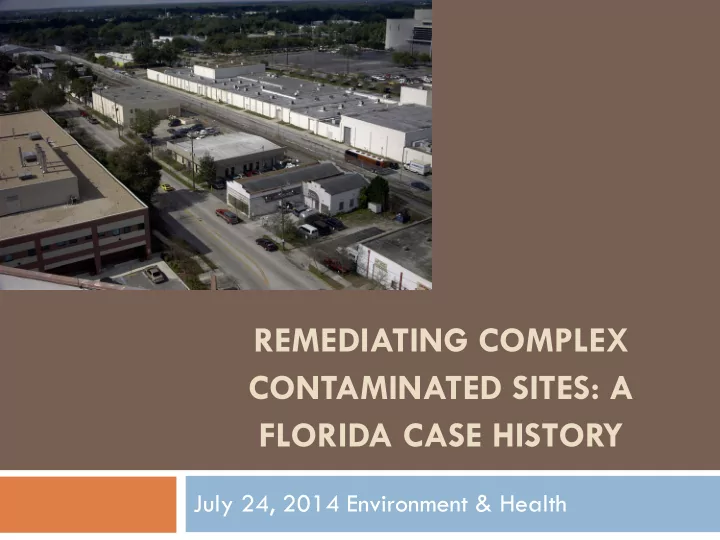
REMEDIATING COMPLEX CONTAMINATED SITES: A FLORIDA CASE HISTORY

July 24, 2014 Environment & Health

slide-2
SLIDE 2

Presentation Outline

2

 Site History  Conceptual Site Model  Remediation Options  Questions

I hope to provide you with a perspective on:

  • the interdisciplinary nature of soil and groundwater remediation
  • how science and engineering contribute to the process,
  • Some of the non-technical issues that are involved.
slide-3
SLIDE 3

Site History

3

 1888 to 1960: Operated as a Manufactured Gas Plant  1960 to Present: Property uses and ownership change.  1995 to present: Current property owners, the City and

past MGP owners perform site investigations, risk assessment, and feasibility studies; oversight by USEPA and FDEP under the Superfund program.

 2013: USEPA selects remedy for OU1 (top 60 feet);

investigations continue on OU2 (190 to 450 feet below ground surface)

 January 2016: Projected start date for OU1

remediation

slide-4
SLIDE 4

Former MGP Operations Layout

Based on Sanborn Fire Insurance Maps (1897-1973) and 1948 Plant Engineering Drawing

slide-5
SLIDE 5

On-Site Parcels

slide-6
SLIDE 6

Conceptual Site Model – Current Site Conditions

slide-7
SLIDE 7

Developing a Conceptual Site Model

Common Sense Geology Hydrogeology Microbiology Toxicology Chemistry Site History

slide-8
SLIDE 8

Conceptual Site Models Evolve Over Time

Review past and current site activities and properties Identify site and contaminant characteristics that affect fate and transport Identify existing and potential receptors Define the current distribution of contaminants Screen potential risk management options Screen various remediation options Identify information gaps Collect more information and refine the Conceptual Site Model

TIME

slide-9
SLIDE 9

Site Conceptual Model

RGB 128/143/165

No direct exposure No imminent risk

slide-10
SLIDE 10

OU1

Soils and Surficial Aquifer Groundwater

slide-11
SLIDE 11

Shallow Soil Contamination (2-10 feet bgs)

11

slide-12
SLIDE 12

Shallow Groundwater Benzene Contamination

12

Groundwater movement is very slow, no surface water nearby.

slide-13
SLIDE 13

Surficial Aquifer Zone

13

slide-14
SLIDE 14

Conceptual Site Model –

Generalized Cross-Section of Impacted Areas

14

slide-15
SLIDE 15

Remedial Objectives for OU1

 Contaminants: Benzene, naphthalene, ethylbenzene,

polynuclear aromatic hydrocarbons (PAHs)

 Objectives:

 Prevent contact with contaminated soil and groundwater  Prevent migration of impacted groundwater  Remove or treat the contaminated soil  Use safe, implementable and proven technologies, be

cost effective.

slide-16
SLIDE 16

In situ Stabilization/Solidification

16

slide-17
SLIDE 17

Biosparging – In situ Biodegradation

17

slide-18
SLIDE 18

In Situ Chemical Oxidation

18

slide-19
SLIDE 19

Selected Remedy (as refined in the ROD)

LNAPL Impacted soil to 15 ft bgs LNAPL Impacted soil to 15 ft bgs

slide-20
SLIDE 20

OU2

Upper Floridan Aquifer Groundwater

slide-21
SLIDE 21

Conceptual Site Model – OU2

21

slide-22
SLIDE 22

Upper Floridan Aquifer - Benzene

22