RegulatingEfficiency Why Its Broken, and How to Fix It Jordan - - PowerPoint PPT Presentation

regulatingefficiency
SMART_READER_LITE
LIVE PREVIEW

RegulatingEfficiency Why Its Broken, and How to Fix It Jordan - - PowerPoint PPT Presentation

RegulatingEfficiency Why Its Broken, and How to Fix It Jordan Endicott jendicott@kentlaw.edu Contents A. Historical Overview of Efficiency Standards (1) Where did the idea come from? (2) How do the requirements work? B. The Failings of the


slide-1
SLIDE 1

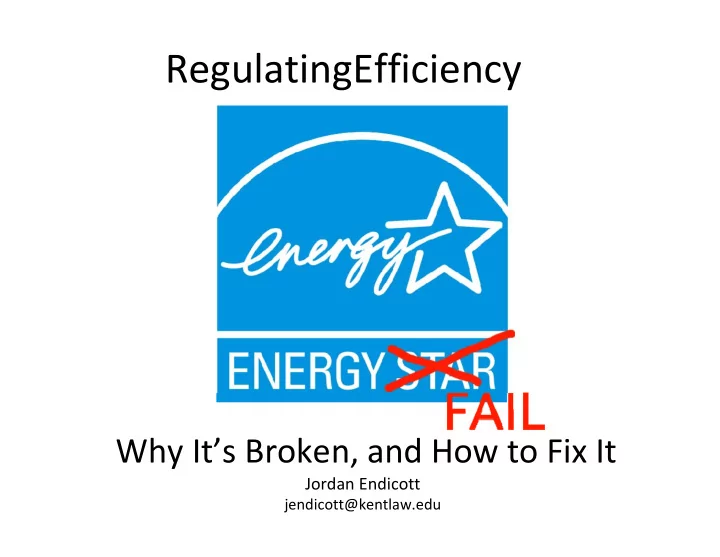
RegulatingEfficiency

Why It’s Broken, and How to Fix It

Jordan Endicott

jendicott@kentlaw.edu
slide-2
SLIDE 2

Contents

  • A. Historical Overview of Efficiency Standards

(1) Where did the idea come from? (2) How do the requirements work?

  • B. The Failings of the Current System

(1) Overall weak and slow changing requirements (2) Lack of enforcement (3) Consumer demand

  • C. Potential Solutions?

(1) Additional oversight (2) Self monitoring and communal regulation (3) Consume less

slide-3
SLIDE 3
  • A. Historical Overview
  • Energy Star was created in 1992 by the United

States Environmental Protection Agency.

  • The program is now administered jointly by

the EPA and the U.S. Department of Energy.

slide-4
SLIDE 4
  • Computer products were primarily the initial

area covered by the label.

  • Areas now covered include lighting, home
  • ffice, homes, electronics, appliances, and

heating and cooling systems.

slide-5
SLIDE 5

(1) The Purpose

  • The focus of Energy Star was to create a

voluntary labeling program.

  • Energy efficient devices that met the

requirements could be identified and promoted.

slide-6
SLIDE 6
  • According to Energy Star, the program has

saved billions:

slide-7
SLIDE 7

(2) Multiplicity of Labels

  • Following the success of the Energy Star logo,

there are now several certification programs.

  • While being a sign of success, this has created

a complicated marketplace for consumers.

slide-8
SLIDE 8
slide-9
SLIDE 9
  • B. The Enforcement Failure
  • Because of Energy Star’s popularity,

manufacturer’s see having the logo on their products as desirable.

  • However, poor execution in the Energy Star

program has led to fraud and a lack of reliability.

slide-10
SLIDE 10

(1) Low Standards

  • Energy Star has consistently been criticized for

setting energy standards that are too low; and

  • Standards that are too slow to adapt to

changing technologies and consumer patterns.

  • Products are placed into categories which give

manufacturers favorable results.

slide-11
SLIDE 11
  • Example: Side‐by‐side (French door)

refrigerators are in a different category then the more efficient freezer‐on‐top refrigerator design.

slide-12
SLIDE 12
  • The result is that a side‐by‐side refrigerator

can earn an Energy Star logo, while being much less efficient then a freezer‐on‐top model.

slide-13
SLIDE 13

(2) No Oversight

  • Manufacturers are allowed to test their own

products.

  • Based solely on the results of a manufacturer

testing their own products, the Energy Star label can be awarded.

slide-14
SLIDE 14
  • Self testing allows manufacturers to cheat, by

disabling features that consumers would enable for typical usage.

  • Example: TV screen brightness is set to the

lowest setting, and then testing is done.

slide-15
SLIDE 15
  • In a recent internal audit, the Department of

Energy found that it does not properly review the granting of Energy Star labels.

  • While some investigations are conducted (5

LG refrigerators were striped of their Energy Star Logos in 2008), fraud from a lack of

  • versight is pervasive.
slide-16
SLIDE 16

(3) Consumer Demand

  • "What we didn't predict was people's

insatiable appetites for gizmos." ‐ Cathy Zoi

slide-17
SLIDE 17
  • Average television screen size has been

steadily increasing,

  • Especially as consumers upgrade from older

tube television sets to newer LCD or Plasma

  • nes.
slide-18
SLIDE 18
  • At the same time that screen sizes have seen a

dramatic rise, consumers have also been purchasing more devices.

  • Energy Star’s low requirements and slow to

adopt standards are ill equipped for this situation.

slide-19
SLIDE 19
  • C. Making Efficiency Standards Work
  • A voluntary label program is only as valuable

as the consumers faith in it.

  • If manufacturers are allowed to continue to

misappropriate label logos, the logo will be seen as unreliable.

slide-20
SLIDE 20
  • However, there are options for label programs

like Energy Star to pursue.

slide-21
SLIDE 21

(1) Real Oversight

  • Providing online database access listing

products tested, with testing results.

  • Additional regulators.
  • Stiffer fines and penalties for fraudulent

companies.

slide-22
SLIDE 22
  • Establishing an easy to use online database

would allow both manufacturers and consumers to clearly see what type of efficiency claims are being made.

  • The openness of such a system would be
  • versight in and of itself.
slide-23
SLIDE 23
  • Jail time for fraudulently claiming Energy Star

status would make little sense;

  • However, severe monetary penalties for fraud

would deter false claims.

slide-24
SLIDE 24

(2) Take Manufacturers Words with a Grain of Salt

  • Given the overall economic environment,

additional funding for more regulators and

  • versight is unlikely.
  • Consumers though do have the ability to

monitor their own products.

slide-25
SLIDE 25
  • Consumers can test the accuracy of energy

efficiency claims with products such as Kill‐A‐ Watt.

  • With access to check results against a

database, it would also increase fact checking

  • f manufacturers claims.
slide-26
SLIDE 26
slide-27
SLIDE 27
slide-28
SLIDE 28

(3) Simply Consume Less

  • Higher energy efficiency standards can only

do so much.

  • The amount of electronics and appliances in

the home continue to rise,

  • At the same time that microwaves, TVs,
  • vens, refrigerators, and washers and dryers

continue to get bigger.

slide-29
SLIDE 29
slide-30
SLIDE 30
  • Cutting a TV’s energy usage in half doesn’t

matter when there are four TV’s in a home instead of one.

  • Do we really need a TV in every bedroom?
  • What can the law do to reduce consumerism?