REGINA QUAPPELLE REGIONAL HEALTH AUTHORITY July 20, 2016 - - PDF document

regina qu appelle regional health authority
SMART_READER_LITE
LIVE PREVIEW

REGINA QUAPPELLE REGIONAL HEALTH AUTHORITY July 20, 2016 - - PDF document

REGINA QUAPPELLE REGIONAL HEALTH AUTHORITY July 20, 2016 ____________________________________________________________________________________________________________________ Integrated Health Services Executive Summary Sharon Garratt, Vice


slide-1
SLIDE 1

REGINA QU’APPELLE REGIONAL HEALTH AUTHORITY

July 20, 2016

____________________________________________________________________________________________________________________

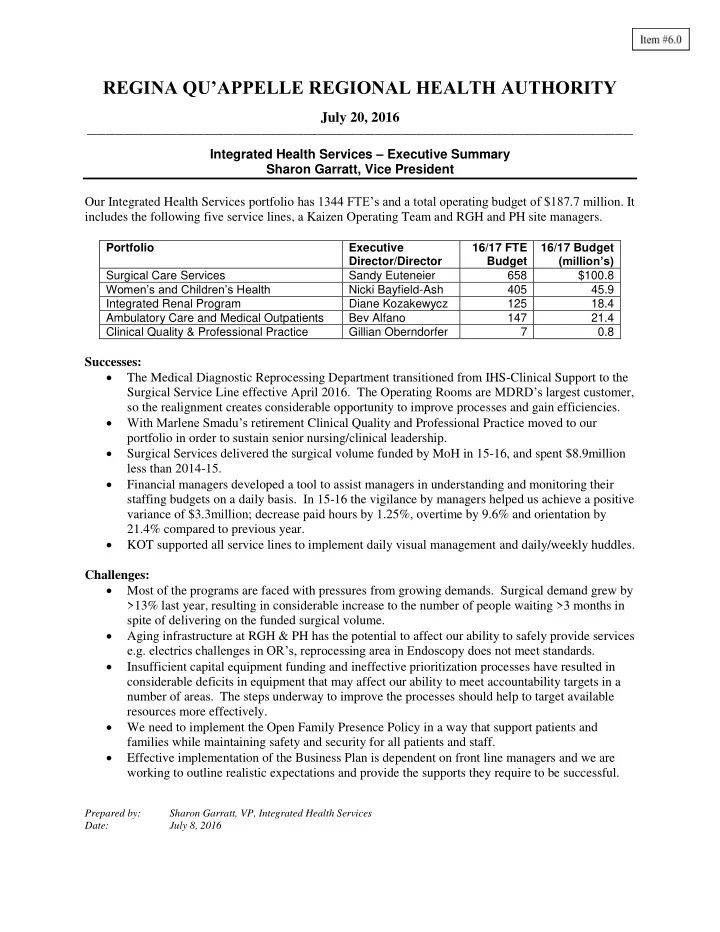
Integrated Health Services – Executive Summary Sharon Garratt, Vice President Our Integrated Health Services portfolio has 1344 FTE’s and a total operating budget of $187.7 million. It includes the following five service lines, a Kaizen Operating Team and RGH and PH site managers.

Portfolio Executive Director/Director 16/17 FTE Budget 16/17 Budget (million’s) Surgical Care Services Sandy Euteneier 658 $100.8 Women’s and Children’s Health Nicki Bayfield-Ash 405 45.9 Integrated Renal Program Diane Kozakewycz 125 18.4 Ambulatory Care and Medical Outpatients Bev Alfano 147 21.4 Clinical Quality & Professional Practice Gillian Oberndorfer 7 0.8

Successes:  The Medical Diagnostic Reprocessing Department transitioned from IHS-Clinical Support to the Surgical Service Line effective April 2016. The Operating Rooms are MDRD’s largest customer, so the realignment creates considerable opportunity to improve processes and gain efficiencies.  With Marlene Smadu’s retirement Clinical Quality and Professional Practice moved to our portfolio in order to sustain senior nursing/clinical leadership.  Surgical Services delivered the surgical volume funded by MoH in 15-16, and spent $8.9million less than 2014-15.  Financial managers developed a tool to assist managers in understanding and monitoring their staffing budgets on a daily basis. In 15-16 the vigilance by managers helped us achieve a positive variance of $3.3million; decrease paid hours by 1.25%, overtime by 9.6% and orientation by 21.4% compared to previous year.  KOT supported all service lines to implement daily visual management and daily/weekly huddles. Challenges:  Most of the programs are faced with pressures from growing demands. Surgical demand grew by >13% last year, resulting in considerable increase to the number of people waiting >3 months in spite of delivering on the funded surgical volume.  Aging infrastructure at RGH & PH has the potential to affect our ability to safely provide services e.g. electrics challenges in OR’s, reprocessing area in Endoscopy does not meet standards.  Insufficient capital equipment funding and ineffective prioritization processes have resulted in considerable deficits in equipment that may affect our ability to meet accountability targets in a number of areas. The steps underway to improve the processes should help to target available resources more effectively.  We need to implement the Open Family Presence Policy in a way that support patients and families while maintaining safety and security for all patients and staff.  Effective implementation of the Business Plan is dependent on front line managers and we are working to outline realistic expectations and provide the supports they require to be successful.

Prepared by: Sharon Garratt, VP, Integrated Health Services Date: July 8, 2016

slide-2
SLIDE 2

Vice President Sharon Garratt

Executive Assistant Andrea Deregowski

Integrated Health Services

Surgical KOT Director Brent Kitchen

June 1, 2016

Director Specialized Ambulatory Care Kidney Program Diane Kozakewycz Director Specialized Ambulatory Care Ambulatory Care & Medical Outpatients Bev Alfano Clinical Manager Hemodialysis Shelley Stamm Business Manager Hemodialysis & Ingetrated Renal Programs Lisa Cairns Manager, Integrated Renal Programs Edward LeBlanc Manager Eye Centre, Enterostomal Therapy & Dermatology Karen Kimpton Manager Ambulatory Care RGH & PH & Infectious Diseases Clinic Susan Jackiw Manager – Endoscopy, GI Unit & HTPN Brenda Johnson

Executive Director Surgical Services Sandy Euteneier

Director Perioperative Services Pam Hawkins Director Surgical Access & Inpatient Services Barb Neumann Manager - OR RGH - Lois Schatz PH – Ginette Marchildon Manager Pre-Admission Clinic Tom Stewart Manager - Surgical Patient Information Management Emilie Jewett-Curley Project Manager Faye Matthews Utilization Analyst Dmytro Rukas Manager – Day Surgery RGH – Debra McCabe PH – Janelle Mazur Manager - Surgical Clinical Pathways Lilyans Zelada Manager – Short Stay RGH – Deb Kosabek PH – Connie Fiorante Manager – Unit 5A RGH Jodi Foley Manager – Unit 5F RGH Ryan Purdue Manager – 6A RGH Deb Kosabek Manager – 4C PH Blair Broadfoot Manager – 4D PH Connie Fiorante Manager - PACU RGH – Debra McCabe PH – Janelle Mazur Director Surgical Support Sheryll Inkson Manager Special Projects Jennifer Erickson Business Manager Kevin Krepakevich

Confidential Assistant Shayna Klein

Executive Director Women’s & Children’s Health Nicki Bayfield-Ash

Confidential Assistant Katelyn Forsythe

Manager Pediatrics, RGH Lorie Kinneberg Manager, Labour & Birth Perinatal Outreach Pgm Michelle Downton Manager NICU Tom Sorensen Manager, Mother/Baby Unit & Maternity Visiting Program Myrna Weisbrod Manager Women’s Health Centre Fetal Assessment Unit Rawlco Centre Hostel Jacki Shannon Manager Children’s Program WRC W&C Social Work Kim Woycik Site Managers RGH Stacey Cortes Charolette Bater Monica Gretchen Deborah Huys PH Brenden Wallace Victoria Case, Delasi Essien Deborah Huys Manager Trauma Program Jamie Appel Manager Pediatric Homecare & Pediatric Outpatients RGH Tamara McDermit

Confidential Assistant Terena Palmer

Director Clinical Quality & Professional Practice Gillian Oberndorfer

Confidential Assistant Suann Wolf

slide-3
SLIDE 3

Integrated Health Services Sharon Garratt

Regina Qu’Appelle Regional Health Authority Board Presentation July 20, 2016

slide-4
SLIDE 4

Portfolio Overview

  • Surgical Care Services
  • Women’s and Children’s Health

– RGH & PH Site Managers

  • Integrated Renal Program
  • Ambulatory Care & Medical Outpatients
  • Clinical Quality and Professional Practice
  • Kaizen Operating Team
slide-5
SLIDE 5

Ambulatory Care & Medical Outpatients

20000 40000 60000 80000 100000 120000 2010/11 2011/12 2012/13 2013/14 2014/15 2015/16

Ambulatory Care & Medical Outpatient Visits

Ambulatory Care RGH & PH: Surgical Procedures; Infusion/Transfusions; Cast Clinic; Physician Consultation Infectious Diseases Clinic RGH: Diagnosis & ongoing Therapeutic care, Strong Research focus Eye Centre PH: Diagnostics & Therapeutics; Low Vision Clinic; Eye Bank; Orthoptics Clinic Enterostomal Therapy PH & RGH (community consultation support): Ostomy Care, Wound Care Dermatology PH: Phototherapy & other treatments; Allergy patch testing Home TPN PH, RGH & Community: Parental nutritional teaching inpatient followed to home support GI/Endoscopy: Gastroenterology endoscopy; Bronchoscopy; Cystoscopy; Capsule Endoscopy; and various diagnostics

slide-6
SLIDE 6

Ambulatory Care & Medical Outpatients

Successes:

  • Replacing current end of life Endoscopy Electronic Health record
  • Increased Anesthetist support to GI/Endoscopy patients requiring deep

sedation during procedures

  • Colonoscopy CO2 insufflation improves patient comfort
  • Provincial/RQHR Cost Per Procedure contract for specialized Endoscopy

equipment throughout RQHR Challenges:

  • Not meeting accreditation standards in reprocessing area Endoscopy -

renovations pending

  • Recruitment of fully qualified/credentialed personnel for specialty programs
  • Ongoing replacement of aging equipment such as scope high level

disinfectant reprocessors

  • Allocation of clinic time for physicians given limited resources/space
  • Increasing volumes of patients especially in Transfusions to reduce patient

visits to Emergency.

slide-7
SLIDE 7

Integrated Renal Program

5000 10000 15000 20000 25000 30000 35000 40000 2010/11 2011/12 2012/13 2013/14 2014/15 2015/16

Hemodialysis Treatments

slide-8
SLIDE 8

Integrated Renal Program

100 200 300 400 500 600 700 800 Home Hemodialysis Peritoneal Dialysis Chronic Kidney Disease TPE Organ & Tissue Donors

Integrated Renal Program

2010/11 2011/12 2012/13 2013/14 2014/15 2015/16

slide-9
SLIDE 9

Integrated Renal Program

Successes:

  • Implemented a Patient and Family Advisory Committee
  • Introduced primary care model in Hemodialysis Unit
  • Implemented draft policy on routine reporting of all deaths

to Transplant Program, researched impact

  • Cross trained Home Dialysis staff which eliminated

duplication of on-call staff. Challenges:

  • Align staffing model with Saskatoon Health Region

(SRNA/SALPN challenges affect)

  • Transplant Program will respond to revisions in Human

Tissue and Gift Act

slide-10
SLIDE 10

Perinatal and Women’s Health

1000 2000 3000 4000 5000 6000

Fetal Assessment Unit Visits

Fetal Assessment Unit Maternal Fetal Medicine Pregnancy & Diabetes Clinic 2000 4000 6000 8000 10000 12000 Women's Health Centre Labour & Birth -

  • utpatients

Labour & Birth - deliveries Mother Baby Unit (patient days) NICU (patient days)

Perinatal & Women's Health Activity

2010/11 2011/12 2012/13 2013/14 2014/15 2015/16

slide-11
SLIDE 11

Children’s Health

1000 2000 3000 4000 5000 6000 7000 8000 9000 10000

Pediatric Outpatient Unit WRC - Children's Program Pediatrics - 4F (patient days)

Children's Health

2010/11 2011/12 2012/13 2013/14 2014/15 2015/16

slide-12
SLIDE 12

Women’s & Children’s Health

Successes:

  • Early Pregnancy Clinic set up in Women`s Health Centre, redirected 54

women experiencing early pregnancy complications from the ED in June 2016.

  • High acuity care transitioned from Medical Intensive Care Unit to the

Pediatric Unit April 2016 after extensive training.

  • Peds SIM Lab Program implemented
  • NICU Transport Team performed its first isolette and team transport to

southern SK via STARS Challenges:

  • Pediatric Home Care Program has had a number of staffing challenges

which have impacted their ability to support children and families.

  • Pediatric Outpatient Unit, Pediatric Inpatient Unit and Emergency

Departments require renovations in order to safety and effectively meet the needs of the children and families they serve.

slide-13
SLIDE 13

Children’s Centre Vision

slide-14
SLIDE 14

Surgical Care Surgical Cost Savings

Mar 2015 Mar 2016 YTD YTD Decrease Surgical Access & In-Patient Units 40,553,282 38,448,193 2,105,089 OR & Perioperative Units 60,367,845 54,176,453 6,191,392 KOT, Trauma, Admin, units 6,605,031 6,049,601 555,430 Total 107,526,158 98,674,247 8,851,911

Successes:

  • Patient satisfaction with Hip & Knee Clinic experience is spreading and

growing the demand.

  • Stroke Prevention Clinic used lean quality improvement tools to decreased

number of days waiting by 50%

  • Medical Device Reprocessing Department has installed new sterilizers,

cartwasher, washer disinfectors and work tables which will significantly improve instrument flow at both sites.

slide-15
SLIDE 15

Surgical Care

Challenges:

  • Increasing number people waiting >3 months due to increase in demand
  • Growing infrastructure (OR electrical challenges) and equipment needs
  • Need to streamline supply chain management from procurement to storage to

reprocessing to right equipment in OR for right case at the right time

  • Bariatric Surgical Program waitlist is ~3 years. Work is underway to make

program changes to improve

slide-16
SLIDE 16

RQRHA Dashboard – Indicator Glossary As of 14/07/2016

Focus Area: System Sustainability

Measure: # of Surgical Cases Waiting Greater than Three Months

WHAT IS BEING MEASURED? Indicator: The number of patients waiting greater than 3 months. Definition: Surgical time is the time from when the patient is waitlisted until offered a surgical date or has surgery performed. Calculation:

Number of Surgical Patients waiting greater than 3 months

Data Source: MoH Surgical Patient Registry WHY IS THIS OF INTEREST? Patient’s quality of life may be affected adversely while waiting for surgery WHAT IS THE TARGET? Reduce the number of patients waiting more than 3 months for surgery. As of March 31, 2016 RQHR has 1934 patients waiting greater than 3 months for surgery. HOW ARE WE DOING? As of May 22, 2016 there are 2,065 patients waiting longer than 3 months for surgery. We are on track to provide the target number of surgeries based on anticipated MoH funding. However, based on the current mismatch between funded volumes and increasing demand, we are projecting a minimum 3,500 patients will be waiting longer than 3 months by end of the fiscal year. WHAT ACTIONS ARE WE TAKING?  Work with MoH to finalize 16-17 target volume and funding. Continue monthly meetings to keep MoH informed of increasing demand.  Allocate available Operating Room (OR) time to meet funded volume, adjusting In Patient (IP)/ Out Patient (OP) mix to equalize wait times.  Review and adjust OR allocation quarterly based

  • n demand.

 Meet bi-weekly to address long-waiters.  Review emergency cases to ensure they are appropriate.  Review IP cases to identify opportunities to shift to OP.  Explore strategies to optimize use of Hip and Knee Clinic

Performance is less than 100% of target; Action Planned

Improvement Target Actual

No <1934 2065

!

slide-17
SLIDE 17

RQHR Performance Dashboard – Indicator Glossary As of 14/07/2016 4