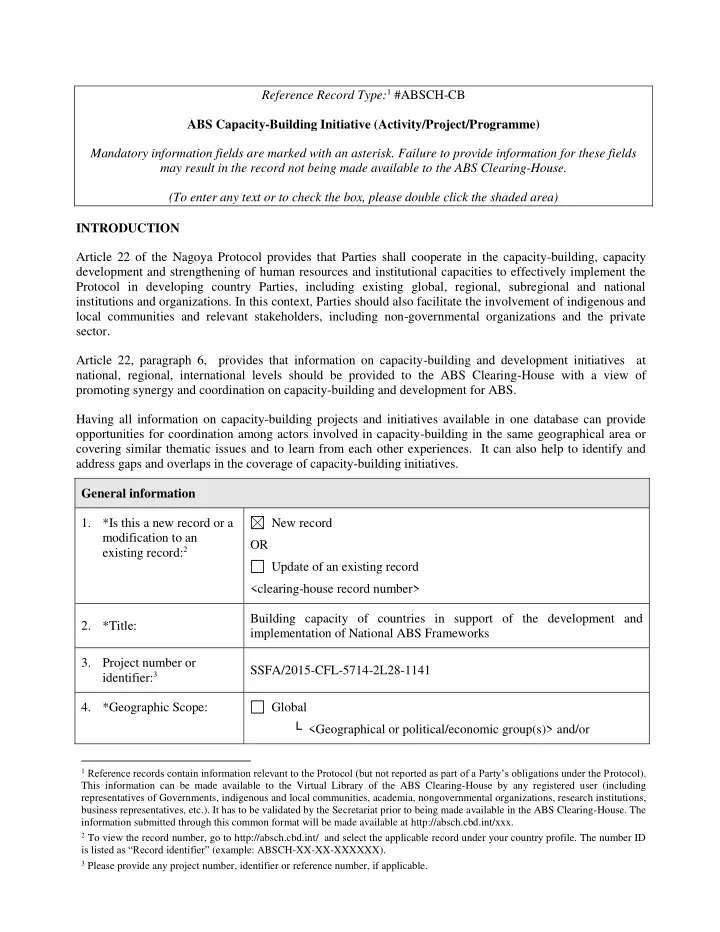
SLIDE 1 Reference Record Type:1 #ABSCH-CB ABS Capacity-Building Initiative (Activity/Project/Programme) Mandatory information fields are marked with an asterisk. Failure to provide information for these fields may result in the record not being made available to the ABS Clearing-House. (To enter any text or to check the box, please double click the shaded area) INTRODUCTION Article 22 of the Nagoya Protocol provides that Parties shall cooperate in the capacity-building, capacity development and strengthening of human resources and institutional capacities to effectively implement the Protocol in developing country Parties, including existing global, regional, subregional and national institutions and organizations. In this context, Parties should also facilitate the involvement of indigenous and local communities and relevant stakeholders, including non-governmental organizations and the private sector. Article 22, paragraph 6, provides that information on capacity-building and development initiatives at national, regional, international levels should be provided to the ABS Clearing-House with a view of promoting synergy and coordination on capacity-building and development for ABS. Having all information on capacity-building projects and initiatives available in one database can provide
- pportunities for coordination among actors involved in capacity-building in the same geographical area or
covering similar thematic issues and to learn from each other experiences. It can also help to identify and address gaps and overlaps in the coverage of capacity-building initiatives. General information
- 1. *Is this a new record or a
modification to an existing record:2 New record OR Update of an existing record <clearing-house record number>
Building capacity of countries in support of the development and implementation of National ABS Frameworks
identifier:3 SSFA/2015-CFL-5714-2L28-1141
Global └ <Geographical or political/economic group(s)> and/or
1 Reference records contain information relevant to the Protocol (but not reported as part of a Party’s obligations under the Protocol).
This information can be made available to the Virtual Library of the ABS Clearing-House by any registered user (including representatives of Governments, indigenous and local communities, academia, nongovernmental organizations, research institutions, business representatives, etc.). It has to be validated by the Secretariat prior to being made available in the ABS Clearing-House. The information submitted through this common format will be made available at http://absch.cbd.int/xxx.
2 To view the record number, go to http://absch.cbd.int/ and select the applicable record under your country profile. The number ID
is listed as “Record identifier” (example: ABSCH-XX-XX-XXXXXX).
3 Please provide any project number, identifier or reference number, if applicable.
SLIDE 2 <Country name> Regional or sub-regional └ Lao PDR, Myanmar, and Viet Nam National/Federal └ <Country name> Sub-national └ <Country name> and Name of the sub-national jurisdiction: <Text entry> Community └ <Country name> and Name of the community: <Text entry>
Proposed (not yet approved)4 Approved5 Ongoing Completed
Starting date: 2015-04-03 Ending date: 2016-06-30 OR Duration: <Text entry>
- 7. *Agency(ies) or
- rganisation(s)
implementing and/or executing the initiative:6 Implementing agency(ies) or organization (s):7 United Nations Environment Programme - China Trust Fund Please enter the clearing-house record number containing information about the entity (ies) responsible for overseeing and administering the development and implementation of the initiative. If it is not registered, complete and attach an “organisations” common format.8 AND/OR Executing agency(ies) or organization (s):9 ASEAN Centre for Biodiversity Please enter the clearing-house record number containing information
4 “Proposed” refers to initiatives for which concepts have been developed but not yet submitted to donors or are submitted but not
yet accepted/approved by donors.
5 “Approved” refers to initiatives whose project concepts have been accepted/approved by donors in principle and are being
developed/elaborated into full proposals/project documents.
6 In some instances an agency could play both the implementing and executing roles. In those cases, please select both boxes. 7 Implementing agency refers to the organisation or legal entity responsible for developing the initiative and overseeing its
implementation, monitoring and evaluation, including making funding available, ensuring that fiduciary standards and quality assurance are applied, and preparation of the project completion reports. The implementing agency is ultimately the entity responsible for the completion of the initiative and is accountable to the donor.
8 All ABS Clearing-House common formats are available at https://absch.cbd.int/help. 9 Executing agency refers to the organisation/institution directly managing the initiative, including the day-to-day planning,
coordination and execution of its activities, monitoring and reporting on the progress made, procuring and managing resources (staff, funds, equipment, etc.), and carrying out other project management functions.
SLIDE 3 about the entity(ies) directly carrying out activities of the initiative, managing its resources and reporting on the progress. If it is not registered, complete and attach an “organisations” common format.10 AND/OR Collaborating partner(s):11 Biotechnology and Ecology Institute - Lao PDR; Environmental Conservation Department-Myanmar; and Biodiversity Conservation Authority-Viet Nam; SCBD Please enter the clearing-house record number containing information about the entity(ies) contributing, or providing direct support, to the implementation of the initiative. If it is not registered, complete and attach an “organisations” common format.12
- 8. Contact person(s):
- Mr. Roberto V. Oliva and Mr. Anthony Foronda
Please enter the clearing-house record number containing this information
- r, if not registered, attach a “Contact details” common format.13
- 9. *Type of capacity-
building initiative: Project/programme14 Component as part of a related project/programme/initiative15 └ Please provide further information on the project/programme/initiative: <Text entry> Stand-alone activity16
document describing the initiative: <URL and website name> and/or <Attachment> Detailed information
- 11. *Short description of the
initiative, including its goals and objectives (max 150 words): The project aims to initate or further develop national ABS regulatory and institutional frameworks; enhance capacity building in the implementation
- f activities using ABS measures; enhance regional cooperation
knowledge sharing and learning; and to support the preparation of PIF on a proposed project for Myanmar for the implementation of the Nagoya Protocol on ABS to be submitted to the GEF secretariat.
10 All ABS Clearing-House common formats are available at https://absch.cbd.int/help. 11 Collaborating partners refer to entities or organizations making significant financial or other contribution to the initiative and/or
actively supporting or collaborating in the implementation of the initiative.
12 All ABS Clearing-House common formats are available at https://absch.cbd.int/help. 13 All ABS Clearing-House common formats are available at https://absch.cbd.int/help 14 Select this option if the entire project or programme is for building capacity in ABS. 15 Select this option if the ABS-related activity/component is part of a broader non-ABS project (e.g. a protected area project with an
ABS component or activity) and provide the title and further details about the broader project/initiative.
16 Select this option if the activity is not part of a project or programme.
SLIDE 4
group(s)/beneficiary(ies): Civil society organizations General public Government National/federal Sub-national Indigenous peoples and local communities Intergovernmental organizations Media Private sector Researchers/academia Ex-situ collections
capacity building activities: Experiential learning17 (e.g. on-job training, field/study trip, staff exchange, etc.) Online forums and networks Online learning (e-learning modules, webinars, etc.) Provision of capacity-building tools and resources Institutional capacity-building Matchmaking and fundraising support Provision of legal/technical support Research/analysis Trainings18 Workshops19 Information on funding
source(s): Bilateral (China Trust Fund) Global Environment Facility Government budget Multilateral Non-government organization/Foundation Private sector Self-funding20 (please specify: <Text entry>)
17 Experiential learning involves action learning through hands-on experience, observation, interaction and reflection. This can be
achieved through on-the-job training (e.g. apprenticeships/internships, job-shadowing, mentoring, etc.), study tours, and staff exchange or twinning programmes.
18 This may include formal classroom-based, instructor-led training courses. 19 This may include general peer-to-peer exchange workshops, multi-stakeholder workshops or workshops for exchange of
experiences, good practices and lessons learned.
20 This may include funds obtained through crowd funding, membership fees, etc.
SLIDE 5
<clearing-house record number> China Trust Fund Please enter the clearing-house record number containing this information
- r, if not registered, attach an “organisations” common format.21
- 16. Co-financing source(s):
<clearing-house record number> Lao PDR, Myanmar, Viet Nam, SCBD, and ASEAN Centre for Biodiversity; Please enter the clearing-house record number containing this information
- r, if not registered, attach an “organisations” common format.22
- 17. Total budget (amount,
US dollars):23 184,380 Capacity-building outcomes24
Main achievements: Please provide a short summary of the main achievements of the initiative, including those related to advancing gender equality in achieving the objectives of the Convention and its Protocols, if
- applicable. (max 200 words): Lao PDR, Myanmar and Viet Nam have each
developed a draft national frameworks; Lao PDR and Viet Nam have each piloted an ABS measure; a draft PIF for Myanmar was developed; and a knowledge sharing and learning experiences in ASEAN and China was conducted. AND Main outputs: Please attach/upload a copy of, or provide web link to, the relevant products (e.g. tools and materials) developed by the initiative and/or reports. Please enter the clearing-house record number containing relevant information <clearing-house record number> and/or <URL> and/or <Attachment>
- 19. Best practices and lessons
learned: Best practices and lessons learned: Please provide a short summary of the best practices and lessons learned (max 500 words:) Lesson 1: Involve a competent legal person from the country to develop frameworks in coordination with the regional expert; Lesson 2: Complement resource needs of collaborating partners and project team to deliver outputs Information on the thematic coverage of the initiatives
Biodiversity Target(s): 16
- 21. *Key areas and strategic
measures for capacity- Key area 1: Capacity to implement and to comply with the obligation
21 All ABS Clearing-House common formats are available at https://absch.cbd.int/help. 22 All ABS Clearing-House common formats are available at https://absch.cbd.int/help. 23 This may include in kind contributions expressed in monetary terms. 24 This information can be provided once that there are some results (outputs, outcomes or impacts) or best practices and lessons
learned from the ongoing or completed initiative.
SLIDE 6
building and development:25 1.1 Enabling ratification of, or accession to, the Protocol (Organization of workshops for government officials on the provisions of the Protocol; Provision of funding support and technical assistance/resource persons for organization of stakeholder consultation workshops on the provisions of the Protocol) 1.2 Raising awareness of the importance of GR and TK, and related ABS issues 1.3 Mapping of relevant actors, including other relevant international instruments on ABS, and existing expertise for the implementation of the Protocol 1.4 Mobilizing new and innovative financial resources to implement the Protocol 1.5 Establishing mechanisms for domestic interagency coordination 1.6 Employing the best available communication tools and Internet-based systems for ABS activities including providing information to the ABS Clearing-House 1.7 Developing mechanisms to monitor the utilization of genetic resources, including the designation of checkpoints 1.8 Reporting on measures taken to implement the Protocol Key area 2: Capacity to develop, implement and enforce domestic legislative, administrative or policy measures on access and benefit-sharing 2.1 Developing a domestic policy framework on ABS (Provision of technical assistance for analysis of existing ABS- related policies for the identification of gaps; Provision of technical assistance for developing policy frameworks on ABS) 2.2 Taking stock of existing domestic measures to identify gaps in light of the obligations of the Protocol (Provision of technical assistance for taking stock of existing measures relevant to the implementation of the Protocol) 2.3 Setting-up new or amending existing ABS legislative, administrative or policy measures with a view to implementing the Protocol (Provision of technical and legal assistance for reviewing, updating and/or developing domestic ABS legislative, administrative or policy measures, including, as appropriate, provisions on customary use and community protocols and exchange of genetic resources and TK) 2.4 Developing regional model legislation 2.5 Establishing institutional arrangements and administrative systems for ABS (Facilitating the establishment of institutional arrangements and coordination mechanisms for implementing ABS legislative, administrative or policy measures, through working with national institutions to enhance synergies) 2.6 Developing procedures for granting or refusing to grant
25 The key areas have been identified by the Strategic Framework for capacity-building and development to support the effective
implementation of the Nagoya Protocol (decision NP-1/8).
SLIDE 7
prior informed consent (PIC) 2.7 Promoting compliance with domestic legislation or regulatory requirements on ABS Key area 3: Capacity to negotiate mutually agreed terms 3.1 Promoting equity and fairness in negotiation of MAT, including through training in relevant legal, scientific and technical skills 3.2 Developing model sectoral and cross-sectoral contractual clauses 3.3 Developing and implementing pilot ABS agreements (Documentation of case studies on ABS agreements) 3.4 Promoting better understanding of business models in relation to the utilization of genetic resources Key area 4: Capacity needs and priorities of indigenous and local communities and relevant stakeholders, including the business sector and the research community 4.1 Participating in legal, policy and decision-making processes (Organization of trainings for other relevant stakeholders, including the business sector and the research community, on the implementation of the Protocol) 4.2 Developing minimum requirements, as appropriate for MAT to secure the fair and equitable sharing of benefits arising from the utilization of TK 4.3 Developing community protocols in relation to access to TK and the fair and equitable sharing of benefits arising from the utilization of that knowledge 4.4 Developing model contractual clauses for benefit-sharing arising from the utilization of TK 4.5 Enhancing the capacity of ILCs, in particular women within those communities, in relation to access to genetic resources and/or TK 4.6 Negotiating favourable MAT 4.7 Increasing understanding of the obligations of Parties under the Protocol with regard to TK and ILCs (Organization of seminars and workshops on the obligations of Parties under the Protocol with regard to TK and ILCs)
SLIDE 8 Key area 5: Capacity of countries to develop their endogenous research capabilities to add value to their own genetic resources 5.1 Developing and using methods for valuation of genetic resources and associated traditional knowledge 5.2 Facilitating transfer of technology and developing infrastructure for research and building technical capacity to make such technology transfer sustainable 5.3 Undertaking research and taxonomic studies related to conservation of biological diversity and sustainable use of its components and bioprospecting Additional information
- 22. Any other relevant information:26
<Text entry> and/or <URL and website name> and/or <Attachment>
<Text entry> For offline submissions only: This form should be should be completed and sent by e-mail to secretariat@cbd.int
Fax at +1 514 288-6588; or Postal mail to: Secretariat of the Convention on Biological Diversity 413 rue Saint-Jacques, suite 800 Montreal, Québec, H2Y 1N9 Canada
26 Please use this field to provide any other relevant information that may not have been addressed elsewhere in the record. 27 The field “Notes” is for personal reference and can be seen only when the record is being edited.