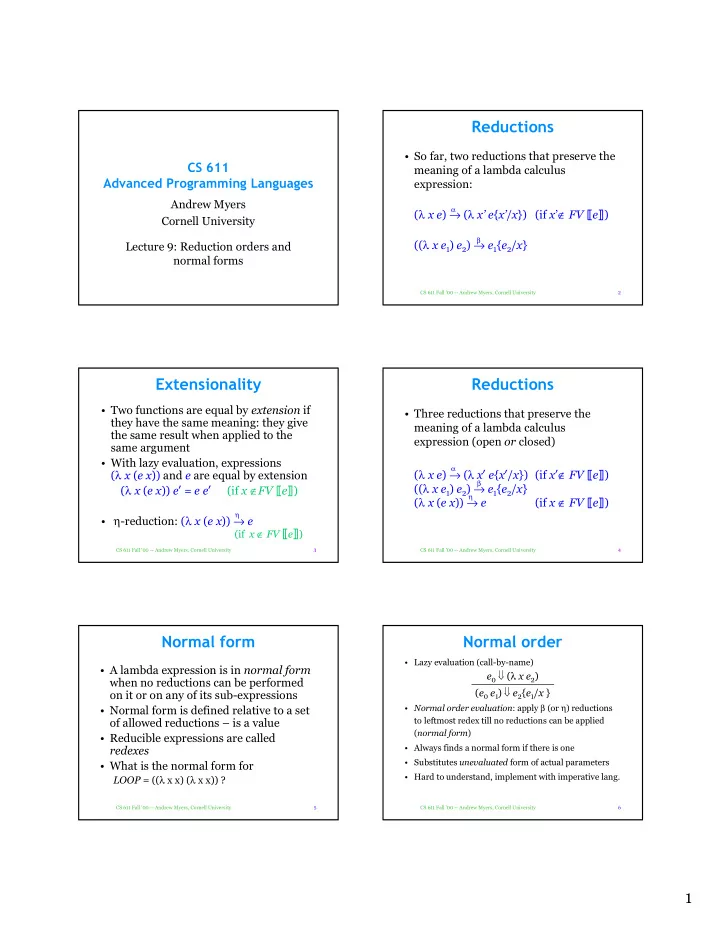

SLIDE 1
1
CS 611 Advanced Programming Languages
Andrew Myers Cornell University Lecture 9: Reduction orders and normal forms
CS 611 Fall '00 -- Andrew Myers, Cornell University 2
Reductions
- So far, two reductions that preserve the
meaning of a lambda calculus expression: (λ x e) → (λ x’ e{x’/x}) (if x’∉ FV e) ((λ x e1) e2) → e1{e2/x}
β α
CS 611 Fall '00 -- Andrew Myers, Cornell University 3
Extensionality
- Two functions are equal by extension if
they have the same meaning: they give the same result when applied to the same argument
- With lazy evaluation, expressions
(λ x (e x)) and e are equal by extension (λ x (e x)) e = e e (if x ∉FV e)
- η-reduction: (λ x (e x)) → e
(if x ∉ FV e)
η
CS 611 Fall '00 -- Andrew Myers, Cornell University 4
Reductions
- Three reductions that preserve the
meaning of a lambda calculus expression (open or closed) (λ x e) → (λ x e{x/x}) (if x∉ FV e) ((λ x e1) e2) → e1{e2/x} (λ x (e x)) → e (if x ∉ FV e)
η β α
CS 611 Fall '00 -- Andrew Myers, Cornell University 5
Normal form
- A lambda expression is in normal form
when no reductions can be performed
- n it or on any of its sub-expressions
- Normal form is defined relative to a set
- f allowed reductions – is a value
- Reducible expressions are called
redexes
- What is the normal form for
LOOP = ((λ x x) (λ x x)) ?
CS 611 Fall '00 -- Andrew Myers, Cornell University 6
Normal order
- Lazy evaluation (call-by-name)
e0 (λ x e2) (e0 e1) e2{e1/x }
- Normal order evaluation: apply β (or η) reductions
to leftmost redex till no reductions can be applied (normal form)
- Always finds a normal form if there is one
- Substitutes unevaluated form of actual parameters
- Hard to understand, implement with imperative lang.