Reductions and NP Part I Lecture 2 August 29, 2013 Reductions - - PowerPoint PPT Presentation

reductions and np
SMART_READER_LITE
LIVE PREVIEW

Reductions and NP Part I Lecture 2 August 29, 2013 Reductions - - PowerPoint PPT Presentation

CS 573: Algorithms, Fall 2013 Reductions and NP Part I Lecture 2 August 29, 2013 Reductions Continued Sariel (UIUC) CS573 1 Fall 2013 1 / 66 Sariel (UIUC) CS573 2 Fall 2013 2 / 66 Propositional Formulas Satisfiability Definition


slide-1
SLIDE 1

CS 573: Algorithms, Fall 2013

Reductions and NP

Lecture 2

August 29, 2013

Sariel (UIUC) CS573 1 Fall 2013 1 / 66

Part I Reductions Continued

Sariel (UIUC) CS573 2 Fall 2013 2 / 66

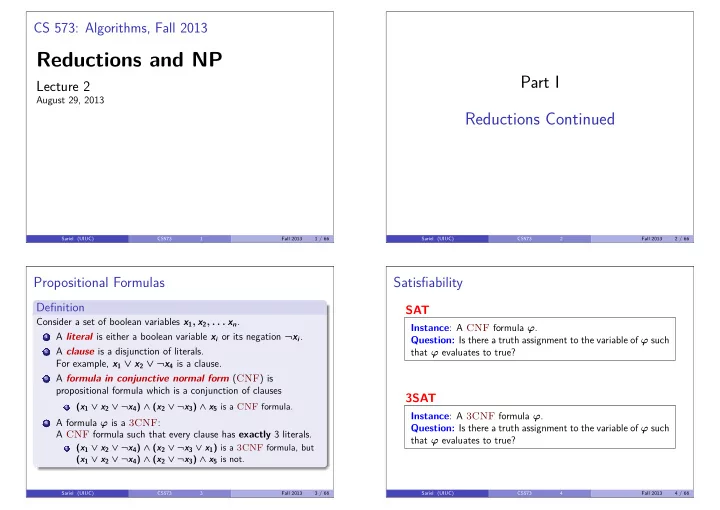
Propositional Formulas

Definition

Consider a set of boolean variables x1, x2, . . . xn.

1

A literal is either a boolean variable xi or its negation ¬xi.

2

A clause is a disjunction of literals. For example, x1 ∨ x2 ∨ ¬x4 is a clause.

3

A formula in conjunctive normal form (CNF) is propositional formula which is a conjunction of clauses

1

(x1 ∨ x2 ∨ ¬x4) ∧ (x2 ∨ ¬x3) ∧ x5 is a CNF formula.

4

A formula ϕ is a 3CNF: A CNF formula such that every clause has exactly 3 literals.

1

(x1 ∨ x2 ∨ ¬x4) ∧ (x2 ∨ ¬x3 ∨ x1) is a 3CNF formula, but (x1 ∨ x2 ∨ ¬x4) ∧ (x2 ∨ ¬x3) ∧ x5 is not.

Sariel (UIUC) CS573 3 Fall 2013 3 / 66

Satisfiability

SAT

Instance: A CNF formula ϕ. Question: Is there a truth assignment to the variable of ϕ such that ϕ evaluates to true?

3SAT

Instance: A 3CNF formula ϕ. Question: Is there a truth assignment to the variable of ϕ such that ϕ evaluates to true?

Sariel (UIUC) CS573 4 Fall 2013 4 / 66

slide-2
SLIDE 2

Satisfiability

SAT

Given a CNF formula ϕ, is there a truth assignment to variables such that ϕ evaluates to true?

Example

1

(x1 ∨ x2 ∨ ¬x4) ∧ (x2 ∨ ¬x3) ∧ x5 is satisfiable; take x1, x2, . . . x5 to be all true

2

(x1 ∨ ¬x2) ∧ (¬x1 ∨ x2) ∧ (¬x1 ∨ ¬x2) ∧ (x1 ∨ x2) is not satisfiable.

3SAT

Given a 3CNF formula ϕ, is there a truth assignment to variables such that ϕ evaluates to true? (More on 2SAT in a bit...)

Sariel (UIUC) CS573 5 Fall 2013 5 / 66

Importance of SAT and 3SAT

1

SAT and 3SAT are basic constraint satisfaction problems.

2

Many different problems can reduced to them because of the simple yet powerful expressively of logical constraints.

3

Arise naturally in many applications involving hardware and software verification and correctness.

4

As we will see, it is a fundamental problem in theory of

NP-Completeness.

Sariel (UIUC) CS573 6 Fall 2013 6 / 66

SAT ≤P 3SAT

How SAT is different from 3SAT?

In SAT clauses might have arbitrary length: 1, 2, 3, . . . variables:

  • x ∨ y ∨ z ∨ w ∨ u
  • ¬x ∨ ¬y ∨ ¬z ∨ w ∨ u
  • ¬x
  • In 3SAT every clause must have exactly 3 different literals.

To reduce from an instance of SAT to an instance of 3SAT, we must make all clauses to have exactly 3 variables...

Basic idea

1

Pad short clauses so they have 3 literals.

2

Break long clauses into shorter clauses.

3

Repeat the above till we have a 3CNF.

Sariel (UIUC) CS573 7 Fall 2013 7 / 66

3SAT ≤P SAT

1

3SAT ≤P SAT.

2

Because... A 3SAT instance is also an instance of SAT.

Sariel (UIUC) CS573 8 Fall 2013 8 / 66

slide-3
SLIDE 3

SAT ≤P 3SAT

Claim

SAT ≤P 3SAT. Given ϕ a SAT formula we create a 3SAT formula ϕ′ such that

1

ϕ is satisfiable iff ϕ′ is satisfiable.

2

ϕ′ can be constructed from ϕ in time polynomial in |ϕ|. Idea: if a clause of ϕ is not of length 3, replace it with several clauses of length exactly 3.

Sariel (UIUC) CS573 9 Fall 2013 9 / 66

SAT ≤P 3SAT

A clause with a single literal

Reduction Ideas

Challenge: Some of the clauses in ϕ may have less or more than 3

  • literals. For each clause with < 3 or > 3 literals, we will construct a

set of logically equivalent clauses.

1

Case clause with one literal: Let c be a clause with a single literal (i.e., c = ℓ). Let u, v be new variables. Consider c′ =

  • ℓ ∨ u ∨ v
  • ℓ ∨ u ∨ ¬v
  • ℓ ∨ ¬u ∨ v
  • ℓ ∨ ¬u ∨ ¬v
  • .

Observe that c′ is satisfiable iff c is satisfiable

Sariel (UIUC) CS573 10 Fall 2013 10 / 66

SAT ≤P 3SAT

A clause with two literals

Reduction Ideas: 2 and more literals

1

Case clause with 2 literals: Let c = ℓ1 ∨ ℓ2. Let u be a new

  • variable. Consider

c′ =

  • ℓ1 ∨ ℓ2 ∨ u
  • ℓ1 ∨ ℓ2 ∨ ¬u
  • .

Again c is satisfiable iff c′ is satisfiable

Sariel (UIUC) CS573 11 Fall 2013 11 / 66

Breaking a clause

Lemma

For any boolean formulas X and Y and z a new boolean variable. Then X ∨ Y is satisfiable if and only if, z can be assigned a value such that

  • X ∨ z
  • Y ∨ ¬z
  • is satisfiable

(with the same assignment to the variables appearing in X and Y).

Sariel (UIUC) CS573 12 Fall 2013 12 / 66

slide-4
SLIDE 4

SAT ≤P 3SAT (contd)

Clauses with more than 3 literals

Let c = ℓ1 ∨ · · · ∨ ℓk. Let u1, . . . uk−3 be new variables. Consider c′ =

  • ℓ1 ∨ ℓ2 ∨ u1
  • ℓ3 ∨ ¬u1 ∨ u2
  • ℓ4 ∨ ¬u2 ∨ u3

· · · ∧

  • ℓk−2 ∨ ¬uk−4 ∨ uk−3
  • ℓk−1 ∨ ℓk ∨ ¬uk−3
  • .

Claim

c is satisfiable if and only if c′ is satisfiable. Another way to see it — reduce size of clause by one: c′ =

  • ℓ1 ∨ ℓ2 . . . ∨ ℓk−2 ∨ uk−3
  • ℓk−1 ∨ ℓk ∨ ¬uk−3
  • .

Sariel (UIUC) CS573 13 Fall 2013 13 / 66

An Example

Example

ϕ =

  • ¬x1 ∨ ¬x4
  • x1 ∨ ¬x2 ∨ ¬x3
  • ¬x2 ∨ ¬x3 ∨ x4 ∨ x1
  • x1
  • .

Equivalent form: ψ = (¬x1 ∨ ¬x4 ∨ z) ∧ (¬x1 ∨ ¬x4 ∨ ¬z) ∧ (x1 ∨ ¬x2 ∨ ¬x3) ∧ (¬x2 ∨ ¬x3 ∨ y1) ∧ (x4 ∨ x1 ∨ ¬y1) ∧ (x1 ∨ u ∨ v) ∧ (x1 ∨ u ∨ ¬v) ∧ (x1 ∨ ¬u ∨ v) ∧(x1 ∨ ¬u ∨ ¬v) .

Sariel (UIUC) CS573 14 Fall 2013 14 / 66

Overall Reduction Algorithm

Reduction from SAT to 3SAT ReduceSATTo3SAT(ϕ): // ϕ: CNF formula.

for each clause c of ϕ do if c does not have exactly 3 literals then

construct c′ as before

else

c′ = c ψ is conjunction of all c′ constructed in loop

return Solver3SAT

(ψ)

Correctness (informal)

ϕ is satisfiable iff ψ is satisfiable because for each clause c, the new 3CNF formula c′ is logically equivalent to c.

Sariel (UIUC) CS573 15 Fall 2013 15 / 66

What about 2SAT?

2SAT can be solved in polynomial time! (specifically, linear time!) No known polynomial time reduction from SAT (or 3SAT) to

  • 2SAT. If there was, then SAT and 3SAT would be solvable in

polynomial time.

Why the reduction from 3SAT to 2SAT fails?

Consider a clause (x ∨ y ∨ z). We need to reduce it to a collection

  • f 2CNF clauses. Introduce a fake variable α, and rewrite this as

(x ∨ y ∨ α) ∧ (¬α ∨ z) (bad! clause with 3 vars)

  • r

(x ∨ α) ∧ (¬α ∨ y ∨ z) (bad! clause with 3 vars). (In animal farm language: 2SAT good, 3SAT bad.)

Sariel (UIUC) CS573 16 Fall 2013 16 / 66

slide-5
SLIDE 5

What about 2SAT?

A challenging exercise: Given a 2SAT formula show to compute its satisfying assignment... (Hint: Create a graph with two vertices for each variable (for a variable x there would be two vertices with labels x = 0 and x = 1). For ever 2CNF clause add two directed edges in the graph. The edges are implication edges: They state that if you decide to assign a certain value to a variable, then you must assign a certain value to some other variable. Now compute the strong connected components in this graph, and continue from there...)

Sariel (UIUC) CS573 17 Fall 2013 17 / 66

Independent Set

Independent Set

Instance: A graph G, integer k. Question: Is there an independent set in G of size k?

Sariel (UIUC) CS573 18 Fall 2013 18 / 66

3SAT ≤P Independent Set

The reduction 3SAT ≤P Independent Set

Input: Given a 3CNF formula ϕ Goal: Construct a graph Gϕ and number k such that Gϕ has an independent set of size k if and only if ϕ is satisfiable. Gϕ should be constructable in time polynomial in size of ϕ Importance of reduction: Although 3SAT is much more expressive, it can be reduced to a seemingly specialized Independent Set problem. Notice: We handle only 3CNF formulas – reduction would not work for other kinds of boolean formulas.

Sariel (UIUC) CS573 19 Fall 2013 19 / 66

Interpreting 3SAT

There are two ways to think about 3SAT

1

Find a way to assign 0/1 (false/true) to the variables such that the formula evaluates to true, that is each clause evaluates to true.

2

Pick a literal from each clause and find a truth assignment to make all of them true. You will fail if two of the literals you pick are in conflict, i.e., you pick xi and ¬xi We will take the second view of 3SAT to construct the reduction.

Sariel (UIUC) CS573 20 Fall 2013 20 / 66

slide-6
SLIDE 6

The Reduction

1

Gϕ will have one vertex for each literal in a clause

2

Connect the 3 literals in a clause to form a triangle; the independent set will pick at most one vertex from each clause, which will correspond to the literal to be set to true

3

Connect 2 vertices if they label complementary literals; this ensures that the literals corresponding to the independent set do not have a conflict

4

Take k to be the number of clauses

¬x1 ¬x2 ¬x1 x1 x3 x3 x2 x2 x4 ¬x1 ¬x2 ¬x1 x1 x3 x3 x2 x2 x4 ¬x1 ¬x2 ¬x1 x1 x3 x3 x2 x2 x4 ¬x1 ¬x2 ¬x1 x1 x3 x3 x2 x2 x4 ¬x1 ¬x2 ¬x1 x1 x3 x3 x2 x2 x4

Figure : Graph for ϕ = (¬x1 ∨ x2 ∨ x3) ∧ (x1 ∨ ¬x2 ∨ x3) ∧ (¬x1 ∨ x2 ∨ x4)

Sariel (UIUC) CS573 21 Fall 2013 21 / 66

Correctness

Proposition

ϕ is satisfiable if and only if Gϕ has an independent set of size k (= number of clauses in ϕ).

Proof.

⇒ Let a be the truth assignment satisfying ϕ

1

Pick one of the vertices, corresponding to true literals under a, from each triangle. This is an independent set of the appropriate size

Sariel (UIUC) CS573 22 Fall 2013 22 / 66

Correctness (contd)

Proposition

ϕ is satisfiable iff Gϕ has an independent set of size k (= number of clauses in ϕ).

Proof.

⇐ Let S be an independent set of size k

1

S must contain exactly one vertex from each clause

2

S cannot contain vertices labeled by conflicting clauses

3

Thus, it is possible to obtain a truth assignment that makes in the literals in S true; such an assignment satisfies one literal in every clause

Sariel (UIUC) CS573 23 Fall 2013 23 / 66

Transitivity of Reductions

Lemma

X ≤P Y and Y ≤P Z implies that X ≤P Z. Note: X ≤P Y does not imply that Y ≤P X and hence it is very important to know the FROM and TO in a reduction. To prove X ≤P Y you need to show a reduction FROM X TO Y In other words show that an algorithm for Y implies an algorithm for X.

Sariel (UIUC) CS573 24 Fall 2013 24 / 66

slide-7
SLIDE 7

Part II Definition of NP

Sariel (UIUC) CS573 25 Fall 2013 25 / 66

Recap . . .

Problems

1

Clique

2

Independent Set

3

Vertex Cover

1

Set Cover

2

SAT

3

3SAT

Relationship

Vertex Cover ≈P Independent Set ≤P Clique≤PIndependent Set Independent Set ≈PClique 3SAT ≤PSAT≤P3SAT3SAT ≈PSAT 3SAT≤PIndependent Set Independent Set ≤PVertex Cover ≤PIndependent Set Independent Set ≈PVertex Cover

Sariel (UIUC) CS573 26 Fall 2013 26 / 66

Problems and Algorithms: Formal Approach

Decision Problems

1

Problem Instance: Binary string s, with size |s|

2

Problem: A set X of strings on which the answer should be “yes”; we call these YES instances of X. Strings not in X are NO instances of X.

Definition

1

A is an algorithm for problem X if A(s) = ”yes” iff s ∈ X.

2

A is said to have a polynomial running time if there is a polynomial p(·) such that for every string s, A(s) terminates in at most O(p(|s|)) steps.

Sariel (UIUC) CS573 27 Fall 2013 27 / 66

Polynomial Time

Definition

Polynomial time (denoted by P) is the class of all (decision) problems that have an algorithm that solves it in polynomial time.

Example

Problems in P include

1

Is there a shortest path from s to t of length ≤ k in G?

2

Is there a flow of value ≥ k in network G?

3

Is there an assignment to variables to satisfy given linear constraints?

Sariel (UIUC) CS573 28 Fall 2013 28 / 66

slide-8
SLIDE 8

Efficiency Hypothesis

A problem X has an efficient algorithm iff X ∈ P, that is X has a polynomial time algorithm. Justifications:

1

Robustness of definition to variations in machines.

2

A sound theoretical definition.

3

Most known polynomial time algorithms for “natural” problems have small polynomial running times.

Sariel (UIUC) CS573 29 Fall 2013 29 / 66

Problems with no known polynomial time algorithms

Problems

1

Independent Set

2

Vertex Cover

3

Set Cover

4

SAT

5

3SAT There are of course undecidable problems (no algorithm at all!) but many problems that we want to solve are of similar flavor to the above. Question: What is common to above problems?

Sariel (UIUC) CS573 30 Fall 2013 30 / 66

Efficient Checkability

Above problems share the following feature:

Checkability

For any YES instance IX of X there is a proof/certificate/solution that is of length poly(|IX|) such that given a proof one can efficiently check that IX is indeed a YES instance. Examples:

1

SAT formula ϕ: proof is a satisfying assignment.

2

Independent Set in graph G and k: a subset S of vertices.

Sariel (UIUC) CS573 31 Fall 2013 31 / 66

Certifiers

Definition

An algorithm C(·, ·) is a certifier for problem X if for every s ∈ X there is some string t such that C(s, t) = ”yes”, and conversely, if for some s and t, C(s, t) = ”yes” then s ∈ X. The string t is called a certificate or proof for s.

Definition (Efficient Certifier.)

A certifier C is an efficient certifier for problem X if there is a polynomial p(·) such that for every string s, we have that ⋆ s ∈ X if and only if ⋆ there is a string t:

1

|t| ≤ p(|s|),

2

C(s, t) = ”yes”,

3

and C runs in polynomial time.

Sariel (UIUC) CS573 32 Fall 2013 32 / 66

slide-9
SLIDE 9

Example: Independent Set

1

Problem: Does G = (V, E) have an independent set of size ≥ k?

1

Certificate: Set S ⊆ V.

2

Certifier: Check |S| ≥ k and no pair of vertices in S is connected by an edge.

Sariel (UIUC) CS573 33 Fall 2013 33 / 66

Example: Vertex Cover

1

Problem: Does G have a vertex cover of size ≤ k?

1

Certificate: S ⊆ V.

2

Certifier: Check |S| ≤ k and that for every edge at least one endpoint is in S.

Sariel (UIUC) CS573 34 Fall 2013 34 / 66

Example: SAT

1

Problem: Does formula ϕ have a satisfying truth assignment?

1

Certificate: Assignment a of 0/1 values to each variable.

2

Certifier: Check each clause under a and say “yes” if all clauses are true.

Sariel (UIUC) CS573 35 Fall 2013 35 / 66

Example:Composites

Composite

Instance: A number s. Question: Is the number s a composite?

1

Problem: Composite.

1

Certificate: A factor t ≤ s such that t = 1 and t = s.

2

Certifier: Check that t divides s.

Sariel (UIUC) CS573 36 Fall 2013 36 / 66

slide-10
SLIDE 10

Nondeterministic Polynomial Time

Definition

Nondeterministic Polynomial Time (denoted by NP) is the class of all problems that have efficient certifiers.

Example

Independent Set, Vertex Cover, Set Cover, SAT, 3SAT, and Composite are all examples of problems in NP.

Sariel (UIUC) CS573 37 Fall 2013 37 / 66

Why is it called...

Nondeterministic Polynomial Time

A certifier is an algorithm C(I, c) with two inputs:

1

I: instance.

2

c: proof/certificate that the instance is indeed a YES instance

  • f the given problem.

One can think about C as an algorithm for the original problem, if:

1

Given I, the algorithm guess (non-deterministically, and who knows how) the certificate c.

2

The algorithm now verifies the certificate c for the instance I. Usually NP is described using Turing machines (gag).

Sariel (UIUC) CS573 38 Fall 2013 38 / 66

Asymmetry in Definition of NP

Note that only YES instances have a short proof/certificate. NO instances need not have a short certificate.

Example

SAT formula ϕ. No easy way to prove that ϕ is NOT satisfiable! More on this and co-NP later on.

Sariel (UIUC) CS573 39 Fall 2013 39 / 66

P versus NP

Proposition P ⊆ NP.

For a problem in P no need for a certificate!

Proof.

Consider problem X ∈ P with algorithm A. Need to demonstrate that X has an efficient certifier:

1

Certifier C on input s, t, runs A(s) and returns the answer.

2

C runs in polynomial time.

3

If s ∈ X, then for every t, C(s, t) = ”yes”.

4

If s ∈ X, then for every t, C(s, t) = ”no”.

Sariel (UIUC) CS573 40 Fall 2013 40 / 66

slide-11
SLIDE 11

Exponential Time

Definition

Exponential Time (denoted EXP) is the collection of all problems that have an algorithm which on input s runs in exponential time, i.e., O(2poly(|s|)). Example: O(2n), O(2n log n), O(2n3), ...

Sariel (UIUC) CS573 41 Fall 2013 41 / 66

NP versus EXP

Proposition NP ⊆ EXP. Proof.

Let X ∈ NP with certifier C. Need to design an exponential time algorithm for X.

1

For every t, with |t| ≤ p(|s|) run C(s, t); answer “yes” if any

  • ne of these calls returns “yes”.

2

The above algorithm correctly solves X (exercise).

3

Algorithm runs in O(q(|s| + |p(s)|)2p(|s|)), where q is the running time of C.

Sariel (UIUC) CS573 42 Fall 2013 42 / 66

Examples

1

SAT: try all possible truth assignment to variables.

2

Independent Set: try all possible subsets of vertices.

3

Vertex Cover: try all possible subsets of vertices.

Sariel (UIUC) CS573 43 Fall 2013 43 / 66

Is NP efficiently solvable?

We know P ⊆ NP ⊆ EXP.

Big Question

Is there are problem in NP that does not belong to P? Is P = NP?

Sariel (UIUC) CS573 44 Fall 2013 44 / 66

slide-12
SLIDE 12

If P = NP . . .

Or: If pigs could fly then life would be sweet.

1

Many important optimization problems can be solved efficiently.

2

The RSA cryptosystem can be broken.

3

No security on the web.

4

No e-commerce . . .

5

Creativity can be automated! Proofs for mathematical statement can be found by computers automatically (if short ones exist).

Sariel (UIUC) CS573 45 Fall 2013 45 / 66

P versus NP

Status

Relationship between P and NP remains one of the most important

  • pen problems in mathematics/computer science.

Consensus: Most people feel/believe P = NP. Resolving P versus NP is a Clay Millennium Prize Problem. You can win a million dollars in addition to a Turing award and major fame!

Sariel (UIUC) CS573 46 Fall 2013 46 / 66

Part III Not for lecture: Converting any boolean formula into CNF

Sariel (UIUC) CS573 47 Fall 2013 47 / 66

The dark art of formula conversion into CNF

Consider an arbitrary boolean formula φ defined over k variables. To keep the discussion concrete, consider the formula φ ≡ xk = xi ∧ xj. We would like to convert this formula into an equivalent CNF formula.

Sariel (UIUC) CS573 48 Fall 2013 48 / 66

slide-13
SLIDE 13

Formula conversion into CNF

Step 1

Build a truth table for the boolean formula. value of xk xi xj xk = xi ∧ xj 1 1 1 1 1 1 1 1 1 1 1 1 1 1 1 1

Sariel (UIUC) CS573 49 Fall 2013 49 / 66

Formula conversion into CNF

Step 1.5 - understand what a single CNF clause represents

Given an assignment, say, xk = 0, xi = 0 and xj = 1, consider the CNF clause xk ∨ xi ∨ xj (you negate a variable if it is assigned one). Its truth table is xk xi xj xk ∨ xi ∨ xj 1 1 1 1 1 1 1 1 1 1 1 1 1 1 1 1 1 1 1 Observe that a single clause as- signs zero to one row, and one everywhere else. An conjunc- tion of several such clauses, as such, would result in a formula that is 0 in all the rows that cor- responds to these clauses, and

  • ne everywhere else.

Sariel (UIUC) CS573 50 Fall 2013 50 / 66

Formula conversion into CNF

Step 2

Write down the CNF clause for every row in the table that is zero. xk xi xj xk = xi ∧ xj CNF clause 1 1 1 1 1 1 1 xk ∨ xi ∨ xj 1 xk ∨ xi ∨ xj 1 1 xk ∨ xi ∨ xj 1 1 xk ∨ xi ∨ xj 1 1 1 1 The conjunction (i.e., and) of all these clauses is clearly equivalent to the original formula. In this case ψ ≡(xk ∨ xi ∨ xj)∧(xk ∨ xi ∨ xj)∧(xk ∨ xi ∨ xj)∧(xk ∨ xi ∨ xj)

Sariel (UIUC) CS573 51 Fall 2013 51 / 66

Formula conversion into CNF

Step 3 - simplify if you want to

Using that (x ∨ y) ∧ (x ∨ y) = x, we have that:

1 (xk ∨ xi ∨ xj) ∧(xk ∨ xi ∨ xj) is equivalent to (xk ∨ xi). 2 (xk ∨ xi ∨ xj) ∧(xk ∨ xi ∨ xj) is equivalent to (xk ∨ xj).

Using the above two observation, we have that our formula ψ ≡(xk ∨ xi ∨ xj)∧(xk ∨ xi ∨ xj)∧(xk ∨ xi ∨ xj)∧(xk ∨ xi ∨ xj) is equivalent to ψ ≡(xk ∨ xi ∨ xj) ∧(xk ∨ xi) ∧(xk ∨ xj). We conclude:

Lemma

The formula xk = xi ∧ xj is equivalent to the CNF formula ψ ≡(xk ∨ xi ∨ xj) ∧(xk ∨ xi) ∧(xk ∨ xj).

Sariel (UIUC) CS573 52 Fall 2013 52 / 66