RED SEA- DEAD SEA PROJECT/PHASE I The Government of the HASHEMITE - - PowerPoint PPT Presentation

red sea dead sea project phase i
SMART_READER_LITE
LIVE PREVIEW

RED SEA- DEAD SEA PROJECT/PHASE I The Government of the HASHEMITE - - PowerPoint PPT Presentation

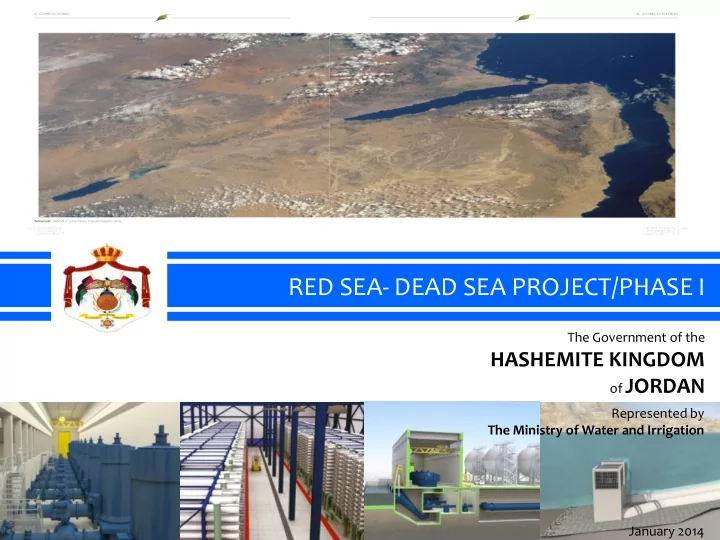
RED SEA- DEAD SEA PROJECT/PHASE I The Government of the HASHEMITE KINGDOM of JORDAN Represented by The Ministry of Water and Irrigation January 2014 Establish a Secure and Affordable Water Supply for Jordan while Saving the Dead Sea from

slide-1
SLIDE 1

RED SEA- DEAD SEA PROJECT/PHASE I

The Government of the

HASHEMITE KINGDOM

  • f JORDAN

Represented by The Ministry of Water and Irrigation January 2014

slide-2
SLIDE 2

Establish a Secure and Affordable Water Supply for Jordan while Saving the Dead Sea from Extinction Support Widespread Economic Growth in Jordan Provide for Potential Regional Water Sharing Facilitate Private and Public Partnership through a (BOT) project.

❹ ❸ ❷ ❶

slide-3
SLIDE 3

Water Deficit in Jordan

2015 2020 2025 2030 2035

MCM/Yr MCM/Yr MCM/Yr MCM/Yr MCM/Yr

Demand Supply Deficit Demand Supply Deficit Demand Supply Deficit Demand Supply Deficit Demand Supply Deficit

Base Deficit

345.6 321.0 -39.8 391.0 321.0

  • 70.0

429.6 321.0 -108.5 472.0 321.0

  • 150.9

518.5 321.0

  • 197.5

Add 25%(15% Physical Losses, 10% Influx from neighboring Countries

240.8 -104.8 240.8 -150.2 240.8 -188.8 240.8

  • 231.2

240.8

  • 277.7

Add Reduction of

  • ver abstraction

0.0

  • 16.1
  • 32.1
  • 48.2
  • 64.2

Total Deficit in the Kingdom w/o Disi

  • 104.8
  • 166.3
  • 220.9
  • 279.3
  • 342.0

Disi

100.0 100.0 100.0 100.0 100.0

Kingdom with Disi

  • 4.8
  • 66.3
  • 120.9
  • 179.3
  • 242.0

Jordan ranks as the 3rd poorest nation in terms of freshwater resources at 133m3/person/year

slide-4
SLIDE 4

Ministry of Water and Irrigation

slide-5
SLIDE 5

Ministry of Water and Irrigation

slide-6
SLIDE 6

6

Completed Studies

  • 1. Feasibility Study

Coyne et Bellier

  • 2. Environmental and

ERM Social Assessment

  • 3. Study of Alternatives

Professors Allan, Tsur and Malkawi

  • 4. Red Sea Modeling Study

Thetis

  • 5. Dead Sea Modeling Study

Tahal

Red Sea – Dead Sea Water Conveyance Study Program WB Study

Multi-Stakeholder Consultations

slide-7
SLIDE 7

7

2060 2050 2040 2030 2020 Beneficiary Party 560 460 370 310 230 Jordan 60 60 60 60 60 Israel 60 60 60 60 60 Palestine 170 90 50 Available for Further Allocation 850 670 540 430 350

Total MCM/Year

635 548 473 418 396

Operating Cost $ Million/Year

slide-8
SLIDE 8

Cyanobacteria

Discharged Water (mcm/yr)

Level change (m/yr) Stratification Biological bloom Gypsum whitening

0 100 200 300 400 500 600 700 800 900 1000

  • 1

Level drop Level rise Mono mictic Mero mictic ?

seasonal long term, dilution

Dunaliella

(crystal size, growth rate)

Sinkholes Groundwater

Acceleration (?)

Due to dilution

More sinkholes Minor depletion No depletion ?

Expected Impact on the Dead Sea (WB)

slide-9
SLIDE 9

As A follow-up on the WB Study The Regional Countries are in agreement to start the implementation of an initial phase to fulfil the concept of: Rapid initiation of RSDS Regional Project with Initial Phase I, and it will serve as a pilot phase. Initiating the infrastructure elements of all subsequent project phases

slide-10
SLIDE 10

 Memorandum of Understanding (MoU) has been signed

  • n Dec 9, 2013 between Jordan, the Palestinian Authority,

and Israel at the World Bank in Washington DC, in which all parties agreed to start the implementation of the first phase of the RSDS project on BoT basis.

 Following up on this MoU, bi-lateral agreements will be

signed between Jordan and Israel and Palestinian Authority and Israel soon;

 This project RSDS-Phase I (Red Sea Desalination

Project at Aqaba) is a result of a joint initiative to promote regional cooperation among Israel, Jordan and the Palestinian Authority (the Beneficiary Parties).

slide-11
SLIDE 11

 Treatment and Desalination Plant (80-100)

mcm/yr

 Freshwater Booster Pump Station to Aqaba

(2 pumps -300 m and 2-50 m pumps)

 Freshwater Conveyance

(4 km of 1.2 m Pipeline to Border) (17.0 km of 0.8 to 1.0 m Pipeline to Aqaba)

 Seawater Conveyance

(2km of 3.7 m pipeline and 22 km of 2.2 m Pipeline)

 Seawater Intake Pump Station

(pumps- 50m VT pumps; 4,500 HP motors)

 Intake Structure

(178 to 222 mcm/yr) with Max Capacity 700 mcm/yr

Red Sea Aqaba

slide-12
SLIDE 12

 Desalination Brine Conveyance

(200 km of 1.4 to 1.8m Pipeline)

 Desalination Brine Pressure Regulation

(3-Pressure Reducing Stations; With the potential to be replaced by Hydropower Generation Stations

 1- (Reservoir) at high point  Two desalination Brine Booster Pump

Station

Dead Sea Red Sea Amman Aqaba

slide-13
SLIDE 13
slide-14
SLIDE 14

Government of Jordan Government of Israel Palestinian Authority

(mcm/yr) (mcm/yr) (mcm/yr)

1 Red Sea Desalination Water

(80-100 mcm/yr) Delivered by Phase I - RSDS Project

30-50 50

  • 2

Lake Tiberias Transfer Water

(50 mcm/yr) Delivered by Beit Zera - KAC Pipeline

50

  • 3
  • Med. Sea Desalination Water

(20-30 mcm/yr) Delivered through Israel's National Carrier

  • 20-30

Potential Total Annual Water Supply 80-100 50 20-30 Recipient Beneficial Parties Water Supplies

slide-15
SLIDE 15

 The Gulf of Aqaba is Protected, no Environmental effects  Infrastructure is Designed to be Expanded  No Infrastructure is Abandoned in Future Phases  The Phase I Desalination Facility at Aqaba Provides Flexibility in

Delivering Freshwater to Current Consumers

 Project Financing is Feasible through a Combination of

Acceptable Water Rates and Financial Grants

 The Project Initiates the Process to Save the Dead Sea

slide-16
SLIDE 16

Next Step

Preparation of RFP for the Selection and Assignment of a Specialized Engineering Firms to prepare Preliminary Design, Legal and Financial Terms, and Tender Documents based on BoT and PPP participation. DRAFT RFP is AVAILABLE

Implementation Schedule Activity Duration

Preparation of Tender Documents 12 months: Starts in March, 2014 Tendering

  • f

Contract for BOT Contractors Nov, 2014 Final Selection of preferred bidder May, 2015 Beginning of Construction Phase Jan, 2016 Duration of Construction 30 months