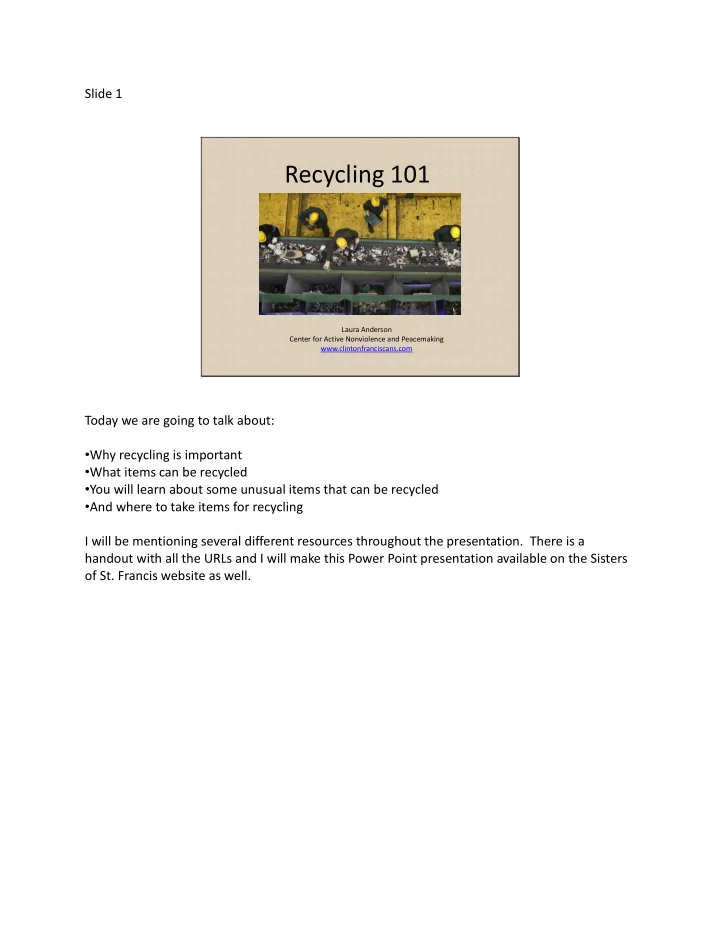
Recycling 101 Laura Anderson Center for Active Nonviolence and - - PDF document

recycling 101
SMART_READER_LITE
LIVE PREVIEW

Recycling 101 Laura Anderson Center for Active Nonviolence and - - PDF document

Slide 1 Recycling 101 Laura Anderson Center for Active Nonviolence and Peacemaking www.clintonfranciscans.com Today we are going to talk about: Why recycling is important What items can be recycled You will learn about some unusual


slide-1
SLIDE 1

Slide 1

Recycling 101

Laura Anderson Center for Active Nonviolence and Peacemaking www.clintonfranciscans.com

Today we are going to talk about:

  • Why recycling is important
  • What items can be recycled
  • You will learn about some unusual items that can be recycled
  • And where to take items for recycling

I will be mentioning several different resources throughout the presentation. There is a handout with all the URLs and I will make this Power Point presentation available on the Sisters

  • f St. Francis website as well.
slide-2
SLIDE 2

Slide 2

Why recycle?

Recycling:

  • reduces the demand on our natural resources,
  • saves money,
  • saves valuable landfill space, and
  • creates opportunities for new industries.

There are lots of good reasons to recycle – Recycling reduces the demand on our natural resources It saves money: The less you throw out, the more you save on trash pick-up fees. And the easiest way to recycle at home and at work is to printing on both sides of a piece of paper doubles your money! Or cut paper up for scratch paper. Using plastic containers from yogurt and sour cream reduces the need to purchase disposable food storage bags. Recycling saves valuable landfill space: If we don’t recycle, we will eventually run out of space for all of our trash. What will we do with it then? And finally, recycling creates opportunities for new industries – new jobs!

slide-3
SLIDE 3

Slide 3

What can be recycled?

  • Glass
  • Paper
  • Aluminum
  • Plastic
  • and much more!

Most municipal governments offer recycling for the basics:

  • Glass
  • Paper
  • Aluminum and
  • Plastic

Of course by now you have probably heard the great news that the Clinton County Area Solid Waste Agency is now accepting plastics 3-7 in addition to 1 and 2. I’ll explain more about that in a minute. And we’ll look at some more unusual items that can be recycled.

slide-4
SLIDE 4

Slide 4

Glass

  • One ton of recycled glass saves one ton of resources
  • Recycling glass reduced air pollution
  • Glass can be recycled indefinitely

What can recycled glass be used for?

  • new glass bottles and jars
  • insulation and construction materials, such as road aggregate
  • glass pebbles for fish bowls and vases
  • Jewelry, stained glass art and kitchen and bath tiles

POP QUIZ: How long does it take for glass to decompose?

When we recycle 1 ton of glass, we save 1 ton of resources. Not only do we save resources by recycling glass, we reduce air pollution. Producing one ton of new glass creates 27.8 pounds of air pollution, while processing recycled glass produces 14-20% less air pollution. Finally: glass can be recycled for ever!! What can recycled glass be used for?

  • Recycled glass can be used to make new glass bottles and jars,
  • insulation, and construction materials, such as road aggregate.
  • Recycled glass is also turned into glass pebbles for fish bowls and vases.
  • Artisans use recycled glass for everything from jewelry to stained glass to kitchen and bath

tiles. How long does it take for glass to decompose?

slide-5
SLIDE 5

Slide 5

500 years

slide-6
SLIDE 6

Slide 6

Tips for recycling glass

  • Containers must be clean
  • No broken glass
  • No flat glass (from picture frames)
  • Please remove screw-on plastic and metal lids (but rims

are ok)

  • Do not need to remove labels
slide-7
SLIDE 7

Slide 7

Paper

Recycling just one ton of paper saves 17 trees. It also saves:

  • 6,953 gallons of water
  • 463 gallons of oil
  • 587 pounds of air pollution
  • 9 cubic yards of landfill space
  • 4,077 Kilowatt hours of energy

What can recycled paper be used for?

  • toilet paper, paper towels, newspaper, and office paper
  • construction materials, such as insulation, wallboard, flooring, padding
  • paper egg cartons, fruit trays, and flower pots

POP QUIZ: How long does it take for newspaper to decompose?

Recycling just one ton of paper saves 17 trees. It also saves: 6,953 gallons of water 463 gallons of oil 587 pounds of air pollution 9 cubic yards of landfill space, and 4,077 Kilowatt hours of energy. Paper can be recycled for many uses. To start, paper can be recycled into toilet paper, paper towels, newspaper, and office paper. Recycled paper is used for construction materials, such as insulation, wallboard, flooring, padding, and more. Recycled paper is repulped and molded into egg cartons, fruit trays, and flower pots. How long does it take for newspapers to decompose?

slide-8
SLIDE 8

Slide 8

5 years

slide-9
SLIDE 9

Slide 9

Tips for recycling paper

  • Staples are ok
  • No glossy paper
  • Phonebooks and catalogues are ok
  • Corrugated cardboard must be cut down to 3’ x 3’
  • Pizza boxes ARE accepted, but remove any food
  • Shredded documents are recyclable (preferably in bags)
  • Cereal boxes are not accepted in Clinton at this time

Several other counties are able to accept cereal boxes (including both Scott and Dubuque counties, but they are for local residents only).

slide-10
SLIDE 10

Slide 10

Aluminum

  • Probably the most valuable of household recycled materials.
  • Recycling aluminum saves 80% of energy and resources.
  • One recycled can saves enough electricity to light a 100-watt bulb for 3.5 hours

What can recycled aluminum be used for?

  • new cans for vegetables, tuna, and soup
  • furniture, foil, cookware
  • most new cars contain at least some recycled steel

POP QUIZ: How long does it take for an aluminum can to decompose?

Generally speaking, aluminum is probably the most valuable of household recycled materials. Recycling aluminum saves 80% of the total energy consumed when aluminum is produced from scratch. One recycled can saves enough electricity to light a 100-watt bulb for 3.5 hours. What can recycled aluminum be used for? New cans for vegetables, tuna, and soup Furniture, aluminum foil and cookware Even the steel in cars can be reclaimed and used again in new cars. In fact, most new cars contain at least some recycled steel. Pop quiz: How long does it take for an aluminum can to decompose?

slide-11
SLIDE 11

Slide 11

500 years

slide-12
SLIDE 12

Slide 12

Tips for recycling aluminum:

  • Containers must be rinsed
  • Remove labels
  • Types of aluminum accepted include pie pans, foil, and

baking pans. Even the wrappers from Hershey’s Kisses!

Tips for recycling aluminum:

  • Containers must be rinsed
  • Remove labels
  • Types of aluminum accepted include pie pans, foil, and baking pans. Even the wrappers

from Hershey’s Kisses!

slide-13
SLIDE 13

Slide 13

Plastic

The numbers signify the type of resin used to produce the plastic, and this affects how the plastic can be recycled.

There are several types of plastic: they are delineated with numbers 1 through 7. The numbers signify the type of resin used to produce the plastic, and this affects how the plastic can be recycled.

slide-14
SLIDE 14

Slide 14

What is recycled plastic used for?

  • laundry detergent bottles, trash bins, plastic pipes, construction materials
  • cleaning product bottles, carpets, tool handles
  • auto parts, sleeping bag insulation, and jacket insulation

POP QUIZ: How long does it take for a plastic cup to decompose?

What is recycled plastic used for?

  • laundry detergent bottles, trash bins, plastic pipes, construction materials
  • cleaning product bottles, carpets, tool handles
  • auto parts, sleeping bag insulation, and jacket insulation

POP QUIZ: How long does it take for a plastic cup to decompose?

slide-15
SLIDE 15

Slide 15

250 years

How about Styrofoam?

slide-16
SLIDE 16

Slide 16

Never

slide-17
SLIDE 17

Slide 17

Tips on Recycling Plastic

  • Drip-proof inserts on top of laundry detergent do NOT need to be removed.
  • Plastic lids with a recycle symbol do NOT need to be removed
  • Labels do not need to be removed
  • Plastic grocery bags are not accepted with curbside recycling (take them to a store or

use cloth bags)

  • No lids with Styrofoam inserts please
  • No containers for hazardous materials (such as anti-freeze, pesticides, chemicals, fuel

treatments, or motor oil)

  • Drip-proof inserts on top of laundry detergent do NOT need to be removed.
  • Plastic lids with a recycle symbol do NOT need to be removed
  • Labels do not need to be removed
  • Plastic grocery bags are not accepted with curbside recycling (take them to a store or use cloth

bags)

  • No lids with Styrofoam inserts please
  • containers for hazardous materials (such as anti-freeze, pesticides, chemicals, fuel treatments,
  • r motor oil)
slide-18
SLIDE 18

Slide 18

Where to take items to be recycled

  • Clinton County Area Solid Waste
  • Behr Recycling-Clinton
  • www.earth911.com

While a lot of materials can be put out for curbside recycling pick-up, there are other items that can be recycled that need to be brought in to a facility. The places you need to know about are: The Clinton Country Area Solid Waste Agency Behr Recycling And earth911.com

slide-19
SLIDE 19

Slide 19

Clinton County Area Solid Waste Agency 4292 220th Street Clinton

Clinton Country Area Solid Waste Agency accepts a lot of larger items as well as hazardous household waste materials. Many of these can be disposed of for free by Clinton County residents.

slide-20
SLIDE 20

Slide 20

Under their Household Hazardous Waste program, the following items can be brought in to the CCASWA to be recycled at no charge for Clinton Country

  • residents. (Non-residents and businesses will be charged a fee)

Adhesives Aerosol Cans Antifreeze Brake Fluid Car Batteries Car Fluids Chemistry Sets Compact Fluorescent Light bulbs Fertilizers Fluorescent Tubes Gasoline and Unwanted Fuels Household Cleaners Insecticides Items Containing Mercury Lacquer Latex Paint Lead-Acid Batteries (Non-Automotive) Marine Used Motor Oil Mercury Thermostats NiCad Batteries Oil-Based Paint Paint Paint Strippers Paint Thinners Pesticides Photographic Chemicals Pool Chemicals Rechargeable Batteries Solvents Transmission Fluid Used Motor Oil and oil filters

Most of these are fluids, but a couple of important ones are: Compact fluorescent light bulbs and Rechargeable batteries – they are your best bet for small rechargeables like double As Call or check their website for specific instructions as to how many items, conditions and restrictions.

slide-21
SLIDE 21

Slide 21

Other items accepted at CCASW:

  • Appliances: cannot throw them away $9-19 per item (microwaves incl.)
  • Scrap Metal: $1 minimum fee ($10 per ton)
  • Tires: $2-3 each for car/light trucks
  • Electronic waste: $5-20 (they DO take TVs and monitors)
  • Medical sharps: no charge to individuals

NOTE: Cash and check are the only forms of payment accepted. No credit or debit cards.

This is the only place you can dispose of microwaves, TVs and monitors. Some of these other items can be recycled without paying a fee…in fact you can get PAID for them….

slide-22
SLIDE 22

Slide 22

Behr Recycling 2815 Liberty Ave. Clinton

They actually pay for most items they accept, including :

  • car batteries
  • lead-acid batteries (non-automotive)
  • NiCad batteries
  • aluminum beverage cans
  • bicycles
  • cookware
  • large and small appliances including

refrigerators

  • metal clothes hangers
  • pipe and scrap metal
  • electronics (but no monitors, TVs or

microwaves)

Behr Recycling is a commercial recycling company with several locations in the midwest. They actually pay for most items they accept, including :

  • car batteries
  • lead-acid batteries (non-automotive)
  • NiCad batteries
  • aluminum beverage cans
  • bicycles
  • cookware
  • large and small appliances including refrigerators
  • metal clothes hangers
  • pipe and scrap metal
  • electronics (but no monitors, TVs or microwaves)
slide-23
SLIDE 23

Slide 23

www.earth911.com

For everything else, there’s Earth911.com: Enter your location and the item you want to dispose of and it will give you the nearest location where it can be recycled. For example, I have a box full of single-use batteries that I have been reluctant to toss into the landfill, so I type in single-use batteries and….

slide-24
SLIDE 24

Slide 24 Sadly I find that the nearest location is in Lisle, Illinois. Well, sometimes it isn’t good news, but it IS an amazing database of information. Believe it or not, you can search for places that accept: golf balls, surf boards, trophies, crayons, wine corks, and more!

slide-25
SLIDE 25

Slide 25

Can it be recycled?

  • Candy wrappers
  • Tyvek (Fed Ex envelopes)
  • Light bulbs
  • Tires
  • Hair
  • Blue jeans
  • Packing peanuts
  • Cotton swabs
  • Keys
  • Stuffed Animals

Candy wrappers: YES! Terracycle.net collects a wide variety of waste items and converts them into a slew of products and materials. You don’t get paid for them but donations are made to the charity of your choice . Other items they accept include: drink pouches, flip flops, chip bags, tooth brushes and many more. Items they make from the recycled materials include: Tote bags, toys, clocks, coasters, etc. Tyvek – not really, but DuPont will take them back if you mail them in (information will be in the handout) Light bulbs: YES! Home Depot accepts unbroken CFB bulbs as well as Clinton Country Area Solid Waste Tires: YES! Most retailers will accept a limited number on trade in or you take them to the CCASWA Hair: YES! Hair can be used to sop up oil spills, can go in compost pile or to Locks of Love Blue jeans: YES! Jeans can be turned into natural fiber insulation used for interior and exterior walls and ceiling applications Packing peanuts – not really, but there are mail-in programs available Cotton swabs: Cotton is also fodder for the compost bin. Cotton balls, cotton swabs (as long as the handle is made of cardboard), lint from the dryer and even old shredded cotton and wool clothing can all go in your compost bin.

slide-26
SLIDE 26

Keys: Keys For Kindness is a small, family-run program designed to raise money through metal key recycling for the Multiple Sclerosis society. The donor pays for shipping Stuffed Animals: YES! There is a national organization called Stuffed Animals for Emergencies which accepts clean, gently used stuffed animals to give to children who have been victims of natural disasters or otherwise traumatized. The handout includes the URL for this group.

slide-27
SLIDE 27

Slide 26

Other ways to recycle

  • Donate your clothes and furniture
  • http://www.freecycle.org/
  • Sell it online (eBay, craigslist, Stuff for Sale-Clinton on Facebook)
  • Recycling fundraisers

Donate Your Clothes and Furniture. Many non-profit organizations, such as Goodwill and The Salvation Army, will accept used clothing, furniture, cars, and household goods. http://www.freecycle.org/ Freecycle Network is made up of nearly five thousand groups with eight and a half million members around the world. It's a grassroots and entirely nonprofit movement of people who are giving (and getting) stuff for free in their own towns. It's all about reuse and keeping good stuff out of landfills. Each local group is moderated by local volunteers. Membership is free. The Clinton Country group has over 800 members! Usable items can be sold on ebay, Craigslist or Stuff for Sale – Clinton on Facebook. The Clinton schools band program accepts many types of electronics as well as ink cartridges, video games, cell phones, etc.

slide-28
SLIDE 28

Slide 27

Earth-wise shopping

  • Buy recycled
  • Buy products with less packaging
  • Buy products that are reusable
  • Bring your own shopping bags

Buy Recycled. Not only it is important to recycle – it is almost MORE important that you continue to purchase products made from recycled materials. If there is no market for products made from recycled materials, companies won’t recycle!!!!! Not only do you save energy and resources, but you also promote a new market. Recycled materials can be found in everything from back packs to bird feeders. Check products to see if they are made and packaged with recycled material. Buy products with less packaging. Buying in bulk is one way to reduce waste from packaging. Watch out for bulk items that have individually wrapped items inside; buying these products does not help reduce waste. Buy products that are reusable. Avoid buying one-time use products, such as paper plates, plastic forks, etc. Consider using cloth napkins instead of paper. Bring your own shopping bags. Using canvas bags (or similar reusable bags) eliminates the waste caused by using plastic or paper bags every time you go shopping. When you DO use plastic grocery bags, be sure to return them to the recycling boxes at the store.

slide-29
SLIDE 29

Slide 28

Join the Green Revolution!

SUSTAINABLE CLINTON

Sunday, August 21st 2-3pm The Canticle 843 Thirteenth Avenue North Clinton

Laura Anderson Center for Active Nonviolence and Peacemaking www.clintonfranciscans.com

Finally, I’d like to invite all of you to get involved with the green revolution right here in Clinton. The Sustainable Clinton group meets monthly at the Canticle – the home of the Sisters of St.

  • Francis. We have a diverse group of community members who are interested in learning more

about how to make the Clinton area a more attractive and healthy place to live while keeping watch over the environment and the future of our planet. Thank you for all you do to make the world a better place!