Caring For the Plants/ Caring For the Land: Indigenous Peoples - - PowerPoint PPT Presentation

caring for the plants caring for the land indigenous
SMART_READER_LITE
LIVE PREVIEW

Caring For the Plants/ Caring For the Land: Indigenous Peoples - - PowerPoint PPT Presentation

Caring For the Plants/ Caring For the Land: Indigenous Peoples knowledge and use of plants Nancy Turner and Fiona Hamersley Chambers, School of Environmental Studies, University of Victoria Acknowledgement: Seliliye The WSNEC /


slide-1
SLIDE 1

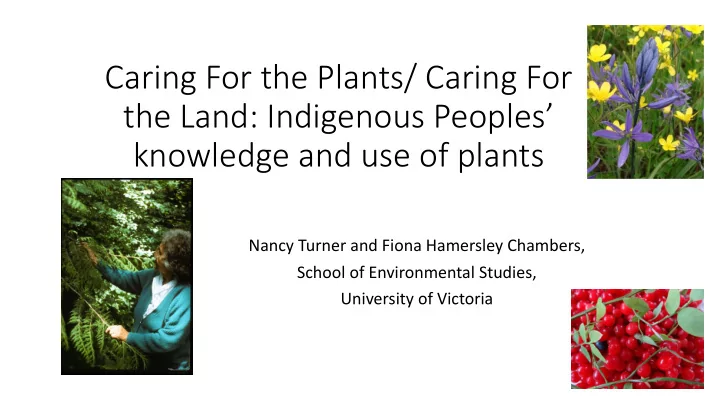
Caring For the Plants/ Caring For the Land: Indigenous Peoples’ knowledge and use of plants

Nancy Turner and Fiona Hamersley Chambers, School of Environmental Studies, University of Victoria

slide-2
SLIDE 2

Acknowledgement:

The WSÁNEC/ Saanich Nation and other First Nations of the Salish Sea, who have lived her since time immemorial and cared for the lands and waters that sustained them… And especially: Chris Paul Sr., Philip Paul Sr., Chris Paul Jr., Kevin Paul, Anna Spahan, Davis Elliott, Sr., John Elliott, Elsie Claxton, Vi Williams, Dr. Earl Claxton Sr., Earl Claxton Jr., Seliliye Belinda Claxton, Nick Claxton, J.B. Williams and Sellemah Joan Morris Thanks, too, to the many other knowledge holders and teachers from BC First Nations and beyond who have contributed to our talks! Seliliye

slide-3
SLIDE 3

And, Thanks so much! To:

  • Mayne Island Conservancy Society (Chair,

Malcolm Inglis) and Trisha Glatthaar: Thanks for your hospitality!

  • Mayne Island Parks & Recreation

Commission and Parks Canada

  • Elizabeth May, OC MP and Green Party
  • Dr. Tim Montler, Dr. Richard Hebda, Dr.

Darcy Mathews, Dr. Brenda Beckwith, Kate Proctor, School of Environmental Studies, and all our friends, colleagues, students

slide-4
SLIDE 4

Our Talks this evening…

  • Tradi&onal Ecological Knowledge,

and Tradi&onal Land and Resource Management

  • Overview of tradi&onal

management prac&ces

  • A few examples: camas, berries,

springbank clover

  • Concluding remarks
slide-5
SLIDE 5

Tradi&onal Ecological Knowledge

A cumulative body of knowledge, practice and belief, evolving by adaptive processes and handed down through generations by cultural transmission (Berkes 1999:8)

Helen Clifton teaches granddaughter Janelle to pound halibut at Gitgaat seaweed camp

Above: Fikret Berkes, author of Sacred Ecology

slide-6
SLIDE 6

Aspects of Traditional Ecological Knowledge

  • Practical strategies and observations

(what, where, when, how?)

  • Worldview, belief systems (respect and

gratitude)

  • Communication and passing on of

knowledge (language, stories, experience, participation)

  • Governance institutions (specialization,

division of labour, leadership, ownership)

  • cyclical time frame extending far into the

past Berries – knowing their names, where they grow, when to pick them, how to prepare them, taboos and traditions about them, how to look after them. Above: Violet Williams, Pauquachin, 1990

slide-7
SLIDE 7

Language: Saanich Song of Swainson’s Thrush (weweles’; Catharus ustulatus)

  • nenelq'xelíqw ('the little black/dark red-

headed ones')

  • nenelpqíqw ('the little white-headed ones')
  • nenelkwemíqw ('the little red-headed ones')
  • nenelpxwíqw ('the little blond/golden-headed
  • nes')
  • "xwexwelexwelexwelexwesh! (ripen, ripen,

ripen, ripen!) [from Elsie Claxton, Tsawout]

Rubus spectabilis, and the salmonberry bird, Swainsons Thrush

Photo by Glenn Bartley

slide-8
SLIDE 8

e.g. Medicine

Elsie Claxtons 10 Barks Medicine… She taught us just how important these medicines are for survival; one day Belinda and I went out with her to learn how to make this medicine

slide-9
SLIDE 9

Deep Lessons: e.g.[Plants]…the Covering or Blanket of the Earth (Nlakapamux)

Flowers, plants & grass especially

the latter are the covering or blanket

  • f the earth. If too much plucked or

ruthlessly destroyed [the] earth [is] sorry and weeps. It rains or is angry and makes rain, fog & bad weather. (ethnographer James Teit, unpublished notes, ca. 1900)

slide-10
SLIDE 10

Embedded in oral histories: e.g. Arbutus

ḰEḰEIȽĆ (qwəqwəy-ílhch) “Once it rained and rained un7l the water of the sea began to rise. People twisted cedar branches into a very long rope so that they might anchor their canoes to some rock or stump…” (Diamond Jenness notes, n.d.). Christopher Paul and Philip Paul explained the

  • rest. People 7ed their canoes to an arbutus at

the top of ȽÁWELṈEW ̲ (lhewəlngəxw) (Mount Newton). Because of its generous role in saving people, Philip Paul said, they never burn arbutus….

slide-11
SLIDE 11

Traditional Land and Resource Management:

part of any Traditional Knowledge System

  • Practices to maintain, sustain

and enhance resources and habitats

  • Working with natural processes

(e.g. succession, regeneration, nutrient cycling)

  • Often grounded in beliefs and

worldviews: responsibility and contingent proprietorship

Seliliye Belinda Claxton of Tsawout harvests a strip of cedarbark after giving thanks to the tree; the tree is still living, 10 years later

slide-12
SLIDE 12

Bri$sh Columbia First Peoples: Dense popula$ons using many resources from land & waters intensively

The Indigenous Peoples of western North America are often called “hunter-gatherers,” with the implication that they simply took what resources they could find from the land and the sea. But… this is a simplistic label! [see M. Kat Anderson. 2005. Tending the Wild. Environmental Management by Native

  • Californians. UC Press, Berkeley]

springbank clover, camas and red huckleberries

Camas photo by Joseph Pallant

slide-13
SLIDE 13

Land and Resource Management Prac2ces

  • Use of fire to maintain prairies, upland

meadows, and other habitats and to renew individual species

  • Pruning and coppicing trees and shrubs
  • Tilling, weeding and selective

harvesting of root vegetables

  • Re-planting, scattering and

transplanting propagules

Salmonberry (Rubus spectabilis) v Using perennials’ capacity to regenerate through partial harvesting

slide-14
SLIDE 14

Land and Resource Management Prac2ces, cont.

  • Creating habitat through

structural alterations

  • Ownership and

proprietorship

  • Distributed use and

harvesting across landscapes and over time

  • Multi-generational

monitoring of plant and animal populations

Edible root of Pacific silverweed (Potentilla egedii), often enhanced by “traditional root garden” cultivation on the Northwest Coast

slide-15
SLIDE 15

Learning about plant regenera/on from the animals…

Beaver-pruned willow re-sprou1ng; Ridgefield Na1onal Wildlife Refuge

slide-16
SLIDE 16

Saanich Reefnet Fishing - a way of life

Drawing Courtesy John Elliott

The late Dr. Earl Claxton, Sr.showing reefnet sites around Gulf Islands Willows, Salix sitchensis at Tl’ches, Chatham Island

slide-17
SLIDE 17

Ceremonial Plants: First Salmon Ceremony, ȾIXEN Tsawout Seafood Festival

KEXMIN (q’əxmín) Sword Fern SŦXÁLEM (sthxéləm)

slide-18
SLIDE 18

Using perennial species…

Plants have amazing regenerative powers; many can be used, in part, year after year, generation after generation; e.g. cattail leaves and tule stems [SȻELEL (skwaləl’)]

Above: SȾA,ḴEN (st’thé7qən) (something with hair on the top) – cattail; left – 4-m long tule mat, Museum of Anthropology, UBC

slide-19
SLIDE 19

Case examples

  • Coast Salish Camas management
  • Berry & fruit management
  • Ne6les and springbank clover

Camas flowers; salal; stinging nettle; evergreen huckleberries

slide-20
SLIDE 20

Camas bulbs – a staple root vegetable of the south coast

  • Two species (Camassia

quamash, C. leichtlinii); Lily Family (Liliaceae)

  • Edible bulbs: but must be

cooked for a long @me to convert main carbohydrate, inulin, to fructose

  • Harvested by the millions

annually: ~10 million per year

  • n Vancouver Island
  • Maintained by burning and
  • ther means
slide-21
SLIDE 21

Fer$le Plains….

  • On reaching the south end of the [Vancouver] island, a decided

improvement was observed in the appearance of the country. …the forest is replaced by a more open and beautifully diversefied [sic] country presenting a succession of plains with groves of oaks and pine [Douglas-fir] trees for a distance of 15 to 20 miles… The plains are said to be fertile and covered with the most luxuriant vegetation (Captain McNeill, 1831, in Rich 1941:286-287, my emphasis).

slide-22
SLIDE 22

Ownership/proprietorship & control

  • Ownership was explained by MG and

AG from Sooke (as recorded by Suttles 1952, pers. comm. to N. Turner 1996): “[T’souke people] had lots [of plots]. They didn’t dig just

  • anywhere. Stakes marked them.

Women owned them, and they would fight for their claims. If someone came on to a woman’s plot, she would quarrel. If the owner died, a near relative got the plot.”

slide-23
SLIDE 23

Looking a)er the Camas beds

One of Wayne Suttles consultants stated that she was responsible for burning the camas area that belonged to her grandmother once they had finished harvesting for the season (Suttles 1974:60). Other people were allowed to harvest from this site, but responsibility for managing the resource site through landscape burning was clearly delegated to ensure that the resource would be available in following years.

slide-24
SLIDE 24

Camas bulb production

  • Photo of Camassia leichtlinii

bulbs rescued and grown with tender loving care out in coldframes at Government House (Dr. Brenda Beckwith’s work and photo)

slide-25
SLIDE 25

Selec%ve harves%ng: Camas bulbs from 1 square meter of garry oak savannah at the Somenos Garry Oak Preserve near Duncan (Kate Proctor’s master’s research)

slide-26
SLIDE 26

Feasting, gifting, story telling

  • Camas bulbs most widely traded

product on S coast aside from salmon (Erna Gunther)

  • Featured in “The Star Husband tale” and
  • ther stories
  • Served at feasts and given at potlatches
slide-27
SLIDE 27

Camas practices: a summary

  • Burning and clearing to maintain prairies (enhancing deer & other plants)
  • Ownership of plots
  • Timing of camas harvest (dormancy/ seed produc=on)
  • Selec=ve harves=ng & replan=ng
  • Transplan=ng
  • Ceremonial harves=ng & serving
  • Large-scale cooking
  • Trade & exchange; potlatches
  • Stories and teachings
  • Dr. Pakki Chipps, Beecher Bay
slide-28
SLIDE 28

Berries and fruits

Berries and other fruits are par0cularly important resources and are o5en managed in various ways: pruning, coppicing, burning, patch ownership…

Mixed berries, Evergreen huckleberry, blackcap, soapberry, Pacific crabapple

slide-29
SLIDE 29

Berry Bushes: Pruning

As soon as they pick all the berries], we tl’exw7id (break off), we breaks them so...[the berries would grow plentifully later]. See, a lot

  • f people think we never touched the wild...
  • berries. But we did. We cultivated it. We

pruned it... Especially that gwadems (red huckleberries), when they finished picking the gwadems, you know, they pruned them. They break the tops off (Clan Chief Adam Dick, pers.

  • comm. to NT).
slide-30
SLIDE 30

Fire and Landscape Burning

Many kinds of berries and wild root vegetables are known to have been enhanced by landscape burning

slide-31
SLIDE 31

Ownership & Responsibility…

“Everybody had their own berry patches, just like everybody had their own clam beds. Things like [salal patches], Yeah, salmonberries and all that, all kinds of berries, wild crabapple, you just don’t go [out and pick] .... There’s a certain places that a certain family goes, especially that wild crabapples. Our family used to go over here. And the other families go over here. They got markers too, for celxw [crabapples]. Oh, yes, they have pegs, you put pegs all around the tree…. You just pick up those little sticks and you just peg, put it around the [tree]. … Anything that’s pegged, you know it’s someone’s.” (Chief Adam Dick,

  • pers. comm. to NT, 1997).
slide-32
SLIDE 32

A staple fruit in W North America; berries rich in iron; used as a sweetener for

  • ther food; many varieties

named; bushes sometimes transplanted, pruned and coppiced, also burned to enhance their growth and productivity; not just for berries, but for withes for basketry (Mary Thomas, Secwepemc)

Saskatoonberry, or Serviceberry (Amelanchier alnifolia)

slide-33
SLIDE 33

e.g. Crabapple (Malus fusca): tended and owned by individuals

  • Trees carefully tended,

sometimes pruned to enhance production

  • Trees owned by chiefs and

individuals through inheritance

  • Several distinct varieties
  • Widely used as feast food and

Chiefs’ food, as well as for trading

slide-34
SLIDE 34

Highbush Cranberries (Viburnum spp.)

  • Bushes pruned
  • Bushes transplanted
  • Patches owned by chiefs &

matriarchs

Viburnum edule & V.

  • pulus (top rt)
slide-35
SLIDE 35

Transplanting: Nass Valley (Nisga’a’)

Emma Nyce’s grandmother at Gitwinksihlkw was blind. She s:ll loved picking berries, so her grandfather transplanted frui:ng bushes (Saskatoons, black hawthorn, crabapple) behind her house to make them more accessible to her. Some are s:ll there (Emma Nyce, pers. comm. 2013)

“People used to do that all the -me; they would bring plants and plant them around their houses.” (pers. comm. 2013)

slide-36
SLIDE 36

Heiltsuk Berry gardens, Roscoe Inlet

  • Special sites, sunny, beside

waterfalls

  • Berry bushes fertilized with

fish remains and trapping remains, clamshells and ashes

  • Berry bushes sometimes

transplanted to these sites

  • You an pull the berries off by

the handful…

  • Cyril Carpenter and Pauline

Waterfall (pers. comm. to NT, April, 2002), from their grandmothers, Bessie Brown and Beatrice Brown

slide-37
SLIDE 37

A resource management constellation at Hauyat (Heiltsuk territory)…

Giant ne(lesè, çcrabapples, CMTs; gooseberries, ê

slide-38
SLIDE 38

Orchard Gardens of Dałth Gyilakyaw (“Robintown’) (Kitsumkalum Ts’msyen)

Crabapple, hazelnut, highbush cranberry, Saskatoonberry, red elderberry, nettles, riceroot and many more….

slide-39
SLIDE 39

Integrated mul--resource management systems

  • Combined management strategies
  • Working together across mul5ple resources and

habitats

e.g. Hunter Island, Heiltsuk territory: salmon weirs, clam gardens, root gardens, berry patches, hunting areas, culturally modified trees = immense populations of people in the past

River estuary, and bear manure in root “garden” area

slide-40
SLIDE 40

Trifolium wormskjoldii (Springbank Clover)

  • “[clover plots] …have been in the family for many
  • genera3ons. These hereditary possessions cannot

be sold nor given away; …. Clover land is very valuable, because the roots… are regarded as indispensable to good health and hence can readily be sold at a high price. For this reason the land is well cared for. The main root stocks are never taken, and such pieces as are not deemed good for food are put back into the ground…”(E.S. Cur3s 1915, The Kwakiutl p. 43)

slide-41
SLIDE 41

Keys to Perpetuating Indigenous Knowledge

  • Connect with Communities and Places
  • Celebrate Intergenerational Learning and Teaching; Revitalize Languages
  • Recognize Holistic Relationships and Interacting Processes
  • Instill Gratitude, Accountability, and Responsibility
  • Value and Support Diversity
  • Embrace Different Teaching Approaches and Learning Styles
  • Food for Biocultural Renewal
  • Integrate Old and New Materials and Technologies
  • Renew and Re-create Vibrant Ethnoecosystems
slide-42
SLIDE 42

Thank-you!