
SLIDE 1
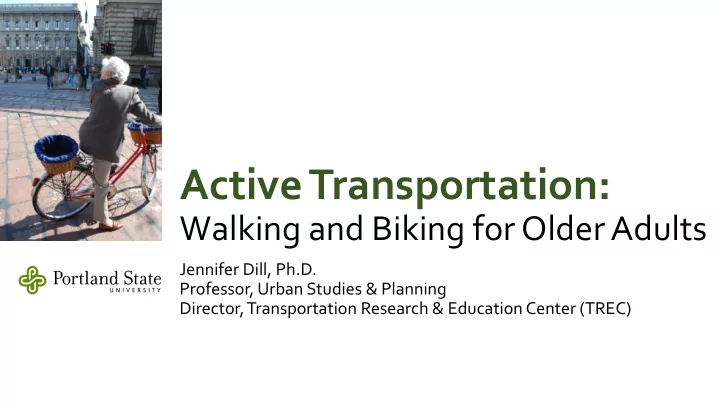
Active Transportation:
Walking and Biking for Older Adults
Jennifer Dill, Ph.D. Professor, Urban Studies & Planning Director, Transportation Research & Education Center (TREC)
Active Transportation: Walking and Biking for Older Adults Jennifer - - PowerPoint PPT Presentation
Active Transportation: Walking and Biking for Older Adults Jennifer Dill, Ph.D. Professor, Urban Studies & Planning Director, Transportation Research & Education Center (TREC) Benefits of physical activity for older adults May
Jennifer Dill, Ph.D. Professor, Urban Studies & Planning Director, Transportation Research & Education Center (TREC)
May reduce…
morbidity mortality
type 2 diabetes cardiovascular disease
chronic pain chronic obstructive pulmonary disease high cholesterol high blood pressure some cancers risk of falls clinical depression depressive symptoms Alzheimer’s risk
May improve…
living independently quality of life well-being physical function cognitive function
Kerr, J., Rosenberg, D., & Frank, L. (2012). The role of the built environment in healthy aging: community design, physical activity, and health among older adults. Journal of Planning Literature, 27(1), 43-60.
per week and muscle strengthening 2x/week
https://www.cdc.gov/physicalactivity/basics/older_adults/index.htm Photos by Dan Burden
53% 49% 49% 50% 51% 54% 59% 52% 54% 59% 60% 66% 18 - 24 25 - 34 35 - 44 45 - 54 55 - 64 65 or older
% of adults meeting 150 minute recommendation
U.S. Washington
2015 BRFSS data
https://nccd.cdc.gov/dnpao_dtm/rdPage.aspx?rdReport=DNPAO_DTM.ExploreByLocation&rdRequestForwarding=Form
76% 71% 69% 76% 75% 74% 74% 72% 63% 52% 35% 11% 8% 10% 10% 9% 8% 6% 2% 1% 5-15 16-17 18-24 25-34 35-44 45-54 55-64 65-74 75-84 85+ 1 or more walk trips in past 7 days 1 or more bike trips in past 7 days
Data from 2017 National Household Travel Survey. Of the older adults that walk, about half is for transportation. Of those that bike, most is for recreation.
74% 73% 67% 60% 74% 71% 60% 48% 55-64 65-74 75-84 85+
Walked in the past 7 days
Male Female 11% 9% 4% 2% 6% 3% 1% 0% 55-64 65-74 75-84 85+
Biked in the past 7 days
Male Female
0% 10% 20% 30% 40% 50% 60% 70% 80% 90% 100% 18-34 35-54 55-65 65+
Walked in the last 7 days
0-99 100-499 500-999 1,000-1,999 2,000-3,999 4,000-9,999 10,000-24,999 25,000-999,999 0% 5% 10% 15% 20% 25% 30% 35% 40% 18-34 35-54 55-65 65+
Biked in the last 7 days
0-99 100-499 500-999 1,000-1,999 2,000-3,999 4,000-9,999 10,000-24,999 25,000-999,999
Density in census tract, housing units/sq. mile
3 0.8 0.8 0.7 0.5 2 2 2 1 1 14 9 9 9 11 9 32 20 14 14 15 15 15 40 25 21 22 23 5 10 15 20 25 30 35 40 45 5-15 16-24 25-39 40-65 65 + 0-16 17-29 30-59 60-65 65+ 0-17 18-25 26-44 45-59 60-65 65 + 10-19' 20-29 30-39 40-49 50-59 60-69 70-74 0-17 18-25 26-44 45-64 65 +
Percent of trips by cycling Age Group
NL US A GER DK UK Cycling declines with age in the US, but not Germany, Denmark, and the Netherlands
Source: Pucher and Buehler (eds.) City Cycling. Cambridge, MA: MIT Press, 2012
Walking
parks, malls, etc.)
Bicycling
parks, malls, etc.)
AARP Livable Communities: https://www.aarp.org/livable-communities/ 8 to 80 Cities: https://www.880cities.org/ National Association of City Transportation Officials: nacto.org
Bellevue, WA
Credit: Dan Burden
US DOT, FHWA
City of Vancouver https://www.cityofvancouver.us/parksrec/page/burnt-bridge-creek-trail-8-miles
US DOT, FHWA, SEPARATED BIKE LANE PLANNING AND DESIGN GUIDE
Phoenix, AZ
https://www.phoenix.gov/news/streets/1863
Austin, TX
Bluebonnet Lane
Arcata, CA
US DOT, FHWA, Small Town and Rural Multimodal Networks, December 2016
Ellensburg, WA
https://peopleforbikes.org/blog/red-county-blue-county- ellensburg-wa-finds-a-bikeway-makes-good-sense/
US DOT, FHWA, Small Town and Rural Multimodal Networks, December 2016
Ramps at crosswalks Reduce crossing distances with bulb-outs Tigthen curb radii Rectangular Rapid Flash Beacons Allow longer times for pedestrian signal (assume slower walking speed, e.g. 2.5 ft/sec) Provide for a “Leading Pedestrian Interval” of 3-7 seconds.
Saugutuck, Michigan
Credit: Dan Burden https://safety.fhwa.dot.gov/provencounter measures/lead_ped_int/ Credit: Toole Design Group
Credit: Urban, Rural and Suburban Complete Streets Design Manual For The City Of Northampton And Communities In Hampshire County, January 2017
Saugutuck, Michigan
Credit: Dan Burden
Portland, ME
Credit: Dan Burden
National survey of over 1,600 e-bike owners found that 28% were owned by people aged 55-64; 19% by 65+ “I am 63 years old and have had 3 knee surgeries and cardiac
would on my regular bike. You need to understand how beneficial e-bikes are to us as we get older.” “As a 64-year old retired person, it is a new and exciting experience to ride along the gorgeous dedicated bike path near the Sacramento River where I live. I don't give up and feel too exhausted trying to bike up the hills.”
Zander, A., Passmore, E., Mason, C., & Rissel, C. (2013). Joy, exercise, enjoyment, getting out: a qualitative study of older people's experience of cycling in Sydney,
“I loved the wind blowing through your hair, that was lovely! ... That was the exhilarating part of it” (71-year-
Feedback from one skills & support program: