Heat stress basics Cows experience heat stress when effective - - PDF document

heat stress basics
SMART_READER_LITE
LIVE PREVIEW

Heat stress basics Cows experience heat stress when effective - - PDF document

12/23/2013 An Evaluation of CowKhlerZ Evaporative Cooling System for Heat Stress Abatement in High Producing Dairy Cows Katie Ballard and Katie Ballard and Rick Rick Grant Grant William H. William H. Miner Ag Miner Agricu ricultur


slide-1
SLIDE 1

12/23/2013 1

Katie Katie Ballard and Ballard and Rick Rick Grant Grant William H. William H. Miner Ag Miner Agricu ricultur ltural Re al Research Institute arch Institute Chazy Chazy, NY NY

An Evaluation of CowKühlerZ Evaporative Cooling System for Heat Stress Abatement in High Producing Dairy Cows

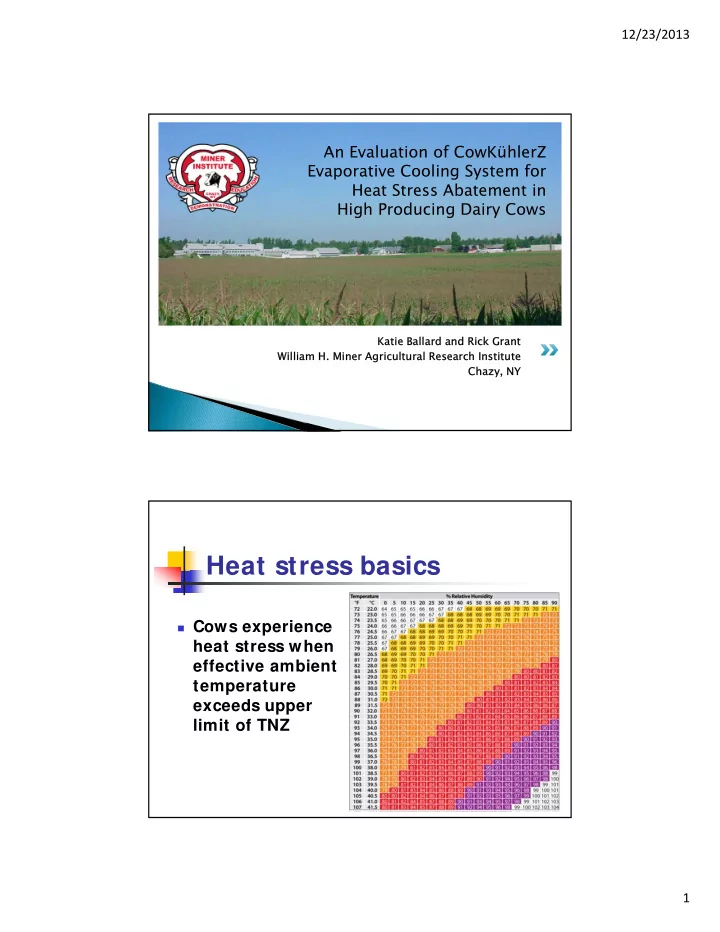
Heat stress basics

 Cows experience

heat stress when effective ambient temperature exceeds upper limit of TNZ

slide-2
SLIDE 2

12/23/2013 2

Heat stress basics

 THI of 68 -

threshold for milk loss for cows producing > 77 lb/ d

  • f milk (Zimbelman et

al., 2009)

 Cows producing

> 100 lb/ d?

Heat stress basics

 Cows become more

sensitive to thermal stress as milk production increases due to greater metabolic heat

  • utput
slide-3
SLIDE 3

12/23/2013 3

Heat production by dairy cow (Smith, 2000)

Human metabolism: 1 100-watt light bulb

Lactating cow: 16 100-watt bulbs

Cows give off 4,500 BTU/ hour

Similar to 1,500-watt hair dryer at high setting running for

  • ne hour

Cow response to heat stress

 Reduced activity  Increased body

temperature >102.5oF

 Panting >80

breaths/minute

 Reduced DMI, 10-15+%  Reduced milk, 10-20+%  As body temperature rises,

cow consumes less feed to produce less metabolic heat

(Rhoads et al., 2009)

slide-4
SLIDE 4

12/23/2013 4

Heat stress and behavioral responses (Tapki and Sahin, 2006)

 As air temp increases from 78 to 104oF

 Eating: decreases 46%  Ruminating: decreases 22%  Standing: increases 34%  Drinking: increases 30%  Locomotion: decreases 19%

 Higher producing cows (> 70 lb/ d) more

sensitive than low producing cows

 Especially for lying/ standing

Lying and standing related to body temperature

(Hillman et al., 2005)

 Cows stand when body temperature

reaches ~102oF; they lie down when it drops below this temperature.

 Body temperature mediates cow’s standing

and lying response to varying conditions of heat stress.

 The quickest way to get a cow to lie

down is to cool her body temperature.

slide-5
SLIDE 5

12/23/2013 5

Lying decreases with higher temperature (Arnold, 1980)

16 18 20 22 24 26 28 45 55 65 75 % cows lying Mean temperature ( oC) (Grant, 2005)

Resting time (h) Milk yield (lb/d)

60 70 80 90 100 110 7 10 13 17

y y = 49.2 = 49.2 + 3.7 + 3.7 x r2 = 0.31 = 0.31 ~3.7 ~3.7 lb/d lb/d more milk more milk for for eac each extr extra hour hour

2 t 2 to 3.5 3.5 lb/ lb/cow Incre Increased resti resting g time w me with g th greater ter DIM, mil DIM, milk yiel yield

(Bach et (Bach et al., al., 2010) 2010)

slide-6
SLIDE 6

12/23/2013 6

Heat stress, lying, and lameness (Cook et al., 2007)

 As THI increased from 56 to 75:

 Lying time decreased from 10.9 to 7.9 h/ d  Standing in alley increased from 2.6 to 4.5

h/ d

 Drinking increased from 0.3 to 0.5 h/ d

 Lameness score/ claw lesions increased

and were associated with greater standing time, sporadic eating, slug feeding

 Lameness peaked ~ 2 months after

temperatures peaked

Economic consequences of heat stress

 Economic loss with minimal abatement

(DeVries, 2012)

 $600/ cow/ yr for Florida and Texas

 Annual hours of THI > 70 were 49 and 36%

$72/ cow/ year for Wisconsin

 Annual hours of THI > 70 were 9%

 Large differences by region of US in heat

stress severity

 Estimated 2:1 return on investment in New

York State (St-Pierre, 2001)
slide-7
SLIDE 7

12/23/2013 7

CowKühlerZ Evaporative Cooling System

 Unique nozzle system delivers precise

spray pattern designed to optimize evaporative cooling while minimizing water use.

 System allows for effective cooling over

stalls as well as feed bunk.

Key questions…

 Primary: How does CowKühlerZ system

compare with minimal cooling (fans

  • nly over stalls)?

 Primary: How do lying and rumination

activity respond to heat abatement and stall cooling?

 Secondary: Can we measure a short-

term milk response?

slide-8
SLIDE 8

12/23/2013 8

Pen 1

“Minimal” heat abatement:

  • fans over stalls

Pen 2

Heat abatement treatments:

  • fans over stalls
  • sprinklers & fans over feeding

area 3’ 48’ 45’ 40’ 53’ Feed Alley

cu curtains ns D

  • r

D

  • r
  • 4 fans, centered over stalls
  • 52-in diameter blades
  • ~8 ft from floor
  • Fans spaced ~ 40 - 48 ft apart
  • Avg. wind speed: 6 mph
slide-9
SLIDE 9

12/23/2013 9

 Located over

feeding area, extends entire length of pen

 9’10” from pen

floor, 3’3” wide

  • 5 fans over feeding area
  • 52” diameter
  • 10’ 3” from floor
  • Spaced 40’ apart
  • Avg. wind speed – 7 mph
  • 4 fans, centered over stalls
  • 52” diameter blades
  • Same spacing as Pen 1
  • Avg. wind speed – 6 mph
slide-10
SLIDE 10

12/23/2013 10

 7’

7’ above above alley alley floor floor

 Soaker heads

Soaker heads (Edstrom C440S) (Edstrom C440S) spaced 6’ spaced 6’ apart apart

 Total 31

Total 31 soaker soaker heads in heads in Pen 2 Pen 2

 Low setting -

Low setting - 78°F; 78°F; 2 min/15 2 min/15 min min int. int.

 High setting -

High setting - 90°F; 90°F; 3 min/9 3 min/9 min min int. int.

7’ hig 7’ high

 Attac

Attached to to existing fans over existing fans over stalls and feedbunk stalls and feedbunk

 Low setting -

Low setting - 72°F; 72°F; 1 min/3 1 min/3 min min int. int.

 High setting -

High setting - 90°F; 90°F; 2 min/3 2 min/3 min min int. int.

slide-11
SLIDE 11

12/23/2013 11

 Quasi

asi-experim experimental ntal

  • Not a

t able t le to co control ntrol extraneous traneous influences fluences

  • Rando

Randomizatio ization of n of trea treatments not tments not f feasible asible

  • Comparin

mparing e g experimental perimental treatments (Pe eatments (Pen 2) 2) against ainst control ntrol or b baseli line ne c cool

  • ling

ing (Pen 1 1)

 Study Period

Study Period

  • Augus

August 6 6 – September eptember 23, 23, 201 2013

  • Rotatio

Rotation t through rough t treatm eatments: 1-w ents: 1-week ek periods riods

 25 cows

25 cows selected/pen lected/pen

 Balan

Balance ced for pari for parity, , DIM, m M, milk yield ilk yield

 All cows receiv

All cows received ed rbST rbST

Ite Item Pen 1 Pen 1 (C (Con

  • ntrol)
  • l)

Pen 2 Pen 2 (Trea (Treatments) s) n 25 25 25 25 Parity Parity 2.2 2.2±0.9 2.5 .5±1.1 Days in mil Days in milk 175± 75±37 158± 58±112 Mil Milk (lb (lb/d) d) 111± 11±11 111± 11±6

slide-12
SLIDE 12

12/23/2013 12

  • Aug
  • Aug. 6-1

6-12; Sep

  • Sep. 3-9

3-9

Edstrom So strom Soakers/ ers/Fans a Fans at Feed Feedbunk + Stall + Stall Fans Fans

  • Aug
  • Aug. 13-

13-19; Sep.

  • Sep. 10

10-16

Co CowKühlerZ wKühlerZ/Fans at Fans at Fe Feedbu edbunk nk and and Stall Stalls

  • Aug
  • Aug. 20-

20-26; Sep.

  • Sep. 17

17-23

Fans Fans only

  • nly at Feed

at Feedbunk unk and and Co CowKühlerZ wKühlerZ/Fans at Fans at St Stalls alls

  • Aug
  • Aug. 27-

27-Sep. 3 3

Edstrom So strom Soakers/ ers/Fans a Fans at Feedbun edbunk and d Co CowKühlerZ wKühlerZ/Fans at Fans at St Stalls alls

A B C D Te Temp mp/H /Humid umidity ity Water Usage Water Usage Milk Producti Milk Production Lying time Lying time Activi Activity ty Rumin Rumination

slide-13
SLIDE 13

12/23/2013 13 Pen 1 Pen 1 Pen 2 Pen 2

40 50 60 70 80 90 100 Temp (F) RH % 40 50 60 70 80 90 100 Temp (F) RH %

40 45 50 55 60 65 70 75 80 85 90 THI THI Pen - 1 Pen - 2

THI - THI - 68

slide-14
SLIDE 14

12/23/2013 14

slide-15
SLIDE 15

12/23/2013 15

slide-16
SLIDE 16

12/23/2013 16

Heat stress and acidosis

5 5.2 5.4 5.6 5.8 6 6.2 6.4 6.6 Rumen pH Cool Hot HR HG CHR HHR CHG HHG

Cool = 64oF, 50% RH; Hot = 85oF, 85% RH HR = 65% Roughage HG = 35% Roughage

Mishra et al. (1970)

slide-17
SLIDE 17

12/23/2013 17

slide-18
SLIDE 18

12/23/2013 18

Edstr Edstrom m Soa Soakers Cow Cow Kuhl KuhlerZ Stalls On alls Only ly Edstr Edstrom m Kuhl Kuhler erZ Cow

  • w Kuhl

KuhlerZ 8/9/2013 8/22/2013 9/1/2013 9/11/2013 Ruminati Rumination Time

  • n Time

Pen 1 Pen 1 319.9 330.9 308.6 276.1 SE SE 16.7 20.8 14.8 22.6 Pen 2 Pen 2 341.0 388.5 356.9 374.8 SE SE 31.6 30.5 27.8 27.4 Acti Activity Ti Time me 8/9/2013 8/22/2013 9/1/2013 9/11/2013 Pen 1 Pen 1 426.6 472.7 458.8 420.3 SE SE 16.5 20.8 24.9 22.0 Pen 2 Pen 2 404.2 422.8 401.9 402.9 SE SE 15.8 20.5 19.2 19.4 Sta Standi ding Bouts Bouts 8/9/2013 8/22/2013 9/1/2013 9/11/2013 Pen 1 Pen 1 12.4 12.6 12.0 12.1 SE SE 0.8 0.8 0.8 0.8 Pen 2 Pen 2 11.4 11.4 10.3 13.0 SE SE 1.0 0.9 0.9 1.1 Lying Time Lying Time 8/9/2013 8/22/2013 9/1/2013 9/11/2013 Pen 1 Pen 1 689.6 639.0 628.0 589.7 SE SE 21.3 27.9 25.0 31.4 Pen 2 Pen 2 698.5 626.2 604.9 615.6 SE SE 30.0 35.4 35.2 36.3 Water Usage r Usage (gallo (gallons) ns) 170 50 220 30

320 690 427 341 699 404

200 300 400 500 600 700 800

Rumination Lying Activity Min Minutes/d Pen 1 Pen 2

slide-19
SLIDE 19

12/23/2013 19

331 639 473 389 626 423 200 300 400 500 600 700 Rumination Lying Activity Min Minutes/d Pen 1 Pen 2 309 628 459 357 605 402 200 300 400 500 600 700 Rumination Lying Activity Min Minutes/d Pen 1 Pen 2

slide-20
SLIDE 20

12/23/2013 20

276 590 420 375 616 403 200 300 400 500 600 700 Rumination Lying Activity Min Minutes/d Pen 1 Pen 2

 DM%

DM% of

  • f sawdus

sawdust bedding collected t bedding collected from stalls from stalls afte after two r two conse consecutive utive days of water use days of water useage ge was simila was similar to bedding r to bedding in Pen 1 in Pen 1

  • 84.9

84.9% DM DM for CowKühl for CowKühler erZ system ystem

  • 86.2

86.2% DM DM for Fans for Fans Only Only

 Need to

Need to evaluate bedding DM% during evaluate bedding DM% during longer-t er-term erm h heat s at stress wh ss when s en system stem r runs ns longe longer.

slide-21
SLIDE 21

12/23/2013 21

 Study design

Study design

 Time of year:

Time of year: mid-su mid-summe mmer to early fall. to early fall.

 Seve

Severe, prol prolonge ged hea d heat stre stress ss event events did not did not

  • ccu
  • ccur d

r during s ring study. y.

 Additional studie

Additional studies nee needed to evaluate to evaluate syste system during extended during extended heat events. heat events.

 Need to

Need to be cautious be cautious not to not to over-inte

  • ver-interpret and

and infe infer results r results . . . . .

 Enha

Enhanced nced coolin cooling durin g during period periods of

  • f heat stress

heat stress improved lying and reduce improved lying and reduced activi activity within ty within pen pen

 Enhanced coolin

Enhanced cooling appeared to g appeared to increas increase milk yield e milk yield

 Enhanced cooling im

Enhanced cooling improved rumination proved rumination

 Most notabl

Most notable during 4 e during 4th

th heat stress period,

heat stress period, CowKü CowKühlerZ erZ System provi ystem provided benefits in ed benefits in

  • gre

greate ter stall stall lyin lying time g time

  • mo

more re rumi ruminatio ion

  • mo

more re milk milk yie yield

  • used l

ed less ss water water th than soaker system an soaker system du during heat at ev events ents ev even en th though

  • ugh th

there was ere was lower wer activat activation temp temp

slide-22
SLIDE 22

12/23/2013 22