recruitment by Aedes aegypti larvae in French Guiana Presentation of - - PowerPoint PPT Presentation

recruitment by aedes aegypti larvae in french
SMART_READER_LITE
LIVE PREVIEW

recruitment by Aedes aegypti larvae in French Guiana Presentation of - - PowerPoint PPT Presentation

Bacterial microbiota recruitment by Aedes aegypti larvae in French Guiana Presentation of Josiann Normandeau-Guimond, Masters student at Institut national de recherche scientifique Centre Armand-Frappier sant biotechnologie Co-authors


slide-1
SLIDE 1

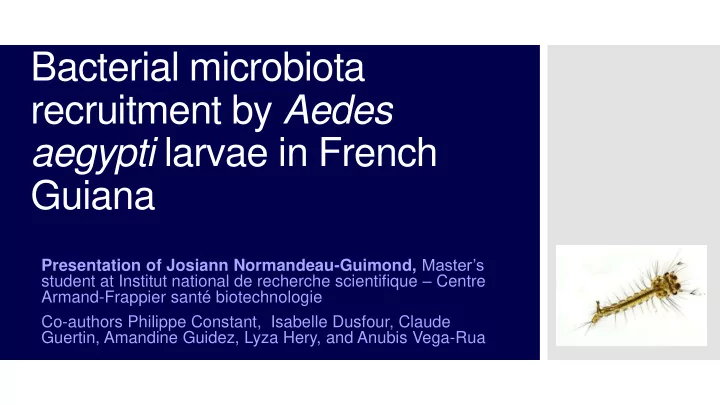
Bacterial microbiota recruitment by Aedes aegypti larvae in French Guiana

Presentation of Josiann Normandeau-Guimond, Master’s student at Institut national de recherche scientifique – Centre Armand-Frappier santé biotechnologie Co-authors Philippe Constant, Isabelle Dusfour, Claude Guertin, Amandine Guidez, Lyza Hery, and Anubis Vega-Rua

slide-2
SLIDE 2

A lot of functions are provided by mosquitoes’ bacterial microbiota.

(Modified of Guégan, 2018)

slide-3
SLIDE 3

Some genera are conserved from larvae to adults, despite the microbiota ‘’flush’’ observed at pupal stage.

(Modified from M. Guégan, 2018)

slide-4
SLIDE 4

α-diversity = number of species in a habitat. β-diversity = diversity of species between two habitats.

Bacterial recruitment indicate all the species acquired from environment.

slide-5
SLIDE 5

Hypothesis

Our study hypothesizes that the structure

  • f bacterial microbiota of Ae. aegypti

larvae result from the structure of bacterial community in breeding sites. Objectives

1. Caracterization of breeding site and larvae’s microbiota. 2. Analysis of micro parameters on larvae’s structures 3. Effect of macro and meso parameters as shaping factors on bacterial microbiota of larvae

slide-6
SLIDE 6

Sample collection and characterization

 69 sites were choosen in French Guiana:

 Larvaes and water from breeding site were collected  Severals pictures of each site were taken

 Physicochemical analysis of water (micro):  pH, T°, turbidity, conductivity, O2 dissolved…  nitrite, nitrate, ammonium, calcium…

6 Macro Meso Micro

slide-7
SLIDE 7

Material and methods

  • 1. Sample collection;
  • 2. DNA extraction using

PowerSoil kit;

  • 3. Library preparation;
  • 4. Illumina sequencing
  • f 16S V6-V8 region ;
  • 5. ASV file generated by

USEARCH;

  • 6. Biostatistical

analysis.

slide-8
SLIDE 8

104992 16530 14645 12643 10744 8760 9058 12351 52141 5331 13090 36186 2590 6389

46562 1280 21 1913 17 8 2796 20984 61212 14895 23507 47089 27812 31789

Novosphingobium Sphingopyxis Herbaspirillum Dysgonomonas Limnohabitans Camelimonas Sediminibacterium Brevibacillus Methylobacterium Polynucleobacter Bosea Acinetobacter Phreatobacter Tabrizicola

Figure 2. Common bacterial genera associated with larvae and their breeding sites

A total of 1662 ASV distributed in 181 genera are

  • bserved. Genera

have different proportions between larvae and breeding site.

Breeding site Larvae

slide-9
SLIDE 9

Table 1. Numbers of sequences for genera found exclusively in only one environnement (larvae or breeding site.)

It appears that some genera are exclusively detect in breeding site or in larvae, suggesting a specifics recruitment.

Genera % abundance in breeding site % abundance in larvae Tessaracoccus 0.099 0.000 Paenibacillus 0.095 0.000 Limnobacter 0.087 0.000 Azohydromonas 0.083 0.000 Lactobacillus 0.076 0.000 Oligoflexus 0.074 0.000 Parasegetibacter 0.062 0.000 Ohtaekwangia 0.042 0.000 Brevibacterium 0.041 0.000 Nocardia 0.039 0.000 Tolumonas 0.037 0.000 Ancylobacter 0.000 1.210 Desulfovibrio 0.000 0.030 Flavihumibacter 0.000 0.021

slide-10
SLIDE 10

Euclidean distance between community structure of larvae and the breeding site ranged from 30,24 to 60,84.

slide-11
SLIDE 11

 Canonical analysis?

ASV found in water explain 55,52% of the ASV found in larvae.

slide-12
SLIDE 12

Conclusion and Perspectives

 Beta diversity between larvae and breeding site microbiota differ from one site to another.  Breeding site microbiota seems to play a role as a shaping factor on the structure of larvae’s microbiota, but it’s not the only factor explaining it Analysis of the effect of micro and meso parameters

  • n larvae’s microbiota for a better comprehension of

bacterial recruitment.

slide-13
SLIDE 13

Acknowledgements

Pr Claude Guertin Narin Srei Judith Mongouong Audrey-Anne Durand Pr Philippe Constant Pr Isabelle Dusfour Amandine Guidez Pr Anubis Rua-Vega Lyze Hery