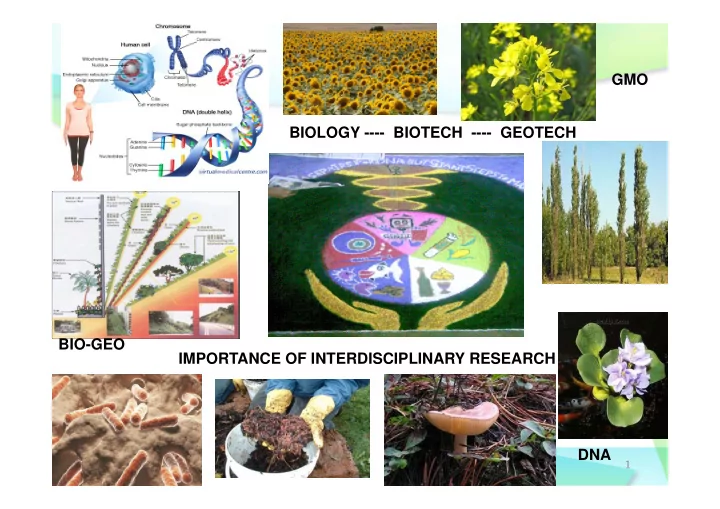
GMO BIOLOGY ---- BIOTECH ---- GEOTECH BIO-GEO IMPORTANCE OF - - PowerPoint PPT Presentation

gmo biology biotech geotech bio geo importance of
SMART_READER_LITE
LIVE PREVIEW

GMO BIOLOGY ---- BIOTECH ---- GEOTECH BIO-GEO IMPORTANCE OF - - PowerPoint PPT Presentation

GMO BIOLOGY ---- BIOTECH ---- GEOTECH BIO-GEO IMPORTANCE OF INTERDISCIPLINARY RESEARCH DNA 1 Biogeotechnology Fundamental Applicative 2 For any application such as Bio-fertilizer, Bioremediation. Sample collection Biological


slide-1
SLIDE 1

1

BIOLOGY ---- BIOTECH ---- GEOTECH GMO BIO-GEO DNA IMPORTANCE OF INTERDISCIPLINARY RESEARCH

slide-2
SLIDE 2

2

Biogeotechnology

Fundamental Applicative

slide-3
SLIDE 3

3

Sample collection

Physico-chemical parameters Biological (Isolation of bacteria)

Taxonomic identification and phylogenetic analysis Screening for specific properties Elucidation of microbe interaction Bioprospecting

For any application such as Bio-fertilizer, Bioremediation….

slide-4
SLIDE 4

4

slide-5
SLIDE 5

5

Growth of bacteria

Water Food/Nutrients Oxygen Temperature pH

slide-6
SLIDE 6

6

slide-7
SLIDE 7

7

slide-8
SLIDE 8

8

slide-9
SLIDE 9

9

Serial dilution and viable plate count method

slide-10
SLIDE 10

10

slide-11
SLIDE 11

11

slide-12
SLIDE 12

12

Optimization of growth conditions C, P, N…. Temperature pH

slide-13
SLIDE 13

13

Sample collection

Physico-chemical parameters Biological (Isolation of bacteria)

Taxonomic identification and phylogenetic analysis Screening for specific properties Elucidation of microbe interaction Bioprospecting

slide-14
SLIDE 14

14

Screen for specific propertiesc

slide-15
SLIDE 15

15

10 20 30 40 50

% reduction in cell number on 6h incubation with 120 ppm uranium Phosphate solubilizing bacterial isolates

4.2 43.3 31.7 33.2

Figure : Percent reduction in cell number on incubation in 0.1 N NaCl, pH 4 solution amended with 120 ppm uranium for 6 h. Vertical bars represent the mean ± SD

3.9

slide-16
SLIDE 16

16

Phylogenetic analysis -- depicts the evolutionary relationships

Phylogenetic tree of seven PSB from sand sample of Someshwara beach based on 16S rRNA gene sequences available from the EMBL database (accession numbers are given in perenthesis) constructed after multiple alignments of the data using CLUSTAL_X. Distances (according to the Kimura two parameter model) and clustering with the neighbour joining method were performed using MEGA version 5. Numbers at the node are the bootstrap percentages. Bacillus safensis FO-036b(T) (AF234854) YU-SS-SB-23 (KF156653) Paenibacillus cineris LMG 18439(T) (AJ575658) YU-SS-SB-26 (KF156656) Curtobacterium citreum DSM 20528(T) (X77436) YU-SS-SB-27 (KF156657) YU-SS-SB-31 (KF156660) Burkholderia latens R-5630(T) (AM747628) YU-SS-SB-25 (KF156655) Acinetobacter pittii LMG 1035(T) (HQ180184) YU-SS-SB-29 (KC433736) Flavobacterium flevense DSM 1076(T) (AM230486) YU-SS-SB-22 (KF156652) 100 100 100 100 100 100 100 99 92 0.02 γ - Proteobacteria β - Proteobacteria Actinobacteria Firmicutes Bacteroidetes

slide-17
SLIDE 17

17

slide-18
SLIDE 18

18

slide-19
SLIDE 19

19

Are all bacteria culturable??

slide-20
SLIDE 20

2 APPROACHES FOR ANALYSIS CULTURE DEPENDENT Bacteria isolation on selective media CULTURE INDEPENDENT Direct isolation of nucleic acids

20

Strain characterization PCR amplification Counting 16S rDNA sequencing & Identification DGGE analysis Sequencing of target gene Bioinformatics Phylogenetic and diversity analysis

Metagenomics

slide-21
SLIDE 21

21

Microbial interaction

Lab scale studies

slide-22
SLIDE 22

22

Fourier Transform Infra Red (FTIR) spectra - - - - elucidates the chemical groups

Peak Group Vibrational mode 545 PO4

3-

Bend; ʋ4 663 PO4

3-

Bend; ʋ4 825 UO2

2+

  • Sym. Stretch; ʋ1

921 UO2

2+

Antisym. Stretch; ʋ3 970 PO4

3-

Antisym. Stretch; ʋ3 1025 H3O+ Bend; ʋ2 1122 H2O Librational 1654 H2O Bend; ʋ2 1799 H3O+ Bend; ʋ4 3175 H3O+/OH Stretch

Table: Details of the peak Armstrong and Clark, 2010

Matches with UP --- Chernikovite

FTIR spectra of the precipitates formed on addition of (A) 250 ppm and (B) 2000 ppm uranium to the cell-free culture supernatant of Acinetobacter sp. YU-SS-SB-29

slide-23
SLIDE 23

23

SEM and EDX images of the precipitates formed on addition of 250 ppm uranium to the cell-free culture supernatant of Acinetobacter sp. YU-SS-SB-29

Scanning Electron Microscopy Images - - - - surface information

slide-24
SLIDE 24

24

XRD spectra of the precipitates formed on addition of A) 250 ppm uranium and B) 2000 ppm uranium to the cell-free culture supernatant of Acinetobacter sp. YU-SS-SB-29

10 20 30 40 50 2000 4000

(111)

Intensity (a u)

(001) (101) (110) (002) (200) (102) (201) (211) (103) (113) (220) (221) (301) (310)

(311)

(302) (204) (303)

2 theta in degrees

A B

X-ray Diffraction (XRD) spectrum

slide-25
SLIDE 25

25

Field application

E nvir

  • nmental

Geotechnologists There is the classic issue encountered when working with bacteria, in that microbial processes are relatively slow and

  • ften

unpredictable, especially when environmental factors are involved

slide-26
SLIDE 26

26

Molecular biology has shown that even the simplest of all living systems on the earth today, bacterial cells, are exceedingly complex objects. Although the tiniest bacterial cells are incredibly small, weighing less than 10-12 gms, each is in effect a veritable micro-miniaturized factory containing thousands of exquisitely designed pieces of intricate molecular machinery, made up altogether of one hundred thousand million atoms, far more complicated than any machine built by man and absolutely without parallel in the nonliving world. Michael Denton

slide-27
SLIDE 27

27

Due to complexity, the microbial geotech would require an integration of microbiology, ecology, geochemistry and geotechnical engineering knowledge

slide-28
SLIDE 28

28

Geotechnologists Biotechnologists

Biogeotechnology