
SLIDE 1
3/21/2016 1
Chemical control & insectiside resistance
Fiocruz Instituto Oswaldo Cruz
Ademir J Martins Jr Maceió, march 13th 2016
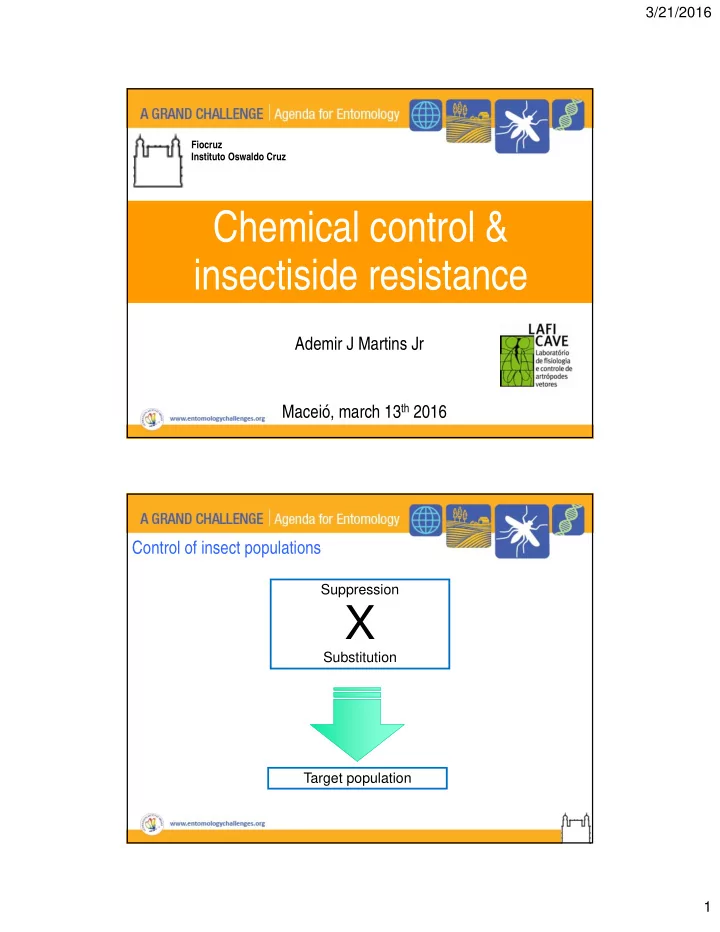
Suppression
X
Substitution Target population
Control of insect populations
X Substitution Target population 1 3/21/2016 Control of Aedes - - PDF document
3/21/2016 Fiocruz Instituto Oswaldo Cruz Chemical control & insectiside resistance Ademir J Martins Jr Macei, march 13 th 2016 Control of insect populations Suppression X Substitution Target population 1 3/21/2016 Control of Aedes
3/21/2016 1
Fiocruz Instituto Oswaldo Cruz
Ademir J Martins Jr Maceió, march 13th 2016
Suppression
Substitution Target population
Control of insect populations
3/21/2016 2
Wolbachia transgenesis Avoid larval breeding sites
Mechanical control
SIT genetic shifting paratransgenesis
Biological control Chemical control
insecticides predators/ parasites
Suppression Substitution
Control of Aedes aegypti populations
Wolbachia transgenesis Avoid larval breeding sites
Mechanical control
SIT genetic shifting paratransgenesis
Biological control Chemical control
insecticides predators/ parasites
Suppression Substitution
Control of Aedes aegypti populations
3/21/2016 3
Bass et al 2014 – Insect Biochem Mol Biol
The Brazilian National Program for Dengue Control only applies insecticides approved by the WHO Pesticide Evaluation Scheme (WHOPES)
Insecticides
updated 5 February 2016
3/21/2016 4
The Brazilian National Program for Dengue Control only applies insecticides approved by the WHO Pesticide Evaluation Scheme (WHOPES)
Insecticides
updated 5 February 2016
N N N N IGR IGR IGR N Bio
The Brazilian National Program for Dengue Control only applies insecticides approved by the WHO Pesticide Evaluation Scheme (WHOPES)
Insecticides
updated 5 February 2016
Pyr Pyr Pyr Pyr OP
3/21/2016 5
The Brazilian National Program for Dengue Control only applies insecticides approved by the WHO Pesticide Evaluation Scheme (WHOPES)
Insecticides
updated 5 February 2016
Insecticides against Ae. aegypti In Brazil
(OPs) until 2009
Aedes aegypti
adulticides to deltamethrin (Pyr)
malathion.
3/21/2016 6
Insecticides against Ae. aegypti In Brazil
Currently indicated by the Brazilian National Program for Dengue Control Larvicide: pyriproxyfen (JH) Adulticides: malathion (OP) – spatial bendiocarb (CA) – residual
(OPs) until 2009
Aedes aegypti
adulticides to deltamethrin (Pyr)
malathion.
3/21/2016 7
Insecticide resistance can contribute to an increase in the incidence of arboviruses
5000 10000 15000 20000 25000 30 40 50 60 70
cumulative dengue incidence mortality (%) R2= 0.7372, p <0.0286
Marília Campinas
Santos SJR Preto Exemple: reduced mortality of Ae. aegypti to pyrethroids showed a significant correlation with dengue incidence in localities from São Paulo Insecticide resistance can contribute to an increase in the incidence of arboviruses Macoris, not published
3/21/2016 8
Insecticide resistance in dengue vectors Ranson et al 2010, TropiKanet Insecticide resistance in dengue vectors Ranson et al 2010, TropiKanet
3/21/2016 9
2005 – 2015 published data on Anopheles resistance
source: IR Mapper
How to evaluate insecticide resistance?
3/21/2016 10
How to evaluate insecticide resistance?
There is an increasing number of validated methods for evaluating insecticide resistance levels and their selected physiological mechanisms CDC bottle bioassay WHO tubes bioassay
How to evaluate insecticide resistance? Bioassays
3/21/2016 11
Behavioral changes Reduced penetration (cuticle) Increase in enzymatic detoxification Target site insensitivity
Main mechanisms selected for insecticide resistance
How to evaluate insecticide resistance? Biochemical and molecular assays
Biochemical assays of enzymatic activity
3/21/2016 12
Mechanisms for insecticide resistance: metabolic resistance in Aedes aegypti from Brazil
High-throughput identification of resistance genes
Faucon et al 2015 – Genome Research
3/21/2016 13
Mechanisms for insecticide resistance: kdr mutations in Aedes aegypti from Brazil
Aedes aegypti SNP chip Evans et al 2015 – Genes, Genomics, Genetics
resistant individuals of several Brazilian populations Bioasays with insecticide Resistant Susceptible
SNPs for each individual in one reaction Aedes aegypti SNP chip
3/21/2016 14
Worldwide insecticide resistance network in mosquito vectors of arboviruses
Acronym: WIN (Worldwide Insecticide-resistance Network) PI’s: Vincent Corbel (IRD, Thailand) and Jean-Philippe David (CNRS, France) The WIN proposes to bring together 15 internationally recognized institutions in vector research, providing a unique framework for tracking insecticide resistance in mosquito vectors of arboviruses around the world. The network aims at identifying the particular countries/regions where resistance could challenge vector control interventions and to provide the WHO and member states with key recommendations for improvement
Is it possible to revert to a susceptible stage? Would we able to continue effectively using insecticides as
3/21/2016 15
Selection pressure insecticide
time
Is it possible to revert to a susceptible stage?
Time of larval development Pupation rate Adults longevity Blood feeding Fecundity: rate of inseminated females Fecundity: number of eggs Locomotor activity Circadian rhythm Fertility: eggs’ viability Competition during larval development Competition for copula
R2 kdr allele has a fitness cost
3/21/2016 16
Time of larval development Pupation rate Adults longevity Blood feeding Fecundity: rate of inseminated females Fecundity: number of eggs Locomotor activity Circadian rhythm Fertility: eggs’ viability Competition during larval development Competition for copula
R2 kdr allele has a fitness cost
Enough to diminish the frequency of the mutant allele in an insecticide-free environment ?
3 6 9 12 15 0.0 0.2 0.4 0.6 0.8 1.0
cage 1 cage 2 cage 3 A generations (F) 1016 Ile (frequecy)
3 6 9 12 15 0.0 0.2 0.4 0.6 0.8 1.0
cage 4 cage 5 cage 6 B generations (F) 1016 Ile (frequecy)
Kdr allele initial frequency (3 independent cages for each situation)
50% 75%
R2 kdr allele has a fitness cost
3/21/2016 17
3 6 9 12 15 0.0 0.2 0.4 0.6 0.8 1.0
cage 1 cage 2 cage 3 A generations (F) 1016 Ile (frequecy)
3 6 9 12 15 0.0 0.2 0.4 0.6 0.8 1.0
cage 4 cage 5 cage 6 B generations (F) 1016 Ile (frequecy)
Kdr allele initial frequency (3 independent cages for each situation)
50% 75%
R2 kdr allele has a fitness cost
Awareness modifier genes
3/21/2016 18
to mosquito control. Merely switching insecticide when the current one no longer works is not effective.
natural populations have to consider the knowledge of genetic, biologic and ecological aspects of the selected mechanisms. Conclusions
Challange #1 : knowledge of the selected mechanisms
Challenge #2 : knowledge of the dynamics of resistance genes in the population Avoid the increase and dispersion of resistance Avoid cross resistance among different class of insecticides Maintain insecticides as one of the possible strategies for mosquito control
Remarks for studying a resistant population
3/21/2016 19
Thank you! Ademir J Martins ademirjr@ioc.fiocruz.br