Loopers! (more caterpillars) Adults, larvae active in cold weather - - PDF document

loopers more caterpillars
SMART_READER_LITE
LIVE PREVIEW

Loopers! (more caterpillars) Adults, larvae active in cold weather - - PDF document

3/6/2017 Loopers! (more caterpillars) Adults, larvae active in cold weather Many hosts: cole crops, spinach, leafy greens Larvae chew holes in leaves Fly at night, cold weather, too; dull, gray patterns Evidence of Pests (Hint: Name these


slide-1
SLIDE 1

3/6/2017 1

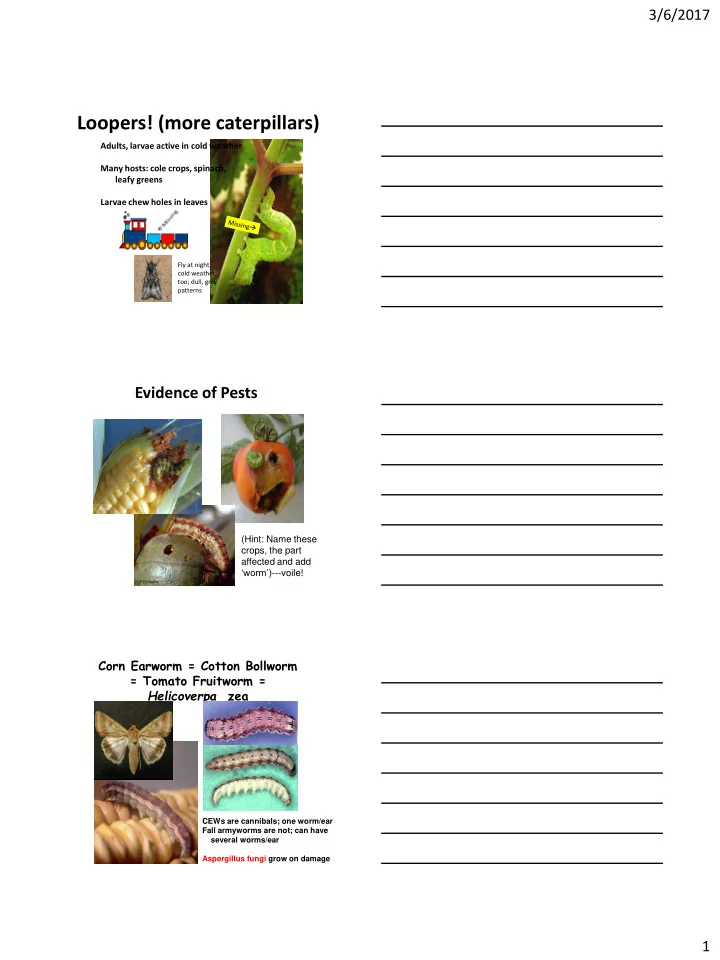
Loopers! (more caterpillars)

Adults, larvae active in cold weather Many hosts: cole crops, spinach, leafy greens Larvae chew holes in leaves

Fly at night, cold weather, too; dull, gray patterns

Evidence of Pests

UFEntNema

(Hint: Name these crops, the part affected and add ‘worm’)---voile!

Corn Earworm = Cotton Bollworm = Tomato Fruitworm = Helicoverpa zea

CEWs are cannibals; one worm/ear Fall armyworms are not; can have several worms/ear Aspergillus fungi grow on damage

slide-2
SLIDE 2

3/6/2017 2 Corn Earworm/Tomato Fruitworm Management

CORN

  • Smear oil on

‘fresh’ silks several times

  • Spray ‘fresh’ silks,

shuck ends with BT* several times TOMATOES

  • Spray plants &

fruit with BT* as needed

4

  • BT = Bacillus thuringiensis kurstaki;

toxin produced by this commercially grown soil bacteria will kill many common caterpillar pests

  • Dipel, Thuricide, Biobit, others are

Paralyzes gut; die later Affects ONLY ‘worm stage! Smothers eggs

Evidence of Pests

Difficult to detect Major damage can occur

  • ver night!

Tomato (& Pepper) Hornworm

Life Cycle-clockwise Hand pick or BT frequently

slide-3
SLIDE 3

3/6/2017 3 Management Tactics for Hornworms

Hand-pick while scouting, weeding BT or Pyrethrin sprays: work best on small worms

More Evidence of Pests

Epitrix cucumeris WCranshaw, CO State Univ, bugwood.org Systena blanda WCranshaw, CO State Univ, bugwood.org Epitrix tuberis WCranshaw, CO State Univ, bugwood.org Phyllotreta cruciferae CO State Univ, bugwood.org

Flea Beetles ---More Hole Makers

Systena blanda, WCranshaw, CO St Univ bugwood.org Epitrix tuberis, ACushman, USDA SEL, bugwood.org Epitrix cucumeris Hannah Royals USDA APHIS ITP bugwood.org

Adults often shiny metallic colors; 1-3 mm long. JUMP! Larvae can burrow into stems, tubers, etc.

slide-4
SLIDE 4

3/6/2017 4

Managing Flea Beetles

Incorporate organics Weed control=harborage Mulches=hiding places (don’t leave on surface) Insecticides? ~~control. Damage usually worst

  • n older leaves, especially early

in season. a Azadirachtin, oils, soaps, pyrethrins labeled. Spinosad may help, but may kill beneficials.

Evidence of Pests

Hosts susceptible between germination & flowering Summer squash can be affected Leaves wilt first, then stems, then whole plant Plants ‘recover’ at night but wilt again Death often occurs in 7-14 days Features of Adult Beetle

  • abt. ¼” long; soft, elongated oval body
  • thorax & wing covers shiny green
  • 6 black spots on each wing cover
  • antennae, legs and head black

Transmits bacterial wilt & cucumber mosaic virus BW survives inside adults overwintering in weeds &

debris around field

Management Strategies

Grow cultivars selected for resistance to BW No weeds year long; eliminate field debris at end of season (harborage) Row covers from germination to bloom (remove for pollination!)

Spotted Cucumber Beetle

slide-5
SLIDE 5

3/6/2017 5

Remember: New Pests May Appear

1-Brown marmorated stink bug 2-Bagrada Bug (cole crops) 3-African Cluster Bug (mints) 4-Tomato/potato psyllid 5-Sage/Mint Leafhopper And more!!!

5 1 2 3 4

Are There Any Beneficial Insects?

(Yes, and many are natives)

14

Some might be ordered to augment natural populations. Still, you need to know your pests.

Spiders: Under-appreciated Predators

Generalists---Accept Them

slide-6
SLIDE 6

3/6/2017 6 Predatory Mites---Think VERY

Small

(If prey levels drop too much, some of these can die out; be prepared to monitor these as well as pests)

Neoseiulus sp. for thrips Hypoaspis sp.

Some occur naturally; some can be purchased

Phytoseiulus sp. (arbico.com) Neoseiulus sp. on spider mite

Predatory Bugs: Various Natives

Minute Pirate—tiny, aggressive* Damsel---occasionals Big-Eyed Predatory Stink (Podisus) ---larger, occasional Assassins---

Green Lacewings: Valuable!

Eggs---pin-head size, white, on ‘soft’ pogo-sticks Adult---abt ½” long; pale green, eyes Metallic gold or copper; weak flyer Larvae---alligator shaped, long, hollow jaws, very active hunters; can’t travel Can be locally common; also, can be ordered.

Order Neuroptera