Recent cross-section results from MicroBooNE Supraja - - PowerPoint PPT Presentation

β–Ά
recent cross section results from microboone
SMART_READER_LITE
LIVE PREVIEW

Recent cross-section results from MicroBooNE Supraja - - PowerPoint PPT Presentation

TAUP 2019 | 09.09.2019 Recent cross-section results from MicroBooNE Supraja Balasubramanian , on behalf of the MicroBooNE collaboration Yale University 1 Short Baseline Neutrinos @ FNAL 3 liquid argon TPCs Study - e


slide-1
SLIDE 1

Supraja Balasubramanian,

  • n behalf of the MicroBooNE

collaboration Yale University

Recent cross-section results from MicroBooNE

1
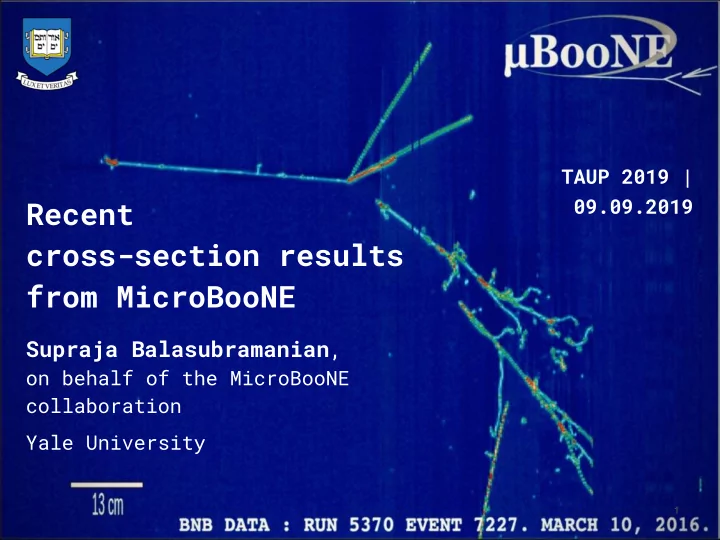
TAUP 2019 | 09.09.2019

slide-2
SLIDE 2

2

Short Baseline Neutrinos @ FNAL

Booster Neutrino Beam NuMI

3 liquid argon TPCs Study 𝛏𝝼-𝛏e oscillations On the Booster Neutrino Beam

SBND MicroBooNE I C A R U S

110m 470m 600m

Supraja Balasubramanian | TAUP 2019

2

slide-3
SLIDE 3

3

Short Baseline Neutrinos @ FNAL

Booster Neutrino Beam NuMI

3 liquid argon TPCs Study 𝛏𝝼-𝛏e oscillations On the Booster Neutrino Beam

SBND MicroBooNE I C A R U S

110m 470m 600m

STATUS: Under construction DATA-TAKING: 2020 STATUS: Transported from CERN DATA-TAKING: late 2019

Supraja Balasubramanian | TAUP 2019

3

slide-4
SLIDE 4

4

Short Baseline Neutrinos @ FNAL

Booster Neutrino Beam NuMI

3 liquid argon TPCs Study 𝛏𝝼-𝛏e oscillations On the Booster Neutrino Beam

SBND MicroBooNE I C A R U S

110m 470m 600m

GOALS:

  • Investigate the MiniBooNE

β€œlow-energy excess”

  • Conduct LArTPC r&d for future

large-scale detectors [DUNE].

  • Study 𝛏-Argon interactions

Supraja Balasubramanian | TAUP 2019

slide-5
SLIDE 5

5

Short Baseline Neutrinos @ FNAL

Booster Neutrino Beam NuMI

3 liquid argon TPCs Study 𝛏𝝼-𝛏e oscillations On the Booster Neutrino Beam

SBND MicroBooNE I C A R U S

110m 470m 600m

Supraja Balasubramanian | TAUP 2019

GOALS:

  • Investigate the MiniBooNE

β€œlow-energy excess”

  • Conduct LArTPC r&d for future

large-scale detectors [DUNE].

  • Study 𝛏-Argon interactions
slide-6
SLIDE 6

The MiniBooNE LEE

6

The MiniBooNE Low Energy Excess1

  • 1. FERMILAB-PUB-18-219, LA-UR-18-24586

electron-like

  • r

photon-like? [oscillation signal from additional sterile neutrino] [unknown photon background]

Supraja Balasubramanian | TAUP 2019

slide-7
SLIDE 7

...enter MicroBooNE

7

electron photon

same neutrino beam + similar baseline + can distinguish between electrons & photons

MicroBooNE’s LArTPC technology can distinguish between electrons & photons. e- shower 𝝳 shower

  • β€œGap” :

𝝳 showers have it & e- showers don’t.

  • dE/dx:

𝝳 pair-produces to make a shower => twice the dE/dx of the e- shower

Supraja Balasubramanian | TAUP 2019

𝝳 e-

slide-8
SLIDE 8

8

Short Baseline Neutrinos @ FNAL

Booster Neutrino Beam NuMI

3 liquid argon TPCs Study 𝛏𝝼-𝛏e oscillations On the Booster Neutrino Beam

SBND MicroBooNE I C A R U S

110m 470m 600m

Supraja Balasubramanian | TAUP 2019

GOALS:

  • Investigate the MiniBooNE

β€œlow-energy excess”

  • Conduct LArTPC r&d for future

large-scale detectors [DUNE].

  • Study 𝛏-Argon interactions
slide-9
SLIDE 9

9

LArTPC technology: light & charge

85 tons active mass of LAr Cryostat temperature @ 77K Nominal E field 273 V/cm

Supraja Balasubramanian | TAUP 2019

  • Prompt scintillation light:

captured by 32 PMTs + acts as trigger

  • Ionization charge:

drifted in electric field + collected by 3 anode wire planes.

slide-10
SLIDE 10

10

MicroBooNE’s LArTPC: advantages

Supraja Balasubramanian | TAUP 2019

  • High precision: millimeter-scale resolution
  • High statistics: Booster Neutrino Beam
  • Fully automated 3D reconstruction of 𝛏 interaction
  • Excellent particle ID: topology & calorimetry
  • Argon: relevant to SBND, ICARUS, DUNE
slide-11
SLIDE 11

11

Short Baseline Neutrinos @ FNAL

Booster Neutrino Beam NuMI

3 liquid argon TPCs Study 𝛏𝝼-𝛏e oscillations On the Booster Neutrino Beam

SBND MicroBooNE I C A R U S

110m 470m 600m

Supraja Balasubramanian | TAUP 2019

GOALS:

  • Investigate the MiniBooNE

β€œlow-energy excess”

  • Conduct LArTPC r&d for future

large-scale detectors [DUNE].

  • Study 𝛏-Argon interactions
slide-12
SLIDE 12

12 12

𝛏-Argon interactions in MicroBooNE

slide-13
SLIDE 13

13

Booster Neutrino Beam

MicroBooNE

13

approved to take 13.2e20 POT

𝝃’s @ MicroBooNE: Booster Neutrino Beam

Supraja Balasubramanian | TAUP 2019

MicroBooNE

slide-14
SLIDE 14

14

Supraja Balasubramanian | TAUP 2019

Cross sections in MicroBooNE

slide-15
SLIDE 15
  • Development of 𝛏 interaction generators:

Very little data on Argon nucleus => MicroBooNE’s data is crucial.

15

Supraja Balasubramanian | TAUP 2019

Cross sections in MicroBooNE

slide-16
SLIDE 16
  • Development of 𝛏 interaction generators:

Very little data on Argon nucleus => MicroBooNE’s data is crucial.

  • 𝛏 energy & flux calculation:

Understanding 𝛏-Ar interactions necessary for future LArTPC oscillation studies.

16

Supraja Balasubramanian | TAUP 2019

Cross sections in MicroBooNE

slide-17
SLIDE 17
  • Development of 𝛏 interaction generators:

Very little data on Argon nucleus => MicroBooNE’s data is crucial.

  • 𝛏 energy & flux calculation:

Understanding 𝛏-Ar interactions necessary for future LArTPC oscillation studies.

17

Supraja Balasubramanian | TAUP 2019

Cross sections in MicroBooNE

  • Constraining model

systematics: Important for oscillation studies.

slide-18
SLIDE 18
  • Development of 𝛏 interaction generators:

Very little data on Argon nucleus => MicroBooNE’s data is crucial.

  • 𝛏 energy & flux calculation:

Understanding 𝛏-Ar interactions necessary for future LArTPC oscillation studies.

18

Supraja Balasubramanian | TAUP 2019

Cross sections in MicroBooNE

  • Constraining model

systematics: Important for oscillation studies.

  • Probe for nuclear effects:

Argon is a big nucleus; 𝛏-Ar cross sections are sensitive to final state interactions.

slide-19
SLIDE 19
  • Development of 𝛏 interaction generators:

Very little data on Argon nucleus => MicroBooNE’s data is crucial.

  • 𝛏 energy & flux calculation:

Understanding 𝛏-Ar interactions necessary for future LArTPC oscillation studies.

19

Supraja Balasubramanian | TAUP 2019

Cross sections in MicroBooNE

  • Constraining model

systematics: Important for oscillation studies.

  • Probe for nuclear effects:

Argon is a big nucleus; 𝛏-Ar cross sections are sensitive to final state interactions.

MicroBooNE provides high-precision event reconstruction & high-statistics 𝛏-Argon data required to perform 𝛏 cross-section measurements.

slide-20
SLIDE 20

20

Supraja Balasubramanian | TAUP 2019

Selected recent MicroBooNE cross-section publications

𝛏𝝼 CC inclusive: First Measurement of Inclusive Muon Neutrino Charged Current Differential Cross Sections on Argon at Eν∼0.8 GeV with the MicroBooNE Detector [Accepted to PRL, arXiv:1905.09694] 𝛏𝝼 CC pi0: First Measurement of Ξ½ΞΌ Charged-Current Ο€0 Production on Argon with a LArTPC [Phys.Rev. D99 (2019) no.9, 091102, arXiv:1811.02700] CC N protons: Selection of Ξ½ΞΌ charged–current induced interactions with N>0 protons and performance of events with N=2 protons in the final state in the MicroBooNE detector from the BNB. [MICROBOONE-NOTE-1056-PUB] Others: Charged particle multiplicity: Eur. Phys. J. C (2019) 79: 248, arXiv:1805.06887 NC elastic: MICROBOONE-NOTE-1053-PUB 𝛏e CC with the NuMI beam: MICROBOONE-NOTE-1054-PUB ...

slide-21
SLIDE 21

21 21

𝝃𝝼 CC inclusive channel

slide-22
SLIDE 22

22

Signal: interactions with a neutrino-induced muon.

  • High-statistics inclusive selection.
  • Includes different interaction modes.
  • Test neutrino interaction models.
  • Selection for other exclusive channels.

𝝃𝝼 CC inclusive

Supraja Balasubramanian | TAUP 2019 arXiv:1905.09694

slide-23
SLIDE 23

EVENT SELECTION: COSMIC REJECTION

Signal: interactions with a neutrino-induced muon. βž” TPC-PMT matching to detect scintillation light from 𝝃 interaction in beam-spill window βž” Avoid through-going tracks, stopping muons

Supraja Balasubramanian | TAUP 2019

𝝃𝝼 CC inclusive

1 beam spill 1 𝝃 interaction 25 cosmic rays 1 𝝃 interaction 1.6𝝼s 600 beamspills 1 event 15,000 cosmic rays

23

this selection achieves 99.9% cosmic rejection

slide-24
SLIDE 24

EVENT SELECTION: NEUTRINO ID

Signal: interactions with a neutrino-induced muon. βž” Vertex & track reconstruction using Pandora pattern recognition [Eur. Phys. J. C78, 1, 82 (2018)] βž” Require vertex-track association + fiducial volume, topological & calorimetric selection βž” Muon momentum measured using multiple coulomb scattering

Supraja Balasubramanian | TAUP 2019

𝝃𝝼 CC inclusive

24

arXiv:1905.09694

24

slide-25
SLIDE 25

25

  • Compared to various 𝝃-nucleus

interaction generators: GENIE v2 &v3, GiBUU, NuWRO

  • Favors GENIE v3, i.e. new

improvements to GENIE model (local Fermi gas, RPA).

  • Full angular & momentum

coverage

𝝃𝝼 CC inclusive results

Supraja Balasubramanian | TAUP 2019

First total, single & double differential cross-section measurement on Argon at low energy [paper on arXiv, accepted by PRL]

arXiv:1905.09694

slide-26
SLIDE 26

26

arXiv:1905.09694

𝝃𝝼 CC inclusive results

Supraja Balasubramanian | TAUP 2019

First total, single & double differential cross-section measurement on Argon at low energy [paper on arXiv, accepted by PRL]

This result is a systematic test of the brand-new GENIE v3.

slide-27
SLIDE 27

27 27

𝝃𝝼 CC πž€0 channel

slide-28
SLIDE 28

𝝃𝝼 CC πž€0

28

Signal: interactions with a 𝛏𝝼-induced muon that produce a single πž€0.

  • πž€0’s decay into 2 𝝳’s

=> important background for the 𝛏e oscillation analysis.

  • resonant pion production

=> important to understand for DUNE.

  • involves FSI

=> probe to understand these.

Supraja Balasubramanian | TAUP 2019

slide-29
SLIDE 29

𝝃𝝼 CC πž€0

29

Supraja Balasubramanian | TAUP 2019

EVENT SELECTION: EM SHOWERS

Signal: interactions with a 𝛏𝝼-induced muon that produce a single πž€0. βž” Pre-filter similar to CC inclusive selection. βž” Shower reconstruction done via OpenCV clustering & cluster-matching across planes.

  • Phys. Rev. D 99, 091102(R) (2019)

Selection uses one-shower search, with diphoton mass from two-shower subset sample used as a cross-check.

slide-30
SLIDE 30

30

Total cross-section measurement

  • n Argon at low energy

[paper published in PRD, 2019]

  • Compared with different pion production models:

β—‹ GENIE: Rein-Sehgal (RS) with and without FSIs enabled, Berger-Sehgal (BS) β—‹ NuWRO: Adler-Rarita-Schwinger, Onset cascade for FSI

  • Provides first high-statistics data at higher nuclear mass to confirm model generators.

𝝃𝝼 CC πž€0 results

  • Phys. Rev. D 99, 091102(R) (2019)

Supraja Balasubramanian | TAUP 2019

mean diphoton mass agrees with πž€0 hypothesis.

first fully automated shower reconstruction in a LArTPC.

slide-31
SLIDE 31

31 31

𝝃𝝼 CC with protons channel

slide-32
SLIDE 32

𝝃𝝼 CC with protons

32

Supraja Balasubramanian | TAUP 2019

Signal: interactions with a 𝛏𝝼-induced muon & protons.

  • proton kinematics [angle, momentum, etc] allow

insight on nuclear effects such as short range correlations, meson-exchange current

  • low energy threshold, full angular coverage &

precision tracking in LArTPC

slide-33
SLIDE 33

𝝃𝝼 CC with protons

33

Supraja Balasubramanian | TAUP 2019

EVENT SELECTION: proton PID

Signal: interactions with a 𝛏𝝼-induced muon and N protons. βž” Uses CC inclusive selection as pre-filter. βž” Calorimetric information used for proton particle ID.

contained tracks

33

slide-34
SLIDE 34

34

Supraja Balasubramanian | TAUP 2019

Conclusion & Outlook

MicroBooNE is a LArTPC 𝝃 detector with:

  • High precision 3D event reconstruction
  • Large statistics with Argon

MicroBooNE 𝝃-Argon interaction measurements are crucial for:

  • the development of GENIE & other 𝝃

interaction generators.

  • calculation of 𝝃 flux & energy for future
  • scillation experiments.
  • constraining model systematics for 𝝃
  • scillation measurements.
slide-35
SLIDE 35

35

thank you!

Supraja Balasubramanian | TAUP 2019