MicroBooNE B. Fleming, S. Zeller July 2019 PAC Presentation - - PowerPoint PPT Presentation

microboone
SMART_READER_LITE
LIVE PREVIEW

MicroBooNE B. Fleming, S. Zeller July 2019 PAC Presentation - - PowerPoint PPT Presentation

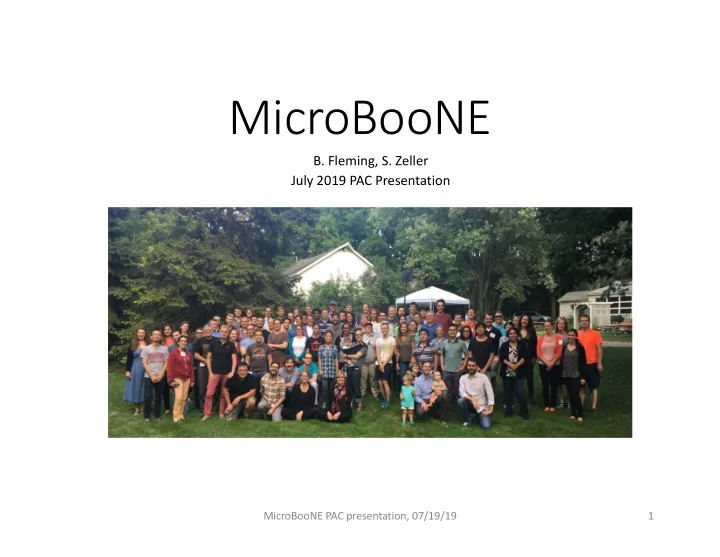
MicroBooNE B. Fleming, S. Zeller July 2019 PAC Presentation MicroBooNE PAC presentation, 07/19/19 1 Charge to MicroBooNE We would like to invite the MicroBooNE collaboration to present a Report on the MicroBooNE experiment at the next

slide-1
SLIDE 1

MicroBooNE

  • B. Fleming, S. Zeller

July 2019 PAC Presentation

MicroBooNE PAC presentation, 07/19/19 1

slide-2
SLIDE 2

MicroBooNE PAC presentation, 07/19/19 2

Charge to MicroBooNE

We would like to invite the MicroBooNE collaboration to present a “Report on the MicroBooNE experiment” at the next PAC Meeting in July 2019. The meeting will take place in downtown Chicago. The speaker is expected to review the following topics:

  • The current status of operations
  • Physics program for 2019-2020
  • Physics program for 2021 and beyond
  • The improvement to the simulation, reconstruction, and estimate of systematic uncertainties,

along with the expected impact on flagship analyses

  • How the recent results from the collaboration are informing the flagship analyses
  • The plan for reducing the systematic uncertainties (and how these are improved in MCC9)

[*] We ask the committee to review the short-term analysis plans for the collaboration over the next year, as well as its plans beyond this time scale, particularly in regard to the LEE analyses

slide-3
SLIDE 3

MicroBooNE PAC presentation, 07/19/19 3

MicroBooNE Organizational Chart

Spokespeople B.T. Fleming, S. Zeller

July 2019

Beam

  • A. Wickremasinghe

Detector Physics

  • R. Castillo Fernandez
  • W. Tang

Cross Sections

  • A. Furmanski
  • J. Mousseau

Astro Particle & Exotics

  • J. Crespo

Y-T. Tsai

Neutrino Division: Computing Sector:

Institutional Board Chair: A. Ereditato

Computing Sector Liaison

  • A. Mazzacane

Reconstruction

  • G. Cerati
  • E. Snider

Simulations

  • L. Jiang
  • H. Wei

Data and MC Production

  • L. Ren
  • W. Tang

Release Manager

  • C. Barnes
  • R. Itay

Accelerator Division:

DAQ: A. Ashkenazi, K. Duffy CRT: D. Lorca Cryo: Run Co Drift HV/TPC: J. Raaf Laser: Y. Chen MuCS: R. An Online: N. Tagg Slow Controls: S. Gollapinni

Operations

Run Coordinator: S. Berkman Deputy: Z. Pavlovic GENIE:

Analysis Tools

  • H. Greenlee, T. Usher

Physics Analysis

  • M. Weber

, M. Toups

Data Quality Management

  • P. Guzowski
  • P. Hamilton

Sub-system Leads

ESH&Q:

Beam Liaison

  • T. Kobilarcik

GENIE Liaison

  • S. Dytman

Experimental Liaison Officer (ELO)

  • C. Joe
  • C. McGivern (deputy)

Cryogenics

  • B. Norris

Division Safety Officer (ND)

  • A. Aparicio

Shift Policy Committee

Chair: S. Pate Calibrations

  • H. Rogers
  • W. Wu

Shift Manager

  • T. Strauss

Oscillations

  • J. Evans
  • W. Ketchum

Systematics

  • A. Ashkenazi
  • A. Mastbaum

PMTs: A. Hourlier PUBs: M. Kirby Readout: J. Crespo SLAM: B. King Trigger

  • D. Caratelli

Code of Conduct

Chair: E. Snider

Talks Committee

Chair: J. Spitz

Style Committee

Chair: S. Wolbers

Tech Board

Chair: T. Bolton

slide-4
SLIDE 4

MicroBooNE Operations

MicroBooNE PAC presentation, 07/19/19 4

  • have collected a total of 13.4x10²⁰ POT
  • 50% with full CRT installed and taking data
  • detector continues to operate well: 96% detector + DAQ uptime
  • BNB delivery has been excellent
  • very dedicated MicroBooNE team committed to operating the experiment
  • Sharing commissioning and operations tools, procedures, and experience with

ICARUS and SBND

POT accumulation/year: FY16: 3.6x10²⁰ POT FY17: 2.9x10²⁰ POT FY18: 3.1x10²⁰ POT FY19: 3.8x10²⁰ POT 13.4x10²⁰ POT

slide-5
SLIDE 5

MicroBooNE PAC presentation, 07/19/19 5

  • MicroBooNE is now the longest running LAr TPC to date
  • we have learned a lot about long term liquid argon purity, drift high voltage,

scintillation light, and cold electronics stability over time

  • Over time, detector contaminant level decreases. Recovery time from low

purity improves; recovery time: 6-9 days in early years, 2-3 days now

MicroBooNE Operations (cont’d)

slide-6
SLIDE 6

MicroBooNE PAC presentation, 07/19/19 6

  • We need more data with the CRT
  • presently we have ~6x10²⁰ POT with the CRT (50% of total data set)
  • would like to move closer to 13.2x10²⁰ POT with CRT
  • Impact of running with CRT
  • can remove >40% of cosmics for ne analyses
  • allows relaxation of cuts downstream and hence increases selection

efficiency for LEE analyses

  • Overlap in data taking with first data from ICARUS
  • good for overall SBN program

Motivation for FY2020 Running

we request endorsement of continued running through FY2020 as is planned for in FNAL Operations Plan

slide-7
SLIDE 7

7

CRT Performance

  • CRT performance over time is stable

in all 73 modules

  • simulation and data for hits in each

module are consistent above 100 PE threshold

  • CRT has been successfully merged

with in-tank events (important also for other SBN detectors)

JINST 14, P04004 (2019)

Corresponds to > 1 MIP

1 year

slide-8
SLIDE 8

MicroBooNE PAC presentation, 07/19/19 8

example of passing cosmic where associated shower is instead reconstructed by Pandora as a candidate ne (reconstructed quantities shown

  • ffset)
  • use of external detector (CRT) to reject events like this enables relaxed use of pattern

recognition with potential boost in efficiency. Quantitative analysis underway with MCC9.

  • R&D: important input to rest of SBN program to inform optimal selection for removing

isolated showers from cosmic ray activity, e.g. cylinder size 10cm à 14 cm?

Use of CRT as a Distance Tagger

slide-9
SLIDE 9

Running beyond FY2020…

MicroBooNE PAC presentation, 07/19/19 9

  • Continued running with CRT will improve analysis with initial

reduction in cosmic backgrounds in pre-selection phase (like all present surface LAr TPCs)

  • Collect increased statistics for signature analysis, rare

process analyses, differential and double differential cross section measurements

Signature results will guide decisions with respect to running beyond FY2020

slide-10
SLIDE 10

Lessons Learned from MicroBooNE

MicroBooNE PAC presentation, 07/19/19 10

  • First use of cold front-end electronics in a LAr TPC (JINST 12, P08003, 2017)
  • ASIC saturation: new generation ASICs now have additional input bias current settings
  • Wire vibrations: spacers have been added to support the anode wires in the design of new LAr TPCs to reduce vibrations and wire motion from fluid flow
  • Misconfigured channels: additional electrostatic discharge protection has been added on the configuration pins in next generation ASICs
  • ASIC startup: design margin of the bandgap reference circuit has been increased in the new ASIC design to remove start-up problems
  • Electronics environment: additional attention is being paid to grounding during building construction (e.g., SBND, ICARUS) and during detector installation
  • Offline noise filtering: MicroBooNE noise filtering approach and code had an immediate impact on the analysis of DUNE 35 ton and protoDUNE data (JINST 12, P08003, 2017)
  • Demonstration of very high argon purity without evacuation in a fully instrumented vessel (public note #1026)
  • Breakdown in high purity argon is a serious issue in the design of LAr TPCs (JINST 9, T11004, 2014, JINST 9, P11001, 2014)
  • Very stable liquid argon purity can be achieved for years at a time with a properly designed cryogenics systems (public note #1026)
  • Argon delivery schedule should be well thought-out in advance; filling is the largest source of thermal gradients; can be controlled with heaters and gas flow
  • Learned that there is a trade-off between the requirements on argon purity and drift high voltage that has become an important part of planning for DUNE
  • First use of a UV laser calibration system (public note #1055)
  • Electric field can be mapped using an in-situ steerable UV laser system; such a system is now under consideration for the DUNE far detector (JINST 9, T11007, 2014)
  • First high statistics measurement of space charge effects in a LAr TPC comparing measurements from cosmics and UV laser (public note #1018)
  • UV laser system requires special maintenance – lessons learned from MicroBooNE experience are being communicated to SBND
  • Lessons learned for future UV laser system designs in LAr communicated in a public note to DUNE for TDR preparation (public note #1055)
  • LAr TPC calibrations and TPC signal processing
  • 2D-deconvolution improves reconstruction of particle tracks in liquid argon (JINST 13, P07006, 2018, JINST 13, P07007, 2018)
  • Multiple Coulomb scattering parameters tuned for argon (JINST 12, P10010, 2017)
  • Michel electron energy spectrum needs to be corrected for large radiative effects in argon (JINST 12, P09014, 2017)
  • Anode/cathode piercing muon tracks can be used to measure argon purity in real-time for detector monitoring and subsequent data analysis (public notes #2016, #1048)
  • 39Ar beta decays as a possible calibration source for DUNE (public note #1050)
  • Long Term LAr TPC Operations
  • Lessons learned from commissioning MicroBooNE were documented and communicated to protoDUNE (MicroBooNE docdb #15878)
  • Developed means to inspect the integrity of wire planes inside a sealed cryostat (JINST 10, T08006, 2015)
  • Raised awareness of the need to be able to assess HV feedthrough connectivity during operations; developed novel means to use anode plane signals to assess real-time connectivity
  • Documented stability a LAr TPC over years of operations (public note #1013)
  • MicroBooNE developed the first implementation of a continuous readout stream for supernova neutrino physics (JINST 12, P02017, 2017)
  • Serious thought should be given to the reduction of LAr TPC data rates both through triggering and further development of data compression techniques
  • An unknown source of large single photoelectron rates can be present in a surface LAr TPC which can impact triggering considerations and data rates; comparing rates with protoDUNE-SP
  • Experience from MicroBooNE operations led to plans for both overburden and cosmic ray taggers for the SBND and ICARUS detectors (JINST 14, P04004, 2019)
  • Developing CRT to TPC matching and sharing with SBN
  • Neutrino Data Analysis
  • First detailed comparisons of neutrino kinematics in argon to GENIE (and other generator) predictions (arXiv:1905.09694, PRD99 091102(R) 2019, Eur.Phys. J. C79, 248, 2019)
  • First use of machine learning in the analysis of LAr TPC data (JINST 12, P03011, 2017, PRD99, 092001, 2019, public note #1051, #1042)
  • First tests of automated reconstruction on neutrino data and in the analysis of multiple different neutrino interaction types (public note #1049)
  • First development of tools to remove cosmic rays in neutrino interaction events (arXiv:1812.05679, public note #1005, JINST 12, P12030, 2017)
  • First demonstration of automated 3D shower reconstruction (public note #1012)
  • Reconstruction of protons down to low kinetmatic thresholds (public note #1056, #1053)
  • Validation and development of Pandora tool-kit also being used for DUNE and proto-DUNE using MicroBooNE neutrino data (Eur. Phys. J. C78, 1, 2018)
slide-11
SLIDE 11

Where Are We Going and Where Are We Now?

MicroBooNE PAC presentation, 07/19/19 11

  • a lot of new results since we last presented to the PAC
  • see next slides …
  • MicroBooNE is developing the technology both from the

hardware side and the analysis side

  • a lot of young people involved!
  • we have neutrino data and that is our competitive advantage
  • we are on track on many fronts
slide-12
SLIDE 12

Low Energy Excess (LEE) Analyses

MicroBooNE PAC presentation, 07/19/19 12

Pandora gLEE: Photon analysis Pandora eLEE : Electron analysis Deep Learning: new capabilities in topology, kinematics, and particle content WC + Pandora hybrid eLEE: upstream WC imaging + downstream hybrid Pandora toolset consolidated Pandora output à new toolset, impact on development of downstream cuts

Foundation for all analyses

Foundation of all analyses now have access to: Ø 2D deconvolution and signal processing Ø common optical filtering and improved track/flash matching Ø CRT tagging for improved upstream cosmic rejection Ø data-driven calibrations and systematic error determination Ø centralized data and Monte Carlo production

slide-13
SLIDE 13

MicroBooNE PAC presentation, 07/19/19 13

arXiv:1905.09694 submitted to PRL

CC Inclusive (nµ + Ar à µ + X)

  • 26k events (1.6x10²⁰ POT)
  • pioneering use of MCS to

include exiting tracks à full kinematic coverage

  • first neutrino double

differential cross section measurement on argon

  • Fermilab W&C seminar
  • n May 29, 2019

backwards going muons forward going muons

slide-14
SLIDE 14

MicroBooNE PAC presentation, 07/19/19 14

  • first comparison of event

generators to high statistics, 2D neutrino data on argon à first test “with fire”

  • MicroBooNE data prefers GENIE

(v3) with more sophisticated nuclear models (local FG, RPA)

  • GENIE is the most comprehensive

simulation which plans to support the broader neutrino physics program in the coming decade. MicroBooNE’s work with GENIE will ensure our data will be used in guiding improvements to modeling.

  • PRL referee: “Heard the MicroBooNE team

lead the developments for the release of GENIE v3. I read the note describing the

  • changes. Good work and thank you on behalf
  • f the rest of the community.”

CC Inclusive (nµ + Ar à µ + X)

arXiv:1905.09694 submitted to PRL

slide-15
SLIDE 15

MicroBooNE PAC presentation, 07/19/19 15

Many New Neutrino Results

  • have also studied multiple exclusive modes
  • important basis for demonstrating that we understand neutrino

interactions on argon for LEE

public note #1056 public note #1056 public note #1056 arXiv:1905.09694 submitted to PRL

slide-16
SLIDE 16

MicroBooNE PAC presentation, 07/19/19 16

MicroBooNE public note #1056

  • we can successfully identify protons
  • multiplicity distribution provides

important check of nuclear effects, FSI modeling

  • direct relevance to LEE analyses that

preferentially select nucleon final states (1p, Np)

Proton Multiplicity

slide-17
SLIDE 17

MicroBooNE PAC presentation, 07/19/19 17

MicroBooNE public note #1056

  • kinematics impacted by short range

correlations and FSI

  • distribution can look very different

for different generators

  • data-driven check of potential feed-

down into LEE 1p channels

1µ2p (nµ + Ar à µ + 2p)

q2p

slide-18
SLIDE 18

MicroBooNE PAC presentation, 07/19/19 18

Moving Now from Tracks to Showers …

slide-19
SLIDE 19

CC p0 (nµ + Ar à µ + p0)

MicroBooNE PAC presentation, 07/19/19 19

PRD 99, 091102(R), 2019

  • electron and photon

reconstruction is key to neutrino

  • scillation measurements
  • MicroBooNE has developed the

first fully automated reconstruction tools for EM reconstruction in LAr TPCs

  • observe 20% energy resolution

with good data/MC agreement

  • first measurement of nµ CC p0

cross section on argon

  • validates p0 production in argon

(x2 higher predicted absorption rate than in hydrocarbon)

new paper on p0 reconstruction coming soon

slide-20
SLIDE 20

ne from NuMI Beam

MicroBooNE PAC presentation, 07/19/19 20

MicroBooNE public note #1054

  • MicroBooNE sits 80 off axis from the NuMI beam
  • NuMI beam is a source of ne’s in MicroBooNE
  • similar energy as BNB ne’s
  • fully automated ne selection and reconstruction
  • first e/g separation in MicroBooNE
slide-21
SLIDE 21

MicroBooNE PAC presentation, 07/19/19 21

Additional On-Going Neutrino Analyses

  • nµ NC elastic scattering
  • proton identification and reconstruction
  • with low proton detection thresholds,

we are at the forefront

  • MicroBooNE public note #1053
  • nµ NC p0 production
  • crucial background constraint for g LEE
  • MicroBooNE public note #1041
slide-22
SLIDE 22

MicroBooNE PAC presentation, 07/19/19 22

We Are Even Reconstructing Kaons

  • relevant for DUNE nucleon decay sensitivity validations
  • plan to measure neutrino-induced rate of kaon production in argon
slide-23
SLIDE 23

What We Are Learning for LEE

MicroBooNE PAC presentation, 07/19/19 23

neutrino results role in developing LEE analysis

charged track multiplicity initial combined tests of GENIE modeling of argon, detector simulation, vertex and track reconstruction CC inclusive muon identification and reconstruction, cosmic rejection, initial evaluation of detector systematics for tracks, central value GENIE selection using 2D kinematics CC p0, NC p0 shower reconstruction, initial evaluation of detector systematics for showers, background constraint CC Np, CC 1p, CC 2p calorimetry, recombination, proton ID, understanding systematics for 1p final states, migration in/out of 1p channel, cosmic rejection for 1mu1p final states NuMI ne electron identification and reconstruction using data, dE/dx for electrons

  • Eur. Phys. J. C79, 248 (2019)

arXiv:1905.09694 PRD99, 091102(R) (2019) public note #1056 arXiv:1812.05679 public note #1054

slide-24
SLIDE 24

What We Are Learning for LEE

MicroBooNE PAC presentation, 07/19/19 24

detector physics & reconstruction role in developing LEE analysis

electric field data-driven electric field maps MicroBooNE public note #1055 dQ/dx à dE/dx calibration detector uniformity, calorimetry validation paper currently in collaboration review Wire Cell

  • ptical reconstruction, flash-track matching, cosmic rejection

arXiv:1803.04850 Wire Cell imaging performance 2-track reconstruction Deep Learning-based LEE 1µ1p analysis reconstruction validation MicroBooNE public note #1042 and performance paper currently in collaboration review electromagnetic PID Deep Learning network demonstration, validation, and PRD99, 092001 (2019) and performance data-driven reconstruction studies tracking, MCS performance, vertex finding MicroBooNE public note #1049 p0 reconstruction improved shower reconstruction with SSNet, dE/dx for photons paper currently in collaboration review

slide-25
SLIDE 25

Recent Progress

MicroBooNE PAC presentation, 07/19/19 25

  • MicroBooNE has a well-operating detector and large neutrino data

samples that are being analyzed

  • We have a mature software framework (Major collaboration wide effort!)

(through 3 major releases: MCC7 à MCC8 à MCC9)

  • simulation tuned to MicroBooNE data
  • fully calibrated data and Monte Carlo
  • robust reconstruction tools
  • use of data-driven methods in as many places as possible
  • MCC8 is producing physics publications now, but we need the

improvements in MCC9 for our signature LEE results

slide-26
SLIDE 26

MCC9

MicroBooNE PAC presentation, 07/19/19 26

  • MicroBooNE has incorporated significant improvements in MCC9
  • This has been a major collaboration-wide effort
  • Improved Signal processing, better dynamic induced charge model

(JINST 13, P07006 (2018), JINST 13, P07007 (2018))

  • CRT is bringing new information from an entirely new system
  • Making use of data-driven methods to replace simulation

(electric field maps, cosmic data overlays, data-driven calibrations, etc.)

  • Upgraded GENIE with improved physics models
  • Better use of induction planes for reconstruction and calorimetry
  • Creation of lighter files for faster processing of higher level reconstruction

(MCC8: > 50 MB/evt à MCC9: < 7 MB/evt; months à weeks of processing time)

  • These are not tweaks
slide-27
SLIDE 27

Plan for Reducing Systematic Uncertainties

MicroBooNE PAC presentation, 07/19/19 27

  • uncertainty table from nµ CC inclusive cross section measurement

(arXiv:1905.09694) dominated by uncertainty in induced charge effects (13%); and E-field effects (see next slide) CRT & improved reconstruction will help reduce out of detector backgrounds will be reduced with use of cosmic data overlays

slide-28
SLIDE 28

MicroBooNE PAC presentation, 07/19/19 28

Data-Driven Electric Field Maps

  • we are no longer using simulation for

mapping the electric field in MicroBooNE

  • this is new in MCC9 and will reduce space

charge uncertainties in MicroBooNE

  • public note on UV laser produced as input

to DUNE Technical Design Report (TDR)

MicroBooNE public note #1055 distortion map using laser data

slide-29
SLIDE 29

MCC9

MicroBooNE PAC presentation, 07/19/19 29

  • extensive development of advanced techniques for noise filtering and signal

processing (JINST 12, P08003 (2017), JINST 13, P07006 (2018), JINST 13, P07007 (2018))

slide-30
SLIDE 30

30

  • with proper de-convolution, are able to pick out more detail especially in

induction planes; clarity is better with improved signal processing

MicroBooNE PAC presentation, 07/19/19

induction planes induction planes collection plane

MCC8 MCC9

collection plane

slide-31
SLIDE 31

MicroBooNE PAC presentation, 07/19/19 31

  • separate tracks (yellow) and showers (cyan) to aid in downstream

reconstruction

  • validated in data with stopping muons and CC p0 events
  • disagreement between network and human labeling at the 2.5%

level; data/MC is consistent

PRD 99, 092001 (2019)

SSNet Hit Tagging

DOE Science highlight Jan 2019

slide-32
SLIDE 32

nµ CC Inclusive Analysis

MicroBooNE PAC presentation, 07/19/19 32

MCC8 MCC9

  • improved data/MC agreement in drift direction due to improved signal processing
slide-33
SLIDE 33

dE/dx

MicroBooNE PAC presentation, 07/19/19 33

  • large data/MC

disagreement in MCC8 à adhoc modeling done to try and reproduce

  • bserved shape
  • with 2D de-

convolution, agreement is much better in MCC9 in modeling low level signals

  • allows us to make

more use of induction planes

MCC8 MCC9

dQ/dx (U plane) dQ/dx (V plane)

slide-34
SLIDE 34

Proton Reconstruction: much better at proton ID at low energies à better hit

finding efficiency, better pattern recognition, better data/MC agreement à puts it all together!

MicroBooNE PAC presentation, 07/19/19 34

slide-35
SLIDE 35

Physics Program in 2019-2020

MicroBooNE PAC presentation, 07/19/19 35

  • Get out our first low energy excess results
  • Crucial add’l supporting work that is needed and in progress
  • comprehensive calibration paper
  • trigger efficiency paper
  • scintillation light yield paper
  • electric field paper (using cosmics and laser)
  • Putting the result in context
  • if we confirm MiniBooNE, what is the nature of the excess?
  • is it electrons or photons?
slide-36
SLIDE 36

Physics Program Beyond 2020

MicroBooNE PAC presentation, 07/19/19 36

MicroBooNE’s publication plans …

Low Energy Excess

  • Low Energy Excess (LEE) update(s)

à depends on what we see

  • MicroBooNE nµ/ne fitting method
  • joint analyses with SBN

Astroparticle Physics and Exotics

  • heavy sterile neutrino search in BNB
  • heavy sterile neutrino search in NuMI
  • supernova neutrino readout stream
  • dark tridents (e+e- final states)

Detector Physics

  • calibrations (long term time dependence)
  • scintillation light yields & triggering
  • electric field maps (laser + cosmics)
  • diffusion
  • Recombination
  • Ar39

Neutrino Cross Sections

  • updated CC p0
  • updated CC inclusive
  • CC Np
  • CC 1p
  • CC Np
  • CC 0p (MiniBooNE-like)
  • NuMI ne
  • NC elastic
  • NC p0
  • CC p+
  • CC coherent p+
  • kaon production
  • NuMI KDAR
  • transverse kinematics

Reconstruction

  • updated p0 reconstruction
  • updated Michel e-
  • flash-track matching
  • many-to-many flash matching
  • CRT-TPC matching
  • Wire Cell imaging
  • PMT reconstruction
  • MeV activity in a LAr TPC
  • cosmic-correlated activity
  • data-driven reconstruction

performance validation

  • Deep Learning advances
slide-37
SLIDE 37

37

MicroBooNE Collaboration

*spokespeople

University of Bern, Switzerland: Y. Chen, A. Ereditato, I. Kreslo, D. Lorca, M. Lüethi, T. Mettler, J. Sinclair, M. Weber Brookhaven: M. Bishai, H. Chen, W. Gu, X. Ji, B. Kirby, Y. Li, X. Qian, B. Viren, H. Wei, C. Zhang University of California, Santa Barbara: X. Luo University of Cambridge: J. Anthony, L. Escudero Sanchez, A. Smith, M. Uchida University of Chicago: K. Miller, D.W. Schmitz University of Cincinnati: R.A. Johnson Colorado State University: I. Caro Terrazas, R. LaZur, M. Mooney Columbia University: D. Cianci, J. Crespo, Y.-J. Jwa, G. Karagiorgi, M. Ross-Lonergan, W. Seligman, M. Shaevitz, K. Sutton Davidson College: B. Eberly Fermilab: S. Berkman, D. Caratelli, R. Castillo Fernandez, F. Cavanna, G. Cerati, K. Duffy, S. Gardiner, E. Gramellini, H. Greenlee, C. James, W. Ketchum,

  • M. Kirby, T. Kobilarcik, S. Lockwitz, A. Marchionni, S. Marcocci, T. Mohayai, O. Palamara, Z. Pavlovic, J.L. Raaf, A. Schukraft, E. Snider, P. Spentzouris,
  • M. Stancari, J. St. John, T. Strauss, M. Toups, S. Wolbers, M. Wospakrik, W. Wu, T. Yang, G.P. Zeller*, J, Zennamo

University of Granada: D. Gamez Harvard University: M. Del Tutto, N. Foppiani, R. Guenette, J. Martin-Albo, S. Prince, R. Soleti Illinois Institute of Technology: R. An, I. Lepetic, B. Littlejohn Kansas State University: M. Alrashed, T. Bolton, G. Horton-Smith, K. Neely, V. Meddage. A. Paudel Lancaster University: A. Blake, D. Devitt, J. Nowak Los Alamos: E-C. Huang, W.C. Louis, T. Thornton, R. Van de Water Manchester: V. Basque, A. Bhanderi, J. Evans, O. Goodwin, P. Green, P. Guzowski, N. McConkey, K. Mistry, D. Porzio, S. Söldner-Rembold, A.M. Szelc University of Michigan, Ann Arbor: C. Barnes, R. Fitzpatrick, J. Mousseau, J. Spitz University of Minnesota: A. Furmanski MIT-HEP: J.M. Conrad, A. Hourlier, J. Moon, L. Yates; MIT-NP: A. Ashkenazi, O. Hen, A. Papadopoulou New Mexico State University: V. Papavassiliou, S.F. Pate, L. Ren, S. Sword-Fehlberg Otterbein University: N. Tagg University of Oxford: G. Barr, W. Van De Pontseele University of Pittsburgh: S. Dytman, L. Jiang, D. Naples, V. Paolone Pacific Northwest National Laboratory: E. Church Rutgers: A. Mastbaum

  • St. Catherine University: H. Rogers

Saint Mary’s University of Minnesota: P. Nienaber SLAC: M. Convery, L. Domine, R. Itay, L. Rochester, K. Terao, Y-T. Tsai, T. Usher South Dakota School of Mines & Technology : A. Fiorentini, D. Martinez, J. Rodriguez Rondon Syracuse University: A. Bhat, P. Hamilton, G. Pulliam, M. Soderberg Tel Aviv University: E. Cohen, E. Piasetzky University of Tennessee, Knoxville: S. Gollapinni, A. Mogan, W. Tang, G. Yarbrough University of Texas at Arlington: J. Asaadi, Z. Williams Tufts University: K. Mason, J. Mills, R. Sharankova, T. Wongjirad Virginia Tech: L. Gu, C. Mariani, M. Murphy, V. Pandey University of Warwick: J. Marshall Yale University: S. Balasubramanian, L. Cooper-Troendle, B.T. Fleming*, D. Franco, J.H. Jo, B. Russell, G. Scanavini

170 collaborators 38 institutions 41 postdocs 47 grad students (30% international) since last PAC, we have added 7 new institutions:

  • UCSB
  • Granada
  • Minnesota
  • Rutgers
  • St. Catherine
  • SDSMT
  • Warwick
slide-38
SLIDE 38

MicroBooNE Postdoc Placement

MicroBooNE PAC presentation, 07/19/19 38

  • ~80% of former postdocs remain in

particle physics (35/42)

  • ~70% have remained on MicroBooNE
  • faculty placements in 2018-2019
  • Brandon Eberly, Davidson
  • Andy Furmanski, Minnesota
  • Xiao Luo, UCSB
  • John Marshall, Warwick
  • David Martinez, SDSM&T
  • Andy Mastbaum, Rutgers
  • Hannah Rogers, St Catherines
  • Serhan Tufanli, CERN Fellowship
  • Joseph Zennamo, Wilson Fellow
slide-39
SLIDE 39

MicroBooNE Grad Student Placement

MicroBooNE PAC presentation, 07/19/19 39

  • out of 19 former

MicroBooNE graduate students, 14 remain in particle physics and 5 have private sector jobs

slide-40
SLIDE 40

MicroBooNE PAC presentation, 07/19/19 40

We have a very good team. We are on track on many fronts…

MCC9 campaign incredibly impactful for us and incredibly impactful for SBN and DUNE We are seeing all the ripple effects downstream We ask for your endorsement of FY2020 running

MCC8 MCC9