
SLIDE 1
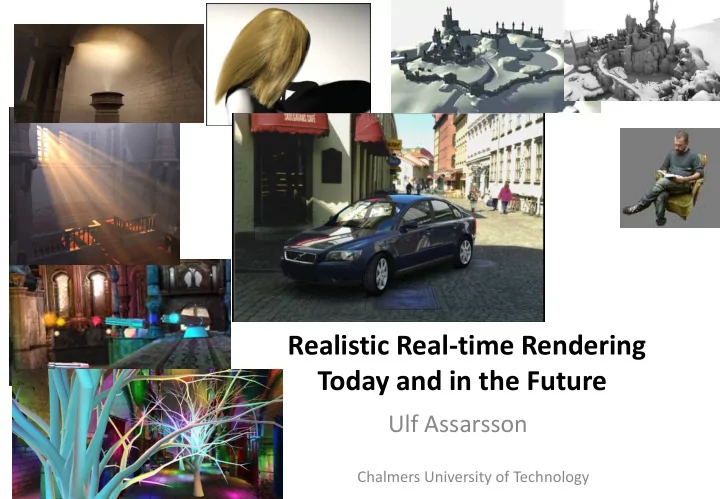
Realistic Real-time Rendering Today and in the Future
Ulf Assarsson
Chalmers University of Technology
Realistic Real-time Rendering Today and in the Future Ulf Assarsson - - PowerPoint PPT Presentation
Realistic Real-time Rendering Today and in the Future Ulf Assarsson Chalmers University of Technology Department of Computer Engineering The screen consists of pixels Department of Computer Engineering Grafikkort Department of Computer
Chalmers University of Technology
Department of Computer Engineering
Department of Computer Engineering
Department of Computer Engineering
Z X Y
Department of Computer Engineering
Department of Computer Engineering
Department of Computer Engineering
+ =
Department of Computer Engineering
Department of Computer Engineering
light
Department of Computer Engineering
Materials Reflections Shadows Fire Water Airlight
Typical test box (Cornell box), often compared to actual photograph:
0 bounces 1 bounce 2 bounces 4 bounces 8 bounces infinite bounces
~20 to ~1015 photons/s
The eye has a resolution of 130M receptors: 120M gray scale (rods / stavar) 7M color (cones / tappar)
problem would be limited.
photons from light to eye.
photon
Sunny day outdoor scene: ~ 1021 photons/m2s
Facts:
photons is as noticable as for 1010 or 2*1010 photons
Beast used in e.g.: WET (A2M) Mirror's Edge (EA Digital Illusions Creative Entertainment) Mortal Kombat (Midway) EVE Online (CCP Games) CrimeCraft (Vogster Entertainment LLC) Alpha Protocol (Obsidian Entertainment Inc) Dragon Age: Origins (BioWare) God of War III [8] (Sony Computer Entertainment) Gran Turismo (Polyphony Digital) and also the Unreal Engine
Illuminate Labs produkt “Beäst” för realistisk belystning i spel
19 5 100 1 63 79 1 5 19 63 79 100 e.g. sorting:
Avalanche Studios Bosch Intel Fallout 4, NVIDIA
Our Research
Projects
Millions of lights (games)
Airlight (games)
Hair and Fur (games) Shadows (games) Scene compression Free Viewpoint Video GPGPU
Splinter Cell Sim City Infamous 2
http://www.cse.chalmers.se/~uffe/mindary/demo/v2.html
The color of a reflective surface is view dependent. So, what color should we use?
1. View-dependent colors. (here also different exposure times for the two cameras). The more reflective surface, the larger the problem. “Solution”:
photographing.
reflections when visualizing the 3D scene. Very reflective surfaces (e.g. mirror) does not work.
The most important 1st light bounces (i.e., sharp and glossy reflections)
The most important 1st light bounces (i.e., sharp and glossy reflections) Combinig photo textures and computer-generated view- dependent reflections
Why use voxels? Autodesk fluid simulation
RealFlow by nextLimit
0 1
1
Each node has eight children, representing an
0 1
1
Each node has eight children, representing an
– Naively: 262 TB – We => < 1GB
0 1
1
For identical subgraphs, only store one instance, and point to that instance.
Epic Citadel
Resolution: 128K × 128K × 128K Number of nodes SVO: 5.5 billion DAG: 45 million (0.8%)
Hairball
Resolution: 8K × 8K × 8K Number of nodes SVO: 781 million DAG: 44 million (5.6%) Identical colors are identical subvolumes of size 4 × 4 × 4
Node occurrence 370 586 70 915 69 974 37 326 10 987 275 143
0 1
1
Geometry: Voxel colors: Three problems: 1. How can we compress the colors efficiently? 2. Connection between voxels and their colors 3. Fast color lookups
frames
For every time step (=frame) in a dynamic scene, convert the whole voxelized 3D scene to a DAG: 70 frames 2048³ grid Length: 2.9 sec @24Hz 1.9 MiB (=2.3 GiB/hour) 5.2 Mbits/s
70 frames 2048³ grid Length: 2.9 sec @24Hz 1.9 MiB (=2.3 GiB/hour) 5.2 Mbits/s
Want: 1. convert a real scene to 3D graphics, 24 times/second. 2. Render scene from any viewpoint.
Med 2 eller fler kameror kan man beräkna djup – precis som våra ögon.
Med 2 eller fler kameror kan man beräkna djup – precis som våra ögon.
Med 2 eller fler kameror kan man beräkna djup – precis som våra ögon.
Med 2 eller fler kameror kan man beräkna djup – precis som våra ögon. Varje kub ~1cm3. Önskar ~1mm3
480 frames 512³ grid 20 sec @24Hz 5.2 MiB 0.9 GiB/hour 2.1 Mbits/s
500 photos, static scene. Precomputation time: hours We: 3 cameras, dynamic scene. Precomputation time: 5 minutes.
Microsoft: ~100 cameras, triangles Precomputation time: ~100 hours.
Our method:
away input data.
But we still have no view-dependent colors. I.e., no reflections that change with the view position
kamerornas foton.
60:ies 2000
80:ies 2010
Oculus Rift HTC Vive
– Holodeck (maybe in a few decades) – Or plug into brain like in Matrix…
– 3D printers – Mid-air displays – Virtual matter (particles)