Real World Example Big Picture Computer Overview (Chapter 1) - - PowerPoint PPT Presentation

real world example
SMART_READER_LITE
LIVE PREVIEW

Real World Example Big Picture Computer Overview (Chapter 1) - - PowerPoint PPT Presentation

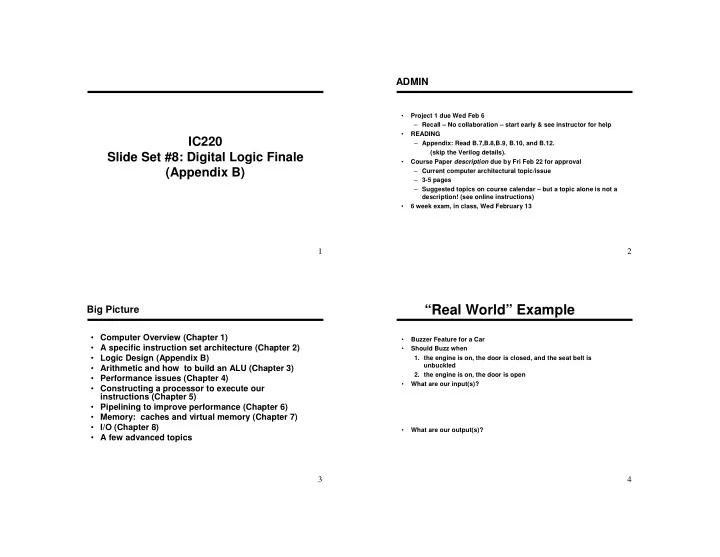
ADMIN Project 1 due Wed Feb 6 Recall No collaboration start early & see instructor for help READING IC220 Appendix: Read B.7,B.8,B.9, B.10, and B.12. (skip the Verilog details). Slide Set #8: Digital Logic Finale


slide-1
SLIDE 1

1

IC220 Slide Set #8: Digital Logic Finale (Appendix B)

2

ADMIN

  • Project 1 due Wed Feb 6

– Recall – No collaboration – start early & see instructor for help

  • READING

– Appendix: Read B.7,B.8,B.9, B.10, and B.12. (skip the Verilog details).

  • Course Paper description due by Fri Feb 22 for approval

– Current computer architectural topic/issue – 3-5 pages – Suggested topics on course calendar – but a topic alone is not a description! (see online instructions)

  • 6 week exam, in class, Wed February 13

3

Big Picture

  • Computer Overview (Chapter 1)
  • A specific instruction set architecture (Chapter 2)
  • Logic Design (Appendix B)
  • Arithmetic and how to build an ALU (Chapter 3)
  • Performance issues (Chapter 4)
  • Constructing a processor to execute our

instructions (Chapter 5)

  • Pipelining to improve performance (Chapter 6)
  • Memory: caches and virtual memory (Chapter 7)
  • I/O (Chapter 8)
  • A few advanced topics

4

“Real World” Example

  • Buzzer Feature for a Car
  • Should Buzz when
  • 1. the engine is on, the door is closed, and the seat belt is

unbuckled

  • 2. the engine is on, the door is open
  • What are our input(s)?
  • What are our output(s)?
slide-2
SLIDE 2

(extra space)

6

Check Yourself

  • Could you have filled in the truth table?
  • Could you have filled in the K-Map?
  • Can you use the K-Map to minimize the equation?
  • Can you draw the circuit?

7

Bigger Units of Combinational Logic

  • Gates useful but fairly low level
  • Easier to constructs circuits with higher-level building blocks

instead: – Combinational Logic

  • Multiplexors (mux)
  • Decoders

– (later) Sequential Logic

  • Registers
  • Arithmetic unit (ALU)
  • What is this an example of?

8

Multiplexor – Example Usage

Adder

$t0 $t1 $t2 $a3 $a2

slide-3
SLIDE 3

9

Multiplexor – 1-bit version

  • Think of a mux as a selector
  • S selects one input to be the output
  • N-way mux has

– # inputs: – # selector lines (S): – # outputs:

  • Implementation?

D0 D1 D2 D3 S0 S1 EN Q

10

Multiplexor – Wider version

  • 32 bit wide, 2-way Mux:
  • Pictures don’t always show the width

(especially if 32 bits)

EX: B-31 to B-32

11

End of Combinational Logic

12

Combinational vs. Sequential Logic

  • Combinational Logic – output depends only on
  • Sequential Logic – output depends on:
  • Previous inputs are stored in “state elements”

– __________ determines when an element is updated

  • State elements will involve use of feedback in circuit

– Not permitted in combinational circuits

slide-4
SLIDE 4

13

Truth Tables

  • Next State Tables
  • New kind of input:

1 1 1 1 1 1 1 1 1 A 1 1 1 1 1 1 1 Qt+1 Qt B

14

Clocks and State Elements

  • Clock Frequency is the __________ of _______________.
  • When should updates occur to state elements?

– Edge – change state when – Level – change state when

15

D-Type Flip Flop

  • State only changes
  • Otherwise…

remembers previous state

  • Abstraction:

D C Q

Q-flipflop

EX: B-41

16

State Diagrams

  • State = Contents of memory
  • Diagrams are a tool to

represent ALL transitions from one state to another – What causes state changes?

  • Example for D Flip-Flop:

Q=0 Q=1

slide-5
SLIDE 5

17

Finite State Machines

  • Can use state diagrams to express more complex sequential logic.
  • Example: Candy Machine

– Inputs: N (nickel received), D (dime received) – Outputs: C (dispense candy), R (give refund) – Should dispense candy after 15 cents deposited, + refund if

  • verpaid. Then await next customer.
  • We’ll use Moore machine – output depends only on
  • What states do we need?

18

Example: Candy Machine

Inputs: (N)ickel, (D)ime Outputs: (C)andy, (R)efund

EX: B-51 to B-53

19

Implementing Finite State Machines

  • Squares =
  • Circles =
  • We don’t always show the clock for registers/memory diagrams, but

will be implicit

20

FSM Example

slide-6
SLIDE 6

21 Combining Combinational and Sequential Logic

  • Finite State Machine was our first example of this
  • Two general patterns:

1. State Machine 2. Pipeline

  • In either case, have important timing concerns

– Output of combinational logic block may oscillate before settling – Clock cycle time must be long enough so combo-logic settles before the sequential logic (state) reads the new value – State elements ensure that combo-logic inputs remain stable

22

Registers and Register Files

  • Registers store data (bits) (i.e. have memory)

– Each register =

  • Register files contain:

– Set of registers – Logic for read/write

  • MIPS register file has how

many registers?

  • How does it store data?
  • How does it know which

register to access?

23

Memory

  • Why so many types?
  • Basic types:

– RAM “random access memory” (read/write)

  • Main memory
  • Volatile
  • Types:

– SRAM – async, sync, pipeline burst, cache; – DRAM – M, FPM, EDO, burst EDO, sync, DR, DDR

– ROM (read only)

  • Small
  • Stores critical operating instruction (BOOT strap)
  • Non-volatile
  • Common in embedded system (toys, cameras, printers, etc)
  • Types: PROM, EPROM, EEPROM, flash memory

24

Appendix B Summary

  • Truth tables and Gates

– AND, OR, NOT, NOR, NAND, XOR

  • Boolean Algebra

– Distributive, DeMorgan’s, Inverse, Identity, etc

  • Combinational Logic

– Circuits – Design, reduction / minimization, K-maps – Multiplexor

  • Sequential Logic

– Flip/flops – Clock & state diagrams

  • Register files
  • Memory

– RAM vs ROM, SRAM vs. DRAM