SLIDE 1 readme
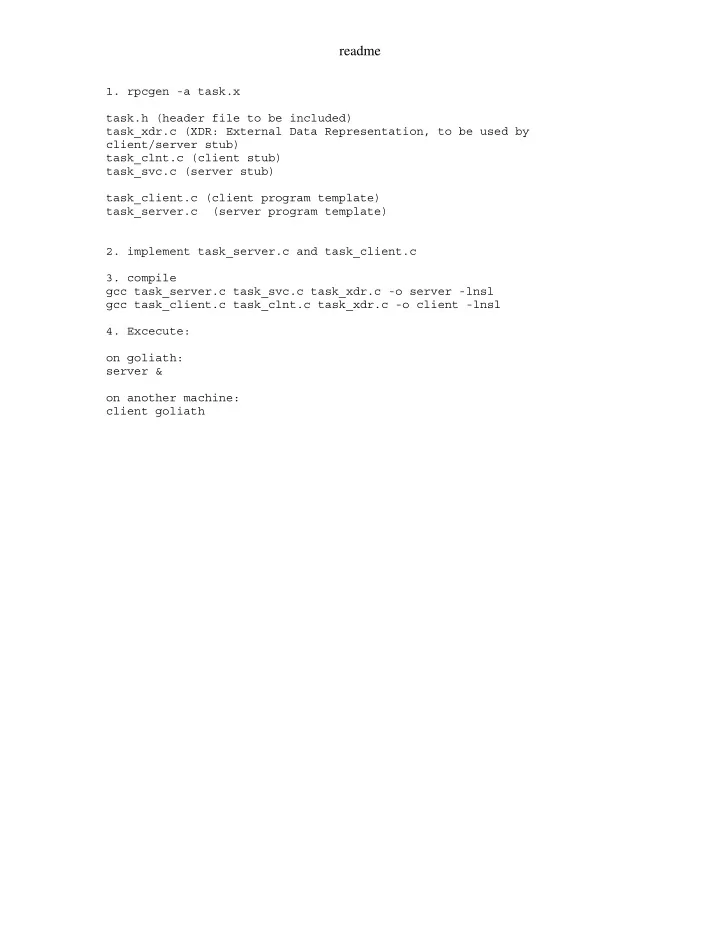
task.h (header file to be included) task_xdr.c (XDR: External Data Representation, to be used by client/server stub) task_clnt.c (client stub) task_svc.c (server stub) task_client.c (client program template) task_server.c (server program template)
- 2. implement task_server.c and task_client.c
- 3. compile
gcc task_server.c task_svc.c task_xdr.c -o server -lnsl gcc task_client.c task_clnt.c task_xdr.c -o client -lnsl
server &
client goliath
SLIDE 2
task.x
const MAX=10000; struct programarg{ char file[MAX]; int length; }; struct taskarg{ char file[MAX]; int length; int id; }; program EXECTASK { version VERSION { int SET_TASK(programarg)=1; taskarg EXEC_NEXT_TASK()=2; }=1; }=9999;
SLIDE 3
task.h
/* * Please do not edit this file. * It was generated using rpcgen. */ #ifndef _TASK_H_RPCGEN #define _TASK_H_RPCGEN #include <rpc/rpc.h> #define MAX 10000 struct programarg { char file[MAX]; int length; }; typedef struct programarg programarg; struct taskarg { char file[MAX]; int length; int id; }; typedef struct taskarg taskarg; #define EXECTASK 9999 #define VERSION 1 #define SET_TASK 1 extern int * set_task_1(); #define EXEC_NEXT_TASK 2 extern taskarg * exec_next_task_1(); extern int exectask_1_freeresult(); /* the xdr functions */ extern bool_t xdr_programarg(); extern bool_t xdr_taskarg(); #endif /* !_TASK_H_RPCGEN */
SLIDE 4
task_xdr.c
/* * Please do not edit this file. * It was generated using rpcgen. */ #include "task.h" bool_t xdr_programarg(xdrs, objp) register XDR *xdrs; programarg *objp; { #if defined(_LP64) || defined(_KERNEL) register int *buf; #else register long *buf; #endif int i; if (!xdr_vector(xdrs, (char *)objp->file, MAX, sizeof (char), (xdrproc_t) xdr_char)) return (FALSE); if (!xdr_int(xdrs, &objp->length)) return (FALSE); return (TRUE); } bool_t xdr_taskarg(xdrs, objp) register XDR *xdrs; taskarg *objp; { #if defined(_LP64) || defined(_KERNEL) register int *buf; #else register long *buf; #endif int i; if (!xdr_vector(xdrs, (char *)objp->file, MAX, sizeof (char), (xdrproc_t) xdr_char)) return (FALSE); if (!xdr_int(xdrs, &objp->length)) return (FALSE); if (!xdr_int(xdrs, &objp->id)) return (FALSE); return (TRUE); }
SLIDE 5
task_clnt.c
/* * Please do not edit this file. * It was generated using rpcgen. */ #include "task.h" #ifndef _KERNEL #include <stdio.h> #include <stdlib.h> /* getenv, exit */ #endif /* !_KERNEL */ /* Default timeout can be changed using clnt_control() */ static struct timeval TIMEOUT = { 25, 0 }; int * set_task_1(argp, clnt) programarg *argp; CLIENT *clnt; { static int clnt_res; memset((char *)&clnt_res, 0, sizeof (clnt_res)); if (clnt_call(clnt, SET_TASK, (xdrproc_t) xdr_programarg, (caddr_t) argp, (xdrproc_t) xdr_int, (caddr_t) &clnt_res, TIMEOUT) != RPC_SUCCESS) { return (NULL); } return (&clnt_res); } taskarg * exec_next_task_1(argp, clnt) void *argp; CLIENT *clnt; { static taskarg clnt_res; memset((char *)&clnt_res, 0, sizeof (clnt_res)); if (clnt_call(clnt, EXEC_NEXT_TASK, (xdrproc_t) xdr_void, (caddr_t) argp, (xdrproc_t) xdr_taskarg, (caddr_t) &clnt_res, TIMEOUT) != RPC_SUCCESS) { return (NULL); } return (&clnt_res); }
SLIDE 6
task_clnt.c
/*
1 2 3 4 5 6 7 8 9 10 11 12 13 14 15 16 17 18 19 20 21 22 23 24 25 26 27 28 29 30 31 32 33 34 35 36 37 38 39 40 41 42 43 44 45 46 47 48 49 50 51 52 53 54 55 56
* Please do not edit this file. * It was generated using rpcgen. */ #include "task.h" #include <stdio.h> #include <stdlib.h> /* getenv, exit */ #include <signal.h> #include <sys/types.h> #include <memory.h> #include <stropts.h> #include <netconfig.h> #include <sys/resource.h> /* rlimit */ #include <syslog.h> #ifdef DEBUG #define RPC_SVC_FG #endif #define _RPCSVC_CLOSEDOWN 120 static int _rpcpmstart; /* Started by a port monitor ? */ /* States a server can be in wrt request */ #define _IDLE 0 #define _SERVED 1 static int _rpcsvcstate = _IDLE; /* Set when a request is serviced */ static int _rpcsvccount = 0; /* Number of requests being serviced */ static void _msgout(msg) char *msg; { #ifdef RPC_SVC_FG if (_rpcpmstart) syslog(LOG_ERR, msg); else (void) fprintf(stderr, "%s\n", msg); #else syslog(LOG_ERR, msg); #endif } static void closedown(sig) int sig; { if (_rpcsvcstate == _IDLE && _rpcsvccount == 0) { int size; int i, openfd = 0; size = svc_max_pollfd; for (i = 0; i < size && openfd < 2; i++) if (svc_pollfd[i].fd >= 0)
SLIDE 7 task_svc.c
57 58 59 60 61 62 63 64 65 66 67 68 69 70 71 72 73 74 75 76 77 78 79 80 81 82 83 84 85 86 87 88 89 90 91 92 93 94 95 96 97 98 99 100 101 102 103 104 105 106 107 108 109 110 111 112 113
if (openfd <= 1) exit(0); } else _rpcsvcstate = _IDLE; (void) signal(SIGALRM, (void(*)()) closedown); (void) alarm(_RPCSVC_CLOSEDOWN/2); } static void exectask_1(rqstp, transp) struct svc_req *rqstp; register SVCXPRT *transp; { union { programarg set_task_1_arg; } argument; char *result; bool_t (*_xdr_argument)(), (*_xdr_result)(); char *(*local)(); _rpcsvccount++; switch (rqstp->rq_proc) { case NULLPROC: (void) svc_sendreply(transp, xdr_void, (char *)NULL); _rpcsvccount--; _rpcsvcstate = _SERVED; return; case SET_TASK: _xdr_argument = xdr_programarg; _xdr_result = xdr_int; local = (char *(*)()) set_task_1; break; case EXEC_NEXT_TASK: _xdr_argument = xdr_void; _xdr_result = xdr_taskarg; local = (char *(*)()) exec_next_task_1; break; default: svcerr_noproc(transp); _rpcsvccount--; _rpcsvcstate = _SERVED; return; } (void) memset((char *)&argument, 0, sizeof (argument)); if (!svc_getargs(transp, _xdr_argument, (caddr_t) &argument)) { svcerr_decode(transp); _rpcsvccount--; _rpcsvcstate = _SERVED; return; } result = (*local)(&argument, rqstp);
SLIDE 8 task_svc.c
if (result != NULL && !svc_sendreply(transp, _xdr_result, result)) {
114 115 116 117 118 119 120 121 122 123 124 125 126 127 128 129 130 131 132 133 134 135 136 137 138 139 140 141 142 143 144 145 146 147 148 149 150 151 152 153 154 155 156 157 158 159 160 161 162 163 164 165 166 167 168 169 170
svcerr_systemerr(transp); } if (!svc_freeargs(transp, _xdr_argument, (caddr_t) &argument)) { _msgout("unable to free arguments"); exit(1); } _rpcsvccount--; _rpcsvcstate = _SERVED; return; } main() { pid_t pid; int i; (void) sigset(SIGPIPE, SIG_IGN); /* * If stdin looks like a TLI endpoint, we assume * that we were started by a port monitor. If * t_getstate fails with TBADF, this is not a * TLI endpoint. */ if (t_getstate(0) != -1 || t_errno != TBADF) { char *netid; struct netconfig *nconf = NULL; SVCXPRT *transp; int pmclose; _rpcpmstart = 1;
- penlog("task", LOG_PID, LOG_DAEMON);
if ((netid = getenv("NLSPROVIDER")) == NULL) { /* started from inetd */ pmclose = 1; } else { if ((nconf = getnetconfigent(netid)) == NULL) _msgout("cannot get transport info"); pmclose = (t_getstate(0) != T_DATAXFER); } if ((transp = svc_tli_create(0, nconf, NULL, 0, 0)) == NULL) { _msgout("cannot create server handle"); exit(1); } if (nconf) freenetconfigent(nconf); if (!svc_reg(transp, EXECTASK, VERSION, exectask_1, 0)) { _msgout("unable to register (EXECTASK, VERSION)."); exit(1); } if (pmclose) { (void) signal(SIGALRM, (void(*)()) closedown); (void) alarm(_RPCSVC_CLOSEDOWN/2); }
SLIDE 9 task_svc.c
svc_run();
171 172 173 174 175 176 177 178 179 180 181 182 183 184 185 186 187 188 189 190 191 192 193 194 195 196 197 198 199 200 201 202 203 204 205 206 207 208 209 210 211 212 213 214 215 216 217 218 219 220 221 222 223 224 225 226 227
exit(1); /* NOTREACHED */ } else { #ifndef RPC_SVC_FG int size; struct rlimit rl; pid = fork(); if (pid < 0) { perror("cannot fork"); exit(1); } if (pid) exit(0); rl.rlim_max = 0; getrlimit(RLIMIT_NOFILE, &rl); if ((size = rl.rlim_max) == 0) exit(1); for (i = 0; i < size; i++) (void) close(i); i = open("/dev/null", 2); (void) dup2(i, 1); (void) dup2(i, 2); setsid();
- penlog("task", LOG_PID, LOG_DAEMON);
#endif } if (!svc_create(exectask_1, EXECTASK, VERSION, "netpath")) { _msgout("unable to create (EXECTASK, VERSION) for netpath."); exit(1); } svc_run(); _msgout("svc_run returned"); exit(1); /* NOTREACHED */ }
SLIDE 10
task_svc.c 228 229 230 231 232 233 234 235 236 237 238 239 240 241 242 243 244 245 246 247 248 249 250 251 252 253 254 255 256 257 258 259 260 261 262 263 264 265 266 267 268 269 270 271 272 273 274 275 276 277 278 279 280 281 282 283
SLIDE 11
task_client.c
/* * This is sample code generated by rpcgen. * These are only templates and you can use them * as a guideline for developing your own functions. */ #include "task.h" #include <stdio.h> #include <stdlib.h> /* getenv, exit */ void exectask_1(host) char *host; { CLIENT *clnt; int *result_1; programarg set_task_1_arg; taskarg *result_2; char * exec_next_task_1_arg; #ifndef DEBUG clnt = clnt_create(host, EXECTASK, VERSION, "netpath"); if (clnt == (CLIENT *) NULL) { clnt_pcreateerror(host); exit(1); } #endif /* DEBUG */ result_1 = set_task_1(&set_task_1_arg, clnt); if (result_1 == (int *) NULL) { clnt_perror(clnt, "call failed"); } result_2 = exec_next_task_1((void *)&exec_next_task_1_arg, clnt); if (result_2 == (taskarg *) NULL) { clnt_perror(clnt, "call failed"); } #ifndef DEBUG clnt_destroy(clnt); #endif /* DEBUG */ } main(argc, argv) int argc; char *argv[]; { char *host; if (argc < 2) { printf("usage: %s server_host\n", argv[0]); exit(1); } host = argv[1]; exectask_1(host); }
SLIDE 12
task_server.c
/* * This is sample code generated by rpcgen. * These are only templates and you can use them * as a guideline for developing your own functions. */ #include "task.h" #include <stdio.h> #include <stdlib.h> /* getenv, exit */ #include <signal.h> int * set_task_1(argp, rqstp) programarg *argp; struct svc_req *rqstp; { static int result; /* * insert server code here */ return (&result); } taskarg * exec_next_task_1(argp, rqstp) void *argp; struct svc_req *rqstp; { static taskarg result; /* * insert server code here */ return (&result); }