SLIDE 1
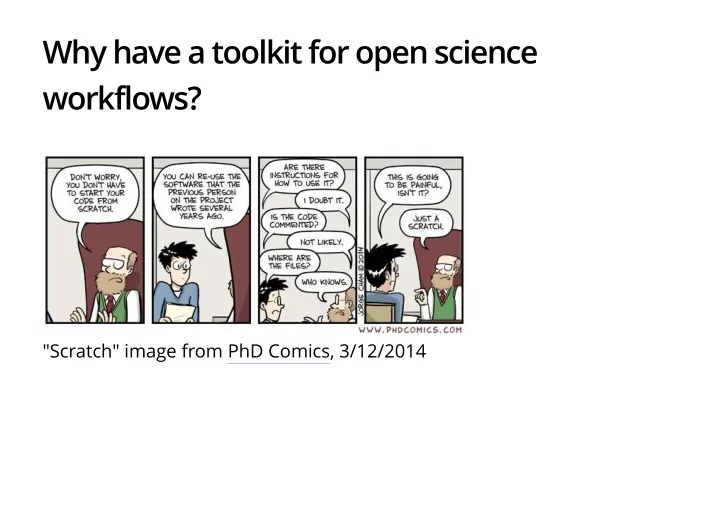
Why have a toolkit for open science workflows?
"Scratch" image from PhD Comics, 3/12/2014
SLIDE 2
Demand for more open science is increasing
From Nature News From https://ec.europa.eu/research/openscience
SLIDE 3
Current available R packages/workflows
rrtools ProjectTemplate makeProject devtools, usethis directly · · · ·
SLIDE 4
… Just another competing package?
Image from: https://xkcd.com/927/
SLIDE 5 … Probably. But, there are still things missing
Fairly complicated Assume complex analyses Don't automate enough Not targeted to "casual coders" Are not opinionated enough · · · · e.g. most health researchers
"Here are options and a general workflow, you decide the rest"
SLIDE 6 What is needed and why?
Lots of support and guidance Opinionated on what services and tools to use Automation of most tasks, rather than through documentation · Many (health) researchers don't know about open science …Or how to do it
Many tools and "moving parts"… it's overwhelming
Default for open science should be easy
SLIDE 7
Enter the prodigenr package
SLIDE 8 Main function…
Generate project directory, setup_project():
. ├── R │ ├── README.md │ ├── fetch_data.R │ └── setup.R ├── data │ └── README.md ├── doc │ └── README.md ├── .Rbuildignore ├── .gitignore ├── DESCRIPTION ├── ProjectName.Rproj └── README.md
SLIDE 9
… similar structure to R packages
Advantages: Established infrastructure Well developed through devtools, usethis Handles range in project difficulty · · · (simple to complex analyses)
SLIDE 10 Some of the other functions:
Add scientific product, e.g. poster, create_poster():
. ├── R │ ├── README.md │ ├── fetch_data.R │ └── setup.R ├── data │ └── README.md ├── doc │ ├── README.md │ └── poster.Rmd ├── .Rbuildignore ├── .gitignore ├── DESCRIPTION ├── ProjectName.Rproj └── README.md
SLIDE 11 Other functions:
Add author(s) to project metadata (=DESCRIPTION file): Include some common "tools": ·
add_first_author() add_coauthor()
include_mit_license() for code include_strobe() for health research reporting
SLIDE 12 Current stage of development
Participating in Mozilla Open Project Leader Training Participated in Mozilla Global Sprint Soon submit next version to CRAN · · Gained some feedback
SLIDE 13
Next steps and future plans
Focus prodigenr on project generation Tag/version bump after e.g. manuscript submission Reproducibility tools (e.g. travis, docker) Other functionality to new package, rostools Teaching material and more docs · · · · ·
SLIDE 14 How does this help?
Open science is evolving Natural extension to the devtools/usethis framework Researchers need easy tools · This automates and bundles together common tools (of course, strongly opinionated on which tools)
· This one of the first steps toward that
SLIDE 15 Reason for this talk…
Licensed under a CC-BY 4.0 International License.
Looking for feedback, thoughts, comments But mostly… seeking potential contributors/collaborators! · · Contact info · GitHub: @lwjohnst86 Email: lwjohnst@ph.au.dk Slides: https://github.com/lwjohnst86/erum2018