Topic 8 graphics "What makes the situation worse is that the - - PowerPoint PPT Presentation

topic 8
SMART_READER_LITE
LIVE PREVIEW

Topic 8 graphics "What makes the situation worse is that the - - PowerPoint PPT Presentation

Topic 8 graphics "What makes the situation worse is that the highest level CS course I've ever taken is cs4, and quotes from the graphics group startup readme like ' these paths are abstracted as being the result of a topological sort on


slide-1
SLIDE 1

Topic 8 graphics

Based on slides bu Marty Stepp and Stuart Reges from http://www.buildingjavaprograms.com/

"What makes the situation worse is that the highest level CS course I've ever taken is cs4, and quotes from the graphics group startup readme like 'these paths are abstracted as being the result of a topological sort on the graph of ordering dependencies for the entries' make me lose consciousness in my chair and bleed from the nose."

  • mgrimes, Graphics problem report 134

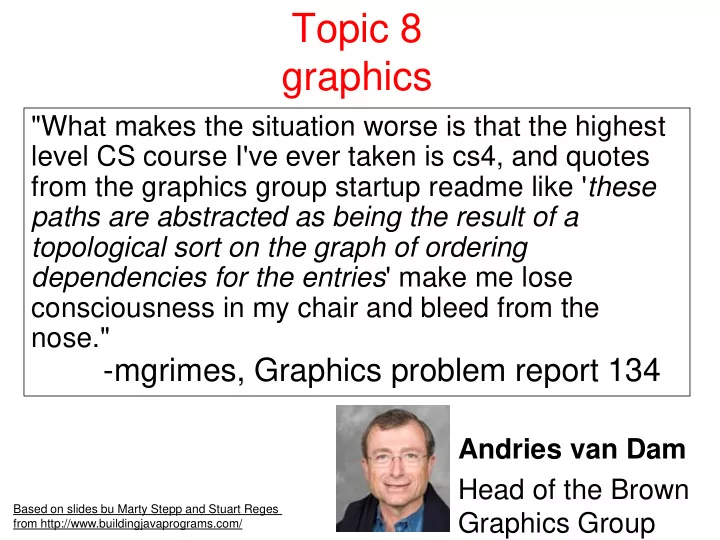
Andries van Dam Head of the Brown Graphics Group

slide-2
SLIDE 2

CS324E, Graphics and Visualization Examples - Heat Map

slide-3
SLIDE 3

Random Art

3

slide-4
SLIDE 4

Image Manipulation

4

slide-5
SLIDE 5

Simulation and Visualization WatorWorld

slide-6
SLIDE 6

Fractal 3D Landscape

6

slide-7
SLIDE 7

Objects (briefly)

object: An entity that contains data and behavior.

– data: variables inside the object – behavior: methods called on object

  • You interact with the methods;

the data is hidden in the object.

  • A class is a data type.

Constructing (creating) an object:

Type objectName = new Type(parameters);

Calling an object's method:

  • bjectName.methodName(parameters);

7

slide-8
SLIDE 8

Graphical objects

We will draw graphics in Java using 3 kinds of

  • bjects:

DrawingPanel: A window on the screen.

– Not part of standard Java; provided by the authors. See class web site.

Graphics: A "pen" to draw shapes and lines on a window. Color: Colors in which to draw shapes.

8

slide-9
SLIDE 9

DrawingPanel

"Canvas" objects that represents windows/drawing surfaces To create a window:

DrawingPanel name = new DrawingPanel(width, height);

Example:

DrawingPanel panel = new DrawingPanel(300, 200);

The window has nothing on it.

– We draw shapes / lines on it with another object of type Graphics.

9

slide-10
SLIDE 10

Graphics

"Pen" or "paint brush" objects to draw lines and shapes

– Access it by calling getGraphics on your DrawingPanel. Graphics g = panel.getGraphics();

Draw shapes by calling methods

  • n the Graphics object.

g.fillRect(10, 30, 60, 35); g.fillOval(80, 40, 50, 70);

10

slide-11
SLIDE 11

Java class libraries, import

Java class libraries: Classes included with Java's JDK.

– organized into groups named packages – To use a package, put an import declaration in your program: // put this at the very top of your program import packageName.ClassName;

Graphics belongs to a package named java.awt

import java.awt.Graphics; – To use Graphics, you must place the above line at the very top of your program, before the public class header.

11

slide-12
SLIDE 12

Coordinate system

Each (x, y) position is a pixel ("picture element"). Position (0, 0) is at the window's top-left corner.

– x increases rightward and the y increases downward.

The rectangle from (0, 0) to (200, 100) looks like this:

(0, 0) x+ y+ (200, 100)

12

slide-13
SLIDE 13

Graphics methods

Method name Description g.drawLine(x1, y1, x2, y2); line between points (x1, y1), (x2, y2) g.drawOval(x, y, width, height);

  • utline largest oval that fits in a box of

size width * height with top-left at (x, y)

g.drawRect(x, y, width, height);

  • utline of rectangle of size

width * height with top-left at (x, y) g.drawString(text, x, y);

text with bottom-left at (x, y)

g.fillOval(x, y, width, height); fill largest oval that fits in a box of size width * height with top-left at (x, y) g.fillRect(x, y, width, height); fill rectangle of size width * height with top-left at (x, y) g.setColor(Color); set Graphics to paint any following shapes in the given color 13

slide-14
SLIDE 14

Color

Specified as predefined Color class constants:

Color.CONSTANT_NAME where CONSTANT_NAME is one of:

BLACK, BLUE, CYAN, DARK_GRAY, GRAY, GREEN, LIGHT_GRAY, MAGENTA, ORANGE, PINK, RED, WHITE, YELLOW

Or create one using Red-Green-Blue (RGB) values

  • f 0-255

Color name = new Color(red, green, blue); – Example: Color brown = new Color(192, 128, 64); Color burntOrange = new Color(191, 87, 0);

List of Colors

14

slide-15
SLIDE 15

Clicker 1

How many rectangles appear on the DrawingPanel when the following code is run?

DrawingPanel p1 = new DrawingPanel(200, 200); Graphics gr = new Graphics(); for(int i = 0; i < 5; i++) { gr.drawRect(i * 25, i * 20, 20, 50); }

  • A. 5
  • B. 6
  • C. 20
  • D. None due to syntax error
  • E. None due to runtime error

15

slide-16
SLIDE 16

Clicker 2

What named color is closest to the Color object created by this code?

Color mc = new Color(255, 255, 255);

  • A. Black
  • B. Brown

C.Gray D.Orange

  • E. White

16

slide-17
SLIDE 17

Using colors

Pass a Color to Graphics object's setColor method

– Subsequent shapes will be drawn in the new color.

g.setColor(Color.BLACK); g.fillRect(10, 30, 100, 50); g.drawLine(20, 0, 10, 30); g.setColor(Color.RED); g.fillOval(60, 40, 40, 70); Pass a color to DrawingPanel's setBackground method

– The overall window background color will change. Color brown = new Color(192, 128, 64);

panel.setBackground(brown);

17

slide-18
SLIDE 18

Outlined shapes

To draw a colored shape with an outline, first fill it, then draw the same shape in the outline color.

import java.awt.Graphics; // so I can use Graphics import java.awt.Color; public class OutlineExample { public static void main(String[] args) { DrawingPanel panel = new DrawingPanel(150, 70); Graphics g = panel.getGraphics(); // inner red fill g.setColor(Color.RED); g.fillRect(20, 10, 100, 50); // black outline g.setColor(Color.BLACK); g.drawRect(20, 10, 100, 50); } }

18

slide-19
SLIDE 19

Superimposing shapes

 When ≥ 2 shapes occupy the same pixels, the last drawn "wins."

import java.awt.Graphics; import java.awt.Color; public class Car { public static void main(String[] args) { DrawingPanel panel = new DrawingPanel(200, 100); panel.setBackground(Color.LIGHT_GRAY); Graphics g = panel.getGraphics(); g.setColor(Color.BLACK); g.fillRect(10, 30, 100, 50); g.setColor(Color.RED); g.fillOval(20, 70, 20, 20); g.fillOval(80, 70, 20, 20); g.setColor(Color.CYAN); g.fillRect(80, 40, 30, 20); } }

19

slide-20
SLIDE 20

Drawing with loops

The x,y,w,h expressions can use the loop counter variable:

panel.setBackground(Color.YELLOW); g.setColor(Color.RED); for (int i = 1; i <= 10; i++) { // x y w h g.fillOval(100 + 20 * i, 5 + 20 * i, 50, 50); }

Nested loops can be used with graphics:

g.setColor(Color.BLUE); for (int x = 1; x <= 4; x++) { for (int y = 1; y <= 9; y++) { g.drawString("Java", x * 40, y * 25); } } 20

slide-21
SLIDE 21

Graphics Example

Write a method that draws straight lines to create a shape with a curved appearance Specify the x and y location of the upper left corner of the drawing and the size of the square to contain the drawing

21

slide-22
SLIDE 22

Zero-based loops

Beginning at 0 and using < can make calculating coordinates easier.

DrawingPanel panel = new DrawingPanel(150, 140); Graphics g = panel.getGraphics(); // horizontal line of 5 20x20 rectangles starting // at (11, 18); x increases by 20 each time for (int i = 0; i < 5; i++) { g.drawRect(11 + 20 * i, 18, 20, 20); }

Exercise: Write a variation of the above program that draws the output at right.

– The bottom-left rectangle is at (11, 98).

for (int i = 0; i < 5; i++) { g.drawRect(11 + 20 * i, 98 - 20 * i, 20, 20); }

22