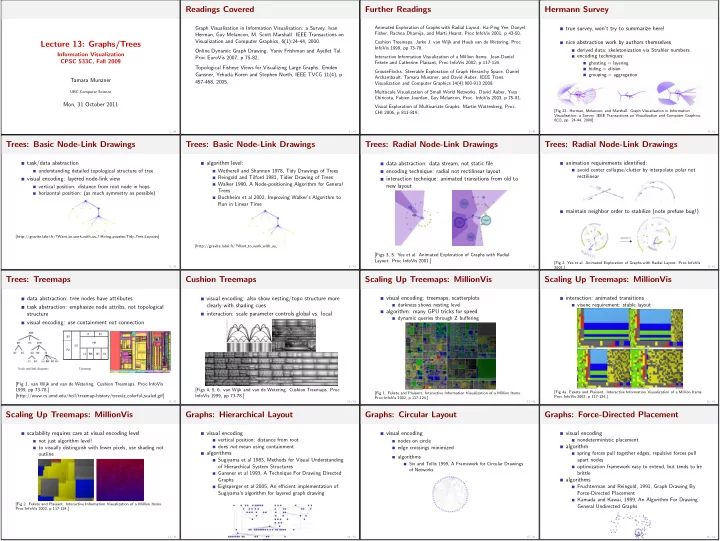
Readings Covered Further Readings Hermann Survey Graph - - PowerPoint PPT Presentation

readings covered further readings hermann survey
SMART_READER_LITE
LIVE PREVIEW

Readings Covered Further Readings Hermann Survey Graph - - PowerPoint PPT Presentation

Readings Covered Further Readings Hermann Survey Graph Visualisation in Information Visualisation: a Survey. Ivan Animated Exploration of Graphs with Radial Layout. Ka-Ping Yee, Danyel true survey, wont try to summarize here! Fisher, Rachna


slide-1
SLIDE 1

Lecture 13: Graphs/Trees

Information Visualization CPSC 533C, Fall 2009 Tamara Munzner UBC Computer Science Mon, 31 October 2011 1 / 41

Readings Covered

Graph Visualisation in Information Visualisation: a Survey. Ivan Herman, Guy Melancon, M. Scott Marshall. IEEE Transactions on Visualization and Computer Graphics, 6(1):24-44, 2000. Online Dynamic Graph Drawing. Yaniv Frishman and Ayellet Tal. Proc EuroVis 2007, p 75-82. Topological Fisheye Views for Visualizing Large Graphs. Emden Gansner, Yehuda Koren and Stephen North, IEEE TVCG 11(4), p 457-468, 2005. 2 / 41

Further Readings

Animated Exploration of Graphs with Radial Layout. Ka-Ping Yee, Danyel Fisher, Rachna Dhamija, and Marti Hearst, Proc InfoVis 2001, p 43-50. Cushion Treemaps. Jarke J. van Wijk and Huub van de Wetering, Proc InfoVis 1999, pp 73-78. Interactive Information Visualization of a Million Items. Jean-Daniel Fekete and Catherine Plaisant, Proc InfoVis 2002, p 117-124. GrouseFlocks: Steerable Exploration of Graph Hierarchy Space. Daniel Archambault, Tamara Munzner, and David Auber. IEEE Trans. Visualization and Computer Graphics 14(4):900-913 2008. Multiscale Visualization of Small World Networks. David Auber, Yves Chiricota, Fabien Jourdan, Guy Melancon, Proc. InfoVis 2003, p 75-81. Visual Exploration of Multivariate Graphs. Martin Wattenberg, Proc. CHI 2006, p 811-819. 3 / 41

Hermann Survey

true survey, won’t try to summarize here! nice abstraction work by authors themselves derived data: skeletonization via Strahler numbers encoding techniques: ghosting = layering hiding = elision grouping = aggregation [Fig 22. Herman, Melancon, and Marshall. Graph Visualisation in Information Visualisation: a Survey. IEEE Transactions on Visualization and Computer Graphics, 6(1), pp. 24-44, 2000] 4 / 41

Trees: Basic Node-Link Drawings

task/data abstraction understanding detailed topological structure of tree visual encoding: layered node-link view vertical position: distance from root node in hops horizontal position: (as much symmetry as possible) [http://gravite.labri.fr/?Want to work with us ?:Hiring puzzles:Tidy Tree Layouts] 5 / 41

Trees: Basic Node-Link Drawings

algorithm level: Wetherell and Shannon 1978, Tidy Drawings of Trees Reingold and Tilford 1981, Tidier Drawing of Trees Walker 1990, A Node-positioning Algorithm for General Trees Buchheim et al 2002, Improving Walker’s Algorithm to Run in Linear Time [http://gravite.labri.fr/?Want to work with us 6 / 41

Trees: Radial Node-Link Drawings

data abstraction: data stream, not static file encoding technique: radial not rectilinear layout interaction technique: animated transitions from old to new layout [Figs 3, 5. Yee et al. Animated Exploration of Graphs with Radial
  • Layout. Proc InfoVis 2001.]
7 / 41

Trees: Radial Node-Link Drawings

animation requirements identified: avoid center collapse/clutter by interpolate polar not rectilinear maintain neighbor order to stabilize (note prefuse bug!) [Fig 2. Yee et al. Animated Exploration of Graphs with Radial Layout. Proc InfoVis 2001.] 8 / 41

Trees: Treemaps

data abstraction: tree nodes have attributes task abstraction: emphasize node attribs, not topological structure visual encoding: use containment not connection [Fig 1. van Wijk and van de Wetering. Cushion Treemaps. Proc InfoVis 1999, pp 73-78.] [http://www.cs.umd.edu/hcil/treemap-history/treeviz colorful scaled.gif] 9 / 41

Cushion Treemaps

visual encoding: also show nesting/topo structure more clearly with shading cues interaction: scale parameter controls global vs. local [Figs 4, 5, 6. van Wijk and van de Wetering. Cushion Treemaps. Proc InfoVis 1999, pp 73-78.] 10 / 41

Scaling Up Treemaps: MillionVis

visual encoding: treemaps, scatterplots darkness shows nesting level algorithm: many GPU tricks for speed dynamic queries through Z buffering [Fig 1. Fekete and Plaisant. Interactive Information Visualization of a Million Items. Proc InfoVis 2002, p 117-124.] 11 / 41

Scaling Up Treemaps: MillionVis

interaction: animated transitions visenc requirement: stable layout [Fig 4a. Fekete and Plaisant. Interactive Information Visualization of a Million Items. Proc InfoVis 2002, p 117-124.] 12 / 41

Scaling Up Treemaps: MillionVis

scalability requires care at visual encoding level not just algorithm level! to visually distinguish with fewer pixels, use shading not
  • utline
[Fig 2. Fekete and Plaisant. Interactive Information Visualization of a Million Items. Proc InfoVis 2002, p 117-124.] 13 / 41

Graphs: Hierarchical Layout

visual encoding vertical position: distance from root does not mean using containment algorithms Sugiyama et al 1983, Methods for Visual Understanding
  • f Hierarchical System Structures
Gansner et al 1993, A Technique For Drawing Directed Graphs Eiglsperger et al 2005, An efficient implementation of Sugiyama’s algorithm for layered graph drawing 14 / 41

Graphs: Circular Layout

visual encoding nodes on circle edge crossings minimized algorithms Six and Tollis 1999, A Framework for Circular Drawings
  • f Networks
15 / 41

Graphs: Force-Directed Placement

visual encoding nondeterministic placement algorithm spring forces pull together edges, repulsive forces pull apart nodes
  • ptimization framework easy to extend, but tends to be
brittle algorithms Fruchterman and Reingold, 1991, Graph Drawing By Force-Directed Placement Kamada and Kawai, 1989, An Algorithm For Drawing General Undirected Graphs 16 / 41
slide-2
SLIDE 2

Online Dynamic Graph Drawing

data abstraction: streaming data not static file task abstraction: dynamic stability (tradeoff) minimize visual changes stay true to current dataset structure [Fig 1. Frishman and Tal. Online Dynamic Graph Drawing. Proc EuroVis 2007, p 75-82.] 17 / 41

Online Dynamic GD: Algorithm

static graph layout algs unstable small changes in input can have large changes in output randomness, no constraints on maintaining geometric proximity dynamic online algorithm first step: initialize, layout later steps: merge, pin, layout, animate acceleration: partition before GPU force-directed layout 18 / 41

Online Dynamic GD: Validation

algorithm level complexity analysis benchmarks: running time for CPU and GPU versions visual encoding level qualitative discussion of result images/video quantitative metrics: pairwise avg node displacement for stability potential energy for quality compare static, full dynamic, dynamic without pinning 19 / 41

Critique

20 / 41

Critique

strengths strong algorithmic contribution previous work not scalable very good validation, matches technique contribution best paper award, EuroVis 2007 21 / 41

Critique

strengths strong algorithmic contribution previous work not scalable very good validation, matches technique contribution best paper award, EuroVis 2007 weaknesses using mesh datasets to test graph drawing claims different topological characteristics than typical infovis case [Fig 3a. Frishman and Tal. Online Dynamic Graph Drawing. Proc EuroVis 2007, p 75-82.] 22 / 41

Multi-level Graphs

data abstraction: create cluster hierarchy on top of
  • riginal graph (coarsening)
Graph Hier 1 Graph Hier 2 Graph Hier 3 [Fig 3. Archambault et al. GrouseFlocks: Steerable Exploration of Graph Hierarchy
  • Space. IEEE Trans. Visualization and Computer Graphics 14(4):900-913 2008.]
23 / 41

Multi-level Graphs: GrouseFlocks

visual encoding: containment interaction: expand/contract metanodes to change graph cut [Fig 2. Archambault et al. GrouseFlocks: Steerable Exploration of Graph Hierarchy
  • Space. IEEE Trans. Visualization and Computer Graphics 14(4):900-913 2008.]
24 / 41

Small-World Networks

high clustering, small path length
  • vs. random uniform distribution
examples social networks, movie actors, Web, ... multiscale small-world networks exploit these properties for better layout 25 / 41

Small World Coarsening

remove low-strength edges maximal disconnected subgraphs quotient graph: subgraph = higher-level node [Fig 2. Auber et al. Multiscale Visualization of Small World Networks. Proc. InfoVis 2003, p 75-81.] 26 / 41

Small World: Nested Quotient Graphs

visual encoding containment: subgraph laid out within metanode [Fig 3. Auber et al. Multiscale Visualization of Small World Networks. Proc. InfoVis 2003, p 75-81.] 27 / 41

Small World: Nested Quotient Graphs

pro: very evocative of structure con: does not scale past 2-3 levels of depth [Fig 5. Auber et al. Multiscale Visualization of Small World Networks. Proc. InfoVis 2003, p 75-81.] 28 / 41

Topological Fisheye Views

data abstraction input is laid-out graph construct multilevel hierarchy by coarsening graphs interaction: user controls focus point visual encoding: show hybrid view made from cut through several levels [Fig 2. Gansner, Koren, and North, Topological Fisheye Views for Visualizing Large
  • Graphs. IEEE TVCG 11(4), p 457-468, 2005.]
29 / 41

Topological Fisheye Views

[Fig 4,7. Gansner, Koren, and North, Topological Fisheye Views for Visualizing Large
  • Graphs. IEEE TVCG 11(4), p 457-468, 2005.]
30 / 41

Topo Fisheye: Coarsening Strategy

must preserve graph-theoretic properties topological distance (hops away), cycles cannot just use geometric proximity alone cannot just contract nodes/edges exploit geometric information with proximity graph [Fig 2. Gansner, Koren, and North, Topological Fisheye Views for Visualizing Large
  • Graphs. IEEE TVCG 11(4), p 457-468, 2005.]
31 / 41

Topo Fisheye: Coarsening Requirements

uniform cluster/metanode size match coarse and fine layout geometries scalable [Fig 10. Gansner, Koren, and North, Topological Fisheye Views for Visualizing Large
  • Graphs. IEEE TVCG 11(4), p 457-468, 2005.]
32 / 41
slide-3
SLIDE 3

Topo Fisheye: Hybrid Graph

find active nodes [Fig 14. Gansner, Koren, and North, Topological Fisheye Views for Visualizing Large
  • Graphs. IEEE TVCG 11(4), p 457-468, 2005.]
33 / 41

Topo Fisheye: Distort For Uniform Density

visual encoding geometric distortion for uniform density (colorcoded by depth in hierarchy to illustrate algorithm) [Fig 15. Gansner, Koren, and North, Topological Fisheye Views for Visualizing Large
  • Graphs. IEEE TVCG 11(4), p 457-468, 2005.]
34 / 41

Critique

35 / 41

Critique

strengths topologically sophisticated, not just geometric distortion rigorous approach weaknesses (shared by many approaches) what if mental model does not match coarsening strategy? again, meshes for evaluating infovis claims 36 / 41

PivotGraph

task abstraction: show relationship between node attributes and connections in multiattribute graph data abstraction: rollup and selection transformations [Fig 1. Wattenberg. Visual Exploration of Multivariate Graphs. Proc. CHI 2006, p 811-819.] 37 / 41

PivotGraph

visual encoding: line (1D) or grid (2D), area proportional to attribute grid nodes based on attribute count, not original graph node count! scalability through abstraction, not layout algorithms 38 / 41

PivotGraph

visual encoding: line for 1D rollup, or grid for 2D case [Fig 6. Wattenberg. Visual Exploration of Multivariate Graphs. Proc. CHI 2006, p 811-819.] 39 / 41

PivotGraph

interaction: changing rollup/selection choices, animated transitions between states [Fig 2,3. Wattenberg. Visual Exploration of Multivariate Graphs. Proc. CHI 2006, p 811-819.] 40 / 41

PivotGraph

in general, more compact than matrix view [Fig 7,8. Wattenberg. Visual Exploration of Multivariate Graphs. Proc. CHI 2006, p 811-819.] 41 / 41

Presentation Topics

see course page for your day/topic seed papers coming soon for Wed Nov 9 folks 42 / 41